
Why “Affordable SEO” Is the Wrong Question — and What Small Businesses Should Be Asking Instead
Most small business owners come to SEO with a budget in mind and a simple goal: get found online without overspending. That’s a reasonable starting point. But the framing itself creates a trap. When the primary filter is cost, the secondary filters — methodology, strategic fit, conversion architecture, and long-term compounding value — get ignored. And those are exactly the factors that determine whether an SEO investment produces leads or just reports.
This guide is built around a different question: What does effective SEO actually look like for a small business, and how do you evaluate whether you’re getting it? The answer is more nuanced than any listicle will tell you — and significantly more actionable.
Whether you’re a local service business in the early stages of building your online presence or an established operation trying to break through a ranking ceiling, the strategy that moves the needle depends on where you are, not just how much you spend.
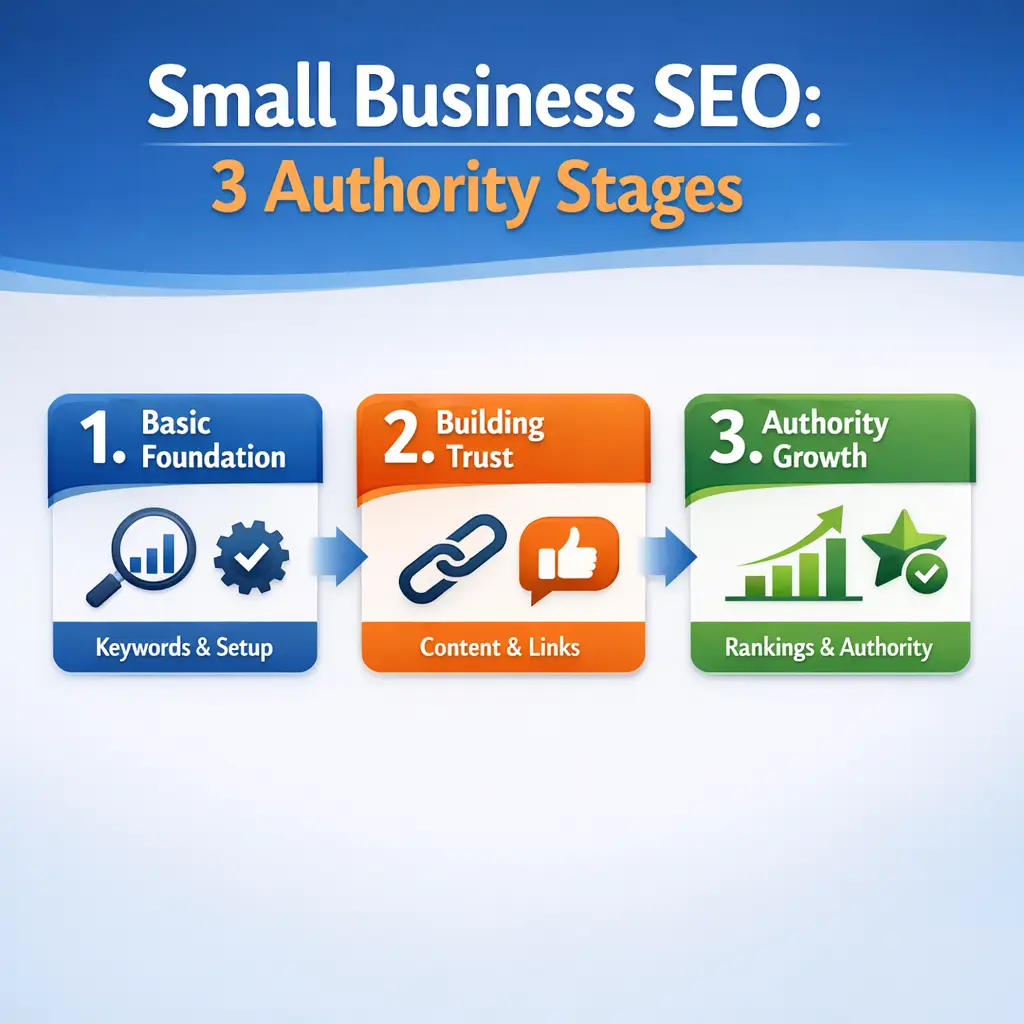
The Authority Stage Framework: Why Your Business Age Changes Everything
One of the most consistent failures in generic SEO advice is the assumption that all small businesses need the same tactics. A business that launched its website six months ago and a business with five years of indexed content are operating in fundamentally different environments — and prescribing identical strategies to both is a reliable path to wasted effort.
Google’s trust in a domain is not binary. It develops progressively, and the tactics that generate the highest return shift at each stage.
Stage 1: Domain Establishment (0–12 Months)
In the first year, Google has limited signals to assess your site’s authority or relevance. The algorithm is still forming its understanding of what your business does, who it serves, and whether your content satisfies search intent reliably. At this stage, the highest-leverage activities are:
- Topical clustering — Rather than publishing isolated pages on unrelated topics, build tightly grouped content around a small number of core service or location themes. This signals topical depth to Google faster than breadth does.
- Entity establishment — Ensure your business is unambiguously understood as a real-world entity. This means consistent NAP (name, address, phone number) across all directories, structured data markup on your site, and a fully optimized Google Business Profile with complete category selection and service descriptions.
- Long-tail, low-competition keyword targeting — Brand-new domains cannot realistically compete for high-volume head terms. Instead, target specific, intent-rich queries where the page quality threshold for ranking is lower. A query like “emergency roof repair [city]” has clearer intent and less competition than “roofing services.”
- Foundational technical health — Core Web Vitals, mobile usability, crawlability, and indexation hygiene are non-negotiable at this stage. No amount of content or links will compensate for a site Google cannot efficiently crawl.
What to avoid at Stage 1: Aggressive link building from irrelevant sources. Low-quality link volume does not accelerate trust development at this stage and can introduce risk. Prioritize relevance and locality over volume.
Stage 2: Authority Building (12–36 Months)
Once your domain has established crawl trust and you have a small collection of ranking pages, the strategic emphasis shifts. You’ve earned Google’s attention — now the goal is to expand it.
- Topical authority expansion — Move from core clusters into adjacent topics that serve your audience at different stages of their decision-making process. A plumbing company might expand from emergency service pages into maintenance guides and water quality content.
- Contextual backlink acquisition — Digital PR, local business partnerships, and contributions to industry publications generate the kind of editorially earned links that compound over time. At this stage, quality and contextual relevance matter more than quantity.
- Conversion rate optimization of ranking pages — Pages that are already generating impressions and clicks deserve optimization investment before you move on to building new content. Improving the conversion rate of an existing page costs less and returns faster than ranking a new one.
Stage 3: Authority Maintenance and Competitive Displacement (36+ Months)
At this stage, the strategic challenge changes again. The gains become defensive as much as offensive.
- Content freshness audits — Google rewards recency signals on established pages in competitive categories. Updating statistics, adding new sections, and refreshing examples on high-performing pages extends their ranking longevity.
- Competitor gap analysis — Identify queries where competitors rank but you don’t, and evaluate whether those gaps represent realistic opportunities given your current domain authority.
- Structured data for AI-driven features — Schema markup for FAQs, local business, services, and reviews becomes increasingly important for visibility in Featured Snippets and AI Overviews, which are reshaping how search results are consumed.
The Competitive Density Problem: When Direct Keyword Competition Isn’t the Right Strategy
Here is the honest assessment that most SEO content deliberately avoids: not every keyword is winnable for a small business, regardless of how good the strategy is.
Certain search categories are structurally dominated by high-authority domains — national directories, aggregators, and large brands with decades of accumulated link equity. Competing directly for “best plumber in [major city]” when your domain is two years old and the top results are occupied by well-established review platforms is not a sound use of resources.
The strategic response is not to give up on SEO — it’s to execute a niche-flanking strategy. This means:
- Targeting geographic sub-areas rather than the top-level city term (neighborhoods, suburbs, and service corridors often have meaningfully lower competition)
- Owning question-based queries that larger sites don’t prioritize because they’re too specific (e.g., “how long does a water heater last in [city]”)
- Building authority in a defined topical niche before expanding — becoming the clear answer for a narrow set of queries positions the domain for credibility transfer to broader terms over time
Understanding your competitive ceiling isn’t defeatism. It’s the difference between a strategy that compounds and one that stalls. For a deeper look at what local SEO companies often leave out of this conversation, the article What Local SEO Companies Won’t Tell You is worth reading before you commit to any engagement.
Why Ranking on Page One Isn’t the Finish Line
This is the section most SEO guides skip entirely — and it’s the one small business owners need most.
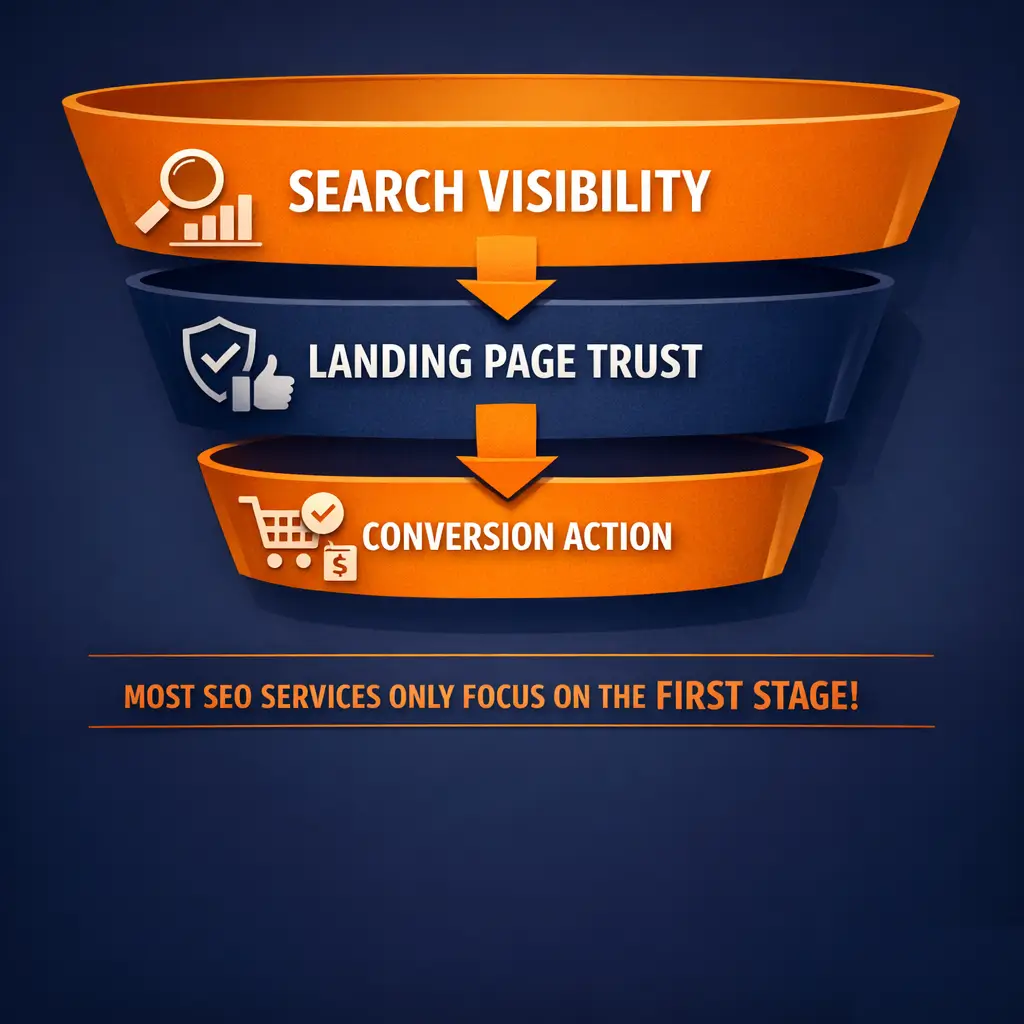
It is entirely possible to rank on the first page of Google and generate zero business from it. It happens frequently. The gap between search visibility and business outcome is real, it’s measurable, and it operates across three distinct dimensions.
Intent Mismatch at the SERP Level
Every search query carries an intent signal. Some queries are informational — the user wants to understand something. Others are transactional — the user wants to take an action. Most are navigational or comparative, somewhere in between.
When a small business page is optimized for a keyword but mismatches the dominant intent behind that keyword, the result is high impressions, high clicks, and low conversions. A roofing company that ranks for “signs of roof damage” is reaching users in the awareness stage. Those users are researching, not buying. Without a content pathway that guides them toward a service inquiry, that traffic produces no leads.
The fix isn’t to abandon informational content — it’s to map every page explicitly to a funnel stage and ensure there’s a conversion pathway appropriate to that stage. Awareness content should build trust and capture email or retargeting data. Decision-stage content should drive direct contact.
Trust Signal Failure at the Landing Page Level
Google’s ranking algorithms evaluate one set of signals. A human visitor evaluates an entirely different set. A page can satisfy technical SEO requirements — structured data, keyword relevance, page speed — while simultaneously failing to communicate credibility to an actual person.
For small businesses, trust is the primary purchase barrier. Visitors who land on your site are asking unconscious questions: Is this business real? Do they serve my area? Have other people used them? Can I contact them easily? Pages that don’t answer those questions within seconds produce bounces, not leads.
The trust signals that most directly affect conversion for small business pages include:
- Visible, specific service area coverage (not just “serving the greater metro area” — name the locations)
- Social proof above the fold (a review excerpt or star rating visible without scrolling)
- Frictionless contact options (click-to-call on mobile, form with minimal required fields)
- Real photography over stock images — this single element consistently improves local service business conversion rates
- Specific credentials, licenses, or certifications relevant to the service
Conversion Architecture Neglect
Most SEO engagements are measured by rankings and traffic. Fewer are measured by what happens after the visit. This is where the return on SEO investment is actually determined.
A page converting at 1% that receives 500 organic visitors per month produces five leads. Doubling that page’s traffic to 1,000 visitors still only produces ten leads. But improving the conversion rate to 3% on the original 500 visitors produces fifteen leads — with no additional ranking effort required.
Before expanding your SEO footprint into new keywords and new pages, audit whether your existing ranking pages are converting at a rate that justifies continued investment in that direction. Specifically, evaluate:
- Form placement and friction — Is the contact form below the fold? Does it require more fields than necessary?
- Call-to-action specificity — “Contact Us” is weaker than “Get a Free Estimate Today.” Specificity reduces decision hesitation.
- Mobile experience quality — For most local service businesses, the majority of organic traffic arrives on mobile devices. If the mobile experience is degraded, rankings are generating less value than they appear to.
- Page speed at the real-device level — Lab-based speed scores and real-device performance frequently diverge. Test on actual mobile hardware, not just developer tools.
Optimizing for AI Search: What Small Businesses Need to Understand Now
The search landscape is in an active structural transition. Google AI Overviews, along with AI-native search tools, are changing which content gets surfaced — and the selection mechanism is meaningfully different from traditional ranking signals.
Traditional SEO targets relevance signals: keyword usage, backlink authority, on-page structure, and domain trust. AI-generated answer panels operate on a different principle. They favor information-dense, citable content that directly answers a specific question with clear attribution, verifiable structure, and balanced analysis.
Understanding this distinction matters for small business SEO strategy because the content architecture that earns a traditional blue link and the architecture that earns a citation in an AI Overview are not identical — though they do overlap significantly.
What Makes Content Citation-Worthy in AI Search
Content that consistently performs in AI-generated answer panels tends to share the following structural characteristics:
| Structural Feature | Why It Matters for AI Citation |
|---|---|
| Direct answer in the first 40 words of a section | AI systems extract answers by identifying the most direct response to a query; burying the answer in preamble reduces citation probability |
| Named entities with clear relational context | Who, what, and where are established quickly, reducing ambiguity in AI interpretation |
| Statistical claims with source attribution | AI systems prefer verifiable, attributed data over unattributed assertions |
| FAQ-compatible question framing | Sections structured as question-answer pairs are easier for AI to extract and format |
| Balanced analysis that acknowledges complexity | AI systems are more likely to cite sources that represent nuanced perspectives rather than purely promotional content |
| Schema markup alignment | FAQ schema, HowTo schema, and LocalBusiness schema increase structured data accessibility |
For small businesses, the practical implication is significant: a single, well-structured page built around a specific location, service, and common question will outperform a sprawling generic service page in AI citation probability. Depth and specificity beat volume and breadth in this environment.
The small business competitive advantage in AI search: Larger brands produce high volumes of broad content. A small business that builds a genuinely comprehensive, locally specific answer to a specific question faces less competition in AI citation than it does in traditional ranking for a head term. This is a strategic opening that most small businesses are not yet exploiting.
How to Evaluate an SEO Vendor’s Methodology — Without Taking Their Word for It
The advice to “find a transparent agency with good reporting” is practically useless without knowing what to look for in that reporting. Here is a diagnostic framework built on what actually separates methodologically sound SEO work from activity that generates reports without results. For a structured walkthrough of the evaluation process, the article How to Choose an SEO Service Provider (Smart Guide) covers the key decision criteria in detail.
Questions to Ask Before Signing Any Agreement
On strategy and sequencing:
– How do you approach a new client domain differently from an established one?
– What is your process for identifying which pages to optimize first?
– How do you determine which keywords are realistically attainable versus structurally out of reach given our current authority?
On reporting and measurement:
– What metrics appear in your monthly reports, and which of those metrics are directly tied to business outcomes?
– How do you distinguish between organic traffic growth caused by your work versus seasonal fluctuations or brand-driven search?
– Do you include conversion data in your reports, or only traffic and ranking data?
On off-page methodology:
– How do you acquire backlinks? What is the typical profile of a site you would pursue a link from?
– Can you provide examples of links acquired for clients with similar domain profiles?
Red Flags in SEO Audits and Proposals
- Volume-first keyword lists without intent classification — a list of 200 keywords sorted by search volume is not a strategy; it’s a starting data set
- Backlink guarantees — editorially earned links cannot be guaranteed; guarantees indicate either low-quality link schemes or misrepresentation
- Reporting that excludes conversion data — if a monthly report only shows keyword position changes and organic sessions without any reference to leads, calls, or revenue events, the engagement is optimizing for the wrong outcomes
- No mention of technical SEO in the discovery phase — skipping a technical audit before executing content or link strategy is analogous to painting a house with a structural foundation problem
- Generic deliverable lists that don’t reference your specific business, location, or competitive environment — if the proposal could have been written for any business in any industry, it wasn’t designed for you
DIY vs. Agency SEO: A Competency-Based Decision Framework
The decision to manage SEO in-house versus engaging an agency is not purely a cost calculation. It’s a competency calculation. Some SEO tasks are genuinely learnable and executable by a motivated business owner. Others require specialist tooling, accumulated experience, or technical depth that isn’t practical to develop while running a business.
Tasks Where DIY Is Viable
- Google Business Profile management — Posting updates, responding to reviews, adding photos, and ensuring category accuracy are manageable without specialist knowledge
- Basic on-page content updates — Refreshing existing page content, improving headings, and adding locally relevant detail to service pages are within reach for most business owners
- Review generation systems — Creating a repeatable process for requesting and responding to customer reviews is a high-value activity that doesn’t require agency support
- Local citation consistency checks — Auditing major directories for NAP accuracy is time-consuming but not technically complex
Tasks Where Specialist Knowledge Is Genuinely Required
- Technical SEO auditing — Diagnosing crawl errors, indexation issues, Core Web Vitals failures, and site architecture problems requires both specialist tooling and interpretive experience
- Keyword research with intent mapping — Identifying the right keywords at the right funnel stage, with realistic competitive assessment, requires access to data tools and pattern recognition developed across multiple client accounts
- Backlink strategy and acquisition — Building a link profile that compounds authority without creating algorithmic risk is one of the highest-skill areas in SEO and the one most commonly damaged by low-quality DIY attempts
- Schema markup implementation — Structured data errors are invisible to the business owner but clearly visible to Google; incorrect implementation can suppress the very features it’s meant to activate
- Generative search optimization — Structuring content to perform in AI Overviews and answer panels requires understanding of how these systems select and attribute content, which is an emerging specialty area
The honest answer for most small businesses: a hybrid model — handling reputation management and content updates internally while engaging a specialist partner for technical infrastructure, strategic sequencing, and off-page authority development — typically produces better outcomes than either full DIY or full outsourcing of tasks the business owner could own.
Putting It Together: What an Effective SEO Engagement Actually Looks Like
Effective SEO for a small business is not a checklist. It’s a sequenced, measurable growth program that adapts as the business’s authority develops. It starts with an honest competitive assessment, builds on a technical foundation, layers in content that matches real search intent, and measures success in business outcomes — not just rankings.
The agencies and strategies that consistently deliver results for small businesses share a few non-negotiable characteristics:
- They sequence tactics to match the business’s current authority stage rather than applying a universal playbook
- They measure and report on conversion outcomes, not just traffic and position data
- They communicate the competitive ceiling honestly rather than promising page-one rankings for terms that are structurally unreachable
- They build content architecture that serves both traditional search and emerging AI-driven answer formats
- They treat conversion rate optimization as part of the SEO mandate, not a separate service engagement
At Mongoose Digital Marketing, every SEO engagement begins with exactly this kind of structured assessment — because getting found online is only valuable if the business outcome follows. If you’re ready to build a search presence that actually generates leads, contact us for a free consultation and we’ll show you what a strategy built around your business actually looks like.
For a broader look at how SEO fits into a full digital growth strategy, the Google Search Central documentation remains the most authoritative reference for understanding how search systems evaluate and rank content.
Strategic Recommendations for 2026
As search behavior continues to shift and AI-driven answer formats become a more significant part of how users find local businesses, small businesses need to be deliberate about where they invest their SEO effort. Three specific priorities stand out for 2026:
1. Invest in Search Experience Optimization (SXO) Over Traditional SEO Alone
Search engines are increasingly evaluating how users engage with content after they click — not just whether they click. Tools like Microsoft Clarity (free) combined with Google Search Console provide a paired view of search performance and on-page behavior. Use these together to identify pages where rankings are solid but user engagement drops, then treat those pages as conversion optimization opportunities, not just content problems.
2. Build for AI Overviews and Generative Answer Formats
Google’s AI Overviews and similar generative features are reshaping which content gets surfaced without a click. Structured content that directly answers specific questions — particularly in local service contexts — is increasingly favored. Prioritize content formats that include concise definitional sections, clear headers, and direct answers to the questions your customers actually ask. Tools like AlsoAsked and Answer the Public remain useful for mapping this question landscape efficiently.
3. Prioritize Local Entity Building Across the Full Citation Ecosystem
Local authority in 2026 is determined by how consistently and completely a business appears across the broader entity ecosystem — not just Google Business Profile. Services like BrightLocal or Whitespark offer structured citation auditing and building that systematically closes the gaps between where your business is listed and where it should be. For small businesses competing in defined geographic markets, this remains one of the highest-leverage investments available. The article Google Business Profile Optimization Tips That Actually Work covers the practical steps for maximizing your presence within Google’s own ecosystem as part of this broader effort.
Frequently Asked Questions
What does affordable SEO actually mean for a small business?
Affordable SEO means structured, results-oriented search optimization that is scaled to match the realistic budget and competitive position of a small business — not a stripped-down version of an enterprise service. The most effective affordable SEO engagements prioritize high-impact fundamentals: technical site health, local authority, and content that matches real search intent. The goal is measurable business outcomes — leads, calls, and conversions — not vanity metrics like raw traffic volume.
How long does it take to see results from SEO for a small business?
Most small businesses begin to see measurable movement in local rankings and organic visibility within three to six months of a well-executed SEO engagement, though this varies significantly based on the business’s starting authority, the competitiveness of the local market, and how consistently the strategy is executed. Content targeting lower-competition, intent-specific terms can produce results faster, while broader competitive terms in saturated markets require sustained effort over a longer horizon. Any agency promising immediate page-one results across highly competitive terms is not being honest about how search systems actually work.
Should a small business hire an SEO agency or handle SEO in-house?
The answer depends on the business’s internal capacity, technical comfort level, and competitive landscape. A practical hybrid approach often works best: the business owner handles relationship-driven content creation and local engagement while a qualified agency manages technical infrastructure, strategic sequencing, and off-page authority development. Full DIY SEO is viable for very low-competition niches but typically produces slower, less consistent results. Full outsourcing without owner involvement in content often produces generic output that fails to differentiate the business meaningfully.
What should a small business look for when evaluating an SEO agency?
Look for agencies that begin with an honest competitive assessment rather than immediate promises, report on conversion outcomes alongside traffic and ranking data, communicate clearly about what is and is not achievable within your market, and can demonstrate a sequenced methodology rather than a generic checklist. Red flags include guaranteed ranking promises, opaque reporting, and agencies that treat every business with the same playbook regardless of industry, authority stage, or competitive context. A good agency will be direct about the competitive ceiling before they ask you to commit.
Conclusion
For small businesses serious about building a search presence that translates into real leads and revenue, the difference between generic SEO and a strategy built around your specific market, authority level, and customer intent is significant. Mongoose Digital Marketing specializes in exactly that kind of structured, outcome-focused engagement — from local SEO and Google Business Profile optimization to content strategy that performs in both traditional and AI-driven search formats. If you’re ready to stop guessing and start building search visibility that actually grows your business, Contact Mongoose Digital Marketing for a free consultation.