

Key Takeaways
- MSP sales cycles typically run 6–18 months, meaning digital marketing strategies built on fast lead-gen tactics alone will consistently underperform without a parallel trust-building framework.
- Vertical specialization in MSP marketing is not simply a messaging choice — it fundamentally lowers customer acquisition effort at every funnel stage by aligning search intent, content authority, and referral network density simultaneously.
- Most MSP marketing attribution models overvalue paid search and undervalue content because the majority of buyer influence happens in channels that never appear in a CRM — a phenomenon known as the dark funnel.
- MSPs transitioning away from referral dependency need a sequenced channel strategy, not a simultaneous one — SEO and content compounds over 12+ months while paid search fills near-term pipeline gaps.
- A managed services digital marketing strategy is only as effective as its alignment to the MSP’s current growth stage; tactics appropriate for a 10-person shop actively work against the positioning goals of a 60-person firm moving upmarket.
If your MSP is still relying on referrals to fill the pipeline, you already know the problem: growth feels unpredictable, and every slow quarter is a reminder of how little control you have over when the next contract walks through the door. The answer most people give — “just do more digital marketing” — is technically correct and almost completely useless without a framework behind it.
Managed services is not a transactional business. You’re asking a company to hand over operational control of their IT environment, often under a multi-year contract, to a team they may have discovered three weeks ago. The trust threshold for that decision is categorically higher than buying a SaaS subscription or hiring a one-time consultant. Generic B2B marketing playbooks were not built for that reality — and applying them without modification is why so many MSPs spend money on digital marketing and see disappointing returns.
This guide is built for MSP owners and operators in the Dayton metro area — including Kettering, Beavercreek, Centerville, Huber Heights, Miamisburg, and Springboro — who want a clear-eyed look at what a managed services digital marketing strategy actually requires, in what order, and why the sequencing matters as much as the tactics themselves.
Why Standard B2B Marketing Frameworks Fall Short for MSPs
Most digital marketing advice treats B2B buyers as rational, relatively fast-moving decision-makers who respond to well-placed ads and compelling landing pages. That model works reasonably well for software, professional services, and commoditized products with short evaluation windows.
MSP buyers are different. Here is what the buying process actually looks like from the prospect’s side:
- An IT director at a mid-sized Dayton manufacturer starts noticing reliability issues with their current provider
- They informally ask a peer at another company who they use — this conversation never appears in any CRM
- Over the next several months, they passively read content from two or three MSPs they’ve encountered on LinkedIn
- They attend a local business event and happen to meet someone from an MSP whose name keeps appearing in their mental shortlist
- Six months later, a contract renewal deadline forces the issue, and they reach out to three providers — including the MSP they’ve been silently evaluating for half a year
At no point in that timeline did a Google ad trigger the decision. At no point did a cold email generate a response. The influence was slow, distributed, and largely invisible to any analytics dashboard. Understanding this is the foundation of every strategic decision that follows.
The Switching Cost Asymmetry That Drives MSP Buyer Psychology
When a business switches MSPs, they are not changing a software subscription — they are reassigning access credentials, migrating documentation, retraining staff, and betting operational continuity on a relationship that is brand new. The risk of a bad switch is enormous. This creates a psychological asymmetry: MSP prospects are far more motivated by the fear of making the wrong choice than by enthusiasm for the upside of making the right one.
Your marketing strategy needs to account for this. Risk reduction messaging — transparent SLAs, clear onboarding documentation, client references in the same industry, and published case studies with specific outcomes — functions as marketing collateral, not just sales support. If that content doesn’t exist, no amount of paid traffic will compensate for it.
The Trust Velocity Framework: Sequencing Marketing for the MSP Buyer Journey
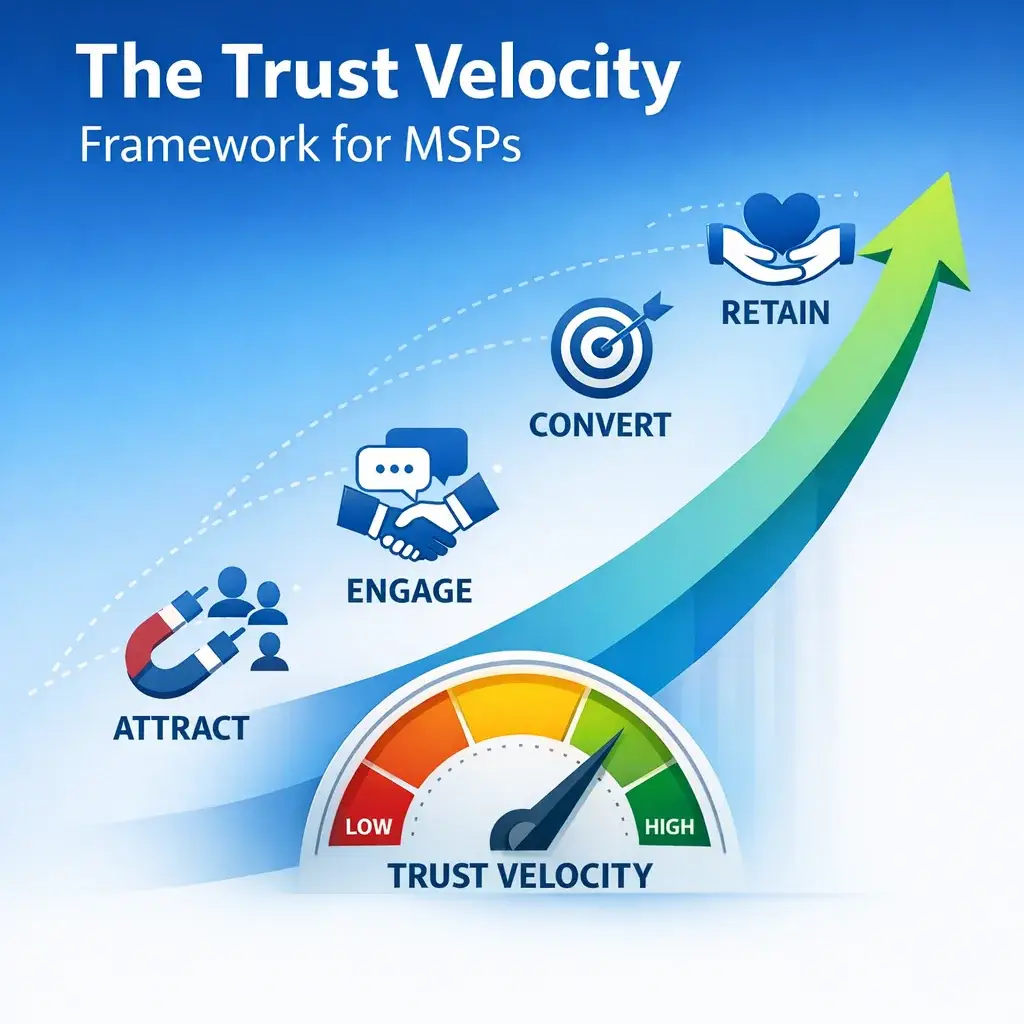
Rather than treating every digital marketing tactic as equally urgent and simultaneously deployable, MSPs need a sequenced approach calibrated to how trust actually accumulates in their market. We call this the Trust Velocity Framework — three stages that map marketing activity to buyer psychology rather than to channel availability.
Stage 1 — Passive Authority Building
This stage is about being discoverable before a prospect knows they need you. It is the longest phase and the one most MSPs underinvest in because it doesn’t generate leads on a short timeline.
Core activities at this stage:
- LinkedIn thought leadership: Publishing substantive content about IT management challenges specific to the industries you serve in the Dayton region — manufacturing, healthcare, legal, professional services. This is not promotional content; it’s content that demonstrates you understand the operational pressures your prospects actually face.
- Local SEO and organic search: Ranking for searches like “managed IT services Dayton OH” or “IT support for manufacturers Centerville” requires consistent technical SEO, local citation management, and location-specific content — all of which take time to compound but create durable, low-cost lead sources once established. The Local SEO for Ohio Service Businesses That Actually Works article breaks down how this process works in practice for businesses competing in Southwest Ohio markets.
- Niche-specific content: Blog articles, white papers, or guides written for a specific vertical create perceived expertise that broad IT content cannot match. Ten deeply researched articles about HIPAA-compliant IT management for healthcare practices in the Dayton area will outperform 100 generic IT articles in both search performance and prospect trust.
Stage 2 — Active Credibility Signals
When a prospect moves from passive awareness to active evaluation, they are looking for reasons to eliminate you, not reasons to choose you. Your job at this stage is to remove every legitimate objection.
- Vertical-specific case studies: A case study about a Beavercreek accounting firm that reduced downtime by a measurable percentage after switching to your MSP does more persuasive work than any homepage headline. It tells the prospect: “Someone like me has already taken this risk and it worked.”
- Third-party review presence: Google Business Profile reviews, Clutch listings, and industry-specific directories give prospects social proof that exists outside your own marketing. A Centerville business owner searching for MSPs will weight Google reviews from local companies heavily.
- Certifications displayed with context: SOC 2, Microsoft Partner status, cybersecurity compliance frameworks — these matter, but only when accompanied by plain-language explanations of what they mean for the client. Logos without context are decoration; logos with business-language explanation are credibility signals.
Stage 3 — Risk Reduction Messaging
This is the conversion stage, but conversion here means “agree to a discovery call,” not “close a contract.” The goal is to make the next step feel low-risk.
- Free assessments or audits: A no-commitment IT assessment gives prospects a structured, low-pressure entry point. It also gives you operational proof of your capability before the sales conversation starts.
- Transparent process documentation: Publishing a clear onboarding timeline — what happens in the first 30, 60, and 90 days — directly addresses the prospect’s operational fear of a disruptive transition.
- Response time and SLA transparency: Stating your support response standards publicly signals confidence in your delivery. Most MSPs bury this information; surfacing it is a competitive differentiator in markets like Dayton where prospects are evaluating multiple local providers.
Vertical Specialization as a Marketing Efficiency Multiplier
Every managed services digital marketing discussion eventually mentions specialization as a differentiating strategy. Most stop there. The deeper truth is that vertical specialization doesn’t just differentiate your positioning — it makes every marketing dollar work harder across multiple simultaneous dimensions.
Here is a direct comparison of how a vertical-specialized MSP and a generalist MSP approach the same marketing channels:
| Marketing Channel | Generalist MSP | Vertical-Specialized MSP |
|---|---|---|
| SEO Keyword Targeting | Broad terms: “managed IT services Dayton” — high competition, mixed intent | Niche terms: “HIPAA IT support for dental practices Dayton” — lower competition, high buyer intent |
| Content Production | General IT topics: cybersecurity tips, cloud migration, remote work | Vertical-specific guides: “EHR system compliance for Dayton medical practices” |
| Referral Network | Broad professional network — referrals are random and irregular | Vertical peer network — decision-makers in the same industry actively share vendor recommendations |
| Partnership Opportunities | Generic IT vendor relationships | Vertical software vendor partnerships (EHR platforms, legal practice management, manufacturing ERP systems) |
| Content Authority Timeline | Competing against national MSPs and IT media outlets | Owning a narrow content category that national players rarely enter |
| Ad Targeting Precision | Targeting by geography and job title | Targeting by geography, job title, AND industry vertical — dramatically higher relevance scores |
| Sales Cycle Length | Longer — must build trust and demonstrate industry knowledge from scratch | Shorter — industry-specific fluency is established before the first call |
The compound effect of these advantages is significant. An MSP serving healthcare practices across Kettering and Centerville — and who has built genuine content authority in that vertical — will acquire clients at a lower relative effort than a generalist MSP with the same size marketing budget competing for the same broad search terms.
This is not an argument for narrowing your client base recklessly. It is an argument for choosing one or two verticals where you already have client concentration, building your marketing infrastructure around that specialization, and letting the compound advantages accumulate over 12–24 months.
Channel Strategy and Sequencing: What to Prioritize and When
One of the most consistent failures in MSP marketing advice is the presentation of every channel as simultaneously valid and equally urgent. For an MSP with limited marketing bandwidth — which describes most MSPs in the Dayton metro market — this creates a paralysis problem: everything is a priority, so nothing gets real resource allocation.
A rational channel sequencing strategy is built around one core distinction: channels that compound versus channels that stop the moment you stop paying.
Channels That Compound Over Time
Search Engine Optimization (SEO): Organic search is the highest-leverage long-term marketing investment for MSPs. A well-optimized service page ranking for “managed IT services Huber Heights” generates leads continuously without recurring cost per click. The trade-off is timeline — meaningful organic rankings for competitive local terms typically require 9–18 months of consistent effort. This is why SEO must start early, regardless of what other channels are active.
Content Marketing: Every substantive article, guide, or case study you publish creates a permanent asset that continues generating traffic and credibility. Vertical-specific content compounds especially well because it builds topical authority signals that search engines reward with broader ranking opportunities over time.
LinkedIn Presence: For MSPs serving business owners and IT decision-makers in the Dayton region, LinkedIn is where thought leadership content surfaces to the right audience without paid amplification. Consistent publishing over 6–12 months builds a visible presence that functions as passive prospecting.
Channels That Require Continuous Investment
Pay-Per-Click (PPC) Advertising: Google Ads and LinkedIn Ads deliver pipeline faster than any organic channel, which makes them valuable for MSPs with near-term revenue targets. The limitation is structural — the moment the campaign stops, the leads stop. PPC also captures existing demand rather than creating it, which means it works best once your brand has enough credibility for a prospect to click through and trust what they find. For a practical breakdown of how to use paid search without overspending, the article on how PPC and SEO work together to grow your business covers the strategic interplay between both channels in detail.
Social Media Advertising: Paid social can accelerate awareness and retargeting — showing your content to prospects who have already visited your website — but requires ongoing budget management and creative refresh to sustain performance.
A Practical Sequencing Model for Dayton-Area MSPs
For MSPs at different growth stages, the sequencing looks different:
Early-stage MSP (under 20 clients, primarily referral-dependent):
– Priority 1: Build foundational SEO infrastructure — Google Business Profile optimization, local citations, service-area pages for Dayton, Kettering, Beavercreek, and surrounding cities
– Priority 2: Develop 4–6 vertical-specific content pieces that demonstrate expertise to the industries you already serve
– Priority 3: Establish LinkedIn publishing cadence for the owner or senior technical lead
– PPC: Optional and limited — use only to test messaging before organic channels are established
Growth-stage MSP (20–50 clients, looking to move upmarket):
– Priority 1: Expand content library with case studies, technical guides, and compliance-specific resources
– Priority 2: Activate PPC campaigns targeting mid-market keywords in the Dayton metro — your credibility infrastructure can now support the traffic
– Priority 3: Pursue strategic partnership content with vertical software vendors or local business associations
– SEO: Ongoing — expand from local terms to vertical-specific and solution-specific keyword clusters
Mature MSP (50+ clients, pursuing enterprise or multi-site accounts):
– Priority 1: Account-based marketing content — highly targeted assets for specific prospect companies or decision-maker profiles
– Priority 2: LinkedIn Ads targeting CFOs and IT Directors in specific industries and company size ranges within Southwest Ohio
– Priority 3: Formal referral program with partner incentives to systematize relationship-based growth that has historically been informal
Solving the Dark Funnel Attribution Problem
If you’ve ever asked a new client “how did you find us?” and received an answer that didn’t match your CRM data, you’ve encountered the dark funnel problem firsthand. MSP buyers consume content, attend events, read LinkedIn posts, and ask colleagues for opinions across a span of months — and none of that activity typically gets captured in attribution systems that only log form fills and direct clicks.
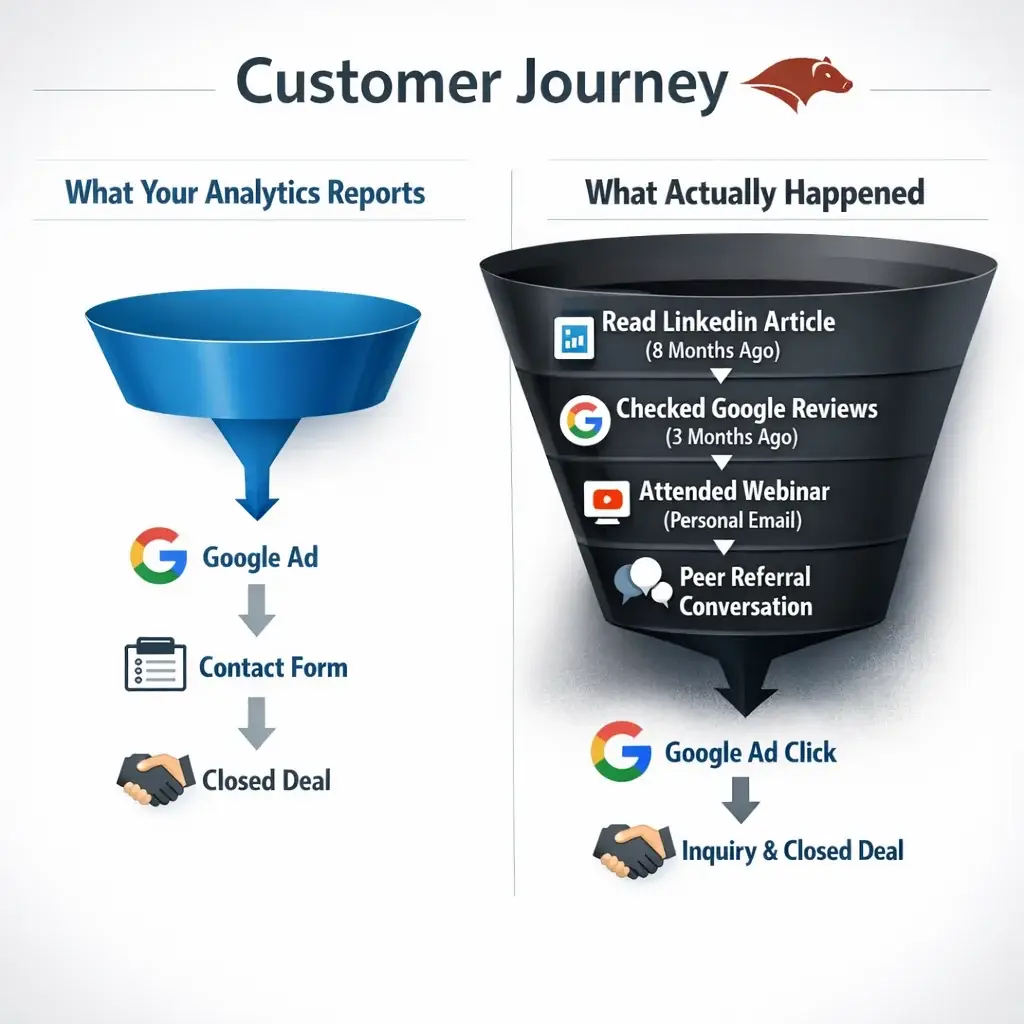
The practical problem with dark funnel attribution is that it systematically distorts your understanding of what’s actually working in your marketing. Specifically:
- Last-touch attribution overvalues paid search: When a prospect who has been reading your content for six months finally clicks a Google Ad and converts, paid search gets 100% of the credit. The content that built the trust gets none.
- Content marketing appears low-ROI on paper: Because content influence rarely gets tracked, MSPs frequently cut content budgets based on dashboard data that doesn’t capture the channel’s actual impact on deal velocity and close rates.
- Campaign optimization decisions get made on bad data: If you’re allocating budget based on attributed conversions rather than pipeline influence, you will consistently over-invest in capture channels and under-invest in trust channels.
How to Measure What Matters
Pipeline influence tracking: Rather than asking only “what was the first touch?” and “what was the last touch?”, track all marketing touchpoints associated with a closed deal. Multi-touch attribution models — even imperfect ones — give a far more accurate picture of channel contribution than single-touch models.
Qualitative client interviews: The most actionable attribution data for MSPs comes from asking closed clients a specific set of questions: What did you read or see from us before you reached out? What convinced you we were different from the other providers you were evaluating? Was there a moment where you felt confident enough to take the next step? These conversations reveal influence patterns that no dashboard can capture.
Revenue influence by content asset: Track which specific articles, case studies, or guides appear in the browsing history of prospects who eventually convert. Even a rough version of this analysis — looking at which content pages a closed client visited before submitting a contact form — produces more actionable insight than aggregate traffic data.
Closed-won surveys: A brief post-close survey sent to new clients within their first 30 days of onboarding generates attribution data while the decision process is still fresh in their memory. This is low-cost and consistently underutilized by MSPs.
Building vs. Buying Your Marketing Function
For MSPs in the Dayton market evaluating whether to hire in-house marketing staff, retain a specialist agency, or pursue a hybrid model, the decision is not primarily about cost. It is about matching marketing capability to the complexity and timeline of your growth goals.
What an In-House Hire Actually Delivers
A single in-house marketing coordinator or manager can handle campaign execution, social media management, and content scheduling effectively. What they typically cannot provide without significant outside support:
- Technical SEO expertise (on-page optimization, schema markup, Core Web Vitals, crawl error resolution)
- PPC campaign management at a sophisticated level (bid strategy, audience segmentation, landing page testing)
- Conversion rate optimization
- Strategic content development for specialized verticals
An in-house hire makes most sense when the MSP already has a defined strategy and needs execution capacity. Without strategy, an in-house hire will execute in circles.
What a Managed Marketing Engagement Delivers
Retaining a digital marketing agency that specializes in — or has significant experience with — managed services providers gives an MSP access to multi-discipline expertise under a single engagement. The key evaluation criteria when selecting an agency partner:
- Demonstrated local SEO capability: Can they show ranking evidence for comparable local service businesses in competitive Ohio markets?
- Content quality standards: Is their content substantive and industry-specific, or is it generic and keyword-stuffed?
- Reporting clarity: Do they report on metrics that connect to your business outcomes (leads, qualified pipeline, conversion rates) or just traffic and impressions?
- Strategic communication: Do they proactively bring ideas and analysis, or do they wait for direction?
The managed services model for marketing works best for MSPs who want to focus leadership time on delivery and client relationships rather than managing a marketing function internally. For Dayton-area MSPs at the growth stage — 20 to 50 clients, expanding service territory across Southwest Ohio — this model typically accelerates the path to predictable inbound pipeline more efficiently than building internal capability from scratch. The article on how to find the right SEO agency outlines the specific evaluation criteria worth applying before committing to any agency relationship.
The Commodity Trap: Why MSP Marketing Must Address Positioning Directly
There is an uncomfortable reality in the managed services market that most marketing guides avoid: the SMB tier of the MSP market is experiencing significant commoditization pressure. Offshore IT providers, hyperscaler self-service platforms, and automated RMM tools are compressing both the technical differentiation and the margin structure that MSPs have historically relied on.
For MSPs in Dayton, Kettering, Miamisburg, and Springboro competing for SMB clients, this creates a positioning imperative that no amount of tactical marketing can paper over: if your value proposition is “reliable IT support at a reasonable cost,” you are competing in a race where the finish line is a margin structure that doesn’t support a sustainable business.
Effective MSP marketing strategy forces the positioning question into the open. The marketing channels and content you build must reflect a genuine answer to: Why would a Dayton-area business choose us over every available alternative, including alternatives that cost less and require no local relationship?
Answers that hold up under pressure typically involve:
- Genuine vertical expertise that offshore and self-service alternatives cannot replicate
- Local operational presence — on-site response capability in Centerville, Beavercreek, or Huber Heights within a defined SLA window that a remote provider structurally cannot match
- Compliance and regulatory fluency in industries with specific legal exposure (healthcare, legal, financial services)
- Strategic advisory capacity — the ability to align IT roadmap decisions with the client’s business growth plans, not just manage ticket volume
Your digital marketing strategy should surface whichever of these differentiators is most defensible for your specific MSP — and then build every content asset, every landing page, and every ad campaign around making that differentiation concrete and credible.
Practical Next Steps for Dayton-Area MSPs
If you’ve read this far and recognized gaps between what you’re currently doing and what a structured managed services digital marketing strategy actually requires, the path forward is straightforward — though not instantaneous.
Start with an honest audit of where you currently sit in the Trust Velocity Framework. Most MSPs discover they’ve been investing in Stage 3 tactics (calls-to-action, paid ads, contact forms) before they’ve built the Stage 1 and Stage 2 foundations that make those tactics work. Reversing that sequencing — even partially — typically improves conversion rates on existing traffic before any additional spend is required.
Then get specific about your vertical. If 40% of your current clients are in manufacturing, that’s not a coincidence — it’s a signal about where your expertise and your network already have momentum. Build your content and SEO strategy to deepen that concentration rather than chase horizontal breadth.
Finally, get your attribution model right before you optimize your channel mix. If you don’t know where your last five clients came from — not just what they clicked last, but what convinced them to trust you — you’re making budget decisions without the information you need.
Mongoose Digital Marketing works with businesses across the Dayton metro — including Kettering, Beavercreek, Centerville, Huber Heights, Miamisburg, and Springboro — to build digital strategies that connect to real pipeline outcomes. If you want a direct conversation about where your current marketing is leaving growth on the table, start with a free consultation and we’ll tell you exactly what we see.
Strategic Recommendations for 2026
As the competitive landscape for managed services continues to tighten, MSPs that treat digital marketing as an ongoing system — rather than a series of one-off campaigns — will consistently outperform those that don’t. Three specific priorities deserve attention heading into 2026:
1. Invest in AI-Assisted Content Workflows
The volume of content required to maintain topical authority in a vertical niche has increased substantially. AI-assisted drafting tools — used responsibly, with human subject-matter expertise guiding every output — allow smaller MSP marketing teams to produce the consistent publishing cadence that search engines and prospective clients both reward. The key is using these tools to accelerate expertise, not replace it.
2. Build a First-Party Data Strategy Before You Need One
Third-party tracking continues to erode across browsers and platforms. MSPs that build email lists, run webinars, and create gated diagnostic tools now will have audience assets that paid advertising alone cannot replicate. A simple lead magnet tied to your vertical — a cybersecurity readiness checklist for manufacturers, for example — creates compounding value that paid clicks never will.
3. Prioritize Video for Trust-Building Content
Text-based content builds authority. Video builds trust at a different speed. Short-form video that shows your team solving real problems, walking through your onboarding process, or explaining a compliance issue in plain language accelerates the Stage 1 and Stage 2 trust-building that the rest of your funnel depends on. For MSPs specifically, seeing and hearing the people behind the service matters — your prospective clients are choosing a long-term partner, not a product off a shelf.
Frequently Asked Questions
What is a managed services digital marketing strategy and why does it differ from general marketing?
A managed services digital marketing strategy is built around the specific buying behavior of businesses evaluating IT support partners — which is fundamentally different from how someone purchases a product or a short-term service. The sales cycle is longer, the trust threshold is higher, and the decision typically involves multiple stakeholders. A general marketing approach optimizes for clicks and conversions; a managed services strategy optimizes for trust accumulation over time, targeting the right verticals with content that demonstrates operational expertise rather than just advertising availability.
How long does it typically take to see results from an MSP digital marketing strategy?
The honest answer depends on where you’re starting. MSPs with no existing content foundation, minimal domain authority, and no defined niche should expect the trust-building stages to take several months before organic channels begin generating consistent leads. However, MSPs that already have a defined client base in a specific vertical — and redirect their marketing to deepen that concentration — often see measurable improvement in lead quality within a shorter window, even before organic traffic meaningfully increases. The sequencing matters as much as the timeline.
Should Dayton-area MSPs focus on local SEO or broader industry content?
Both, but in the right order and proportion. Local SEO is essential for capturing the segment of buyers who are actively searching for IT support in the Dayton metro — including the Kettering, Beavercreek, and Centerville markets — and those searches carry strong commercial intent. Vertical content serves a different purpose: it builds credibility with prospects who are evaluating your expertise before they’ve decided to engage anyone at all. The most effective strategies layer both, using local signals to capture near-term demand while industry content builds the authority that makes your local rankings more defensible over time.
How do MSPs measure whether their digital marketing is actually working?
The most reliable measure is sourced pipeline — meaning, closed or active opportunities where you can trace the prospect’s path back to a specific marketing touchpoint. Revenue-per-client from marketing-sourced leads, vertical concentration of inbound inquiries, and time-to-trust (how many touchpoints before a prospect converts) are all more meaningful for MSPs than surface-level metrics like impressions or website sessions. If your reporting stops at traffic and form fills, you’re measuring activity rather than outcomes. The goal is to connect marketing investment directly to the growth of your client base, not just the volume of your web presence.
Conclusion
Mongoose Digital Marketing works with MSPs and growth-oriented businesses across the Dayton region — including Kettering, Beavercreek, and Centerville — to build digital marketing strategies that are matched to how B2B buyers actually make decisions, not just how algorithms reward activity. Our SEO and content marketing services are built around creating the kind of trust architecture that turns a well-run MSP’s expertise into a consistent, attributable source of new business. If you’re ready to close the gap between where your marketing is today and where your growth plan needs it to be, Contact Mongoose Digital Marketing and we’ll start with an honest look at what’s working and what isn’t.