

Key Takeaways
- Dayton businesses in outer suburbs like Beavercreek, Centerville, and Springboro frequently lose local pack rankings to higher-authority Columbus and Cincinnati-based competitors — a structural SEO challenge that requires a targeted authority-building response, not just standard optimization.
- The Google Business Profile proximity ranking problem disproportionately affects businesses located outside Dayton’s urban core, requiring neighborhood-level content architecture and hyper-local citation strategies to compete effectively.
- Healthcare, legal, and home service businesses in the Dayton metro operate under Google’s YMYL (Your Money or Your Life) guidelines, meaning technical SEO alone is insufficient — verifiable author credentials, license schema markup, and review signals are now measurable ranking factors.
- Dayton’s healthcare and defense/aerospace sectors create a uniquely competitive local search environment where content velocity requirements and domain authority thresholds differ significantly from other local industries.
- Search intent segmentation — distinguishing between informational, navigational, commercial, and transactional queries — is the foundational logic behind effective SEO strategy, yet most Dayton agencies sell keyword volume as a substitute for this analysis.
Dayton is not a generic mid-sized American city from an SEO perspective, and if your agency is treating it like one, you are losing ground to competitors who understand the specific forces shaping search visibility across Montgomery, Greene, and Warren counties.
The honest reality is that most SEO services sold in the Dayton market are built on a template. Service page lists keywords. Service page mentions Google Business Profile. Service page cites a statistic about page-one click rates that was sourced from a 2014 blog post. You get a monthly report with traffic numbers and rankings, and the actual strategic reasoning — why certain keywords were prioritized, why your competitors in Kettering are outranking you despite a newer website, why your map pack visibility collapses the moment a searcher is in Centerville rather than downtown Dayton — never gets explained.
This article is the explanation.
What follows is a frank breakdown of how SEO actually works in the Dayton market: the competitive forces specific to this geography, the technical infrastructure that drives local pack rankings, the E-E-A-T requirements that govern entire industry categories across this region, and the realistic milestones a Dayton business should expect when a properly built SEO campaign goes to work. None of this is theory. It reflects the actual search landscape in this market as it exists in 2025.
The Dayton Competitive Search Landscape: What Makes This Market Different
The Columbus-Cincinnati Corridor Problem
Dayton’s geographic position is one of its most underappreciated SEO challenges. Sitting roughly 70 miles north of Cincinnati and 75 miles west of Columbus, the Dayton metro is flanked by two of Ohio’s largest metropolitan areas — each with massive concentrations of established businesses, high-authority domains, and substantial link equity built over decades.
For most businesses, this would be a non-issue. Local SEO is supposed to favor local businesses. And in theory, it does — Google’s local algorithms apply proximity signals, relevance scores, and prominence rankings to serve geographically appropriate results. The problem is that Google’s definition of “local” does not perfectly align with county lines or metro area boundaries.
Businesses in Dayton’s suburban ring — Springboro, Centerville, Miamisburg, and parts of Beavercreek — sit close enough to the gravitational pull of Cincinnati and Columbus that high-authority businesses from those metros can and do appear in their local search results. A Cincinnati-based law firm with 12 years of link acquisition history and 400 verified Google reviews can outrank a Springboro attorney in their own backyard. A Columbus roofing company with a DR60 domain can surface in Miamisburg searches for storm damage repair. This is not a hypothetical — it’s a documented pattern in competitive local markets where smaller metros sit within the radius influence of larger ones.
The strategic response is not to ignore this. It is to build local authority at a level that makes geographic proximity the decisive tiebreaker rather than the only factor working in your favor.
Dayton’s Industry-Specific Keyword Competition Map
Competitors in the SEO services space routinely mention that Dayton has a “diversified economy” and move on. That sentence contains a critical insight that gets immediately discarded. Diversified means different competitive landscapes across different verticals — and the SEO strategy appropriate for one industry is genuinely inappropriate for another.
Here is how the Dayton market actually breaks down across its major industry verticals from an SEO competition standpoint:
| Industry | SERP Competition Level | Primary Competitive Threat | Content Velocity Required | Authority Threshold |
|---|---|---|---|---|
| Healthcare / Medical | Very High | National health systems + established local practices | High (ongoing blog + FAQ content) | High — YMYL rules apply |
| Legal Services | Very High | National aggregators (Avvo, FindLaw) + regional firms | High | High — YMYL rules apply |
| Defense / Aerospace Contractors | Moderate-High | National firms with Dayton satellite offices | Low-Moderate | Moderate — niche authority matters |
| HVAC / Home Services | High | Franchise networks + large regional operators | Moderate | Moderate |
| Automotive Dealerships / Service | High | OEM national pages + aggregator sites | Moderate | Moderate-High |
| Retail / Local Shops | Moderate | National e-commerce brands | Low-Moderate | Lower — GBP and local signals dominant |
| Professional Services (Accounting, HR) | Moderate | Regional firms with established web presence | Moderate | Moderate |
The Wright-Patterson Air Force Base ecosystem deserves specific attention because it creates a search environment that is unusual among mid-sized Ohio metros. The defense and aerospace contractor community around the base spans Beavercreek, Fairborn, and Xenia — and these businesses frequently compete against nationally recognized defense firms that have local office addresses and well-resourced digital marketing operations. An independent Dayton-area aerospace engineering firm is not competing against other small businesses for visibility. It is competing against Leidos, SAIC, and Booz Allen Hamilton for the same geography-modified search terms.
That competitive reality demands a fundamentally different SEO approach: depth of expertise-demonstrating content, strategic use of technical credentials in author markup, and a link acquisition strategy focused on industry publications and defense industry associations rather than general business directories.
How Local Pack Rankings Actually Work in the Dayton Metro
The Three-Pack Ranking Factors: What Google Is Actually Measuring
Google’s local pack — the map results that appear for searches with local intent — is governed by three core ranking factors that Google itself has formally documented: relevance, distance, and prominence. Understanding how each behaves in Dayton’s specific geography is where generic SEO advice breaks down.
Relevance is how well your Google Business Profile and associated web presence matches what the searcher is looking for. This is not just about your business category. Google evaluates the language across your GBP posts, review content, Q&A responses, photo descriptions, and the content on your website’s landing pages. A Kettering HVAC company that never uses the phrase “heat pump repair” in any of these locations will underperform a competitor who consistently uses it — even if they offer identical services.
Distance is proximity from the searcher’s location to the business. This factor creates the single biggest ranking challenge for businesses in Dayton’s suburban communities. A Centerville dentist is not just competing against other Centerville dentists — they are competing against downtown Dayton dental practices whose proximity advantage activates whenever a searcher’s device places them closer to the Dayton core than to Centerville. On mobile devices, which now drive the majority of local searches, this proximity calculation happens in real time based on GPS data.
Prominence is the aggregate of how well-known and trusted Google perceives your business to be. This incorporates review count, average rating, review recency, inbound link quality pointing to your website, citation consistency across the web, and behavioral signals like click-through rates from local search results. Prominence is the factor that SEO work most directly influences over time, and it is the factor that explains why a newer business with excellent technical SEO can still lose to an older competitor with a mediocre website but 300 Google reviews and 15 years of citation history.
The Proximity Collapse Problem in Dayton’s Suburban Markets
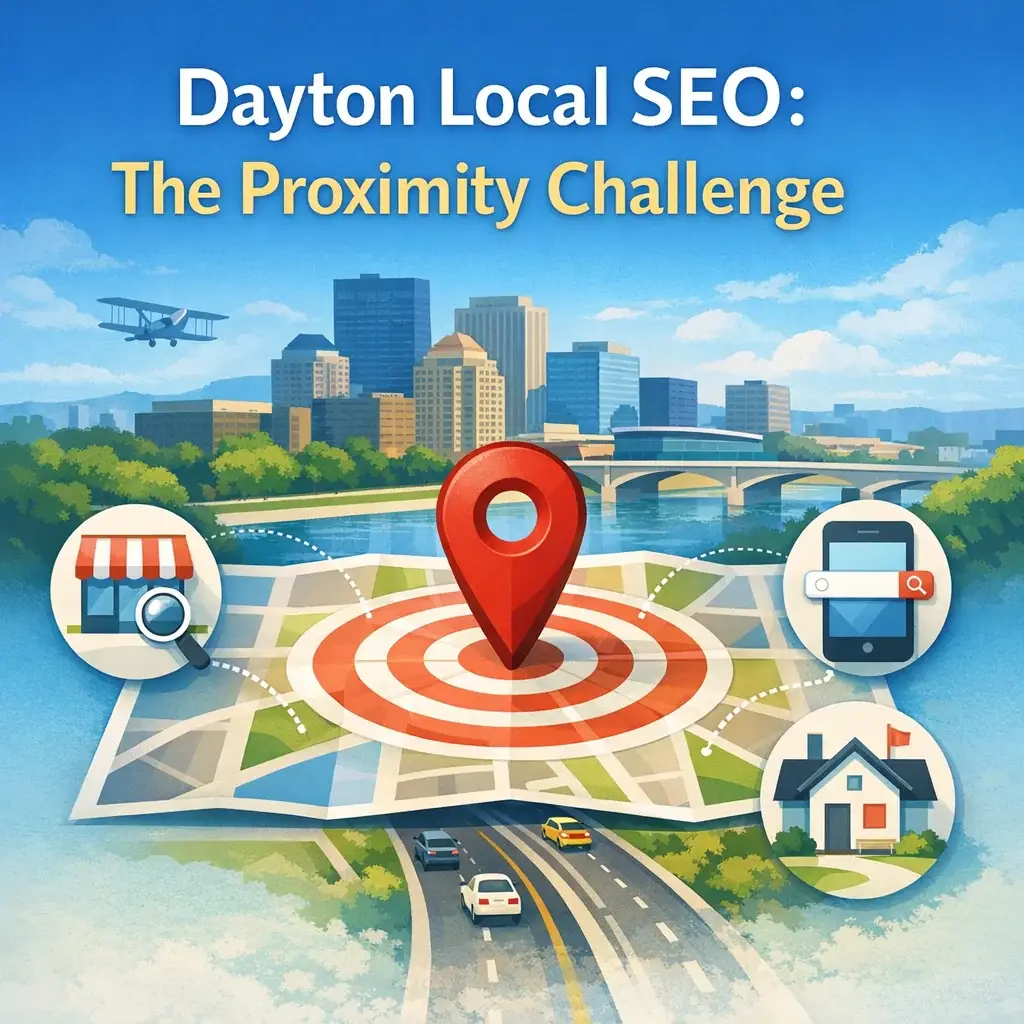
The geographic structure of the Dayton metro creates a specific challenge that no competitor in the SEO services space appears to address directly. Dayton’s urban core is relatively compact, but the population is substantially distributed across Montgomery County suburbs (Kettering, Huber Heights, Miamisburg), Greene County communities (Beavercreek, Fairborn, Xenia), and Warren County growth corridors (Springboro, Centerville, Lebanon).
When a business operates from a Beavercreek or Springboro address, Google’s proximity algorithm frequently places them at a disadvantage for searches originating from Dayton’s urban core — even when those searchers are explicitly looking for businesses in the suburbs. The inverse problem also applies: businesses in the suburbs can find that their local pack visibility is inconsistent, appearing for some suburb-specific searches but disappearing for broader Dayton-area terms where downtown businesses receive the proximity advantage.
The strategic solution operates on three levels:
Level 1 — Neighborhood Content Architecture: Building dedicated, substantive location pages for each community served. Not thin pages with swapped-in city names, but pages with genuine local context — neighborhood-specific service considerations, local landmarks used as geographic reference points, content addressing questions specific to that community’s demographics or housing stock. A roofing company serving both Huber Heights (predominantly mid-century single-family homes) and Springboro (newer construction with different roofing profiles) should have content that reflects those differences.
Level 2 — Hyper-Local Citation Strategy: National directory citations (Yelp, Yellow Pages, Angi) contribute to citation consistency but carry diminishing local relevance signal. The citations that build genuine Dayton-market authority come from locally-rooted organizations: the Dayton Area Chamber of Commerce, the Dayton Christian Chamber, Greene County and Warren County business directories, neighborhood association websites, local news publications like the Dayton Daily News, and community-specific platforms. These citations signal to Google that your business is genuinely embedded in the Dayton community rather than simply operating within its coordinates.
Level 3 — Service Area Configuration and Review Geography: Google Business Profile allows businesses to define service areas by city, ZIP code, or county. Correctly configuring these boundaries — and actively generating reviews that mention specific communities by name — creates a geographic relevance signal that extends map pack eligibility beyond the immediate business address. A Miamisburg business with 30 reviews that mention “Centerville,” “Springboro,” and “Miamisburg” by name has a measurably different geographic relevance profile than a business with 30 reviews that say “great service.” For a deeper look at how to structure and optimize these profile settings, the Google Business Profile optimization tips that actually work article covers the tactical implementation in detail.
The E-E-A-T Problem Dayton Businesses Cannot Afford to Ignore
What Google’s Quality Standards Actually Mean for Dayton Industries
Google’s Quality Rater Guidelines introduced the concept of E-E-A-T — Experience, Expertise, Authoritativeness, and Trustworthiness — as the framework their human quality raters use to evaluate content. Following the Helpful Content Updates of 2022 through 2024, the signals that underpin E-E-A-T have become more tightly integrated into how Google’s algorithms assess and rank web pages.
For the industries that dominate the Dayton economy, this is not an abstract algorithmic concern. It is a direct business impact.
Google applies its highest level of content quality scrutiny to what it categorizes as YMYL content — Your Money or Your Life. This category encompasses any content that could significantly affect a reader’s health, financial stability, safety, or legal standing. The industries where YMYL designation applies most directly to Dayton’s business community include:
- Medical and healthcare (urgent care clinics, specialty practices, mental health providers — all heavily represented across the Dayton metro)
- Legal services (personal injury, family law, estate planning, criminal defense)
- Financial services (accounting, financial planning, insurance)
- Home services involving safety (electrical, HVAC, roofing, plumbing)
- Automotive repair (brake service, structural repair)
For businesses in these categories operating in Dayton, Kettering, Beavercreek, and the surrounding communities, the practical implication is this: standard on-page SEO — optimizing title tags, meta descriptions, H1 structure, and keyword density — is necessary but structurally insufficient. Google’s quality evaluation for YMYL content looks beyond on-page optimization to ask whether the entity behind the content is genuinely credible.
Building E-E-A-T Signals That Google Can Verify
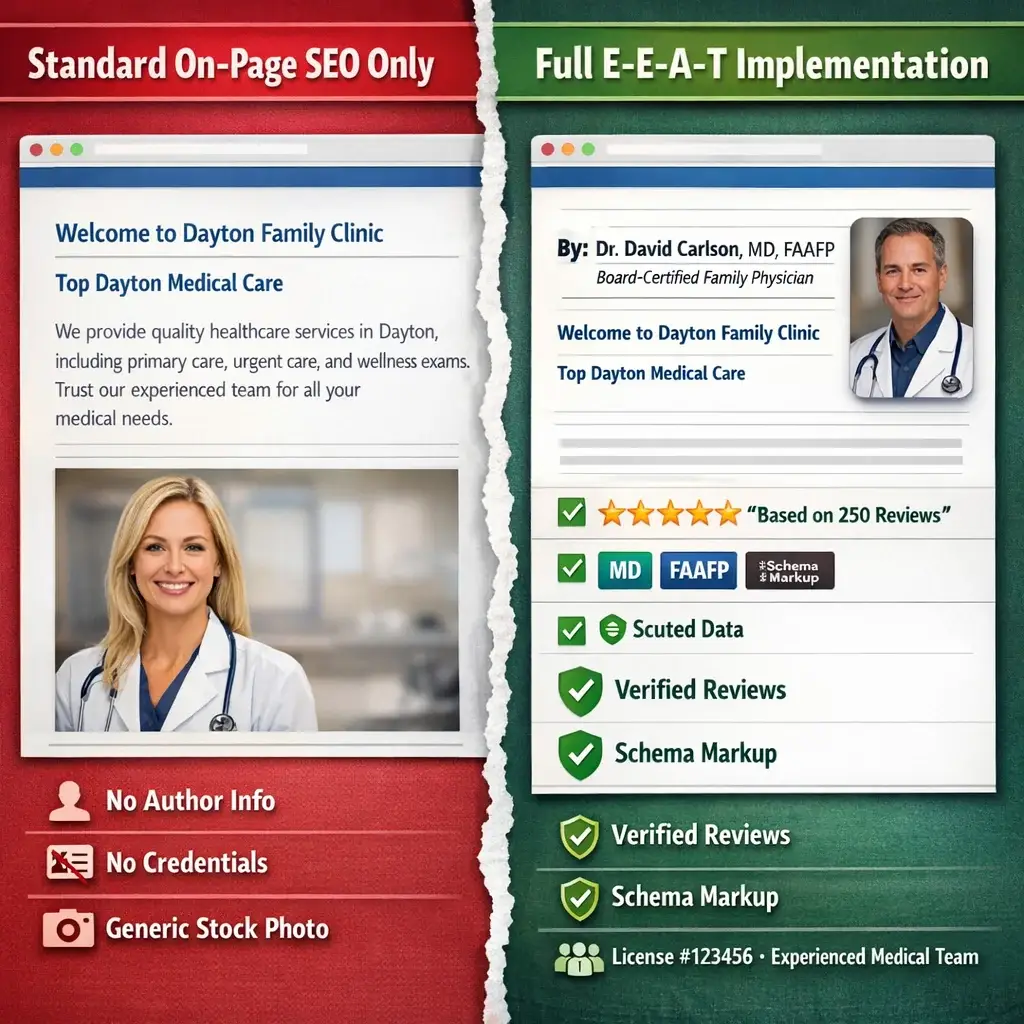
The specific E-E-A-T signals that function as verifiable ranking inputs for Dayton businesses in YMYL categories include:
Author Attribution with Verifiable Credentials
Content on medical, legal, or financial topics needs to be attributed to a named individual with verifiable qualifications. This means author bio pages that include professional licenses, board certifications, bar admissions, or trade certifications — and ideally, links to third-party verification sources like Ohio State Bar Association listings, medical board directories, or professional association memberships. An article about “Dayton HVAC maintenance” carries different authority signals when attributed to a named NATE-certified technician versus published anonymously.
Structured Data Markup for Professionals
Schema.org markup for professional service businesses allows Google to read and verify organizational claims programmatically. A Dayton medical practice that implements proper MedicalOrganization schema with verified license data, Physician author schema on clinical content, and LocalBusiness schema with accurate NAP data is communicating its credibility in a format Google’s systems can process directly. This is entirely separate from — and in addition to — the content optimization that most SEO services provide.
Review Schema and Verified Review Aggregation
Review signals influence both prominence in local pack rankings and E-E-A-T evaluation for YMYL content. The technical implementation matters: AggregateRating schema on service pages allows Google to display star ratings in organic results (rich snippets), which has a demonstrated impact on click-through rates. More importantly, consistent review volume with recency signals — across Google, industry-specific platforms (Healthgrades for medical, Avvo for legal), and general platforms — creates the prominence signal that reinforces YMYL credibility.
Entity Establishment Across the Web
Google builds what practitioners call a “knowledge graph entity” for businesses and individuals. For a Dayton business owner or professional, this means ensuring consistent name, business name, and credential information appears across LinkedIn profiles, professional association directories, local news mentions, podcast appearances, and community organization affiliations. When Google can verify that the same credentialed individual appears across multiple independent sources, the entity’s authority score strengthens — and this directly influences how that business’s content performs in search.
Search Intent Architecture: The Strategic Layer Most Dayton SEO Campaigns Skip
The single most common failure mode in SEO campaigns sold to Dayton businesses is treating keyword research as a volume exercise. An agency identifies that “plumber Dayton OH” receives a certain monthly search volume and builds content around that phrase. The problem is that searchers using the same keyword phrase can have fundamentally different intentions — and content built without accounting for this performs inconsistently at best and actively fails at worst.
Search intent operates in four distinct modes, and each requires a different content and conversion architecture:
Informational Intent — The searcher is researching, not buying. “Why is my furnace making a noise” or “how long does roof replacement take” are informational queries. Businesses that serve the Dayton market should produce content that answers these questions with genuine depth, because doing so builds topical authority and captures searchers early in the buying cycle when a competitor-agnostic relationship can be established.
Navigational Intent — The searcher is looking for a specific brand or business. “Mongoose Digital Marketing Dayton” is navigational. This type of search is largely brand-driven and influenced less by traditional SEO than by brand awareness and reputation management.
Commercial Investigation Intent — The searcher is comparing options before making a decision. “Best HVAC company Dayton,” “Dayton SEO agency reviews,” and “compare Kettering dentists” are commercial investigation queries. These require content that presents genuine differentiators, addresses comparison criteria, and provides social proof in a format that supports evaluation.
Transactional Intent — The searcher is ready to act. “Emergency plumber Beavercreek,” “HVAC repair Centerville OH,” and “book dentist appointment Dayton” are transactional. These queries require pages optimized for conversion: clear service description, strong call to action, phone number prominently displayed, and trust signals (reviews, certifications, guarantees) immediately visible without scrolling.
Most SEO campaigns targeting Dayton businesses conflate these intent categories — building a single service page that inadequately serves all four types of searchers. An effective strategy maps specific pages to specific intent types, creating a content architecture where each page has a defined role in the searcher’s journey.
What a Real SEO Audit Finds on Dayton Business Websites
Generic SEO proposals promise a “comprehensive audit” without explaining what that audit actually examines or what it typically finds. Based on the real technical landscape across Dayton-area business websites, here is what a thorough audit consistently surfaces:
Technical Infrastructure Issues
Core Web Vitals Failures: Google’s page experience signals — Largest Contentful Paint, Cumulative Layout Shift, and Interaction to Next Paint — are measurable ranking inputs. The majority of small-to-mid-sized Dayton business websites fail at least one Core Web Vitals threshold, most commonly LCP (slow load time for the primary page element) driven by uncompressed images and unoptimized server response times. Hosting infrastructure matters here — shared hosting environments common among locally-built websites frequently produce server response times that make Core Web Vitals thresholds structurally unachievable regardless of other optimizations. A technical SEO audit for small business will surface exactly which performance bottlenecks are suppressing your rankings and prioritize which fixes will have the greatest measurable impact.
Crawl Architecture Problems: Internal linking structure determines how effectively Google can discover and index all pages on a site. Many Dayton business websites have orphaned pages — pages that exist but receive no internal links — meaning Google either never discovers them or deprioritizes crawling them. This is particularly common on sites that have added service area pages over time without integrating them into the site’s navigation or internal linking strategy.
Duplicate Content at Scale: Service area pages created by swapping city names into otherwise identical content create duplicate content signals that dilute rather than build authority. This is one of the most common self-inflicted technical SEO problems on Dayton business websites, and it is directly caused by the “create a page for every city” advice that circulates without the accompanying guidance on how to make each page substantively unique.
Local SEO Infrastructure Gaps
NAP Inconsistency Across Aggregators: Business name, address, and phone number must be consistent across the primary data aggregators — Neustar Localeze, Data Axle, Foursquare — that feed citation data to dozens of downstream directories. A business that has changed locations, changed phone numbers, or changed its formal business name frequently has NAP conflicts scattered across the web that create conflicting signals for Google’s local algorithms. Resolving these requires direct submission to the primary aggregators, not just updating the most visible directory listings.
Missing or Incorrect Schema Markup: LocalBusiness schema, service-specific schema, and review schema are absent or incorrectly implemented on the majority of Dayton small business websites. Incorrect implementation — such as schema that references a phone number inconsistent with the NAP on the page — can actively harm local rankings by creating conflicting machine-readable signals.
Google Business Profile Optimization Gaps: Beyond basic profile completion, most GBP profiles for Dayton businesses are underutilizing available features: products and services sections are empty or generic, Google Posts are inactive, Q&A sections have unanswered questions from potential customers, and photo libraries consist of a handful of stock images rather than genuine business photography. Each of these represents an active ranking opportunity left unused.
Realistic SEO Milestones for Dayton Businesses: A 90-Day Framework
One of the most persistent failures in how SEO services are sold in Dayton is the combination of vague timelines and unrealistic expectations. “SEO takes time” is true but useless. What a Dayton business owner actually needs is a clear framework for what legitimate progress looks like in the first 90 days of a properly executed campaign.
Days 1–30: Foundation and Audit Phase
– Technical audit complete with prioritized issue list
– NAP inconsistencies identified across major aggregators and primary directories
– Google Business Profile audit complete; critical gaps identified and corrections submitted
– Keyword research complete with intent segmentation and competitive difficulty assessment
– Baseline rankings documented for target keyword set
– On-page optimization begins on highest-priority service pages
Visible ranking movement at this stage is uncommon and not an indicator of campaign effectiveness. Google’s crawl and indexing cycle means that changes made in week one may not reflect in rankings until week four or later.
Days 31–60: Content and Authority Building Phase
– On-page optimization complete across core service and location pages
– Schema markup implemented and validated
– Local citation campaign underway through primary aggregators and high-value local directories
– Content production begins — FAQ content, informational articles targeting commercial investigation queries, location-specific content
– GBP posting cadence established and active
– Review generation strategy deployed with client team
Ranking movement for lower-competition keywords and long-tail phrases typically begins appearing in this window. Local pack visibility improvements for core service terms may begin if citation work and GBP optimization are producing prominence signals.
Days 61–90: Measurement, Iteration, and Link Acquisition
– First full performance data cycle available for analysis
– Ranking trajectory established for primary keyword targets
– Content performance data informing next content priorities
– Link acquisition outreach underway — local news, community organizations, industry publications
– GBP insights reviewed; searcher behavior data (queries driving profile views, call tracking) integrated into optimization decisions
Meaningful ranking movement for primary commercial keywords typically requires three to six months of sustained work in moderately competitive Dayton verticals. High-competition categories — legal, medical, established home services — should be understood as six to twelve month campaigns before primary keyword rankings become reliable.
Why Tailored Strategy Beats Template SEO in This Market
The Dayton market’s competitive complexity — the corridor pressure from Columbus and Cincinnati, the proximity challenges in suburban communities, the YMYL requirements across dominant local industries, the Wright-Patterson ecosystem’s unique competitive dynamics — makes it a genuinely poor candidate for templated SEO execution.
Agencies that sell Dayton businesses a package built on the same framework they use in every other mid-sized Ohio city are selling a product that ignores the specific forces working against those businesses in search results. The gap between standard SEO execution and strategy built around Dayton’s actual search landscape is not marginal. In competitive categories, it is frequently the difference between page-one visibility and irrelevance.
At Mongoose Digital Marketing, our work in the Dayton metro — serving businesses across Kettering, Beavercreek, Centerville, Huber Heights, Miamisburg, Springboro, and the broader Montgomery, Greene, and Warren County area — is built on the premise that market intelligence is not optional. Understanding which competitive forces are actually working against a specific client in a specific vertical informs every strategic decision, from which keywords to prioritize to how local authority is built to how content is structured and attributed.
If you want to understand exactly where your business stands in Dayton’s search landscape and what it would take to change it, the starting point is a conversation. There is no formula delivered before we understand your specific situation. That is intentional.
Reach out to Mongoose Digital Marketing to schedule your free consultation.
Strategic Recommendations for 2026
Dayton businesses entering or continuing SEO campaigns in 2026 should align their approach with three developments that are reshaping how local search visibility is earned and maintained.
1. Invest in Authoritative Local Content Hubs
Google’s continued emphasis on experience, expertise, authoritativeness, and trustworthiness means thin or templated content is increasingly penalized — particularly in YMYL verticals dominant across the Dayton market. Build topical depth around the subjects your business genuinely owns. A Kettering orthopedic practice should not have one page about knee pain. It should have a content ecosystem that demonstrates clinical depth, provider credentials, and community relevance. Tools like Surfer SEO or Clearscope can help identify the topical gaps between your current content and what’s ranking, but the strategy behind which gaps to close must be driven by market-specific analysis, not automated suggestions alone.
2. Prioritize Google Business Profile as a Primary Asset
For businesses competing in Dayton’s suburban corridor — Beavercreek, Centerville, Springboro, Miamisburg — the Google Business Profile is often the first and most decisive ranking factor in map pack results. In 2026, GBP management should be treated as an ongoing content and engagement channel, not a one-time setup task. Regular posts, photo updates, review response protocols, and Q&A management all feed the signals that determine whether your business appears when proximity-based searches are made. Platforms like BrightLocal offer monitoring and citation management tools that integrate well with sustained GBP strategies.
3. Build a Structured Local Link Acquisition Program
Dayton’s business community — the manufacturing sector, Wright-Patterson contractors, healthcare networks, regional educational institutions — offers legitimate local SEO link acquisition opportunities that out-of-market agencies consistently overlook. Sponsorships, chamber memberships, supplier directories, and editorial coverage in regional publications like Dayton Business Journal represent link equity sources that carry genuine geographic relevance. A structured outreach program targeting these sources, tracked through tools like Ahrefs or Semrush, will outperform any generic link-building package sold by volume.
Frequently Asked Questions
How long does SEO take to show results for a Dayton area business?
Most Dayton businesses in moderately competitive categories begin seeing measurable movement in local rankings within three to six months of sustained, well-executed SEO work. High-competition verticals — legal services, medical practices, established home services contractors — typically require six to twelve months before primary keyword rankings become consistent. The timeline depends significantly on the current state of your website, the strength of existing competitors, and how aggressively the campaign is executed from the start.
Does SEO work differently in Dayton than in other Ohio cities?
Yes, in meaningful ways. Dayton sits between Columbus and Cincinnati, which creates competitive pressure from larger metro markets bleeding into Dayton-area search results. Additionally, the density of suburban communities — Kettering, Beavercreek, Centerville, Huber Heights, and others — creates a fragmented local search landscape where proximity and hyper-local signals matter more than in cities with simpler geographic boundaries. A strategy built for a generic mid-sized Ohio market will miss these dynamics entirely.
What makes an SEO agency the right fit for a Dayton business?
The right agency understands Dayton’s specific competitive landscape rather than applying a uniform framework developed for other markets. That means knowing which industries face YMYL scrutiny, how the Wright-Patterson economic corridor shapes certain B2B categories, and how suburban proximity affects map pack competition across Montgomery, Greene, and Warren Counties. Beyond market knowledge, the right fit is an agency that begins with your specific situation — your vertical, your current visibility, your competitive set — before recommending any approach.
Should a Dayton business focus on local SEO or broader organic search?
For most Dayton businesses, local SEO and organic search are not competing priorities — they are complementary. Local SEO focuses on map pack visibility and proximity-based searches, which drive high-intent traffic from nearby customers. Broader organic search builds topical authority and captures users earlier in the research process. The right balance depends on your business model, your sales cycle, and how your customers actually search. A home services company in Centerville has different priorities than a B2B manufacturer serving Wright-Patterson contractors, and the strategy should reflect that difference.
Conclusion
Businesses across Dayton, Kettering, Beavercreek, and Centerville deserve SEO built around how this market actually works — not a recycled framework applied regardless of local conditions. Mongoose Digital Marketing’s work in local SEO and content strategy is grounded in the specific competitive dynamics of the Dayton metro, which means every recommendation is informed by what’s actually working here, in these communities, against these competitors. If you’re ready to understand where your business stands and what a realistic path to better visibility looks like, Contact Mongoose Digital Marketing to schedule your free consultation.