

Key Takeaways
- Fiverr’s seller badge system (Level 1, Level 2, Top Rated, Vetted Pro) measures platform performance metrics like order completion and response time — not SEO expertise or results quality.
- Purchasing backlink packages on Fiverr without verifying the link acquisition methodology puts your site at direct risk under Google’s Spam Policies, which can result in manual penalties that take months to recover from.
- The most common reason Fiverr SEO engagements fail is scope mismatch — buyers confuse audit deliverables with implementation, or expect one-time purchases to produce ongoing ranking momentum.
- Domain Rating (DR) is an Ahrefs proprietary metric that no Fiverr seller directly controls; any gig guaranteeing a specific DR increase is promising an outcome outside their authority.
- For Ohio businesses in competitive local markets — Dayton, Kettering, Beavercreek, and surrounding communities — a single disconnected Fiverr gig rarely substitutes for a coordinated SEO strategy built around your specific service area and competitive landscape.
If you’ve searched for SEO help recently, Fiverr has almost certainly appeared on your radar. With tens of thousands of SEO gigs available at a wide range of commitment levels, the platform looks like an accessible starting point for business owners who want to grow their search visibility without signing a long-term agency contract.
That surface-level appeal is legitimate. Fiverr does host skilled SEO practitioners, and certain discrete tasks — keyword research, technical audits, schema markup implementation — can be executed competently through the platform when you know exactly what you’re buying and how to vet the person delivering it.
The problem is that most buyers don’t know either of those things. And the content currently available online about Fiverr SEO services doesn’t help — it’s mostly catalogue pages dressed up as buying guides, offering seller listings without a single framework for evaluating what separates a productive engagement from a wasted budget and a damaged site.
This guide is different. We’re going to cover how Fiverr SEO services actually work, where the real risks sit, what evaluation signals matter, and how to think about the role freelance tactical execution plays — or doesn’t play — in building genuine, lasting search authority for a local Ohio business.
What “SEO Services on Fiverr” Actually Covers
Fiverr organizes its SEO gigs across several broad categories, and understanding the distinction between them is the first step toward making an informed purchase decision.
The Core Service Categories
On-Page SEO covers optimizations applied directly to your website’s existing content and structure — title tags, meta descriptions, header hierarchy, internal linking, and keyword placement. This category is relatively safe because the work is largely reversible and confined to your own pages.
Technical SEO addresses how search engine crawlers access and interpret your site — Core Web Vitals, crawl budget efficiency, canonicalization, XML sitemaps, structured data, and site architecture. This category carries medium risk because sellers typically need either direct site access or the ability to implement code-level changes.
Off-Page SEO and Link Building encompasses acquiring backlinks from external websites. This is the highest-risk category on any freelance platform, and we’ll cover it in depth below.
Keyword Research involves identifying target search terms based on volume, competition, and commercial intent. A well-structured keyword research deliverable is genuinely useful and carries minimal site risk.
Local SEO focuses on proximity-based rankings — Google Business Profile optimization, local citation building, NAP consistency, and review strategy. For businesses in Dayton, Kettering, Centerville, or Miamisburg competing in local search results, this category is often where the most immediately actionable work lives. Our article on local SEO for Ohio service businesses goes deeper on what drives results in these specific markets.
Full SEO Packages are bundled offerings that typically combine elements of the above categories. These require the most scrutiny because “full SEO” means different things to different sellers, and the absence of a clear scope document is where budget disappears without proportional results.
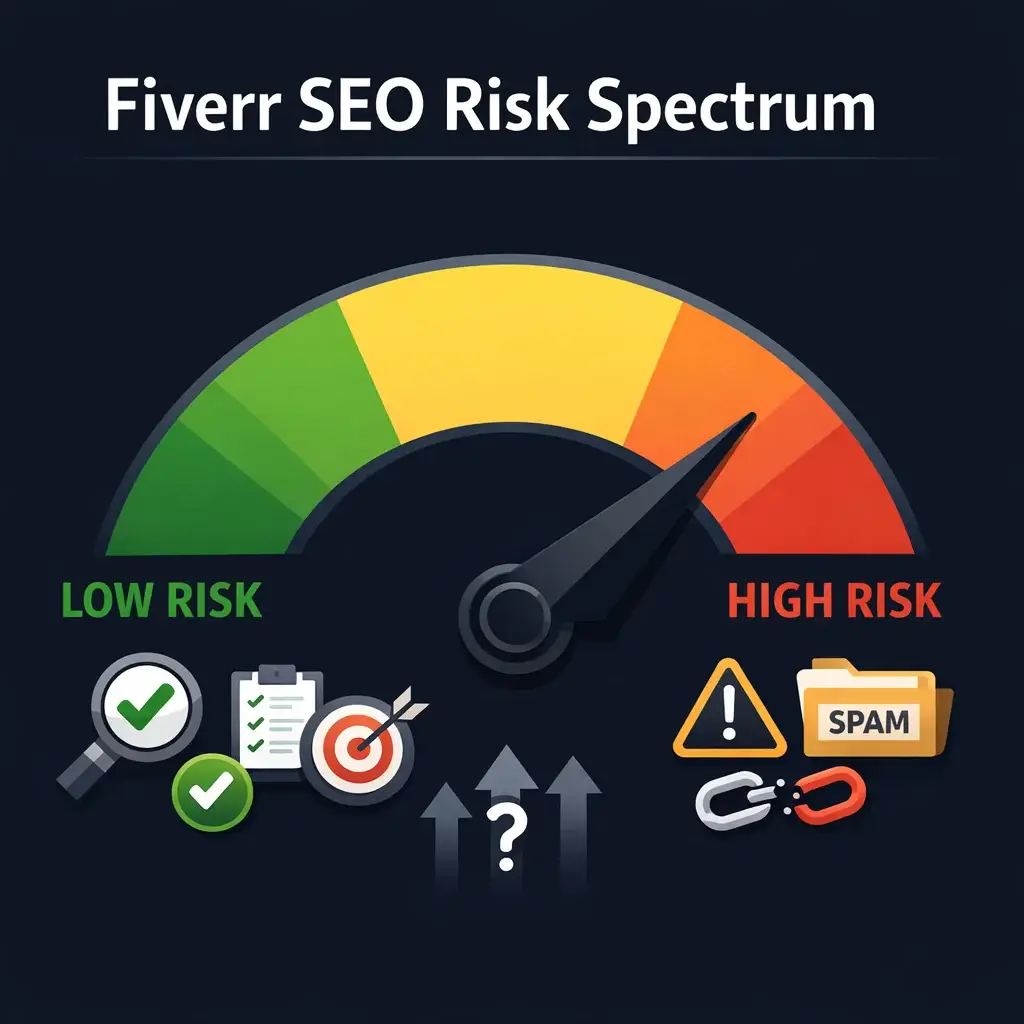
The Risk Spectrum: Not All Fiverr SEO Purchases Are Equal
One of the most significant failures in existing Fiverr SEO content is treating all service categories as roughly equivalent purchasing decisions. They are not. A useful framework is to think about Fiverr SEO services across a clear risk stratification:
| Service Type | Risk Level | Primary Concern | Can Hurt Site? |
|---|---|---|---|
| Keyword research reports | Low | Deliverable quality | No |
| Competitor analysis documents | Low | Analytical depth | No |
| On-page audit (recommendations only) | Low | Report accuracy | No |
| Content briefs and SEO strategy docs | Low | Strategic alignment | No |
| Schema markup implementation | Low–Medium | Code accuracy | Minimally |
| On-page SEO implementation | Medium | Direct site access | Yes, if done incorrectly |
| Technical SEO fixes | Medium | CMS and server configuration | Yes, if misconfigured |
| Local SEO and GBP optimization | Medium | Verification and category accuracy | Yes, if inaccurate data is submitted |
| Link building (manual outreach) | Medium–High | Link quality and relevance | Potentially |
| Bulk backlink packages | High | Google Spam Policy violations | Yes, significantly |
| Full SEO packages (undocumented scope) | High | Scope ambiguity, mixed tactics | Yes |
| AI-generated content at scale | High | Content quality signals, thin content | Yes |
The takeaway here is practical: start your Fiverr SEO engagement in the lower-risk categories. Commission a keyword research deliverable or an on-page audit first. This approach validates the seller’s actual expertise with zero site exposure before you grant access to anything sensitive.
Why Fiverr Seller Badges Don’t Tell You What You Need to Know
Fiverr’s badge hierarchy — Level 1, Level 2, Top Rated Seller, and Vetted Pro — is one of the most misunderstood quality signals on the platform. Every competitor guide presents these badges as if they represent SEO competence. They don’t.
Here’s what each badge tier actually measures:
Level 1: Seller has completed at least 10 orders with a minimum 4.7-star rating over 60 days of active selling. This is a platform activity benchmark, not an expertise threshold.
Level 2: Seller has completed at least 50 orders with sustained ratings and low cancellation rates over 120 days. Again — platform engagement, not SEO knowledge.
Top Rated Seller: Achieved through consistently high order volume, excellent reviews, and low dispute rates over an extended period. A Top Rated badge tells you the seller is reliable at executing orders. It says nothing about whether those orders produced measurable ranking improvements.
Vetted Pro: The most legitimate tier, involving a manual application and vetting process by Fiverr. This is the closest badge to actual credentials — but the vetting criteria are not publicly documented in detail, and “satisfaction guarantee” terms at this tier warrant careful reading before purchase.
The practical implication: a Level 1 seller who spent eight years as an in-house SEO manager at a regional healthcare system brings categorically different expertise than a Top Rated seller who has processed thousands of identical cookie-cutter meta description updates. The badge system cannot surface that distinction. You have to.
The Gig Signals That Actually Matter
When evaluating a Fiverr SEO gig, experienced buyers look past star ratings and focus on the following:
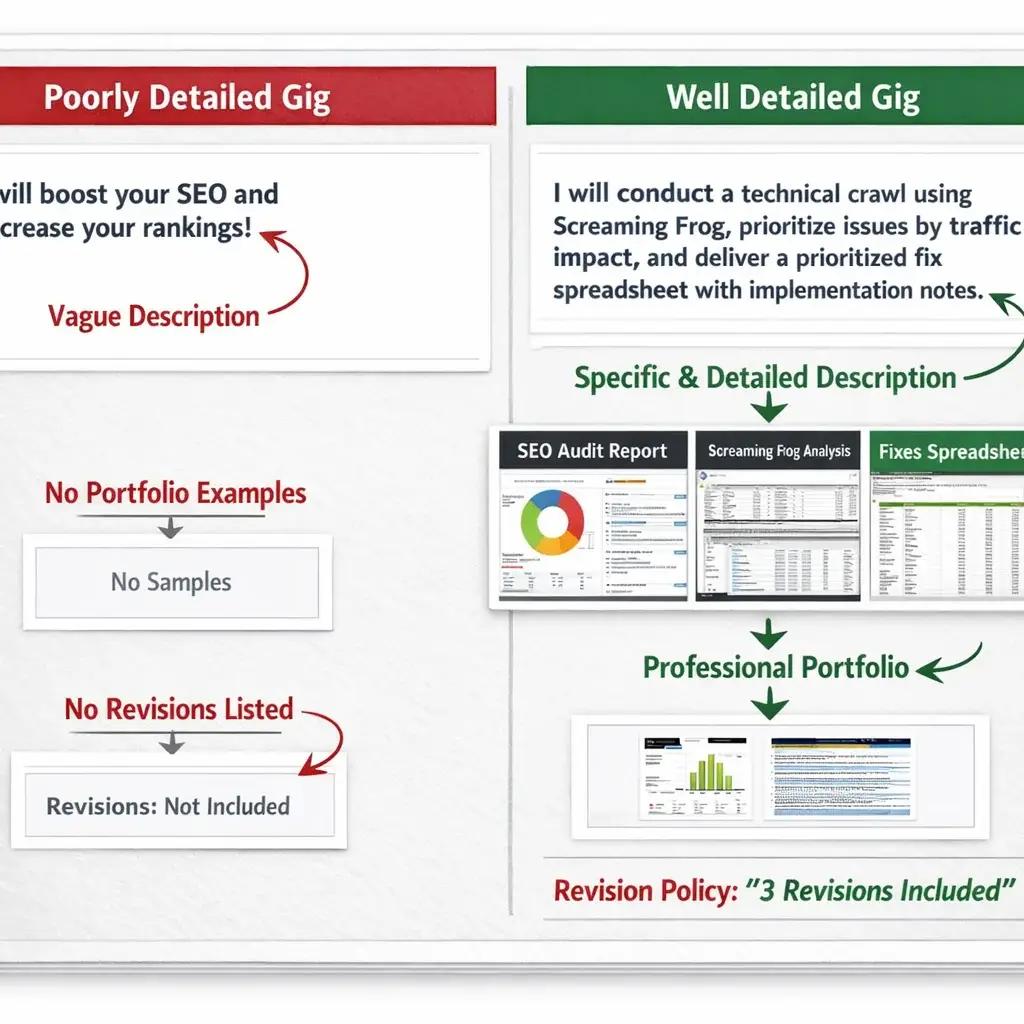
- Gig description specificity: A gig that says “I will improve your SEO” is a warning sign. A gig that describes a documented process — specific tools used, deliverable format, how findings are prioritized — signals a practitioner who has refined their methodology through real engagements.
- Portfolio samples with before/after data: Vanity deliverables like PDF report templates prove nothing. Portfolio samples that show documented ranking movement, organic traffic growth in Google Search Console, or measurable improvements in crawl health are the evidence that matters.
- Response rate and response time: These are visible on seller profiles and function as a reliable proxy for communication quality throughout a project. An SEO engagement with poor communication is almost guaranteed to produce misaligned output.
- Revision policy logic: Unlimited revisions on an SEO audit is a red flag, not a benefit. A legitimate SEO audit reflects objective technical findings — it shouldn’t require infinite revision cycles. Sellers offering unlimited revisions on strategy deliverables may be optimizing for buyer satisfaction scores rather than analytical integrity.
- Review recency, not just volume: A 4.9-star rating based on 40 reviews carries far less statistical reliability than a 4.9 on 1,800 reviews. More importantly, check when the most recent reviews were posted. A seller with 2,000 reviews and no new activity in six months tells a different story than their aggregate rating suggests.
The Scope Mismatch Problem: Where Fiverr SEO Budgets Disappear
The majority of failed Fiverr SEO experiences don’t happen because the seller was incompetent. They happen because the buyer and seller had fundamentally different understandings of what was being purchased.
Audit vs. Implementation
This is the most common and costly confusion. An “SEO audit” gig delivers a document — a report identifying technical issues, on-page optimization opportunities, and recommendations. It does not fix anything. If you purchase an audit expecting a functional website improvement, you’ll receive a spreadsheet of problems and wonder why your rankings didn’t move.
Implementation is a separate engagement. You need to either hire a developer to execute audit recommendations, purchase a separate implementation gig, or have the internal capability to apply fixes yourself. Neither Fiverr nor its sellers make this distinction obvious. Our article on technical SEO audits for small businesses breaks down exactly what a properly scoped audit should surface and how to act on what it finds.
One-Time vs. Ongoing SEO
Fiverr’s transactional structure naturally encourages one-time purchases. SEO is not a one-time discipline. Link equity accumulates over months. On-page optimizations need to be revisited as content ages and competition evolves. Algorithm updates require monitoring and adaptive response.
A business in Beavercreek or Huber Heights trying to rank for competitive local service terms cannot buy a single backlink package, wait 90 days, and expect sustained first-page visibility. The platform’s structure creates this expectation; reality does not support it.
The Brief Quality Problem
Fiverr sellers can only produce output as refined as the input they receive. Buyers who submit vague project requests — “improve my website’s SEO” — should not be surprised when they receive generic output.
A productive Fiverr SEO brief includes:
- Target keywords with current ranking positions (pull from Google Search Console)
- Geographic targeting — for a Springboro HVAC company, this means specifying the service area, not just the city
- CMS platform (WordPress, Squarespace, Shopify, etc.) and any known technical constraints
- Competitor URLs you’re trying to outrank
- Existing technical issues you’re already aware of
- Deliverable format requirements — editable spreadsheet, Google Doc, structured report, etc.
- Access level you’re willing to grant — recommendations only, or implementation access
The quality of the brief is a direct multiplier on the quality of the output. This isn’t exclusive to Fiverr — it applies to any SEO engagement — but it matters more on a platform where sellers manage high volumes of orders simultaneously.
Operational Security: The Staging Environment Rule
Any Fiverr seller with direct CMS access to implement technical SEO changes should never be given live-site credentials without a staging environment in place first. This is non-negotiable.
A staging environment is a duplicate of your live site where changes can be tested before deployment. If a seller’s technical SEO implementation introduces a crawl error, breaks your site’s navigation structure, or incorrectly configures your robots.txt file, discovering that on a live site serving customers is a substantially worse outcome than catching it in a staging environment.
If your hosting provider doesn’t offer one-click staging (most modern managed WordPress hosts do), request it before any third-party gains implementation access to your site.
The Backlink Problem: What Competitors Won’t Tell You About Off-Page SEO on Fiverr
Off-page SEO gigs — particularly bulk backlink packages — represent the highest-risk purchase category on Fiverr, and the competitive content landscape essentially ignores this entirely.
Google’s Spam Policies and Link Schemes
Google’s Spam Policies explicitly identify link schemes as a violation of its guidelines. Specifically, Google targets:
- Buying or selling links that pass PageRank
- Excessive link exchanges
- Links generated through automated programs
- Low-quality directory or article site links created at scale
Many of Fiverr’s most popular and heavily reviewed off-page SEO gigs operate in direct tension with these policies. A gig offering 200 backlinks from “high-DA sites” for a one-time purchase is describing a link scheme. The fact that it has 3,000 positive reviews means thousands of buyers received a deliverable — not that those backlinks produced safe, lasting ranking improvements.
The consequences of a Google manual action for unnatural links are significant and time-consuming to reverse. Recovery requires identifying and disavowing the problematic links, submitting a reconsideration request, and waiting for Google’s review — a process that routinely takes two to six months during which your site may maintain suppressed visibility.
The Domain Rating Myth
Domain Rating is a metric created and owned by Ahrefs. It reflects the relative strength of a website’s backlink profile on a logarithmic scale from 0 to 100. No Fiverr seller — or any external party — directly controls your site’s DR.
What a seller can do is acquire backlinks from other websites that have their own DR scores. Whether those links positively influence your DR depends on the authority, relevance, and indexation status of the linking sites, along with Ahrefs’ own crawl and calculation frequency.
A gig promising to “increase your Domain Rating to DR40” is promising a specific outcome on a third-party metric the seller cannot directly control. That’s not a marketing claim — it’s an impossibility. Any buyer seeing this framing should treat it as a fundamental credibility signal about the seller’s understanding of the work.
AI-Generated Content and Emerging Search Optimization Signals
Some Fiverr SEO gigs now explicitly reference GEO (Generative Engine Optimization) and AEO (Answer Engine Optimization) — terms that reflect the genuine shift in how search results are being generated and displayed as AI-powered platforms like Google’s AI Overviews, Perplexity, and ChatGPT become primary information surfaces.
This is a legitimate and important development. The optimization principles required to appear in AI-generated answers — clear entity definition, structured factual content, demonstrated topical authority, strong E-E-A-T signals — are meaningfully different from traditional keyword-density-based SEO.
The problem on Fiverr is that these terms are appearing in gig titles without the underlying methodology to support them. A gig titled “I will optimize your site for GEO and AEO” from a seller with no documented experience in structured data, entity optimization, or AI search behavior is using emerging terminology as marketing language, not as a signal of actual capability.
If you’re pursuing AI search optimization for your business — a legitimate priority for Ohio service businesses trying to capture answer-position visibility — the vetting requirement is higher, not lower. Ask sellers to document their specific methodology: what structured data schemas they implement, how they approach entity relationship mapping, what tools they use to monitor AI Overview citation rates.
What Fiverr SEO Can and Cannot Replace
For Ohio businesses in Dayton, Kettering, Centerville, Miamisburg, and the surrounding area, the question isn’t whether Fiverr SEO services have value — some clearly do, in the right context. The question is what role they can productively play relative to a coordinated local SEO strategy.
Where Fiverr SEO can contribute genuine value:
- A one-time technical audit that surfaces crawl errors, Core Web Vitals issues, and structural problems before you invest in content
- Keyword research scoped specifically to your service area and competitive set
- Schema markup implementation for local business, service, and FAQ structured data
- A content brief framework for your service pages that incorporates topical authority and search intent alignment
Where Fiverr SEO has structural limitations:
- Algorithm update response — when Google releases a core update affecting local service rankings in Ohio, a one-time Fiverr gig has no mechanism for adaptive response
- Strategy evolution — as your business adds services, expands to new communities, or responds to competitive changes, a Fiverr transaction doesn’t evolve with you
- Account-level continuity — the institutional knowledge about your business, your customers, and your market that a long-term SEO partner builds over months is not replicated through individual gig purchases
- Integrated multi-channel coordination — organic SEO performance in Dayton’s competitive markets is amplified when it connects to paid search data, social audience signals, and website conversion architecture — a level of integration that a single-task freelancer cannot provide
The businesses that get genuine ROI from Fiverr SEO treat it as a tool for specific, bounded tactical tasks — not as a substitute for strategic SEO direction. The strategic layer still requires either internal expertise or an agency partner who understands your market, your goals, and how search performance connects to actual revenue. If you’re evaluating what that looks like in practice, our guide on how to select a local SEO company without getting burned lays out the criteria that separate accountable partners from vendors collecting retainers.
How to Structure a Fiverr SEO Engagement That Doesn’t Backfire
If you’ve decided that Fiverr is the right tool for a specific SEO task, the following protocol significantly improves your probability of a productive outcome:
Before You Purchase
- Identify the specific deliverable you need, not the outcome you want. “I need a technical SEO audit of my 40-page WordPress site” is a purchasable deliverable. “I want to rank number one for HVAC Dayton” is not.
- Run the seller through the gig signals framework above — specificity, portfolio evidence, review recency, revision policy logic.
- Message the seller before purchasing. Ask one substantive question about their methodology. How they respond — and how quickly — tells you what the communication experience will look like throughout the engagement.
- Verify that the deliverable format will be portable. You should own an editable file, not a locked report in a proprietary tool.
During the Engagement
- Submit a complete brief using the framework outlined above. Don’t leave target keywords, geographic targeting, or CMS platform unstated.
- If the seller requires site access, deploy a staging environment and create a limited-access user account — not an administrator account — for the engagement.
- Set a clear deliverable review timeline so both parties have aligned expectations.
After Delivery
- Before implementing any recommendations, have a second set of eyes review significant technical changes — either internally or through a trusted partner.
- Document what was changed, when, and by whom. If rankings shift in either direction after implementation, this record is invaluable for attribution.
- Evaluate the outcome against the specific deliverable, not against ranking positions. An audit is complete when it accurately identifies technical issues. Rankings are influenced by dozens of factors beyond any single engagement.
Partnering With Mongoose Digital Marketing
For businesses across Dayton, Kettering, Beavercreek, Centerville, Huber Heights, Miamisburg, and Springboro, sustainable search growth requires more than individual task execution — it requires a coordinated strategy built around your specific market, your competitive environment, and your growth objectives.
Mongoose Digital Marketing works as a full-service digital partner, connecting SEO strategy with web design, paid search, and social media to create integrated campaigns that move real business metrics. If you’ve been piecing together tactical fixes and want to understand what a coherent, data-driven growth strategy looks like for your business, we offer a no-commitment consultation to start that conversation.
Strategic Recommendations for 2026
As search algorithms continue to evolve and AI-generated content floods competitive verticals, the businesses that will separate themselves in local markets are those investing in deliberate, well-structured SEO strategy rather than one-off task purchases. Three specific directions are worth prioritizing heading into 2026.
1. Invest in a Comprehensive Local SEO Audit From a Vetted Specialist
Before adding more content or building more links, understand the technical foundation you’re working from. A properly scoped local SEO audit — whether sourced from a qualified Fiverr Pro seller or a regional agency — should evaluate crawlability, Core Web Vitals, Google Business Profile completeness, citation consistency across directories, and on-page optimization for geo-targeted keywords. Skipping this step means optimizing on top of unresolved problems.
2. Prioritize E-E-A-T Signal Development
Google’s emphasis on Experience, Expertise, Authoritativeness, and Trustworthiness is no longer a background consideration — it is a front-line ranking factor, particularly in competitive local markets. For 2026, this means building author profiles with verifiable credentials, earning local citations from industry-relevant publications, generating authentic customer reviews across multiple platforms, and ensuring your website clearly communicates who you are, where you operate, and what qualifies you to serve your market.
3. Consolidate Your Vendor Relationships
If your current approach involves separate Fiverr gigs for keyword research, on-page optimization, link building, and reporting, the gaps between those engagements are costing you strategic coherence. Moving toward a single accountable partner — one who connects SEO to your broader digital presence — produces compounding value that individual task execution simply cannot replicate.
Frequently Asked Questions
Are SEO services on Fiverr legitimate for local businesses?
Some Fiverr SEO services are legitimate and can deliver real value, particularly for narrowly defined deliverables like technical audits, keyword research reports, or on-page optimization for a specific page set. The platform hosts credentialed professionals alongside low-quality providers, so outcomes depend almost entirely on how carefully you vet the seller before engaging. Reviewing portfolio samples, reading detailed reviews, and communicating your specific local market context before purchasing gives you a much stronger chance of a useful result.
What types of SEO work are best suited to a platform like Fiverr?
Fiverr works best for discrete, clearly defined deliverables with objective quality standards — things like a structured technical audit, a competitor keyword gap analysis, a schema markup implementation, or a Google Business Profile optimization. It is generally a poor fit for ongoing strategy, integrated campaign management, or engagements that require deep familiarity with your business, your customers, and your local competitive environment over time.
How do I know if an SEO audit I received from Fiverr is accurate?
A credible SEO audit will reference crawl data from recognized tools such as Screaming Frog, Ahrefs, or SEMrush, identify specific URLs alongside specific issues rather than offering generic observations, and prioritize findings by estimated impact rather than presenting every flag as equally urgent. If the audit reads like a template with your domain name inserted, or if it identifies hundreds of issues without any prioritization framework, treat the findings with caution before implementing significant changes to your site.
When does it make sense to move from Fiverr gigs to a full-service SEO partner?
When you find yourself purchasing multiple separate gigs to address different aspects of the same problem, when deliverables aren’t connecting into a coherent strategy, or when you need someone who understands your specific market — including the local competitive dynamics in areas like Dayton, Kettering, or Beavercreek — that’s typically the inflection point where a full-service digital partner produces meaningfully better returns than continued task-by-task execution.
Conclusion
For businesses in Dayton, Kettering, Beavercreek, and the surrounding communities, sustainable search growth is not something that gets built one disconnected gig at a time — it’s built through strategy, consistency, and a partner who understands your local market from the ground up. Mongoose Digital Marketing brings that integrated approach to every client relationship, connecting SEO with web design and paid search to produce results that actually move your business forward. If you’re ready to replace piecemeal fixes with a coherent growth plan, Contact Mongoose Digital Marketing to start the conversation.
See also: SEO Services Dayton: Local Strategies That Actually Work