
Why Most Small Business Social Media Strategies Fail Before They Start
Here’s a frustrating truth most marketing articles won’t tell you: following generic social media advice to the letter is one of the fastest ways to burn your limited time, budget, and energy for near-zero return.
The standard playbook — pick a platform, post consistently, use hashtags, track your likes — is repeated so often that it feels authoritative. It isn’t. It’s a surface-level checklist designed to reduce anxiety for beginners, not to build a customer acquisition engine that actually moves revenue. For small businesses operating with lean teams and real financial stakes, that distinction matters enormously.
This guide takes a different approach. We’re going to address the strategic mechanics that separate social media efforts that generate leads and conversions from those that generate impressions and exhaustion. That means covering platform dependency risk, content signal sequencing, audience intent modeling, and content architecture — the layers of sophistication that rarely appear in introductory roundups but consistently separate businesses that win on social from those that plateau.
If you’re a small business owner serious about making social media work as a growth channel, this is where that conversation starts.
The Foundation Problem: Most Small Businesses Are Building on Rented Land
Before selecting a platform, scheduling your first post, or debating whether Reels outperform carousels, there is a more fundamental strategic question that almost nobody asks: Do you own your audience, or are you just borrowing access to it?
Every social media platform — Instagram, Facebook, TikTok, LinkedIn — is a rented channel. You don’t own your followers. You don’t control the algorithm that determines whether they see your content. You have no recourse if your account is suspended, the platform changes its monetization model, or organic reach collapses.
That last point isn’t hypothetical. Facebook’s organic page reach dropped from approximately 16% of followers in 2012 to under 2% by the early 2020s. Businesses that had spent years building audiences of tens of thousands of followers suddenly found themselves paying to reach people who had already opted in to hear from them. Many of those businesses had no alternative channel. Their entire marketing infrastructure evaporated.
This is the Owned vs. Rented Audience problem, and it’s the most under-discussed strategic risk in small business social media marketing.
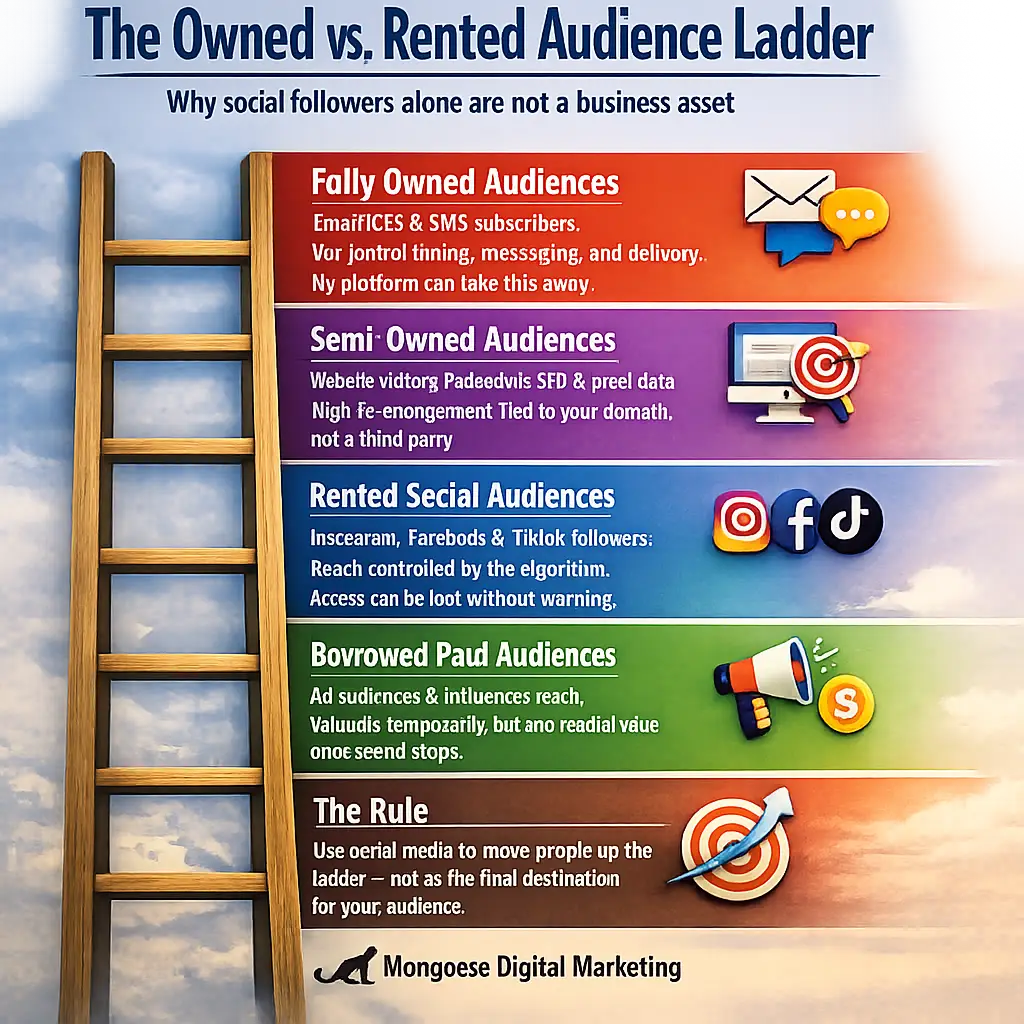
The Owned vs. Rented Audience Ladder
Understanding this hierarchy changes how you think about every social media action:
| Audience Type | Examples | Control Level | Loss Risk |
|---|---|---|---|
| Fully Owned | Email list, SMS subscribers, loyalty program members | Complete — you control timing, content, and delivery | Minimal — platform-independent |
| Semi-Owned | Website visitors (via SEO or retargeting pixel data) | High — you can retarget and re-engage via paid | Low — tied to your own domain |
| Rented (Social) | Instagram followers, Facebook page likes, TikTok audience | None — algorithm controls reach and visibility | High — can disappear overnight |
| Borrowed (Paid) | Ad audiences, influencer audiences | Temporary — ends when spend stops | Complete — zero residual value |
The strategic implication for small businesses is this: social media should function as the top of a funnel that moves people into channels you own, not as the destination itself. Every post, every Story, every Reel should have a secondary objective — driving email sign-ups, directing traffic to your website, or encouraging direct messages that you can convert into relationships outside the platform.
This is how sophisticated direct-to-consumer brands operate. It’s what most local small businesses never do. Fixing this single strategic gap will generate more durable long-term ROI than any posting cadence or hashtag strategy.
Choosing the Right Platform: The Honest Strategic Framework
Most platform selection advice defaults to demographic data: Facebook skews older, TikTok is younger, LinkedIn is professional. That information is useful, but it’s only one layer of a three-layer decision.
Before selecting where to invest your effort, assess three distinct dimensions:
Layer 1 — Audience Presence (Where They Are)
Yes, demographics matter. But go deeper than age and gender. Research which platforms your specific customers are actively engaged on versus which ones they passively scroll. Active engagement — saving posts, leaving substantive comments, sharing content with peers — is a far stronger signal of platform viability for your business than raw user count data.
Layer 2 — Content-Format Fit (What Your Business Can Realistically Produce)
This is the question competitors never ask: Does your business model lend itself to content people actually want to consume on this platform?
A structural engineering firm may have a professional audience on LinkedIn, but producing the kind of technically credible, visually engaging content LinkedIn rewards requires a fundamentally different content skill set than what most small engineering firms have in-house. Conversely, a residential renovation contractor has abundant visual content opportunity on Instagram and Pinterest because the before-and-after transformation format is intrinsically compelling in those environments.
Honest platform selection means choosing where your content has the best chance of being genuinely engaging — not just where your demographic technically exists.
Layer 3 — Algorithmic Cost-Benefit (What Each Platform Actually Demands)
Different platforms have radically different content requirements to achieve meaningful organic reach:
| Platform | Optimal Content Format | Posting Frequency for Organic Growth | Content Half-Life | Resource Intensity |
|---|---|---|---|---|
| Reels (short video), carousels | 4–6x per week | 24–48 hours for feed posts; longer for Reels | High (strong visual production standards) | |
| Video, community group posts | 3–5x per week | 3–5 hours for most posts | Medium (lower visual bar, longer copy acceptable) | |
| Text posts, thought leadership articles, document carousels | 3–4x per week | 24–48 hours | Medium-High (requires genuine expertise content) | |
| TikTok | Short-form vertical video | Daily or near-daily | 1–6 hours (but can resurface via algorithm) | Very High (volume and trend responsiveness required) |
| Static images, infographics, idea pins | 5–10x per week | Weeks to months (evergreen search-driven) | Medium (strong design required, but repurposable) |
The honest recommendation for most small businesses: choose one or two platforms where the content-format fit is strong, then do those platforms exceptionally well. The instinct to maintain a presence everywhere dilutes effort and consistently produces mediocre performance across the board. Focused excellence on one platform will outperform scattered mediocrity across five.
The Content Signal Sequencing Model: Organic First, Paid Second
One of the most costly mistakes small businesses make in social media marketing is running paid promotions before validating what their audience actually responds to organically. The typical sequence — create content, immediately boost it, hope for leads — wastes resources and produces misleading data.
Professional growth marketers use a different sequencing model. Here’s how it works in practice:
Phase 1 — Signal Validation (Weeks 1–6)
Post organic content consistently across at least three content formats: educational content, behind-the-scenes or human content, and direct promotional content. During this phase, you are not trying to go viral. You are running a structured listening exercise.
The metrics that matter in this phase are not likes. Monitor:
– Saves — indicates the content was valuable enough to reference again
– Shares — indicates the content was relevant enough to forward to someone else
– Comments that contain questions or substantive responses — indicates the content prompted genuine cognitive engagement
– Profile visits and website link clicks — indicates the content drove intent-level behavior
Likes and follower counts are passive signals. The metrics above indicate active intent — and active intent is what converts to customers.
Phase 2 — Content Fingerprinting (Ongoing)
After six or more weeks of organic data, identify your top 10–20% of posts by saves and shares specifically. These posts represent your content fingerprint — the specific angles, formats, tones, and topics that your real audience finds genuinely valuable.
Document these patterns with specificity. Is it posts that include a “before and after” structure? Posts that challenge a common industry misconception? Posts that feature your own team members? The pattern matters more than individual posts.
Phase 3 — Amplification with Validation
Only after identifying high-signal organic content should you deploy paid promotion. This sequencing has a compounding advantage most beginners miss: organic engagement on a post carries over when you boost it.
A post that has 40 genuine comments and 85 shares before you add paid spend behind it will consistently outperform a cold-start ad with identical creative but zero social proof. Platform algorithms reward engagement velocity, and existing social proof signals to new viewers that the content is worth their attention. Your organic effort is doing double duty — it both validates the content and pre-warms the paid campaign.
This is the difference between boosting posts and running a structured paid-organic integration strategy. The sequencing is everything. If you’re considering adding paid spend to your social media efforts, the article on Facebook Advertising Management: How Meta’s Algorithm Works is a useful companion read for understanding how the platform distributes paid content.
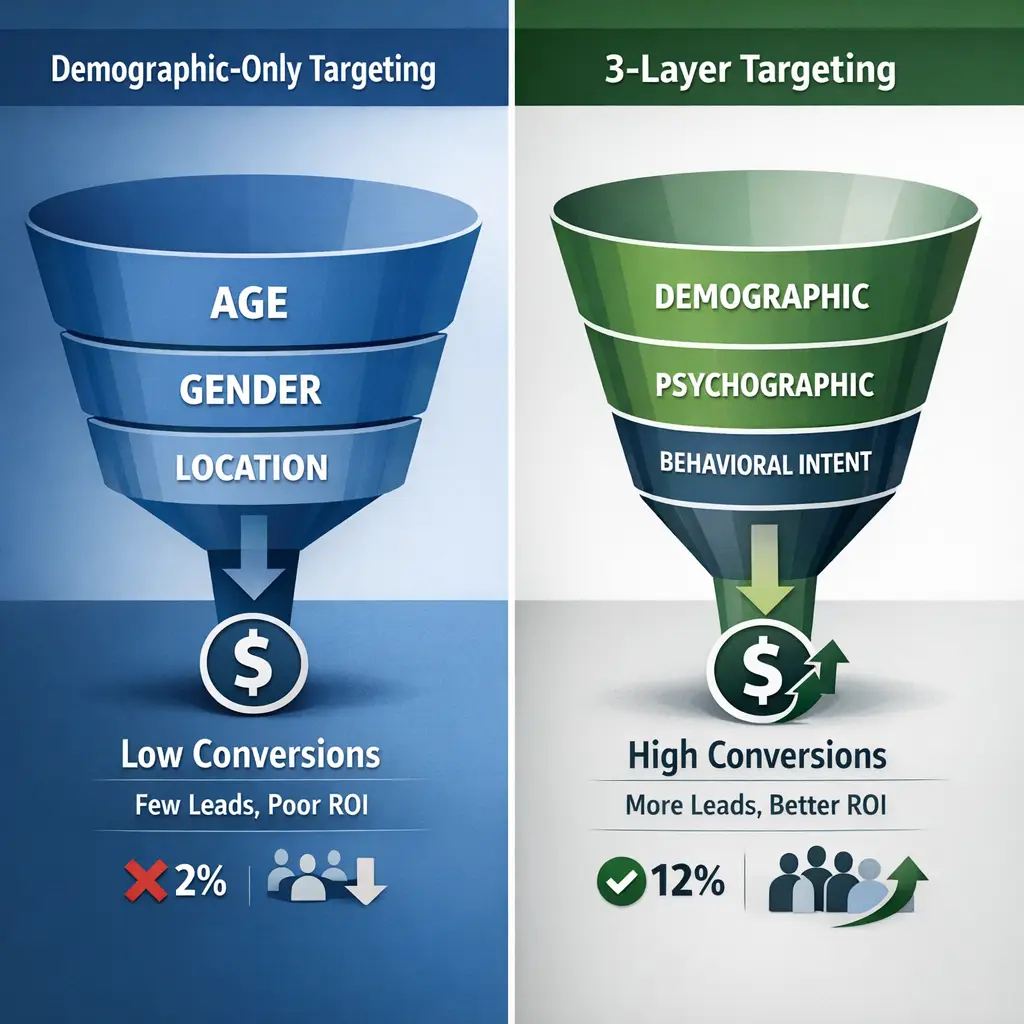
Audience Intelligence Beyond Demographics: The 3-Layer Targeting Model
Demographic targeting — age, gender, location, income bracket — is table stakes. It tells you who your audience is. It tells you almost nothing about why someone would choose your business today versus a competitor, or whether they are actively in the market for what you offer.
Small businesses that treat demographic data as their targeting ceiling consistently underperform against businesses that layer behavioral and psychographic intelligence on top of demographics.
Understanding the 3 Targeting Layers
Layer 1 — Demographic (Who They Are)
This is the foundational layer: age range, gender, geographic location, household income, life stage. Necessary but insufficient on its own. A plumbing company in Dallas can identify homeowners aged 35–65 in their service area. That’s hundreds of thousands of people. Most of them don’t need a plumber today.
Layer 2 — Psychographic (What They Value and How They Think)
Psychographic data captures attitudes, values, lifestyle factors, and decision-making drivers. For the plumbing company, psychographic refinement might target homeowners who value reliability over price, who have engaged with home improvement content, and who respond positively to transparency and reviews. This layer dramatically narrows the audience to people who are more likely to convert when reached.
Layer 3 — Behavioral Intent (What They Are Actively Doing Right Now)
This is the most valuable and most underutilized layer for small businesses. Behavioral intent signals include: recently engaging with competitor content, actively searching for category-related solutions, visiting specific types of websites, or interacting with content at a specific stage of a purchase journey.
| Targeting Layer | What It Identifies | Practical Application | Conversion Potential |
|---|---|---|---|
| Demographic | Who the person is | Platform audience settings: age, location, gender | Low — broad reach, low purchase specificity |
| Psychographic | What the person values and cares about | Interest targeting, content alignment, messaging tone | Medium — resonant messaging, still broad timing |
| Behavioral Intent | What the person is actively doing or researching | Retargeting, custom audience matching, lookalike modeling | High — right person, right moment |
For a local yoga studio, the demographic target might be women aged 25–45 within a 10-mile radius. But the behavioral intent layer targets women in that demographic who are actively engaging with stress management content, following wellness accounts, and visiting competitor studio pages. That’s a fundamentally different audience — and a far more efficient use of any paid social budget.
The operational implication: build your content and targeting strategy around behavioral intent signals from the beginning, not as an afterthought. This is what the most effective small business social campaigns do differently.
The Content Repurposing Architecture: How Small Teams Compete With Big Marketing Departments
One of the most repeated pieces of advice in social media marketing is “post consistently.” What almost nobody tells you is that posting consistently with a small team — while maintaining quality — is only sustainable if you have a systematic approach to content creation and repurposing.
Without a repurposing system, small businesses fall into content debt: the accumulating pressure to produce fresh content across multiple platforms leads to declining quality, creative burnout, and eventually inconsistent posting — the exact outcome the advice was meant to prevent.
The Content Repurposing Waterfall
The solution is a single-source content architecture where one substantial piece of content generates multiple platform-specific assets:
Tier 1 — Long-Form Anchor Content (Created Once)
– A 1,000–1,500 word blog post answering a specific customer question
– A 5–10 minute educational video addressing a common industry problem
– An in-depth case study documenting a client result
Tier 2 — Medium-Format Derivatives (Extracted from Tier 1)
– A LinkedIn article adapting the blog post’s core argument
– 3–4 short-form video clips extracted from the long-form video
– An email newsletter summarizing the blog post’s key takeaways
Tier 3 — Micro-Format Assets (Extracted from Tier 2)
– Instagram or Facebook carousel slides pulling the key points from the article
– Quote graphics designed from a strong line in the LinkedIn post
– A TikTok or Reel using one 60-second clip from the longer video
This waterfall approach means one well-researched piece of content can fuel two to three weeks of consistent posting across multiple platforms — without creating anything new after the initial investment. This is how small marketing teams produce volume without sacrificing quality or experiencing burnout. For a deeper look at how a structured content marketing strategy for small businesses supports this kind of system, that article covers the broader planning framework in detail.
Measuring What Actually Matters: Replacing Vanity Metrics With Operational Intelligence
Follower count. Total impressions. Post likes. These numbers are easy to report, easy to compare, and almost entirely useless as indicators of business growth.
An account with 500 highly engaged followers who consistently click through to your website, sign up for your email list, and request consultations is worth exponentially more to your business than an account with 15,000 passive followers who scroll past your content without taking any action.
The metrics framework for a results-driven small business social media strategy should be built around business outcomes, not platform-native vanity signals:
Primary Business Outcome Metrics (Measure These First)
- Lead volume from social — direct inquiries, form submissions, or calls attributable to social media traffic
- Website sessions from social channels — tracked via platform analytics and verified in Google Analytics or equivalent
- Email list growth rate — new subscribers attributed to social media-driven traffic or sign-up promotions
- Conversion rate from social traffic — what percentage of social visitors take a desired action on your website
Secondary Engagement Quality Metrics (Measure These to Optimize Content)
- Save rate — saves divided by reach; indicates content utility
- Share rate — shares divided by reach; indicates content relevance and audience advocacy
- Comment-to-impression ratio — substantive comments relative to total reach; indicates content depth and resonance
- Link-in-bio click-through rate — indicates whether content is successfully driving off-platform intent
Metrics to Deprioritize
- Total follower count (a lagging, gameable indicator)
- Total impressions (reach without action has no commercial value)
- Like count (passive, low-cost signal with minimal algorithmic or commercial weight)
Establishing this measurement framework from the start of any social media strategy ensures that every decision — what to post, when to post, what to amplify with paid spend — is grounded in data that connects back to real business outcomes. That’s the foundation of a strategy built to grow your business, not just your profile. If improving how your website converts that incoming social traffic is a parallel priority, the article on conversion rate optimisation addresses exactly that problem.
Strategic Recommendations for 2026
As social media platforms continue to evolve their algorithms, ad ecosystems, and creator tools, small businesses that invest now in the right infrastructure will compound their advantage over competitors still chasing follower counts. Here are three specific recommendations to position your social media strategy for stronger results in 2026:
1. Adopt an AI-Assisted Content Planning Tool
Platforms like Buffer, Publer, or Metricool now incorporate AI-driven content scheduling, optimal posting time analysis, and performance forecasting. Rather than guessing when and what to publish, these tools analyze your historical engagement data and surface actionable recommendations. For small business owners managing social media alongside every other operational responsibility, this layer of intelligent automation is no longer a luxury — it’s a practical necessity for consistency.
2. Build a Short-Form Video System, Not Just a Habit
Reels, TikToks, and YouTube Shorts will continue to receive preferential algorithmic distribution through 2026 and beyond. The businesses that win in this format aren’t necessarily the most creative — they’re the most systematic. Invest in a repeatable production process: a defined set of video formats that work for your niche, a simple filming setup, and a basic editing workflow using tools like CapCut or Adobe Express. Batch-produce content in single sessions and schedule in advance. Treat short-form video like a manufacturing process, not an improvised creative act.
3. Integrate Social Media with Your Email List Strategy
The most resilient small business marketing systems in 2026 will treat social media as a top-of-funnel engine that feeds owned channels — primarily email. Use lead magnets, gated resources, and social-exclusive offers to convert engaged followers into email subscribers. Platforms like Mailchimp, Kit (formerly ConvertKit), and Klaviyo integrate cleanly with social traffic flows and allow you to build audience segments based on how subscribers originally discovered your business. Social platforms change their algorithms. They change their terms. They get acquired. Your email list does not.
Frequently Asked Questions
How much time should a small business owner realistically spend on social media marketing each week?
Most small business owners can build a consistent, results-oriented social media presence in five to ten hours per week when they have a clear strategy, a defined content system, and the right scheduling tools in place. The key is working from a content plan rather than creating reactively. Batching content creation — writing captions, filming short videos, and designing graphics in dedicated blocks rather than daily — significantly reduces the time burden while improving overall consistency and quality.
Which social media platform should a small business focus on first?
The right platform is determined by where your specific target audience already spends their time, not by which platform is currently trending in marketing headlines. A B2B service business serving other local companies will typically find more traction on LinkedIn and Facebook. A visually-driven retail or hospitality business may see stronger returns from Instagram and TikTok. Start with one or two platforms where you can show up consistently and serve your audience well, then expand only after you have a repeatable content system in place.
How long does it take to see real business results from social media marketing?
Organic social media is a compounding strategy, not an immediate one. Most small businesses with a focused, consistent approach begin to see measurable improvements in website traffic and lead quality within three to six months. Meaningful revenue-attributable results often take six to twelve months of sustained effort to fully materialize. Paid social campaigns can accelerate this timeline, but they work best when paired with strong organic foundations — clear messaging, proven content, and an optimized destination for traffic.
What is the biggest mistake small businesses make with social media marketing?
The most common and costly mistake is treating social media as a broadcast channel for promotional announcements rather than a relationship-building platform. Audiences on social media are not waiting to be sold to — they are looking for content that educates, entertains, or solves a problem they already have. Small businesses that lead with value, speak in a consistent and human voice, and engage genuinely with their followers will consistently outperform accounts that post only product announcements and sales offers, regardless of follower count or paid spend.
Conclusion
A well-executed social media marketing strategy can be one of the highest-leverage growth tools available to a small business — but only when it’s built on clear goals, the right platforms, and measurement systems tied to actual business outcomes. If you’re ready to stop guessing and start growing, Mongoose Digital Marketing’s social media marketing and digital marketing strategy services are built specifically to help local businesses turn online presence into real-world results. Contact Mongoose Digital Marketing today to start the conversation.