

Why Most Businesses Choose the Wrong Chat Platform — And How to Get It Right
Every week, another business owner signs up for a team chat platform, runs it for six months, and quietly concludes that it hasn’t changed much. The channels are cluttered, notifications are ignored, and half the team still communicates through email threads and text messages. The platform gets blamed. The real problem, almost always, was the decision-making process that led to it.
The standard advice — read a comparison article, pick the tool with the best feature list, sign up — is structurally flawed. It treats platform selection as a product purchase when it is actually an organizational design decision. The tool you choose shapes how information flows, how quickly decisions get made, and whether your team operates as a coordinated unit or a collection of siloed individuals. Get that decision wrong and no feature set in the world will compensate for it.
This guide takes a different approach. Rather than ranking tools by feature checklists, it builds the strategic framework you need before you evaluate a single platform — covering the organizational questions vendors don’t ask, the failure modes comparison articles never mention, and the governance practices that separate teams who genuinely benefit from these platforms from the ones who eventually abandon them.
The Problem With How Businesses Currently Evaluate Chat Platforms
The typical evaluation process goes something like this: a manager Googles “best business chat platforms,” reads two or three listicles, eliminates tools that are outside budget, and selects whichever name appears most frequently. This process optimizes for familiarity, not fit.
What gets missed in that approach are the decisions that actually determine outcomes.
Feature Parity Is Real — And It Makes Feature Comparison Almost Pointless
Here is something the comparison articles won’t tell you: at the enterprise and mid-market level, the major business chat platforms have reached near-feature parity on every dimension that matters for the average team. Messaging, file sharing, video calls, search, integrations with productivity tools, mobile apps, admin controls — all of the headline features exist across all of the leading platforms. Choosing based on feature checklists is like choosing a commercial kitchen based on whether it has ovens.
The meaningful differences between platforms are architectural and cultural. They live in how the tool structures information, what communication behavior it rewards, and how it scales as your organization grows. Those are the variables worth examining.
The Comparison Article Blind Spot: Adoption Failure
There is an inconvenient reality that every vendor comparison article skips entirely: platform adoption regularly fails not because of feature gaps, but because of change management neglect.
Research from organizational behavior practitioners consistently shows that technology rollouts stall when the implementation is treated as an IT project rather than a people project. Employees revert to familiar tools — email, WhatsApp, iMessage threads — when a new platform doesn’t map clearly onto their existing workflows or when they weren’t consulted in the selection process. This creates a shadow IT problem: unofficial communication tools proliferate alongside the official one, fracturing institutional knowledge and creating serious data governance and compliance exposure.
The question is never just “which platform has the best features?” It is “which platform will our specific team actually adopt, sustain, and benefit from?” Those are categorically different questions.
The Organizational Diagnostic You Need Before Evaluating Any Tool
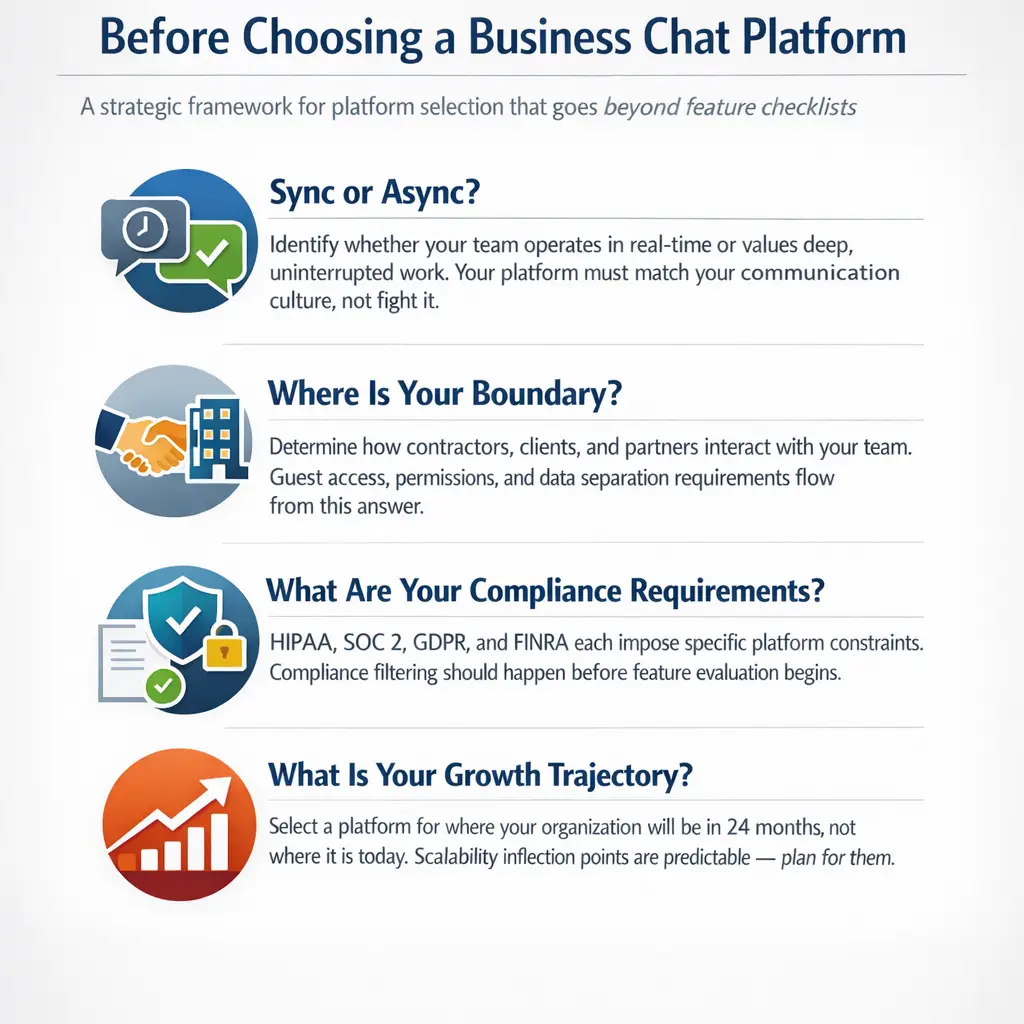
Before you open a single vendor’s website, answer these questions honestly about your organization. Your answers will eliminate most of the market immediately and point you toward the platforms architecturally suited to your actual operating context.
Question 1: Are You Synchronous, Asynchronous, or Hybrid?
This is the single most important dimension in platform selection, and it is almost universally ignored.
A synchronous-dominant organization is one where real-time communication is the norm — customer support centers, trading floors, sales teams working active pipelines, agencies managing live client campaigns. For these teams, instant visibility and rapid response are operational requirements, not preferences. Platforms that deprioritize real-time presence indicators, read receipts, or immediate notification delivery create friction that directly costs revenue.
An async-dominant organization operates where deep, uninterrupted work is the primary output — distributed engineering teams, research teams, creative teams, consultancies with members across multiple time zones. These organizations are actively harmed by platforms that create an implicit expectation of immediate response. The right tool for them respects cognitive load, surfaces threaded conversations clearly, and reduces the pressure of the always-on notification stream.
A hybrid organization — which describes most businesses — has pockets of both. A marketing team may need real-time coordination during a campaign launch while the same company’s product development team needs async-first workflows. The platform you choose must accommodate this internal diversity without forcing false uniformity.
The diagnostic failure most businesses make is choosing a platform based on the loudest internal voice rather than the actual aggregate communication culture of the organization. A single executive who prefers instant messaging can inadvertently impose a synchronous tool on a team that would perform better in a structured async environment.
Question 2: Where Is the Internal/External Communication Boundary?
Every organization has a line between internal team communication and external-facing communication — but that line is rarely as clean as it appears. Guest access, contractor inclusion, client-facing channels, and partner collaboration all blur this boundary in ways that create real governance complexity.
Ask yourself:
– Do you regularly collaborate with external contractors or freelancers who need channel access?
– Do you have clients or partners who benefit from a shared communication space?
– Do you need to separate what those external parties can see from what they cannot?
The answer determines how seriously you need to evaluate guest access controls, permission hierarchy structures, and data retention policies for external conversations. A platform that handles internal team communication adequately may be completely inadequate once you factor in the external communication layer.
Question 3: What Is Your Compliance Exposure?
Security is mentioned in virtually every platform comparison article. It is almost never operationalized.
“Enterprise-grade security” and “end-to-end encryption” are marketing phrases. What matters is whether the specific compliance requirements of your industry map onto the actual security architecture of the platform you are considering. The following compliance scenarios materially constrain your platform options:
- HIPAA (Healthcare): Requires a Business Associate Agreement from the vendor, specific data access controls, audit logging, and strict limitations on where protected health information can be stored or transmitted. Not every major platform can execute a BAA, and those that do may restrict functionality to maintain compliance.
- SOC 2 Type II (Professional Services, SaaS): Requires demonstrated controls around security, availability, and confidentiality. The platform itself may hold SOC 2 certification, but your use of it must also be configured to meet these controls.
- GDPR (European Data Subjects): Data residency matters. If your team or clients include EU residents, where your chat platform stores message data is a legal question, not just a preference.
- FINRA / SEC (Financial Services): Requires archivable, auditable communication records. Some platforms make this straightforward; others make it prohibitively complex.
If your business operates in any of these regulatory environments, compliance requirements should filter your platform shortlist before any feature evaluation begins. A tool that doesn’t meet your regulatory baseline is not a tool — it is a liability.
Question 4: What Does Your Scalability Trajectory Look Like?
Platform selection decisions have a lifecycle. A tool that works well at 15 employees may become a constraint at 150. The structural characteristics that make a platform feel lightweight and easy at small scale — flat channel organization, minimal admin overhead, simple permissions — often become the exact pain points that emerge at larger scale.
Scalability inflection points are predictable if you plan for them:
- 15–30 employees: Flat channel structure works. Everyone knows everyone. Search functions rarely, conversations are findable.
- 50–100 employees: Channel sprawl begins. Department boundaries emerge. Permissions and guest access become operational concerns.
- 150+ employees: Cross-team discoverability degrades. Notification fatigue sets in. Channel governance becomes a dedicated management function, not an afterthought.
If your growth trajectory will take you past any of these thresholds in the next 24 months, select a platform whose administrative infrastructure can handle where you’re going — not just where you are.
The Three Failure Modes Nobody Warns You About
Most businesses that struggle with chat platforms aren’t struggling because they chose the wrong tool. They’re struggling because they walked into one of three predictable, entirely avoidable failure modes.
Failure Mode 1: Channel Entropy
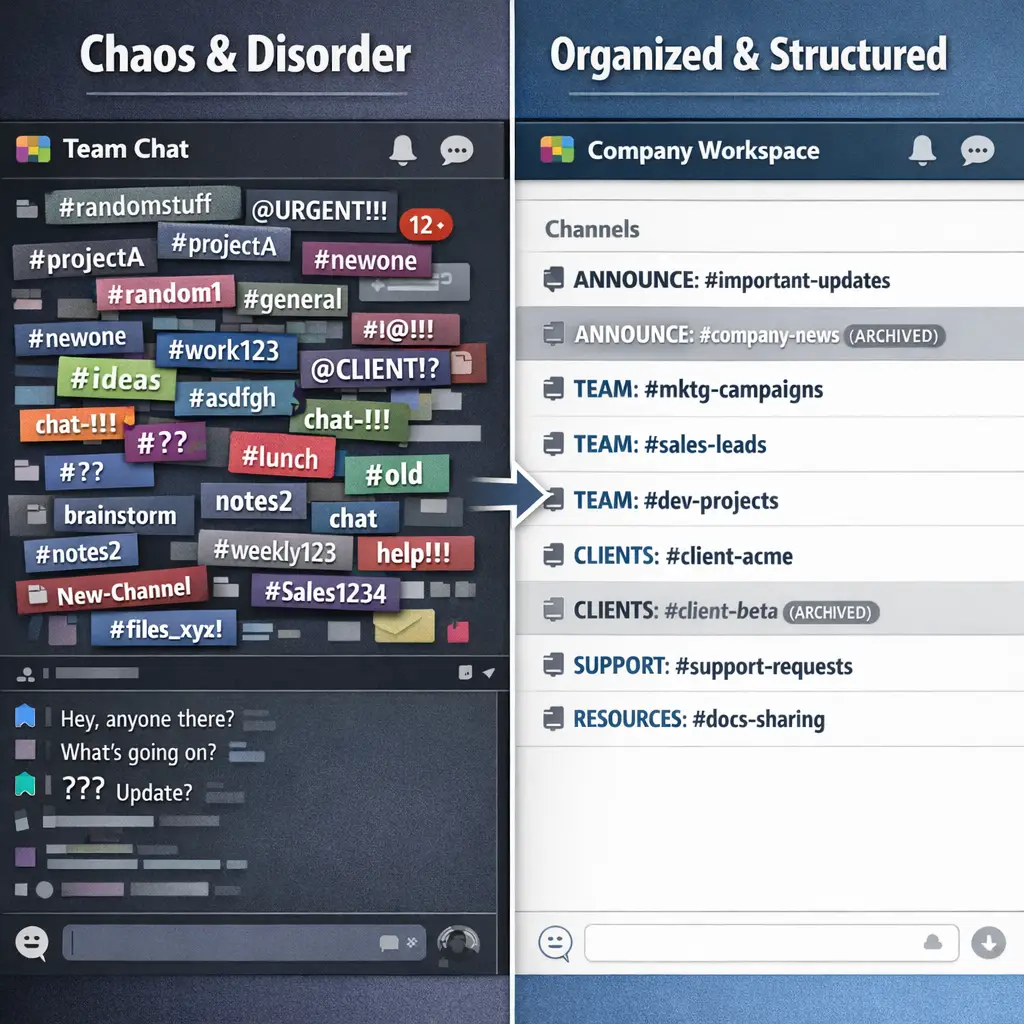
Channel entropy is what happens when team members create channels freely, without governance, over 12 to 18 months of platform use. It is one of the primary reasons enterprise chat platforms degrade over time, and it is almost never discussed in platform comparison content.
Here is how it unfolds: The platform launches with clean, organized channels. Over time, project-specific channels are created and never archived. Teams create parallel channels for the same purpose. Naming conventions drift. Some channels have three members; others have 200. Search returns dozens of results for any given topic. Employees stop trusting the platform’s findability and revert to direct messages, creating information silos that defeat the entire purpose of a shared workspace.
The solution is not a better platform — it is a channel governance policy implemented before entropy sets in. A functional governance framework includes:
- Naming taxonomy: Standardized prefixes that identify channel type at a glance (e.g.,
team-,proj-,client-,announce-) - Lifecycle stages: Defined transitions from active to archived, with clear criteria for when archiving is triggered
- Ownership assignments: Every channel has a named owner responsible for its health and relevance
- Archiving protocols: A regular cadence (quarterly works for most organizations) for reviewing and sunsetting dormant channels
- Creation governance: A defined process — even if simple — for approving new channels rather than allowing unrestricted creation
This is operational expertise, not feature knowledge. No vendor will sell you this framework because it is not a product.
Failure Mode 2: Integration Debt
Integration debt is a concept that every business evaluating a chat platform needs to understand before they finalize a decision.
Every major platform advertises integrations as a pure benefit. Connect your CRM, your project management tool, your support ticketing system, your version control platform — and watch your workflow come together inside a single interface. This is genuinely valuable. It is also, over time, a structural risk.
Here is the mechanism: each workflow you build natively inside a chat platform creates a dependency. A Salesforce alert that routes to a specific channel, a GitHub notification that triggers a review workflow, a Jira ticket creation that fires from a chat command — each of these feels like an efficiency gain in the short term. Cumulatively, they bind your operational processes to a specific platform in ways that make switching exponentially more expensive than the standalone value of the tool would suggest.
Additionally, third-party integrations are deprecated without notice with surprising frequency. A workflow your team depends on may stop functioning because a vendor relationship changed, an API was versioned out, or a marketplace partner went out of business. When that happens inside a deeply integrated chat environment, the blast radius is significant.
Before committing to a platform, conduct an integration dependency audit:
| Integration Category | Business-Critical? | Native or Third-Party? | Deprecation Risk | Switching Cost If Removed |
|---|---|---|---|---|
| CRM Notifications | Yes | Third-party connector | Medium | High — manual workflow required |
| Project Management Sync | Yes | Native API | Low | Medium — rebuild in new platform |
| Support Ticket Routing | Yes | Third-party connector | High | High — core ops dependency |
| Calendar Integrations | No | Native | Low | Low — standalone tool available |
| HR System Alerts | No | Third-party | Medium | Low — email fallback viable |
Map your planned integrations against this framework before you build them. Understand which are business-critical, which carry meaningful deprecation risk, and what your fallback position is if a given integration disappears. This is how experienced organizations avoid becoming hostage to a platform they outgrew or that no longer serves their needs.
Failure Mode 3: The Shadow IT Spiral
When an official platform fails to meet employee needs — whether because it was poorly selected, poorly implemented, or poorly governed — employees solve the problem themselves. WhatsApp groups form for field teams. Discord servers emerge for engineering squads. iMessage threads handle client communication because they’re faster.
This shadow IT proliferation is not a discipline problem — it is a signal. It tells you exactly where the official platform is failing and exactly where institutional knowledge is leaking outside of any system your organization controls.
The risks are real: sensitive business discussions happening in personal messaging apps with no retention policy, no audit trail, and no organizational ownership. Client communication occurring in channels that disappear when an employee leaves. Project context living in a Discord server that no one will remember to archive.
The way to prevent this is to select a platform that genuinely serves the workflows of your actual teams — particularly frontline employees, field workers, and deskless workers who are most frequently underserved by platforms selected by office-based managers. These employees are the most likely to defect to unauthorized tools, and they are often the employees handling the most operationally sensitive communication.
Platform Architecture: The Dimensions That Actually Matter
Once you have completed the organizational diagnostic and identified your primary failure mode risks, platform evaluation becomes significantly more focused. Rather than comparing feature lists, you are comparing architectural decisions.
Topic-Based vs. Team-Based Channel Architecture
The structural choice between organizing channels around topics (e.g., #marketing, #product, #support) versus teams (e.g., #team-east-coast, #team-engineering-pod-3) has long-term organizational implications that most businesses never consider at selection time.
Topic-based architecture works well for smaller organizations where cross-functional visibility is a priority. Information stays centralized. Everyone who cares about a subject can find it. The weakness is that at scale, topic channels become high-noise environments where relevant information drowns in volume.
Team-based architecture works well for larger organizations with distinct functional units. Communication stays contextually relevant. The weakness is reduced cross-functional visibility — teams can become information islands, and organization-wide knowledge sharing requires deliberate effort.
Most platforms support both structures. The point is to choose intentionally, document the decision, and build your channel taxonomy around it from day one rather than letting structure emerge organically.
Presence and Availability Signaling
Different platforms take fundamentally different philosophical positions on presence. Some platforms aggressively surface online/offline status, read receipts, and typing indicators. Others treat availability as private by default.
This is not a trivial distinction. Platforms that emphasize presence signaling create an implicit cultural expectation of immediate availability that has measurable consequences for deep work, focus time, and employee burnout — particularly in distributed and remote teams.
For synchronous-dominant organizations, strong presence signaling is an asset. For async-dominant or hybrid organizations, it can be corrosive. Match the platform’s presence philosophy to your communication culture, not the other way around.
Search Architecture and Knowledge Persistence
One of the underappreciated strategic values of a business chat platform is its potential function as an organizational knowledge repository. Decisions made, context shared, and problems solved inside a chat platform can become permanently searchable institutional knowledge — or they can vanish into a search experience so poor that no one trusts it.
Evaluate search functionality not as a convenience feature but as a knowledge management capability. Ask specifically:
- How far back does search index by default?
- Are message threads fully searchable, or only top-level messages?
- Are file attachments indexed alongside their associated conversations?
- What happens to search access when a channel is archived?
These questions determine whether your chat platform becomes a genuine knowledge asset over time or an ephemeral communication layer with no lasting organizational value.
Making the Platform Work: The Change Management Layer
Selecting the right platform is the beginning of the work, not the end of it. The implementation phase — specifically, how you drive adoption across your team — determines whether the investment pays off.
The Rollout Sequence That Minimizes Resistance
Successful platform implementations follow a consistent pattern. The organizations that fail typically invert this sequence.
Step 1 — Involve before you decide. The teams who will use the platform daily should have input into the selection decision. This is not about reaching consensus on features. It is about creating psychological ownership. People adopt tools they helped choose.
Step 2 — Pilot with your highest-adoption team first. Select the team most likely to champion the platform — typically tech-comfortable, already frustrated with existing communication tools, and influential within the organization. Their visible success creates internal momentum.
Step 3 — Build the governance framework before you open the doors. Channel taxonomy, naming conventions, lifecycle policies, and ownership assignments should exist before general rollout. Retrofitting governance onto a platform with six months of organic chaos is significantly harder than implementing it on day one.
Step 4 — Create role-specific onboarding, not generic training. A customer support agent and a product manager use a chat platform in fundamentally different ways. Training that treats both roles identically produces low adoption in both. Map the platform workflows to specific job functions.
Step 5 — Establish a sunset timeline for legacy tools. The most common adoption killer is running the new platform in parallel with email, text, and other communication channels indefinitely. Employees will default to the familiar tool. Set a clear, communicated timeline for deprecating legacy communication channels, and hold to it.
How This Connects to Your Broader Digital Strategy
A business chat platform does not exist in isolation. The way your team communicates internally has direct consequences for how efficiently you execute marketing campaigns, respond to customer inquiries, manage agency relationships, and act on the data your digital marketing partner surfaces for you.
When your internal communication infrastructure is functioning — information flowing cleanly, decisions made quickly, no channel entropy degrading findability — your organization can move at the speed that competitive digital markets require. When it isn’t, even the best-executed external strategy runs into an internal execution bottleneck.
For businesses working with a digital marketing partner like Mongoose Digital Marketing, clear internal communication infrastructure also means faster campaign approvals, more responsive feedback loops, and tighter alignment between your team’s priorities and the work being done on your behalf. The operational value of getting this decision right compounds across every external initiative you run. If you’re evaluating how your internal operations connect to your external marketing execution, our digital marketing strategy for service businesses article explores how those two layers need to work together.
The businesses that grow online fastest are the ones that operate with internal clarity. That starts with communication infrastructure — and it starts with making the platform decision correctly the first time.
Final Strategic Recommendations for 2026
The platform landscape is shifting, and the decisions businesses make in the next twelve months will define their communication infrastructure for the better part of the decade. Three specific recommendations stand out for organizations that want to position themselves well heading into 2026.
1. Standardize on a platform with native AI summarization. Conversation volume inside business chat platforms has grown to the point where unassisted search and manual review are no longer practical at scale. Tools like Slack and Microsoft Teams are both rolling AI-assisted thread summarization and action-item extraction into their core feature sets. Evaluate whether the platform you select — or currently use — has this capability built in rather than bolted on through a third-party integration.
2. Audit your channel structure before adding users. Growth without governance accelerates entropy. Before expanding your platform to new teams or departments in 2026, run a structured channel audit: identify dormant channels, consolidate overlapping workspaces, and document naming conventions. The organizations that scale cleanly are the ones that did this work before they needed to, not after.
3. Integrate your chat platform directly with your project management and CRM tools. Standalone communication is a diminishing value proposition. The platforms gaining adoption in competitive businesses are the ones embedded in workflows — where a message thread can generate a task, update a contact record, or trigger a campaign approval without leaving the interface. If you’re also looking to turn those tighter workflows into measurable pipeline results, the article on SEO for lead generation in 2026 is worth reviewing alongside your platform strategy. Prioritize integrations with the tools your team already relies on daily.
Frequently Asked Questions
What is the best social media chat platform for small businesses in 2026?
There is no single answer that fits every organization, but small businesses generally benefit most from platforms that combine ease of setup with strong mobile functionality. Slack and Microsoft Teams are the most widely adopted options at scale, while Google Chat works well for teams already embedded in the Google Workspace ecosystem. The right platform depends on your existing tool stack, team size, and the specific workflows you need to support. For businesses also thinking about how chat and social media overlap as lead generation tools, the social media chat lead generation guide covers how these channels can work together.
How is a business chat platform different from a regular messaging app?
Consumer messaging apps are designed for personal, informal communication with limited administrative control. Business chat platforms are built around organizational structure — they include user management, searchable message history, permission controls, compliance archiving, and integrations with business software like CRMs, project management tools, and marketing platforms. The difference matters most when you need accountability, findability, and scalability across a growing team.
How long does it typically take to fully implement a business chat platform?
A basic deployment can be operational within days. A complete implementation — including channel architecture, integrations, role-specific training, and a full transition away from legacy tools — typically takes between four and twelve weeks depending on team size and organizational complexity. Businesses that rush the implementation without establishing governance structures tend to re-do the work within a year.
Can a business chat platform improve how we work with an outside digital marketing agency?
Yes, and meaningfully so. Many digital marketing agencies, including those running ongoing SEO, paid media, or content campaigns, communicate more effectively with clients through shared channels in platforms like Slack than through email chains. Shared workspaces allow for faster campaign approvals, real-time feedback, and cleaner documentation of decisions — all of which reduce turnaround time and improve the quality of work delivered.
Conclusion
Getting your internal communication infrastructure right is foundational to everything else your business does online — including the results you see from search engine optimization and paid digital advertising. At Mongoose Digital Marketing, we work alongside businesses to ensure that the strategic and execution layers of their digital presence are aligned and moving in the same direction. If you’re ready to strengthen your digital foundation and want a team that understands how operations and marketing connect, Contact Mongoose Digital Marketing to start the conversation.