
What PPC Advertising Management Services Actually Involve (And Why Most Accounts Underperform Without Them)
Pay-per-click advertising is one of the fastest ways to put your business in front of people actively searching for what you sell. But there’s a significant distance between running PPC ads and managing a PPC account with the discipline and strategic depth that actually produces consistent returns. Most business owners discover that gap the hard way — after months of ad spend that generated clicks without conversions, or campaigns that worked briefly before quietly degrading.
This article is written for business owners who want to understand what professional PPC advertising management services genuinely involve, how to evaluate whether their current campaigns are being managed properly, and what separates a high-performing managed account from one that’s essentially on autopilot. We’ll go well beyond the basics of “bid on keywords, track conversions” — because that level of advice doesn’t reflect how modern paid search actually operates.
The Difference Between Setting Up a Campaign and Managing One
The most common misconception about PPC is that it’s primarily a setup task. Build the campaign structure, load in the keywords, write the ad copy, set a budget, and let it run. This framing treats paid search as a one-time project rather than an ongoing operational discipline — and it’s why so many business owners are disappointed with their results even after hiring someone to “set up their Google Ads.”
Professional PPC advertising management services are defined by what happens after launch. Setup is table stakes. Management is the work.
Here’s the distinction in practical terms:
| Activity | Campaign Setup | Ongoing PPC Management |
|---|---|---|
| Keyword research | Initial list built at launch | Continuously refined; search term reports reviewed weekly |
| Negative keywords | Basic exclusions added at setup | Layered exclusion architecture maintained and expanded monthly |
| Bid strategy | Selected at launch | Actively monitored, constrained, and adjusted based on conversion signal quality |
| Ad copy | Initial ads created | Systematic testing cadence; RSA asset performance analyzed and rotated |
| Audience targeting | Basic audience segments loaded | Refined based on observed performance data; first-party lists integrated |
| Conversion tracking | Tracking code installed | Attribution integrity audited; cross-source validation against CRM and revenue data |
| Landing pages | Initial pages designated | Tested, iterated, and aligned with search intent at the query level |
| Competitor landscape | Not addressed | Monitored; bid adjustments and positioning strategy updated accordingly |
| Performance review | At client’s request | Structured weekly, monthly, and quarterly diagnostic cadence |
The right column is what you’re paying for when you engage a professional PPC management service. If your current provider is primarily doing the left column, your account is being maintained, not managed.
How Modern PPC Management Works in an Automated Bidding Environment
The conversation around PPC has shifted dramatically in recent years as Google’s automation tools — Smart Bidding, Performance Max, broad match expansion — have taken on an increasingly large role in how ads are served. A common oversimplification you’ll encounter is that automation makes PPC management easier or less hands-on. In practice, the opposite is true.
Why Automation Requires More Strategic Oversight, Not Less
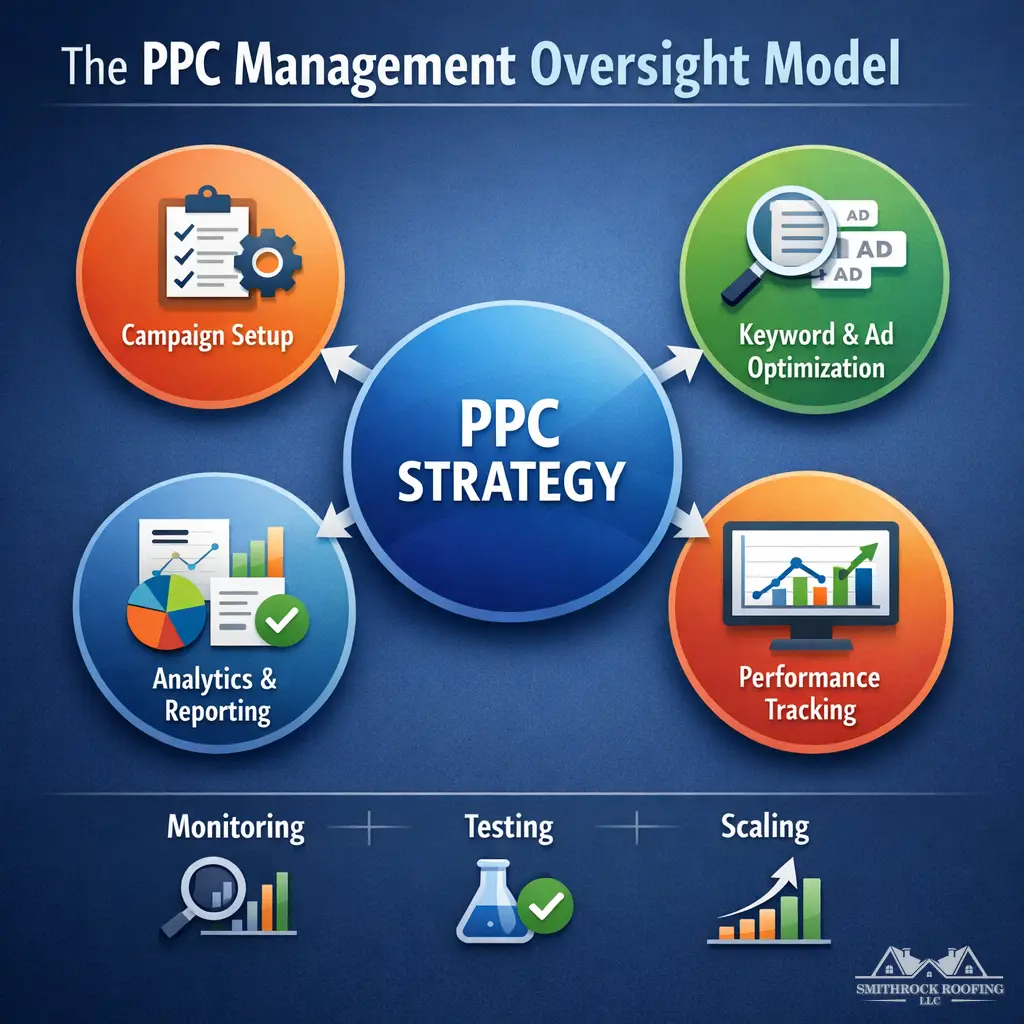
Smart Bidding strategies — Target ROAS, Target CPA, Maximize Conversions — are genuinely powerful tools when they’re given the right inputs. But they optimize toward whatever conversion signals you’ve defined in your account. If those signals are misconfigured, incomplete, or tracking low-value actions, the algorithm will optimize aggressively toward the wrong goal. It won’t tell you it’s doing this. The account will appear to be performing — conversion volume will look healthy — while actual business outcomes stagnate or decline.
This is what we call the automation paradox: the more you lean on machine learning in your PPC account, the more consequential your data infrastructure decisions become. An experienced PPC manager’s highest-leverage work often happens at the conversion signal layer — ensuring the algorithm is learning from genuine revenue-generating events, not form fills that go nowhere or soft engagements that inflate reported conversion counts.
Professional PPC management in this environment involves:
- Conversion signal architecture — defining, auditing, and prioritizing conversion actions so Smart Bidding learns from the right events
- Bid strategy constraint management — setting ROAS targets and CPA caps that balance efficiency with volume, and understanding when to tighten or loosen those constraints based on business cycle
- Performance Max segmentation strategy — because Performance Max campaigns operate with limited transparency, expert managers build deliberate asset group structures, layer audience signals precisely, and implement aggressive placement exclusion frameworks to maintain as much directional control as the platform allows
- Automation override judgment — knowing when campaign performance data indicates the algorithm is optimizing toward a local minimum and human intervention is required
The Performance Max Transparency Challenge
Performance Max deserves specific attention because it represents the most significant management challenge in current paid search. The campaign type consolidates Search, Display, YouTube, Gmail, and Discover placements into a single campaign driven almost entirely by machine learning. The efficiency argument for Performance Max is legitimate. The management challenge is also real.
Expert managers treat Performance Max not as a set-and-forget campaign type, but as a channel that requires deliberate architectural decisions upfront — because those are the primary levers available. Asset group segmentation by product line, audience, or intent stage allows for more meaningful performance analysis. Audience signal quality directly influences how the algorithm targets. And without explicit exclusion management, Performance Max will serve ads across placements that have no relevance to your business goals.
Managing Performance Max well requires accepting limited visibility and compensating with rigorous upstream signal quality and downstream performance analysis.
Why “Completely Measurable” Is More Complicated Than It Sounds
PPC is consistently marketed — including by the ad platforms themselves — as fully measurable. Compared to print advertising or billboards, it is. But professional PPC management requires a more honest accounting of what modern attribution actually tells you, and where it falls short.
The Attribution Accuracy Problem
Most PPC accounts report conversions through a single source: the ad platform. Google Ads reports what Google Ads sees. Microsoft Advertising reports what it sees. Neither has complete visibility into the full customer journey, and several structural factors create meaningful measurement gaps:
Cross-device attribution failures — A user clicks your ad on their phone during a commute. They return to your site three days later on their laptop and complete a purchase. Depending on your tracking configuration, that conversion may be attributed to organic search, direct traffic, or missed entirely. The paid click that initiated the journey gets no credit.
Conversion window mismatches — Google Ads default conversion windows range from 30 to 90 days depending on action type. If your actual sales cycle is longer — common in B2B services, home improvement, or high-consideration purchases — platform-reported conversion data systematically understates paid search’s contribution to revenue.
GA4 attribution model shifts — GA4’s default data-driven attribution model redistributes conversion credit across touchpoints algorithmically. Accounts that previously evaluated performance on last-click attribution will see apparent performance changes after migration that reflect measurement differences, not actual campaign changes.
Audience signal degradation — Privacy changes across Apple’s iOS ecosystem have meaningfully reduced the match rates on remarketing audiences and similar audiences. Accounts that relied heavily on these audience types saw effective reach decline without any corresponding change in campaign settings or reported audience size.
A professional PPC management service cross-references platform data against CRM records, revenue reports, and where possible, incrementality indicators — before making any significant budget allocation or bidding decisions. Accounts managed solely on platform-reported conversions are routinely either over-investing in placements that collect attribution credit without driving incremental revenue, or under-investing in the channels that genuinely initiate demand.
What Proper PPC Reporting Should Actually Show
If your monthly PPC report shows only impressions, clicks, CTR, and Google-reported conversions, you’re seeing a platform summary — not a performance analysis. Professional reporting should include:
- Conversion volume by conversion action — segmented so you can distinguish high-value conversions (phone calls, form submissions from qualified leads, e-commerce transactions) from low-value or miscounted events
- Search term coverage analysis — showing which actual queries triggered your ads and what percentage of spend went to high-intent versus low-relevance queries
- Audience performance breakdown — how different audience segments (remarketing, Customer Match, in-market, demographic) are performing relative to each other, not just in aggregate
- Attribution comparison — platform-reported vs. CRM-matched revenue, with notes on discrepancies
- Competitive position trends — impression share, lost impression share by budget versus rank, and auction insights trends over time
- Account health indicators — Quality Score trends, landing page experience ratings, and ad strength distribution across RSAs
The Account Decay Problem: Why PPC Management Is Never Finished
Here is a reality that rarely appears in PPC content, despite being one of the most important concepts for business owners evaluating management services: PPC accounts decay. Even campaigns that are properly configured and genuinely performing will gradually degrade if they aren’t actively maintained.
This isn’t a flaw in how you’ve managed the account. It’s the nature of the environment. Understanding decay sources is what separates reactive account management from proactive.
Primary Sources of PPC Performance Decay
Search query drift — As Google increasingly defaults to broad match and Smart Bidding drives query expansion, accounts gradually accumulate search term coverage that drifts away from high-intent queries. The headline metrics — CTR, average CPC — may not visibly change, but conversion rates slowly erode as a growing percentage of spend goes to queries that were never the target.
Audience fatigue — Remarketing and similar audience campaigns serve ads to a finite pool of users. Without active audience list refresh and creative rotation, the same users see the same ads repeatedly. Response rates decline, CPCs remain consistent (you’re still bidding the same amounts), and ROAS quietly falls.
Competitor bid landscape shifts — Your account doesn’t operate in isolation. Seasonal industries see significant CPC inflation during peak periods as competitors increase budgets. New market entrants raise auction competition. A campaign that maintained a strong position in January may be significantly displaced by March without any change to your own settings.
Ad creative staleness — Responsive Search Ads (RSAs) are evaluated by Google across asset combinations, but CTR fatigue is real. Even strong-performing asset combinations experience degraded click-through rates over time as users develop recognition patterns. Without a systematic creative testing and refresh cadence, RSA performance plateaus and then recedes.
Landing page relevance drift — Website updates, rebranding, pricing changes, or service offering adjustments can create silent mismatches between ad copy and landing page content. These mismatches affect Quality Score, landing page experience ratings, and — most importantly — conversion rates.
The Structured Account Health Calendar
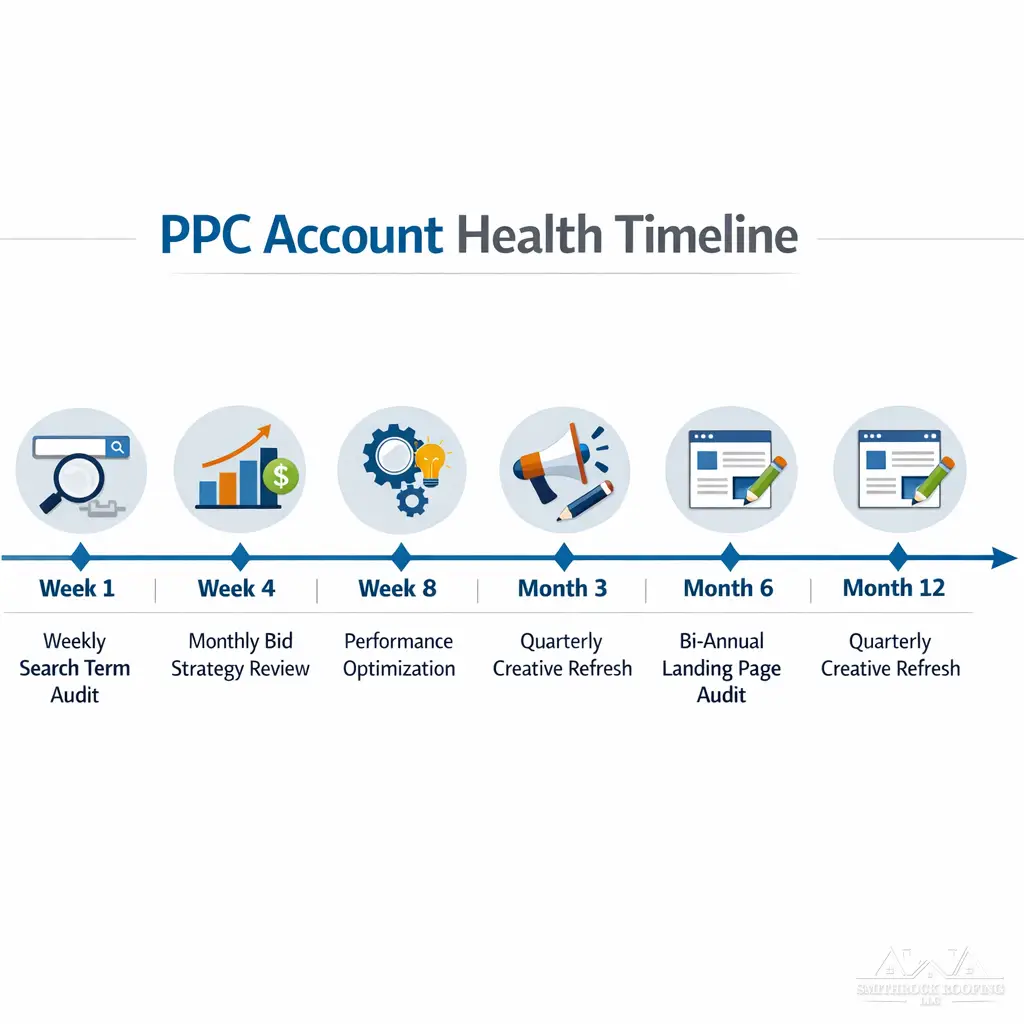
Professional PPC management services operate on a structured review cadence, not a reactive one. Here’s what that framework typically looks like in practice:
Weekly reviews:
– Search term report analysis and negative keyword additions
– Conversion volume check against expected baseline (anomaly detection)
– Budget pacing review and daily budget adjustments
– Bid strategy performance vs. targets
Monthly reviews:
– Ad copy performance analysis; underperforming asset identification and replacement
– Audience list performance comparison; bid adjustment evaluation
– Impression share trends and competitive position analysis
– Landing page conversion rate review against traffic quality
– Quality Score trend monitoring by campaign and ad group
Quarterly reviews:
– Full account structure audit — campaign segmentation, ad group organization, keyword coverage
– Attribution accuracy review — platform data vs. CRM cross-reference
– Creative refresh cycle — new RSA assets, ad copy angles, and messaging tests
– First-party audience list quality check — Customer Match list refresh, CRM sync validation
– Bid strategy reassessment — are current strategies aligned with current business objectives?
This calendar-based management approach is what distinguishes a professional service engagement from a campaign that’s been left to run on Smart Bidding with minimal human oversight.
First-Party Data: The Management Lever Most Accounts Are Ignoring
With third-party cookie deprecation ongoing and audience signal quality continuing to erode from privacy changes, first-party data has moved from a nice-to-have to a foundational management asset. Professional PPC management now involves active first-party data strategy — not as a future consideration, but as a current operational requirement.
What First-Party Data Integration Looks Like in Practice
Customer Match lists — Uploading CRM data (email addresses, phone numbers) to Google Ads allows you to target or bid-adjust for existing customers, high-value prospects, and lapsed customers separately. It also allows you to exclude existing customers from acquisition campaigns, preventing wasted spend on people who’ve already converted.
CRM-sourced audience segments — Syncing CRM data creates audience segments based on real customer behavior and lifecycle stage — something no platform-native audience can replicate. A lead who has visited your pricing page, downloaded a guide, and attended a webinar is categorically different from a cold website visitor. First-party audiences let you bid and message accordingly.
Offline conversion imports — For businesses where the conversion happens offline (a phone call, an in-person sale, a signed contract), importing offline conversion data into Google Ads allows Smart Bidding to optimize toward actual revenue events rather than lead form submissions that may or may not convert downstream.
Enhanced conversions — Google’s enhanced conversions framework uses hashed first-party data from conversion events to improve measurement accuracy in cookieless environments. Implementation requires technical setup and ongoing maintenance, but meaningfully improves conversion attribution accuracy.
Without these integrations, PPC accounts increasingly operate on degraded data — and the gap between accounts that have invested in first-party data infrastructure and those that haven’t will only widen. This is one reason why a broader data-driven digital marketing strategy must underpin your paid search efforts — PPC performance is only as strong as the measurement and audience infrastructure surrounding it.
What to Look For in a PPC Advertising Management Service
If you’re evaluating PPC management services — or reassessing your current provider — the quality signals worth looking for go well beyond ad spend minimums and basic reporting dashboards.
Questions That Reveal Management Quality
On conversion tracking:
– How are conversion actions defined in our account, and what is the primary conversion action used for Smart Bidding optimization?
– When did you last audit our conversion tracking for accuracy, and how do you validate reported conversions against CRM data?
On strategy and structure:
– How do you approach campaign structure for our account, and how has that evolved since launch?
– How do you manage the tension between Smart Bidding’s need for data consolidation and the need for campaign-level performance visibility?
On reporting:
– What attribution model are you using to evaluate performance, and how does that compare to last-click or data-driven models?
– Can you walk me through a recent instance where you identified account decay or performance degradation and what you did about it?
On first-party data:
– Are we using Customer Match or CRM-sourced audiences in any campaigns? If not, what’s the plan to integrate them?
On proactive management:
– What’s your review cadence for this account, and what specifically do you check at each interval?
A competent PPC management service can answer these questions in specific, grounded terms. Vague answers about “monitoring performance” and “optimizing campaigns” are not management — they’re account maintenance.
Putting It Together: What Professional PPC Management Delivers
PPC advertising management services, done at a professional level, operate across five distinct disciplines simultaneously: data infrastructure, bid strategy oversight, audience development, creative testing, and competitive positioning. None of these disciplines is set-and-forget. All of them require ongoing expert judgment to navigate correctly — particularly in an environment where automation has increased the consequences of getting the foundational decisions wrong.
For business owners in competitive markets, the difference between a managed PPC account and an unmanaged one rarely shows up in the first month. It shows up at month four, six, and twelve — in conversion rate trends, in cost-per-acquisition trends, and in whether your paid search investment is compounding into a sustainable acquisition channel or quietly draining budget without proportionate return.
At Mongoose Digital Marketing, we build and manage PPC accounts with exactly this long-term operational discipline — tailored to your specific audience, your sales cycle, and your revenue goals. If you’re ready to find out what your current account is actually doing (or not doing), start with a free consultation.
Strategic Recommendations for 2026
As PPC advertising continues to evolve under the pressure of AI-driven automation, privacy restrictions, and increasingly sophisticated competitors, the following three priorities should anchor your paid search strategy heading into 2026.
1. Invest in a First-Party Data Infrastructure Before You Need It
Tools like Google’s Enhanced Conversions and Meta’s Conversions API are no longer optional enhancements — they are the foundation of accurate attribution in a post-cookie environment. If your current PPC management setup is still relying on browser-based pixel tracking as its primary data layer, you are already working with degraded signal quality. The next step is integrating your CRM directly into your ad platforms so that audience lists, match rates, and conversion data reflect real customer behavior rather than fragmented browser events. Services like Segment, HubSpot’s ad integrations, or direct API connections between your CRM and Google Ads provide the infrastructure layer that separates high-performing accounts from accounts that merely appear to be performing.
2. Adopt a Structured Creative Testing System Tied to Landing Page Variants
In 2026, the accounts that outperform their categories will not be the ones with the largest budgets — they will be the ones with the most efficient feedback loops between ad creative and post-click experience. Tools like Google Ads’ built-in asset reporting combined with dedicated landing page testing platforms — such as Unbounce or a properly configured Google Optimize successor — allow you to run systematic experiments that produce compound performance improvements over time. The key shift is moving from intuition-based creative decisions to hypothesis-driven tests with defined success metrics before the test begins. Strong landing page performance is also directly tied to broader web design and SEO fundamentals — pages that are technically sound, fast-loading, and built around clear user intent will consistently outperform those that are not.
3. Build Competitive Intelligence Into Your Monthly Management Cadence
Tools like Auction Insights, SEMrush’s advertising research module, and SpyFu provide ongoing visibility into how your competitors are positioning their paid search presence. In competitive verticals, a competitor’s budget expansion, a new landing page angle, or a shift in keyword targeting can directly erode your impression share and conversion volume within weeks. Making competitive analysis a structured monthly deliverable — not a quarterly afterthought — gives your PPC team the context to make proactive adjustments rather than reactive ones.
Frequently Asked Questions
What does a PPC advertising management service actually do on an ongoing basis?
A professional PPC management service handles far more than initial campaign setup. On an ongoing basis, this includes bid strategy oversight, audience segmentation and list maintenance, ad copy testing, Quality Score management, Search Term Report analysis to control irrelevant traffic, conversion tracking audits, and competitive positioning reviews. The ongoing management layer is where the majority of long-term account value is built — not in the launch configuration.
How do I know if my current PPC campaigns are underperforming?
Common indicators of underperformance include a rising cost-per-conversion trend over time, declining impression share in your core keyword categories, low Search Term relevance suggesting wasted spend on irrelevant queries, conversion tracking discrepancies between your ad platform and your CRM or analytics, and an absence of structured A/B testing in your account history. If your current provider cannot point to specific optimization decisions made in the last thirty days with documented rationale, that is itself a signal worth investigating.
What is the difference between Smart Campaigns and professionally managed campaigns?
Smart Campaigns and other automated campaign types consolidate control into Google’s algorithm, which optimizes for broad patterns across large datasets. Professional campaign management structures the account with deliberate segmentation, custom audience layering, negative keyword frameworks, and conversion signals that are specific to your business — then uses automation selectively where it adds value rather than surrendering all decisions to the platform. The difference becomes most visible in competitive markets where generic optimization produces generic results.
How long does it take to see results from PPC management improvements?
Initial improvements in efficiency — such as reduced wasted spend from better negative keyword management — can appear within the first few weeks. Structural improvements tied to bid strategy adjustments, audience development, and creative testing typically compound over three to six months as the account accumulates meaningful data. Sustainable performance gains that reflect true account maturity generally become visible at the six-to-twelve month mark, which is why evaluating a PPC management relationship on the basis of month-one results alone rarely gives an accurate picture.
Conclusion
Managing a paid search account to a professional standard requires the kind of ongoing, structured discipline that goes well beyond campaign setup and routine check-ins. At Mongoose Digital Marketing, our PPC advertising management services and paid search strategy work are built around the specific operational depth your account needs to perform consistently over time — not just in the first few weeks. If you want to understand exactly where your current account stands and what it would take to improve it, Contact Mongoose Digital Marketing for a free consultation.