

What Most Social Media Aggregator Guides Won’t Tell You
There is no shortage of articles explaining what a social media aggregator does. Type the term into any search engine and you’ll find a dozen near-identical guides: connect your accounts, customize the display, embed the widget, watch engagement soar. It reads cleanly, sells the concept well, and leaves out almost everything a business owner actually needs to know before committing.
This guide is different. We’re going to cover the fundamentals — because they matter — but we’re also going to cover the parts that most content in this space deliberately sidesteps: API fragility, copyright exposure, website performance trade-offs, and the operational realities of content moderation at scale. If you’re evaluating whether a social media aggregator belongs in your digital strategy, this is the analysis that will actually inform that decision.
What a Social Media Aggregator Actually Does
A social media aggregator is a platform or tool that pulls content from multiple social networks — Instagram, Facebook, X (formerly Twitter), TikTok, LinkedIn, YouTube, and others — and consolidates it into a single, displayable feed. That feed can be embedded on your website, displayed on a digital screen at a physical location, or used internally for social listening and monitoring.
The mechanism behind this is straightforward: aggregators connect to each platform’s Application Programming Interface (API), request authorized content based on your defined parameters (accounts, hashtags, keywords, or geographic tags), and render that content through a widget or iframe on your chosen destination.
At the surface level, the use cases are genuinely compelling:
- E-commerce brands embedding Instagram product tags and customer photos on product pages to serve as authentic social proof
- Event organizers running live hashtag walls that aggregate real-time attendee posts
- Hospitality brands consolidating guest reviews and travel photos across platforms into a single on-site gallery
- B2B companies centralizing their own multi-platform content output into a unified feed for PR and media pages
What separates a well-implemented aggregator strategy from a liability is understanding the architecture underneath — and the risks that architecture carries.
The API Dependency Problem Nobody Talks About
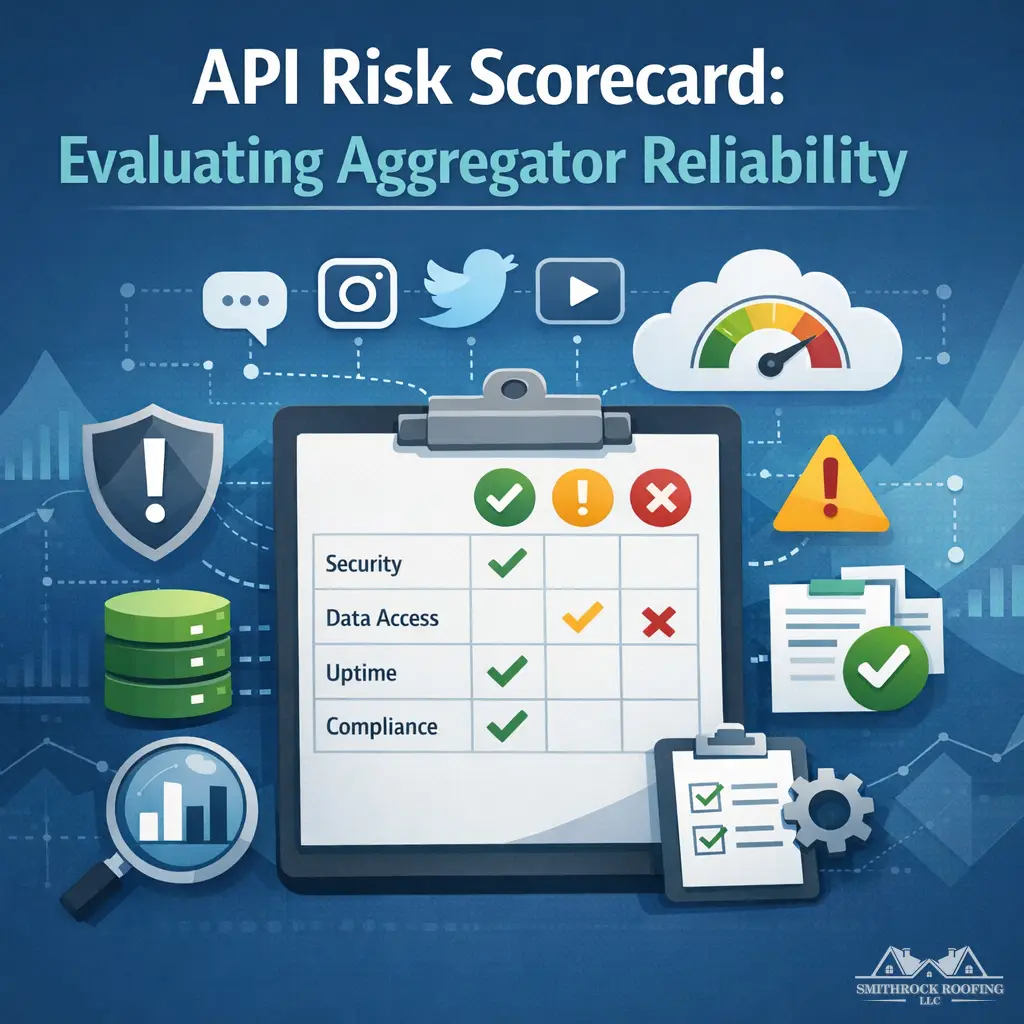
Every social media aggregator is entirely dependent on the API access granted by each platform it aggregates. That dependency is not a technical footnote — it is the single most significant operational risk in this entire category of tools, and it is almost universally ignored in competitor content.
Here is the actual history of what API dependency has done to aggregator functionality:
Instagram’s 2018 API Deprecation
In 2018, Instagram deprecated its original Platform API (v1) and migrated to the Graph API — a migration that removed public hashtag search access for the majority of third-party tools overnight. Tools that had built their core value proposition on hashtag aggregation were forced to either rebuild integrations using the far more restrictive Graph API (which requires Business or Creator account status and Facebook Page linkage) or quietly remove hashtag functionality altogether. Many tools did both, with minimal transparency to paying customers.
The Twitter/X API Restructuring of 2023
In February 2023, Twitter — newly rebranded as X under Elon Musk’s ownership — eliminated free API access entirely and restructured its tier system. The Basic tier introduced strict rate limits that made real-time aggregation functionally impractical for most use cases. Several major aggregator platforms either removed X/Twitter support completely, downgraded it to a cached polling model with significant delays, or passed API costs directly to customers through pricing tier changes. Feeds that had displayed live Twitter content suddenly went dark or stale.
Meta’s Periodic Permission Reviews
Meta conducts periodic app permission audits on third-party applications connected to its Graph API. An aggregator tool can lose the permissions required to access your Business Instagram account with no advance notice if Meta’s systems flag the application during a review cycle. The result: your embedded social feed stops updating, potentially displaying outdated content to visitors until you manually reconnect — assuming the permission can be restored at all.
What This Means When You’re Evaluating a Tool
Before selecting any aggregator, ask these specific questions:
- Does the vendor disclose which platforms are supported through direct API partnerships versus unofficial scraping methods? Scraping is against every major platform’s Terms of Service and represents a significantly higher disruption risk.
- What is the vendor’s documented response protocol when a platform changes API access? A credible vendor will have a published communication policy and a history of transparent updates.
- Does the tool cache content locally, or does it poll the API in real time? Cached models are more resilient to API disruptions but trade freshness for stability.
- What happens to your embedded feed during an API outage or permission revocation? Does it fail gracefully (displaying a static image or hiding the widget entirely) or does it render a broken embed to website visitors?
No competitor article asks these questions on your behalf. They’re the questions a developer or IT manager would raise immediately — and they should be on every marketing team’s evaluation checklist.
UGC, Copyright, and the Legal Exposure Most Businesses Ignore
User-generated content is the primary value driver for most social media aggregator use cases. Displaying real customer photos on your product pages, pulling positive brand mentions into a testimonials feed, showcasing event hashtag posts on your event page — this is the pitch every aggregator vendor leads with.
What the pitch leaves out is a substantive discussion of content rights. This omission is not accidental. Legal nuance creates friction in a sales funnel. But for any business operating at meaningful scale — or operating in a jurisdiction with serious data protection regulation — this is non-negotiable territory.
Aggregating vs. Republishing: A Distinction That Matters
There is a fundamental difference between displaying content and republishing it, and the difference carries real copyright implications.
Display aggregation (the technically legitimate model) renders content by pulling it from the original source via an embed or API call. The content is displayed on your site, but it continues to reside on the original platform’s servers. The original creator retains hosting control and can remove the content, at which point the embed breaks or disappears.
Content republishing involves downloading the original media file — a photo, video, or post — and re-hosting it on your own server or CDN. The content now exists independently of the original source. The creator cannot remove it by deleting the original post. This model is substantially more legally exposed under copyright law, regardless of whether the original post was public.
The problem: many aggregator tools operate somewhere between these two models, and their Terms of Service do not clearly disclose which model they use. Some tools download and store media for performance or redundancy reasons without making this explicit to their customers. You, as the site owner embedding that widget, bear downstream responsibility for how that content is handled.
Platform Terms of Service vs. Copyright Law
Platforms like Instagram and X grant their Terms of Service permission for content to be displayed on their platform and in contextual embeds — but this permission is granted by the platform, not by the content creator. Copyright in a photograph, video, or written post belongs to the creator by default in most jurisdictions. A platform’s ToS cannot override that copyright.
What this means practically:
- Displaying a customer’s Instagram photo on your commercial website through an embed sits in a legally ambiguous space. Most brands do it without incident, but “most brands do it” is not a legal defense.
- Downloading and using that photo as a product page image without explicit permission from the creator is copyright infringement, regardless of the photo being publicly posted.
- Rights management features offered by tools like TINT, Stackla (now Bazaarvoice), or Photoslurp — where the brand sends a formal permission request to the creator and receives a documented response — represent the only genuinely defensible model for commercial UGC use.
GDPR and CCPA Implications
Under the General Data Protection Regulation (GDPR), displaying a person’s publicly posted social content on a commercial website may constitute processing their personal data — a definition broad enough to capture names, usernames, photographs, and any content identifiable to an individual. EU residents have rights over that processing, including the right to erasure.
If your aggregated feed includes content from EU residents and your website is accessible to EU users — which describes virtually every business with a public-facing website — GDPR exposure is real. Your legal obligations do not disappear because the content was originally posted publicly.
California’s CCPA introduces similar considerations for content from California residents. The practical implication: any business embedding a public UGC feed should have a documented data processing justification and a clear process for responding to content removal requests.
A Practical Decision Framework
| Use Case | Content Type | Recommended Approach |
|---|---|---|
| Displaying your own branded posts | Owned content | Standard aggregation — full rights, no issue |
| Embedding customer photos (e-commerce) | Third-party UGC | Rights management request via tool feature or direct DM |
| Hashtag event feed (live display) | Mixed public content | Display-only embed; no download/re-host; monitor continuously |
| Testimonials and reviews feed | User-written content | Review platform ToS and obtain explicit permission for commercial use |
| Influencer content repurposing | Contracted content | Verify contract covers website display rights specifically |
| B2B brand mentions and PR feed | Public posts | Display-only aggregation acceptable; remove on creator request |
The Website Performance Trade-Off: What Your Aggregator Widget Is Doing to Your SEO
Here is the irony most aggregator vendors will never put in their marketing: the widgets they’re selling you can measurably harm your website’s search performance if implemented without care.
The mechanism is straightforward and well-documented in Google’s Core Web Vitals framework.
How Aggregator Embeds Affect Core Web Vitals
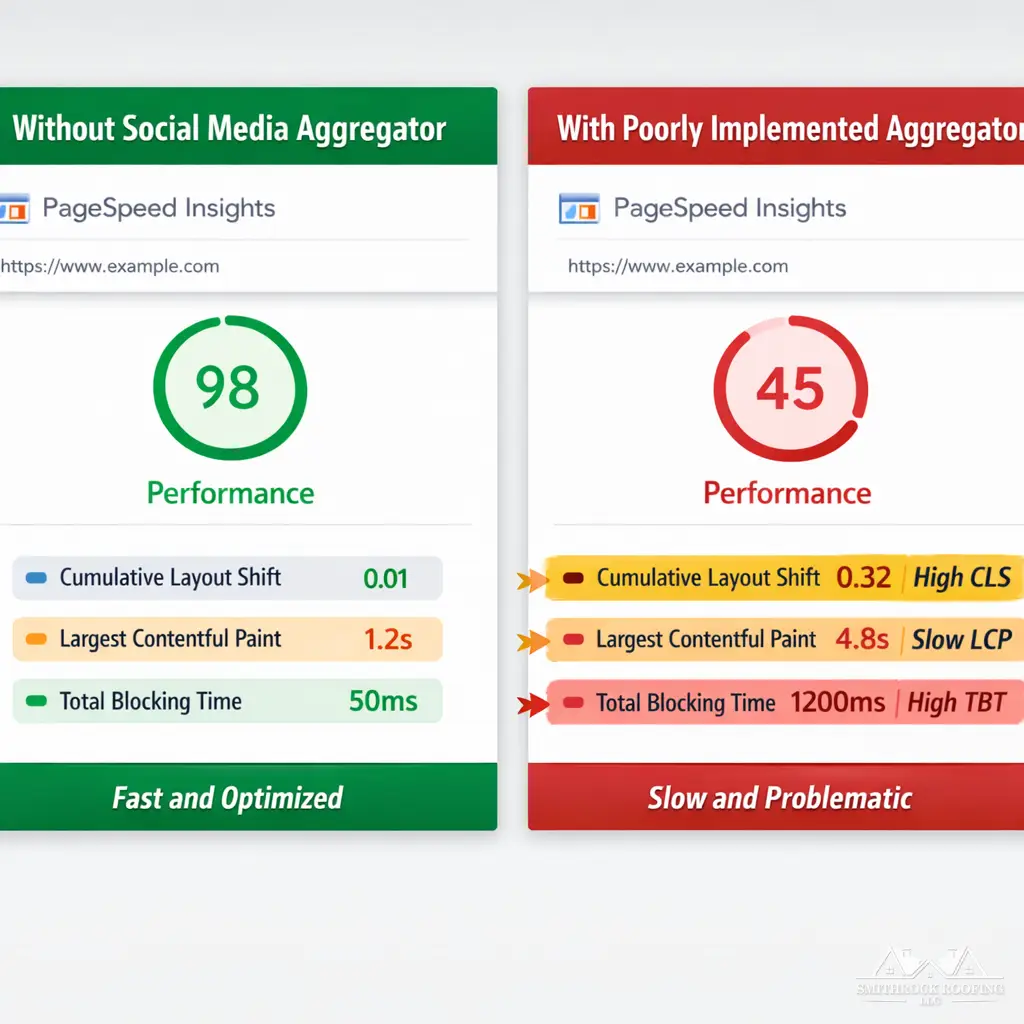
Cumulative Layout Shift (CLS): Social feed widgets that load asynchronously — meaning they initialize after the main page content — are a primary driver of CLS degradation. When a widget loads late and pushes existing content down the page, Google’s ranking algorithm registers a poor layout stability score. CLS is a direct ranking factor.
Largest Contentful Paint (LCP): If your social feed widget is above the fold or near the top of your page, the images within it may become the LCP element — the largest piece of content the browser renders on initial load. Aggregator widgets pulling images from external CDNs via third-party JavaScript consistently perform worse than natively hosted images. LCP degradation translates directly to lower PageSpeed scores and diminished organic ranking potential.
Time to Interactive (TTI) and Total Blocking Time (TBT): Aggregator JavaScript bundles are frequently large and render-blocking. A poorly optimized widget can add 300–600 milliseconds of blocking time to a page load — the kind of performance degradation that increases bounce rates measurably, particularly on mobile connections.
Third-Party Requests: Every aggregator embed introduces multiple third-party network requests to the page load chain — to the aggregator’s own CDN, to platform APIs, and to image hosting endpoints. In high-volume scenarios, these requests can introduce significant server response time variability that affects TTFB (Time to First Byte) scores.
If you want a deeper look at how hidden technical issues like these affect your rankings, the Small Business Technical SEO Audit: 10 Hidden Website Issues That Are Killing Your Google Rankings is worth reviewing alongside this guide.
How to Measure the Impact Before You Commit
The responsible approach to evaluating any aggregator widget is a before-and-after performance audit:
- Run your target page through Google PageSpeed Insights and record baseline scores for mobile and desktop across CLS, LCP, FID/INP, and TTFB.
- Implement the aggregator widget on a staging environment — not your live production site.
- Run the same PageSpeed Insights audit on the staging version and compare metrics directly.
- Use the “Opportunities” and “Diagnostics” sections in the report to identify the specific resources introduced by the widget that are causing degradation.
- Test lazy loading implementation — most quality aggregators support lazy loading, which defers widget initialization until a user scrolls toward it, significantly reducing initial page load impact.
- If performance degradation is substantial (CLS increase of >0.1, LCP increase of >500ms), evaluate whether a server-side rendered or static cached version of the feed is available as an alternative.
Mitigation Strategies That Actually Work
- Lazy loading: Non-negotiable for any aggregator widget that isn’t critical above-the-fold content. Insist on this before purchasing.
- Server-side rendering (SSR): A small number of aggregator tools offer SSR options where the feed is generated server-side and delivered as static HTML rather than client-side JavaScript. This is the highest-performing implementation path and worth specifically requesting from vendors.
- Iframe sandboxing with defined dimensions: If the widget loads in an iframe, defining explicit width and height attributes in the HTML prevents CLS by reserving the space before content loads.
- Content caching frequency: An aggregator that refreshes content every 4–6 hours rather than in real-time significantly reduces the number of live API calls and associated latency on each page load.
- Widget placement audit: Keep social feed widgets below the fold whenever possible. Above-the-fold placement maximizes CLS and LCP exposure. The engagement value rarely justifies the performance cost at the top of the page.
Content Moderation at Scale: The Problem Is Bigger Than a Toggle
Every aggregator feature list includes “content moderation” somewhere in the bullet points. Keyword filters, allow lists, block lists, manual approval queues, AI-powered moderation. It reads like a solved problem. It isn’t.
The Operational Reality
Manual moderation of a hashtag feed during a high-volume event — a product launch, a conference, a sponsored campaign — requires dedicated human attention. The volume of incoming posts can outpace any moderation queue’s capacity to process them. AI moderation systems, which most tools now rely on as the default layer, are trained on general datasets and perform inconsistently when confronted with:
- Context-dependent brand-adjacent content (a post that includes your hashtag and a competitor’s product, for example)
- Language variations, slang, and cultural references outside the model’s training data
- Images and video — visual content moderation remains significantly less reliable than text moderation in most consumer-grade tools
The Brand Crisis Failure Mode
The scenario that no aggregator vendor wants to discuss: a real-world event creates a surge of brand-tagged negative content, and your live website feed — running on a 2-minute polling cycle — begins displaying that content to visitors faster than any moderation workflow can respond.
This isn’t hypothetical. Any major brand operating a live hashtag feed has faced a version of this scenario. During moments of public controversy, negative posts on social platforms multiply exponentially. A moderation system designed to handle normal-volume brand content will not scale to handle crisis volume without direct human intervention and, critically, the operational readiness to intervene quickly.
Practical Moderation Standards Before You Launch
- Never run a fully automated hashtag feed on a live website without an active human monitoring protocol. This applies especially to event feeds and campaign hashtag walls.
- Define a kill switch procedure: who has the authority to take the feed offline, what tool access do they need, and how quickly can it be executed? This should be a documented process before the feed goes live, not something you figure out during a crisis.
- Test your keyword filters adversarially: have someone attempt to get problematic content through your filters before launch. Assume motivated bad actors will try to abuse your hashtag.
- Consider a default-off approval model for UGC feeds where content must be explicitly approved before appearing, rather than a default-on model where content appears unless flagged. The first approach is operationally heavier but substantially lower risk.
- Audit moderation logs regularly: most tools maintain records of what content was filtered and why. Reviewing these logs weekly reveals gaps in your filter configuration before they become public problems.
Platform-Specific Aggregation: Why “Multi-Platform” Isn’t One Uniform Capability
One of the more misleading phrases in aggregator marketing is “multi-platform support.” It implies that aggregating from Instagram, X, TikTok, LinkedIn, and YouTube is a uniform technical capability. It is not. Each platform’s API has distinct characteristics, restrictions, and reliability profiles that directly affect what an aggregator can actually do.
| Platform | API Access Model | Hashtag Search | Real-Time Capability | Key Restrictions |
|---|---|---|---|---|
| Meta Graph API (Business/Creator accounts only) | Limited — requires approved app review | Near real-time for owned content; delayed for hashtag | Requires Facebook Page linkage; public hashtag access heavily restricted post-2018 | |
| X (Twitter) | Tiered paid API | Available on paid tiers | Real-time on Enterprise tier; significantly delayed on Basic | Free API eliminated 2023; Basic tier rate limits make live feeds impractical for most use cases |
| TikTok | Content Posting API / Research API | Very limited | No public real-time feed API available | Research API restricted to approved academic/enterprise partners; public hashtag aggregation largely unsupported officially |
| Meta Graph API | Very limited for public content | Near real-time for Page content | Public post discovery restricted; primarily useful for owned Page content | |
| Official Marketing API | Not available | Near real-time for Company Page content | Personal profile aggregation not permitted; Company Page only | |
| YouTube | Data API v3 | Channel and playlist-based | Near real-time for channel uploads | High quota consumption for frequent polling; live chat aggregation requires separate API scope |
| Pinterest API v5 | Board and profile-based | Delayed (not real-time) | Limited third-party app access; board content only |
What this table tells you is that “multi-platform aggregation” has a very different practical value depending on which platforms matter most to your business. If X/Twitter is central to your audience’s activity, the current API economics make a live aggregated Twitter feed genuinely difficult to sustain without significant cost or functionality compromise. If TikTok content is your primary UGC source, real-time aggregation through official API channels is largely unavailable today.
Any vendor who tells you their tool pulls seamlessly from all platforms in real time without acknowledging these platform-specific constraints is either uninformed or not being straight with you. Ask specifically which platforms use real-time API polling versus cached content versus unofficial methods — and get that answer in writing before signing up.
Strategic Recommendations for 2026
The API landscape across major social platforms continues to shift, and the tools that served aggregation strategies well in previous years are not guaranteed to remain viable. Based on current trajectory and what is likely to define practical success through 2026, here are three focused recommendations.
1. Prioritize Platforms With Stable API Access Before Expanding Coverage
Rather than attempting to aggregate from every platform simultaneously, audit which platforms your actual audience uses and cross-reference that against the API access realities outlined in the table above. Build your aggregation strategy around platforms with stable, documented API access first — YouTube, LinkedIn Company Pages, and Pinterest are currently more predictable than X or TikTok for sustained aggregation. Breadth is not inherently valuable; reliable depth on the right platforms is. If X or TikTok are essential to your audience, allocate budget explicitly for enterprise-tier access and pressure vendors to demonstrate live functionality before committing to a contract.
2. Evaluate Tagbox, Flockler, or Curator.io as Managed Aggregation Layers
For teams that do not want to manage API credentials, rate limits, and platform policy changes internally, managed aggregation platforms remain a practical middle layer. By 2026, tools like Tagbox (formerly Taggbox), Flockler, and Curator.io have each invested in maintaining platform relationships and absorbing compliance overhead on behalf of their users. Each takes a slightly different approach — Flockler leans toward editorial and website embedding use cases, Tagbox toward UGC marketing and social media walls at events, and Curator.io toward developer-friendly customization. Evaluate against your specific display and moderation needs, confirm in writing which platforms are supported at real-time versus cached cadence, and verify that their terms of service align with your intended use cases before onboarding.
3. Build a First-Party Content Strategy as a Long-Term Hedge
The trajectory of platform API restrictions over the past five years points clearly in one direction. Aggregating owned content — your brand’s own posts, verified UGC collected through opt-in campaigns, and content hosted on platforms you control — is structurally more durable than depending on third-party feed access that can be revoked or priced out of reach. Invest in mechanisms that encourage users to submit content directly, use branded hashtags within platforms that still support them reliably, and ensure your aggregation infrastructure can pivot toward first-party sources if platform access narrows further. A well-structured digital marketing strategy that incorporates first-party data collection from the outset will prove far more resilient than one built entirely around aggregated third-party feeds.
Frequently Asked Questions
What is a social media aggregator and how does it work?
A social media aggregator is a tool or platform that collects content from multiple social media sources and displays it in a unified feed or gallery. It typically connects to social platforms via their official APIs, pulling posts, images, videos, or mentions based on defined criteria such as hashtags, usernames, or keywords. The aggregated content is then formatted and embedded on a website, displayed on a digital screen, or used within a marketing campaign. How frequently the content updates depends on the platform’s API access tier and the aggregator tool’s polling schedule.
Are social media aggregators safe to use from a legal and compliance standpoint?
This depends heavily on how the tool accesses content and how you display it. Aggregators that operate through official platform APIs and display content in compliance with each platform’s developer terms are generally considered lower risk. However, displaying user-generated content publicly — particularly for commercial purposes — without explicit user permission can create copyright and consent issues regardless of technical access. Always review the terms of service for each platform you aggregate from, and use tools that provide built-in rights management or permission request features if you plan to use UGC in advertising or promotional contexts.
Why do some social media aggregators not support TikTok or X in real time?
Both TikTok and X have significantly restricted or monetized their public API access in recent years. TikTok’s public content API does not support real-time hashtag or public feed aggregation for most commercial use cases, and their Research API is limited to approved academic and enterprise partners. X eliminated its free API tier in 2023, meaning real-time access now requires a paid subscription at a level that is cost-prohibitive for many businesses. Aggregators that claim full real-time support for these platforms are either operating on expensive enterprise API arrangements or using methods that may not be officially sanctioned — both of which carry meaningful risk. For more context on how platform dynamics have shaped the rise and fall of social media tools, the article on Mixer Social Media: Why Microsoft’s Platform Failed offers a useful parallel case study.
How do I choose the right social media aggregator for my business?
Start by identifying which platforms your target audience is most active on and confirm that any tool you consider has verified, documented API access for those specific platforms. Ask vendors directly whether feeds from your required platforms are real-time or cached, how they handle platform API changes, and what their data retention and moderation policies look like. Consider whether you need the aggregator primarily for website embedding, event displays, internal dashboards, or marketing campaigns, since different tools are optimized for different output formats. Avoid over-indexing on the number of supported platforms — a tool that handles three platforms reliably is more valuable than one that claims twenty with inconsistent results.
Closing Thoughts
Social media aggregation remains a genuinely useful capability when approached with clear expectations and a realistic understanding of how platform access actually works in practice. The gap between marketing claims and API reality is wide enough that due diligence before committing to any tool is not optional — it is essential. As platform policies continue to evolve, the businesses best positioned will be those that combine reliable managed aggregation with a growing first-party content foundation that no API restriction can take away.
If you have questions about how social media aggregation fits into your broader digital strategy or need guidance on evaluating tools for your specific use case, we are glad to help. Contact Us