
What Mixer Social Media Actually Was — And Why Its Failure Was Structurally Inevitable
Microsoft didn’t lose the streaming wars because it ran out of money. It lost because it fundamentally misread how platform economies work — and Mixer paid the price. If you’ve ever searched “mixer social media” trying to understand what the platform was, why it mattered, and what actually killed it, you’ve probably found the same recycled obituary: Beam became Mixer, Ninja got signed, it shut down in 2020, the end.
That version of events is accurate. It is also deeply incomplete.
The real story of Mixer is a graduate-level case study in two-sided market economics, acquisition-driven cultural decay, and what happens when a technically superior product meets a behaviorally entrenched audience. For business owners and marketers, it carries lessons about platform strategy that are directly applicable right now — not just to streaming, but to any environment where creator economies and community-driven growth intersect.
This is the version of the Mixer story that actually explains what went wrong, why, and what it permanently changed.
What Was Mixer? A Platform Built on Genuine Technical Superiority
Mixer launched in January 2016 under the name Beam — a startup founded by Matt Salsamendi and James Boehm. The core premise was straightforward: build a live streaming platform with real-time interactivity that Twitch’s infrastructure couldn’t match. Microsoft acquired it in August 2016, rebranded it as Mixer in 2017, and positioned it as the streaming home for Xbox’s growing ecosystem.
The platform wasn’t a Twitch clone. It had meaningful technical differentiators that any serious analysis has to acknowledge before explaining why they weren’t enough.
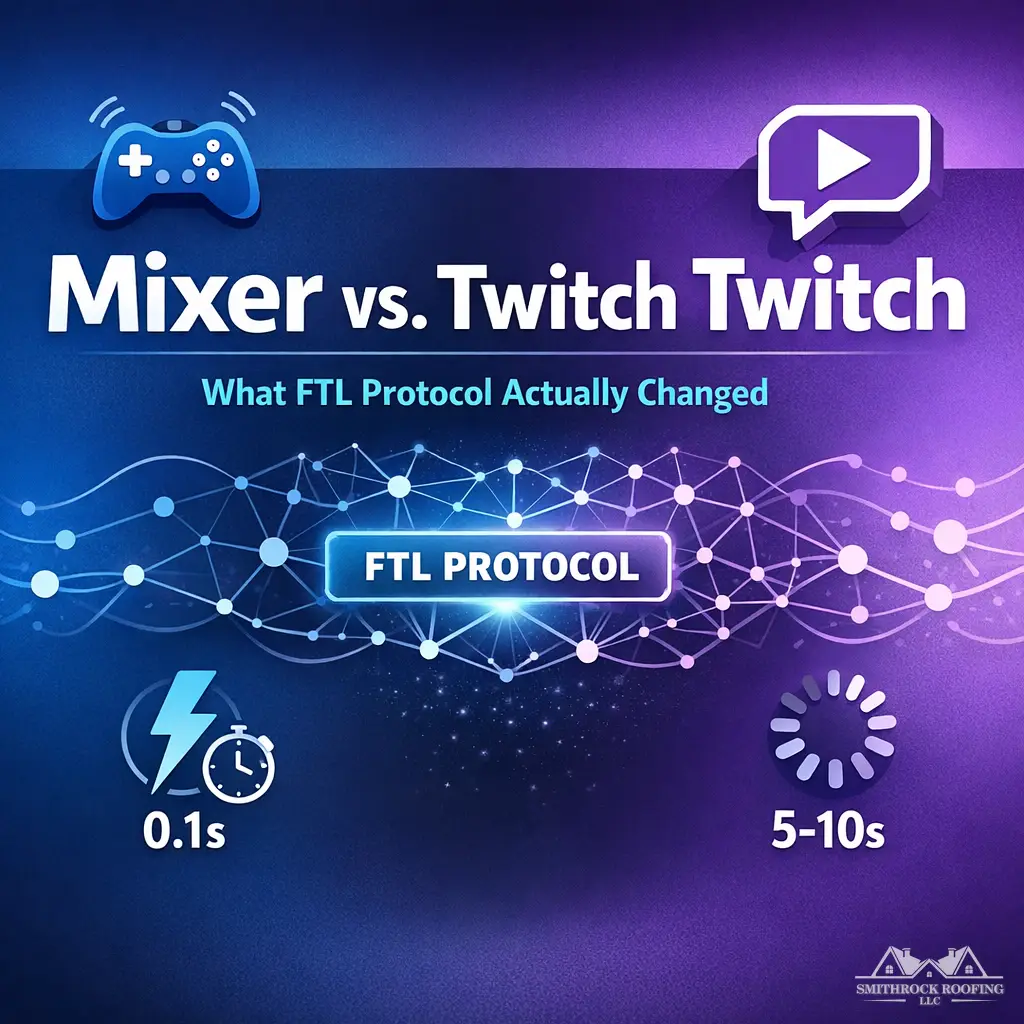
The FTL Protocol: What Sub-Second Latency Actually Meant
Mixer’s headline technical feature was its proprietary FTL (Faster Than Light) streaming protocol. To understand why this mattered — and why it ultimately created as many problems as it solved — you need a basic grasp of how streaming latency works.
Twitch and virtually every competing platform distribute streams via RTMP (Real-Time Messaging Protocol) combined with CDN (Content Delivery Network) distribution. This architecture introduces latency — typically 10 to 30 seconds between what a streamer does and what a viewer sees. The upside is massive scalability and resilience. The downside is that “real-time” interaction is, functionally, delayed interaction.
FTL compressed that latency to under one second. In practice, this meant:
- A viewer typing a chat command during a Mixer stream could genuinely influence gameplay in real time
- Streamer reactions to chat were authentic and immediate, not reactions to messages sent 20 seconds ago
- The interaction loop felt fundamentally different — closer to a video call than a broadcast
This was not a marginal improvement. For a certain category of engaged, interactive viewer, it was a categorically better product.
Interactive Currency and the Participation Barrier Problem
Alongside FTL, Mixer introduced Sparks and Embers — an interactive currency system that let viewers spend earned or purchased tokens to trigger in-stream events, support streamers, and interact with content in ways passive viewing didn’t allow.
On paper, this is a sound engagement mechanic. In practice, it created a participation barrier that contradicted what platform growth actually required at Mixer’s stage of development.
Here is the critical distinction that competitors consistently miss:
- Engaged community members (Mixer’s target user for Sparks/Embers) understand platform-specific currencies, want to invest in streamers they follow, and actively seek deeper participation tools
- Passive new viewers (the audience Mixer needed to acquire to grow) arrive on a platform to watch, not to learn an economy system — and any friction between arrival and content consumption results in bounce, not conversion
Mixer built features for the former while its growth strategy depended entirely on the latter. These two user personas have fundamentally incompatible first-session experiences. No amount of technical innovation resolves that tension if you don’t address it architecturally before you scale acquisition.
The Network Effect Ceiling: Why Microsoft’s Resources Were Never the Answer
The dominant narrative frames Mixer’s failure as a resource competition — Twitch had more users, YouTube Gaming had Google’s backing, and Mixer simply couldn’t keep up. This framing sounds logical and is almost entirely wrong.
Mixer had Microsoft’s balance sheet behind it. Resource scarcity was not the constraint. The constraint was two-sided platform economics, and Microsoft’s leadership appears to have fundamentally misunderstood which side of the market to invest in first.
How Two-Sided Markets Create Unbreakable Moats
A streaming platform is a textbook two-sided market: streamers on one side, viewers on the other. The platform’s value is derived entirely from the interaction between these two groups. This creates a reinforcing dynamic:
- Viewers go to platforms where their favorite streamers are
- Streamers go to platforms where their potential audience already exists
- Each side’s decision is contingent on the other side’s behavior
Once a platform achieves sufficient scale on both sides, this loop becomes self-reinforcing in a way that is mathematically very difficult to disrupt. Twitch had built exactly this loop over years of organic growth. Their audience wasn’t just large — it was behaviorally habituated to Twitch’s discovery environment, community culture, emote language, and social graph.
Why Signing Ninja Was the Wrong Move First
In 2019, Microsoft signed Tyler “Ninja” Blevins — at the time the most-followed streamer in the world — to an exclusive Mixer deal. Shroud followed shortly after. The logic was visible: bring the biggest supply-side assets to the platform and viewers will follow.
The logic was wrong, and platform growth literature explains why.
Signing Ninja addressed the supply side (streamer talent) without solving the demand side (viewer habits). The behavioral phenomenon at play here is what platform economists call viewership inertia — the documented tendency of live stream audiences to return to familiar discovery environments rather than migrate wholesale to follow a single creator.
Twitch viewers who watched Ninja didn’t just watch Ninja — they watched Ninja within an ecosystem of adjacent content, related communities, Prime Gaming integration, and social discovery that Twitch had built over years. Removing Ninja from that ecosystem didn’t move his audience; it removed him from the environment his audience was already habituated to.
The numbers confirmed this. Ninja’s Mixer numbers were a fraction of his Twitch peak, and the platform’s overall market share didn’t shift meaningfully in the 12 months between the signing and the shutdown.
The Timeline Problem No One Calculates
There is a straightforward strategic error embedded in Mixer’s exclusivity play that becomes obvious the moment you apply basic platform growth benchmarks:
| Metric | Mixer’s Situation | Platform Growth Standard |
|---|---|---|
| Ninja exclusivity deal signed | Mid-2019 | — |
| Platform shutdown announced | June 2020 | — |
| Time to convert viewership | ~12 months | 18–24 months minimum for community compounding effects |
| Twitch Prime integration advantage | Not replicable | Built-in Amazon Prime re-engagement loop |
| Viewer habit formation window | Not achieved | Typically requires 6+ months of consistent new-platform usage |
| Streamer network density at launch of deals | Low | Organic growth requires multi-streamer ecosystem, not single-star reliance |
Microsoft gave the exclusivity strategy less than a year to demonstrate results before pulling the plug. Platform growth literature consistently shows that community compounding effects — where an audience begins organically growing through word-of-mouth and social graph expansion — require a minimum of 18 to 24 months to materialize. The timeline was strategically flawed before a single stream went live on Mixer under Ninja’s account.
The Microsoft Acquisition Paradox: How Corporate Infrastructure Killed Startup Culture
The most analytically underexamined dimension of Mixer’s failure is what happened inside the organization after Microsoft’s acquisition — and why it made competitive agility effectively impossible.
Product-Led Growth Requires Organizational Speed
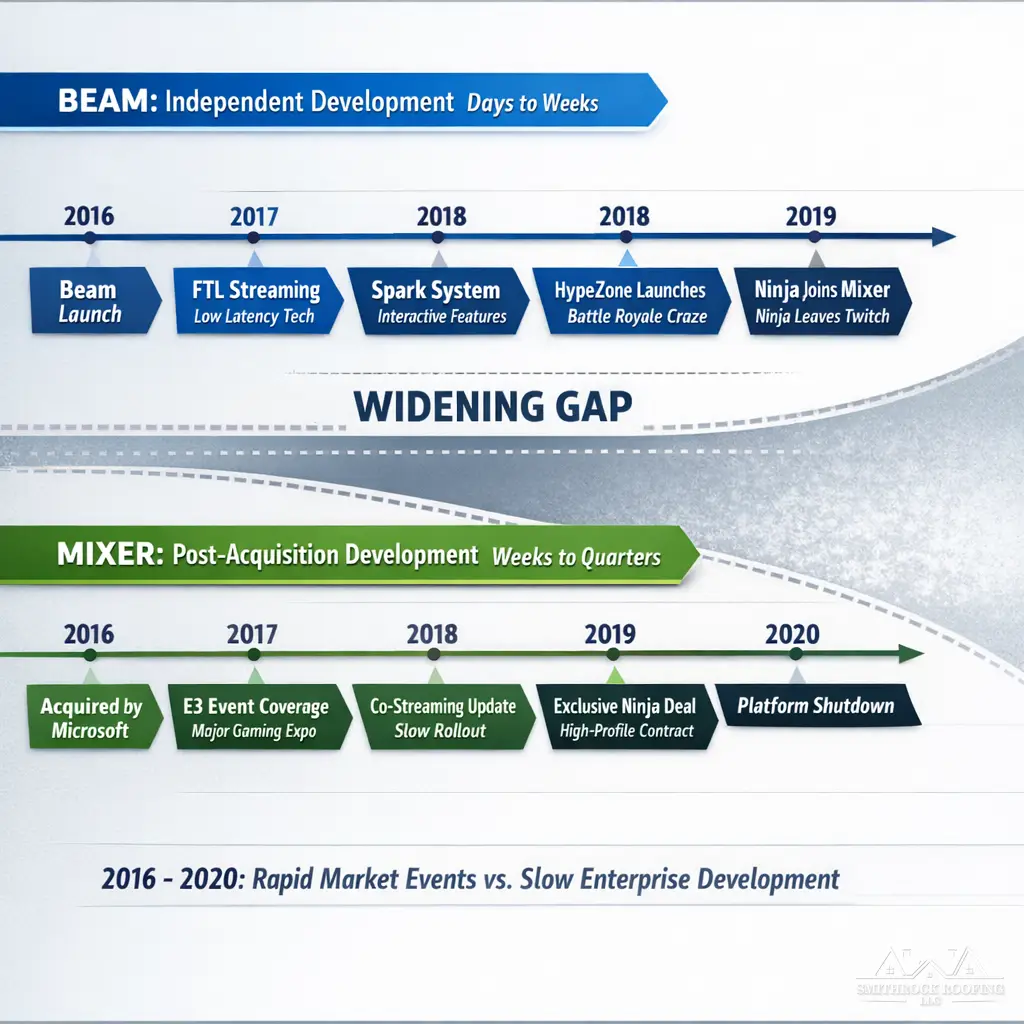
When Beam operated independently, Salsamendi and Boehm could respond to streamer feedback within days. A community request, a technical complaint, a feature idea surfaced during a stream — the team could prototype, test, and ship fast. This is the operating model of product-led growth: the product itself drives acquisition, retention, and expansion by continuously improving in response to real user behavior.
Streaming culture demands exactly this speed. Trends in gaming, memes, community drama, and viral moments move on a weekly news cycle. A platform that can respond to that rhythm builds trust and cultural relevance. A platform that can’t becomes irrelevant faster than its user numbers decline.
Enterprise Change Management vs. Streaming Culture’s Clock Speed
Microsoft’s acquisition introduced enterprise change management cycles — the organizational layers that govern how large technology companies plan, prioritize, and ship product changes. These are not inherently dysfunctional. For enterprise software, quarterly roadmaps make sense. For a live streaming platform competing in a cultural attention economy, they are structurally incompatible with what the market requires.
The mismatch looks like this in practice:
- Streaming culture clock speed: Weekly viral moments, daily community feedback, real-time expectation management from streamer partners
- Enterprise product cycle: Quarterly planning, cross-functional alignment, legal and compliance review, executive approval chains
- Result: Features that competitors shipped in weeks took Mixer quarters. Community feedback loops that Beam could close in days became unresolved tickets in a backlog
This is a documented phenomenon in technology acquisition literature sometimes called “innovation theater” — the condition where a large acquirer preserves the aesthetic markers of startup culture (small team branding, founder-led messaging, agile language) while systematically eliminating the organizational conditions that produced the innovation in the first place. Mixer is a textbook case. The founders were retained. The org chart that made them effective was not.
The Facebook Gaming Transition: A Strategic Asset Trade, Not a User Decision
When Microsoft announced Mixer’s closure in June 2020, they simultaneously announced that displaced streamers would be redirected to Facebook Gaming. Competitor articles almost universally describe this as a “partnership” — language that frames the arrangement as something done for Mixer’s community.
It wasn’t. It was a bilateral asset trade between two corporations with distinct strategic objectives, and the framing matters if you want to understand what actually happened.
What Each Party Actually Got
- Microsoft exited a money-losing platform while positioning its xCloud game streaming technology within Facebook’s massive social graph — a distribution channel for Xbox Cloud Gaming that Microsoft couldn’t have accessed independently
- Facebook Gaming received a pre-qualified base of active streamers who needed a new home immediately — an acquisition of live content creators at scale without running a single recruitment campaign
- Mixer’s streamers and viewers were given 30 days notice via a Twitter announcement and told to migrate to a platform most of them had no relationship with
The shutdown announcement method itself deserves analytical attention. Communicating a platform closure via social media with 30-day notice is a significant breach of creator economy best practices. Platforms that house livelihood-dependent creators have an implicit obligation to those creators that exceeds the legal minimum. Mixer’s shutdown communication established a precedent that has since influenced how the industry discusses platform trust obligations — and not in a positive direction.
Mixer’s Real Legacy: What It Permanently Changed
Mixer is treated as a footnote. It should be treated as a turning point.
The exclusivity deal model that Mixer used aggressively in 2019 — signing creators to platform-exclusive contracts to drive migration — has since become a standard competitive lever across the streaming ecosystem:
- YouTube Gaming signed Valkyrae, Ludwig, and TimTheTatman to exclusive or preferential deals in the years following Mixer’s closure
- Kick emerged as an exclusivity-driven challenger platform using financial exclusives as its primary growth mechanic
- The practice of platform-level creator acquisition, pioneered at scale by Mixer, is now a line item in every major streaming platform’s competitive strategy
Mixer didn’t win. But it changed the rules of engagement permanently. Any analysis that ends with “Mixer failed” without tracing that causal chain is leaving the most strategically useful part of the story on the table.
For brands, agencies, and business owners building presence on creator-driven platforms today — understanding why Mixer failed is directly applicable to decisions about where to invest, which platforms to trust, and how platform health signals translate into marketing ROI. The behavioral dynamics that made Twitch unbeatable in 2019 are the same dynamics that govern platform loyalty, creator trust, and audience migration patterns in every vertical social media network operating right now.
Strategic Recommendations for 2026
The lessons embedded in Mixer’s failure are not historical curiosities — they are active risk factors for anyone building a presence on creator-dependent platforms today. Three specific moves deserve priority attention heading into 2026:
1. Audit Your Platform Dependency with StreamMetrics or similar multi-platform analytics tools.
Any brand, creator, or agency currently concentrated on a single streaming or social platform is carrying concentration risk that Mixer’s collapse demonstrated can materialize with 30 days notice. Tools that aggregate audience data, engagement signals, and cross-platform reach into a unified dashboard allow you to identify dependency before it becomes a liability. The goal is not to be everywhere — it is to have portable audience intelligence that survives any single platform’s decision to shut down.
2. Build an Owned Distribution Layer Using Email and Community Platforms.
Substack, Beehiiv, and community-first tools like Circle or Discord servers function as platform-agnostic infrastructure. Mixer’s creators who had cultivated direct audience relationships through newsletters or off-platform communities recovered significantly faster than those who had invested exclusively in Mixer’s native discovery systems. In 2026, owned distribution is not optional infrastructure — it is the primary hedge against platform risk. Understanding how SEO for lead generation actually drives pipeline is directly relevant here — the same principle of building durable, owned audience channels applies whether you are a creator or a brand.
3. Use Platform Health Scorecards Before Committing Creator or Media Budgets.
Before allocating meaningful resources to any emerging platform — whether that is a new short-form video network, a live commerce destination, or a challenger streaming service — evaluate structured signals: creator payout consistency, corporate parent stability, audience growth trajectory versus engagement quality, and how the platform communicates with its creator base during adversity. Mixer scored poorly on several of these metrics well before its closure announcement. The signals were readable. In 2026, reading them before committing is the baseline standard of due diligence. If you want a framework for applying this kind of analytical rigor to your broader digital marketing investment, the Stop Wasting Your Marketing Budget guide walks through a data-driven approach built specifically for businesses making these allocation decisions.
Frequently Asked Questions
What was Mixer social media and why did it shut down?
Mixer was a live game streaming platform owned and operated by Microsoft that launched under the name Beam in 2016 before rebranding. It shut down in July 2020 after failing to close the audience gap with Twitch despite high-profile and expensive exclusivity deals with top creators including Ninja and Shroud. The core reasons for the shutdown were an inability to build sustainable organic viewership, structural over-reliance on paid creator migration rather than native community growth, and a competitive environment in which Twitch’s network effects proved insurmountable within Microsoft’s timeline for the investment.
Did Mixer’s exclusivity deals with Ninja and Shroud actually work?
By the most meaningful measure — sustained platform growth and audience retention — the exclusivity deals did not work. Both Ninja and Shroud generated significant short-term attention and media coverage when they signed, and their streams attracted viewership during peak moments. However, the broader Mixer platform never developed the discovery ecosystem, concurrent viewer culture, or community density needed to retain casual viewers or convert them into habitual Mixer users. Audience engagement numbers on Mixer consistently trailed what the same creators had achieved on Twitch, indicating that the creators moved but their audiences did not follow at the same scale.
How did Mixer’s failure change the live streaming industry?
Mixer’s failure had a lasting structural impact on how platforms approach creator acquisition and how creators evaluate platform commitments. The exclusivity deal model that Mixer deployed aggressively became a standard competitive mechanic adopted by YouTube Gaming, Kick, and others. Simultaneously, the shutdown demonstrated the risks of platform concentration to creators, accelerating the industry-wide shift toward multi-platform streaming strategies and owned audience infrastructure. Mixer also influenced how the creator economy discusses platform trust obligations, particularly around shutdown communication practices and the responsibilities platforms carry toward livelihood-dependent creators.
What can brands and marketers learn from Mixer’s failure today?
The most directly applicable lesson for brands and marketers is that platform health signals are readable before a crisis — if you know what to look for. Mixer exhibited warning signs including stagnant concurrent viewership despite creator investment, weak organic discovery, and an audience that showed low platform loyalty. Any brand investing media budgets or partnership resources into a platform should be tracking these signals continuously. Beyond platform evaluation, Mixer’s collapse reinforces that audience relationships built natively on a single platform are not portable assets. Brands that simultaneously build owned channels and platform presence carry meaningfully lower risk than those who treat platform reach as a substitute for direct audience relationships.
Conclusion
Mixer’s story is not a cautionary tale about a product that failed — it is a case study in how network effects, audience behavior, and platform trust actually function under competitive pressure. The platforms that win are not always the most innovative or the most heavily funded. They are the ones that build genuine community density and maintain the trust of the creators and audiences who give them meaning. That principle applies as directly to a brand’s social media strategy in 2026 as it did to Microsoft’s streaming ambitions in 2019.
If you are evaluating platform strategy, creator partnerships, or social media investment and want to apply these frameworks to your specific situation, Contact Us.