

Blog Writing Services Are Selling You Posts — Here’s Why You Should Be Buying a Content System Instead
Most businesses come to blog writing services with a reasonable expectation: pay for well-written posts, watch organic traffic grow. It’s a logical assumption, and service providers are more than happy to let it stand unchallenged. The problem is that assumption is wrong — and that gap between expectation and reality is exactly where content budgets quietly disappear.
The blog writing services market has matured into a commodity marketplace. Platforms compete on per-word rates, turnaround times, and writer pool sizes. Sales pages feature client logos, vague traffic claims, and a five-step process diagram that looks identical across every provider. What they almost never offer is an honest account of why most outsourced blog content underperforms — and what a business actually needs to get measurable ROI from content at scale.
This guide closes that gap. We’re not here to rank services by price tier or compare word counts. We’re here to give you the strategic framework that separates a content investment that compounds over time from one that generates a folder full of published posts and very little else.
If you’ve already tried a blog writing service and walked away underwhelmed, this will explain what went wrong. If you’re evaluating providers for the first time, this will save you from the most expensive mistakes in content marketing.
Why Most Outsourced Blog Content Fails Before It’s Even Published
The failure point for outsourced blog content almost never happens during the writing phase. It happens earlier — at the strategy layer that most blog writing services simply don’t provide.
The Intent Mismatch Problem
Search intent is the most underappreciated variable in content performance. A post targeting “project management software” needs to satisfy a fundamentally different user expectation than “best project management software for remote agencies.” One is broad and informational; the other is comparative and closer to a purchase decision. The SERP layout, the content format, the depth of coverage — all of it changes depending on which intent signal Google has mapped to that query.
When a blog writing service builds your content brief without conducting a proper SERP intent analysis, they’re essentially writing for a target they haven’t confirmed exists. The result is technically competent content that quietly fails to rank because it doesn’t match what Google has already determined users want from that search.
Before signing with any blog writing service, ask one direct question: How do you determine search intent before building a content brief? If the answer involves keyword volume and not SERP analysis, content type alignment, or featured snippet structure, that’s a strategic shortcoming — not a writer quality issue.
Isolated Posts Versus a Content Architecture
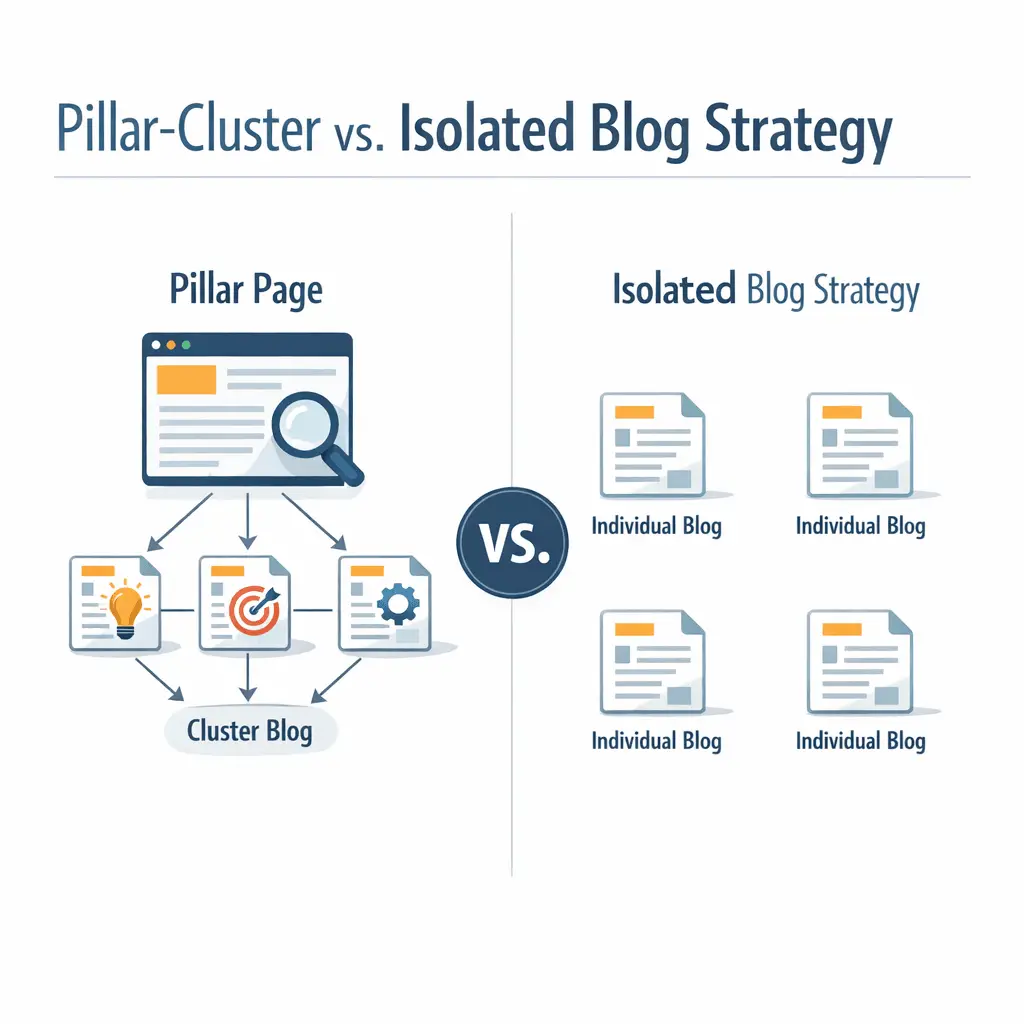
Here is the most important concept this article will give you, and it’s one that virtually no blog writing service discusses in their marketing materials: Google’s Helpful Content System does not evaluate your blog posts in isolation. It evaluates your site’s topical depth and authority as a whole.
A website that publishes 50 loosely connected posts on vaguely related topics signals breadth without depth. A website that publishes a structured ecosystem of content — pillar pages supported by cluster posts that collectively cover every meaningful dimension of a topic — signals genuine expertise. The second site ranks. The first site churns out content and wonders why nothing moves.
This is the pillar-cluster content architecture model, and it’s the structural foundation that separates a content system from a content production line. The practical implication is straightforward: the first thing a serious blog writing service should do is conduct a content gap analysis mapped to your target topic clusters — not hand you a list of high-volume keywords and start writing. For a deeper look at how content architecture connects to measurable business outcomes, the article on SEO for Lead Generation 2026: What Actually Drives Pipeline is worth reading alongside this one.
The E-E-A-T Problem: What “Vetted Writers” Actually Means
Since Google’s 2023 Helpful Content Updates, the concept of E-E-A-T — Experience, Expertise, Authoritativeness, and Trustworthiness — has moved from a quality guideline to a practical ranking factor, particularly in competitive niches. Yet every blog writing service still leans on the same hollow credential: “vetted writers.”
Vetted against what standard? Vetted by whom? These are not rhetorical questions — they have direct implications for whether your content builds search credibility or undermines it.
The Writer Expertise Verification Checklist
Before onboarding any blog writing service, run through this checklist to assess whether their writer matching process is genuinely expertise-driven or just operationally convenient.
| Verification Question | What a Strong Answer Looks Like | Red Flag Response |
|---|---|---|
| How do you match writers to my specific industry? | Writers are matched based on verified professional background, published bylines, or demonstrated domain experience | “We have 10,000 writers across all niches” |
| Can I review a writer’s professional credentials before assignment? | Yes — LinkedIn profiles, published work samples, or industry certifications available on request | “All writers are thoroughly vetted” (with no specifics) |
| For technically complex or YMYL content, is there a subject matter expert review step? | Yes — a specialist reviews technical claims before final delivery | “Our editors check everything” |
| What happens if a writer’s content contains factual inaccuracies? | Clear revision policy with accountability for factual errors, not just grammatical ones | “We offer unlimited revisions” (framed purely around writing style) |
| Will the same writer handle my account consistently? | Yes — writer continuity is offered for brand voice and subject matter consistency | “We assign the best available writer each time” |
| Do writers have bylines or author pages that could support E-E-A-T signals on my site? | Yes — writers can provide bios with verifiable credentials for author pages | “We support ghostwriting” (no pathway to demonstrated expertise) |
This distinction matters most if your business operates in health, finance, legal services, or any other YMYL category. Google’s quality rater guidelines explicitly flag content in these areas for elevated scrutiny of author credentials. A generalist writer who researches your topic superficially poses a measurable risk to your site’s perceived trustworthiness — and that’s a business problem, not just an SEO one.
SEO-Optimized Content vs. a Content Strategy That Builds Topical Authority
Every blog writing service on the market claims to produce “SEO-optimized content.” That phrase has been repeated so many times it has lost all meaningful signal. What it typically means in practice is: the writer was given a target keyword, used it in the title and a few headings, and hit a word count target.
That is on-page SEO execution. It is a single component of a much larger system — and confusing it with a complete content strategy is one of the most expensive mistakes a content buyer can make.
What On-Page SEO Execution Actually Covers
- Target keyword placement in title tag, H1, and first paragraph
- Related keyword and semantic term integration throughout the body
- Internal linking to relevant existing content
- Meta description and title tag optimisation
- Image alt text and file naming
- Proper header hierarchy (H2, H3 structure)
These are table stakes. Any competent blog writing service should be doing all of them automatically. They are necessary but not sufficient for ranking in competitive search environments.
What a Topical Authority Strategy Requires Beyond That
- A content gap analysis that maps your existing coverage against the full semantic territory of your niche
- A planned content calendar that builds cluster depth around core pillar topics before expanding laterally
- Monitoring of keyword cannibalization — identifying where multiple posts compete for the same search terms and actively degrading each other’s rankings
- Internal linking architecture that flows PageRank and topical relevance signals deliberately, not randomly
- Tracking of ranking movement across clusters, not just individual post performance
The difference between these two lists is the difference between a content vendor and a content partner. One delivers posts. The other builds a search asset that appreciates over time. If you’re evaluating where your current SEO efforts stand, the article Outrank Competitors Using Original Data (SEO Guide) offers a practical framework for building content that earns authority rather than just occupying space.
The Content Decay Problem Nobody Talks About
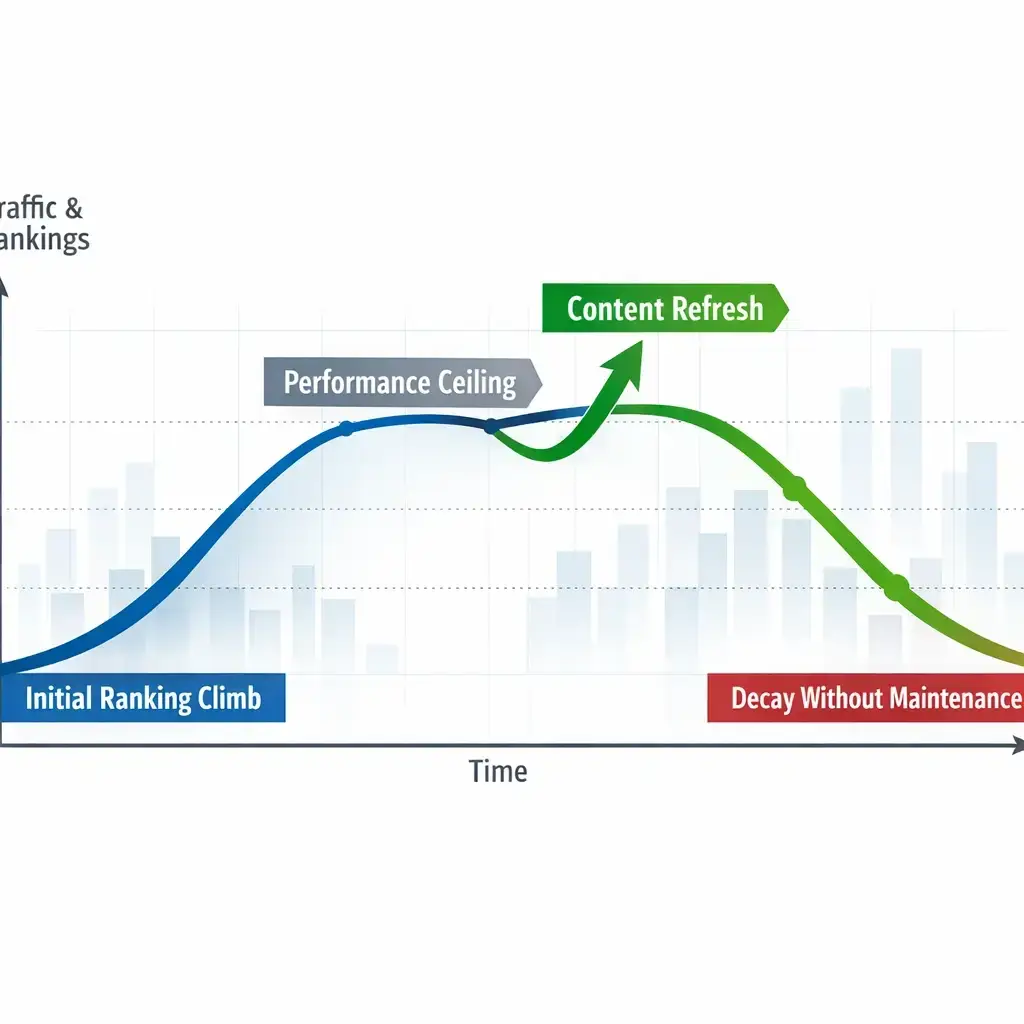
Here is a fact that is almost entirely absent from every blog writing service’s marketing material: published content decays. Rankings drift. Competitors publish fresher, more comprehensive versions of the same posts. Search intent for a given query evolves. Google’s understanding of a topic matures.
Without an active content maintenance program, a blog archive becomes an increasingly poor reflection of your current expertise — and Google treats it that way.
The Three Stages of Content Decay
Stage 1 — Ranking Plateau (Months 3–9)
A post reaches its peak ranking position and stops climbing. This is often misread as “it’s working fine.” In reality, it signals the post has hit the ceiling of its current optimisation level. Targeted updates — adding new sections, strengthening internal links, refreshing data points — frequently push posts past this plateau.
Stage 2 — Slow Ranking Drift (Months 9–18)
Without updates, a post begins to lose ground gradually as competitors improve their versions of the same content. This stage is dangerous because the decline is slow enough to go unnoticed until meaningful traffic has already been lost.
Stage 3 — Content Obsolescence (18+ Months)
Posts with outdated statistics, deprecated product references, or coverage of topics where understanding has evolved become a liability. They signal to both users and search algorithms that your site isn’t actively maintained — a credibility and ranking problem simultaneously.
A reputable blog writing service should have a defined offering around content auditing and refresh cycles, not just new post production. If the service you’re evaluating has no mechanism for revisiting and improving existing content, they’re optimised for their revenue model, not your results.
How to Evaluate AI-Assisted Content Risk for Your Specific Situation
The AI content conversation is one that blog writing services are uniquely incentivised to avoid having honestly. Some providers have built their entire operational model around AI-generated drafts with a light human editing pass. Others produce fully human-written content. Most sit somewhere in between — and very few will tell you exactly where.
This matters, but not in a binary “AI bad, human good” way. The real question is whether the content production method is appropriate for your specific audience, industry, and risk profile.
A Framework for Assessing AI Content Risk
Low Risk Scenarios:
– High-volume, broadly informational content in non-YMYL categories
– Topics where factual accuracy is easily verifiable and unlikely to cause harm
– Content targeting early-stage awareness (top of funnel) where trust signals matter less than coverage breadth
– Businesses where the blog supports brand discoverability, not professional credibility
Elevated Risk Scenarios:
– YMYL industries (health, finance, legal, medical devices) where factual errors have real-world consequences
– Professional services firms where the blog is a direct signal of practitioner expertise
– Technically complex B2B products where shallow, AI-researched content is immediately recognisable to your target audience
– Businesses in regulated industries where content accuracy has compliance implications
The Right Question to Ask Any Service:
“What percentage of the content delivered to clients involves AI-generated drafts, and what is your editorial process for ensuring factual accuracy and brand voice consistency in those cases?”
If they can’t answer that question specifically, you don’t have enough information to assess the risk you’re taking on.
The Accountability Metrics Most Services Don’t Want to Define
Content marketing has a trust problem. Services sell outputs — posts published, words delivered, turnaround times met. Clients want outcomes — traffic, leads, pipeline, revenue. The gap between those two things is where content programs stall and budgets get cut.
The reason blog writing services rarely define accountability metrics upfront is straightforward: connecting content output to business outcomes requires time, attribution sophistication, and a willingness to be measured against something harder than “posts delivered on schedule.”
A serious content partner should be able to define success across three metric tiers within an agreed timeframe.
The Three-Tier Blog Content Attribution Model
Tier 1 — Vanity Metrics (Do Not Use These to Evaluate ROI)
– Total posts published
– Total word count delivered
– Social shares
– Raw pageview counts in the first 30 days post-publish
These numbers are easy to generate and easy to report. They tell you almost nothing about whether your content investment is building a durable search asset or generating business outcomes.
Tier 2 — Progress Metrics (Use These to Evaluate Whether Strategy Is Working)
– Keyword ranking movement for target terms (measured at 60 and 90 days post-publish, not 7 days)
– Google Search Console crawl indexation rate (are posts being indexed, and how quickly?)
– Average time-on-page relative to industry benchmarks (a signal of content quality and intent alignment)
– Internal link click-through rates from cluster posts to pillar pages
– Organic click-through rate (CTR) improvements from title tag testing
Tier 3 — Business Metrics (These Define Whether Content Is Worth the Investment)
– Assisted conversions from organic blog traffic (tracked via GA4 multi-touch attribution)
– Pipeline influenced by organic content (tracked via CRM source data)
– Form submissions, demo requests, or consultation bookings attributable to organic blog entry points
– Email list growth from blog content opt-ins
– Return visitor rate from organic — a signal that your content is building an engaged audience, not just capturing one-time search traffic
A blog writing service that cannot discuss Tier 2 metrics and has no framework for connecting their output to Tier 3 metrics is not a content strategy partner. They’re a production vendor — and there’s nothing wrong with knowing that, as long as you have someone else responsible for the strategy layer.
The threshold for evaluating a content program realistically is a minimum of 90 days for progress metrics and 180 days for meaningful business metric movement. Any service that promises ranking or traffic results within 30 days of publishing is either targeting low-competition queries where the win is small, or overstating what content alone can deliver.
Final Strategic Recommendations for 2026
The content landscape entering 2026 rewards programs built on precision, not volume. Before you sign a contract with any blog writing service, take these three concrete steps to make sure your investment is positioned to compound rather than evaporate.
1. Audit Your Existing Content Baseline with Semrush Content Audit
Before adding new content to a site with unresolved structural problems, run a full content audit using Semrush’s Content Audit tool. Map every existing post to one of three categories: keep and optimize, consolidate, or remove. Services that skip this step and immediately start publishing new posts are building on an unstable foundation. A clean, well-organized content library improves crawl efficiency, reduces keyword cannibalization, and gives new posts a better environment to rank in. This step takes time upfront but dramatically improves the ROI of every post published afterward.
2. Implement a Topic Cluster Architecture Using HubSpot’s Strategy Tool or Ahrefs’ Site Structure Analysis
Isolated blog posts are increasingly difficult to rank and even harder to convert from. In 2026, content programs that outperform are built around deliberately structured topic clusters — a pillar page supported by a network of semantically related cluster posts that link inward. Use Ahrefs to identify the topical gaps in your current content map, or HubSpot’s content strategy module to build the architecture before your writing service publishes a single word. Give your service a clear brief that includes the cluster structure, internal link targets, and which post is the pillar. A service that can work within that architecture is a partner. One that resists it is optimizing for output, not outcomes.
3. Establish a Content Performance Review Cadence with GA4 + Google Search Console Integration
Set up a structured 90-day and 180-day review process before your content program launches, not after. Connect GA4 to Google Search Console so you can track organic landing page behavior, keyword impression growth, and assisted conversion paths in a single workflow. Create a dashboard — Looker Studio offers a free, customizable template for this — and define your Tier 2 and Tier 3 metrics before the first post goes live. When you establish what success looks like before publishing begins, you create accountability that benefits both sides of the engagement. You’ll identify what’s working faster, make smarter reinvestment decisions, and avoid the common mistake of canceling a content program right before it crosses the compounding threshold.
Frequently Asked Questions
How long does it take for blog content to show measurable results in search?
Realistic timelines depend on your domain authority, competition level, and content quality — but a reliable framework is to evaluate keyword ranking progress at 60 to 90 days post-publish and business-level outcomes at 180 days or beyond. Sites with stronger domain authority and well-structured content may see indexation and early ranking movement sooner, but sustainable organic traffic growth is a medium-to-long-term investment. Any service promising significant ranking or traffic results within the first 30 days is either targeting very low-competition terms or overstating what content alone can achieve.
What is the difference between a blog writing service and a content strategy partner?
A blog writing service produces content to a brief — they execute on direction you or your team provide. A content strategy partner contributes to or owns the strategic layer: keyword research, topic cluster architecture, competitive gap analysis, content calendar development, and performance reporting tied to business outcomes. Most businesses need both functions covered, but it is important to know which one a vendor is actually providing. Paying for production without a strategy layer is one of the most common reasons content programs fail to generate ROI.
How many blog posts per month does a content program need to be effective?
There is no universal answer, but frequency should follow strategy, not the other way around. Publishing two deeply researched, well-optimized posts per month that target high-value keywords within a coherent topic cluster will outperform publishing eight thin, loosely related posts. The right cadence depends on your competitive landscape, your team’s capacity to distribute and promote content, and whether you have the internal linking infrastructure to support new posts effectively. Start with quality and structure, then scale volume once the system is proven.
How do I evaluate whether a blog writing service understands SEO beyond basic keyword insertion?
Ask them to explain their approach to search intent alignment, topic cluster architecture, and internal linking strategy. A service with genuine SEO competency should be able to distinguish between informational, navigational, and transactional intent — and explain how their writing decisions reflect those differences. They should also be able to speak to on-page structure beyond keyword density: heading hierarchy, semantic relevance, meta description strategy, and how they approach word count relative to what is already ranking. If the conversation stays at the surface level of “we write SEO-friendly content,” that is a signal to probe further before committing. Our services cover the full strategic layer — from content architecture to performance reporting — for businesses that need more than a production vendor.
Conclusion
Choosing the right blog writing service is not a decision about content — it is a decision about how your business intends to compete for attention and trust over the next two to three years. The services that generate compounding returns are the ones selected with a clear brief, evaluated against the right metrics, and given the strategic infrastructure to perform. The services that disappoint are rarely bad at writing. They are misaligned with outcomes because the engagement was built around deliverables instead of results.
If you are ready to build a content program that connects production to pipeline, we would welcome the conversation. Contact Us