

Why Most Small Business Websites Don’t Generate Leads — And the Architectural Decisions That Determine Whether Yours Will
There is a persistent myth in the small business world that having a professional website is the same as having a website that performs. It is not. Thousands of small businesses are sitting on websites that look polished, load reasonably fast, and tick every surface-level checklist — and yet produce almost no qualified leads, no measurable traffic growth, and no return on the investment it took to build them.
The reason is almost never the visual design. It is almost always the architecture underneath it.
This guide is written for small business owners who are either considering investing in web design services for the first time, or who have already done so and are quietly wondering why the results haven’t materialized. What follows is not a feature checklist or a platform comparison. It is a practitioner-level breakdown of the decisions that separate a website that generates business from one that simply occupies space on the internet.
The Fundamental Problem: Design Quality Is Not the Same as Business Performance
Every agency pitch — and nearly every article on this topic — will show you beautiful portfolio work and talk about mobile responsiveness, fast load times, and clean aesthetics. These things matter. But they are table stakes, not differentiators.
The question that almost no one asks before a web design project begins is this: What is this website actually supposed to do, for whom, and at what stage of their buying decision?
Without a clear answer to that question, even the most technically proficient web design is built on a shaky foundation. You end up with a site that is designed for one type of visitor — usually someone who already knows your business and is ready to call — while ignoring the far larger population of potential customers who are still deciding whether they need your service at all, or whether you are the right provider for their situation.
This is the information architecture problem. And it is where most small business web design projects quietly fail.
Understanding Visitor Intent: The Three Audiences Your Website Ignores
Most small business websites are built for hot buyers. These are visitors who know exactly what they need, know roughly what it costs, and are comparing their final two or three options. The website’s job for this audience is simple: be credible, be clear, and make it easy to contact you.
But hot buyers represent a small fraction of your total web traffic. The majority of visitors fall into two other categories that most small business websites are architecturally unprepared to serve.
Cold Traffic: Visitors Who Are Problem-Aware, Not Solution-Ready
Cold traffic visitors know they have a problem but haven’t yet committed to a solution — or even to your category of solution. A homeowner searching “why is my energy bill so high” is cold traffic for an HVAC company. A restaurant owner searching “how to get more customers” is cold traffic for a marketing agency.
These visitors will not convert on a contact form. They will not call your number. What they will do is read, evaluate, and either decide you are worth remembering or leave and never return. A website without content pathways designed for cold traffic has no mechanism for capturing this audience.
Warm Traffic: Visitors Who Are Evaluating Options
Warm traffic visitors have identified their need and are actively researching providers. They are reading reviews, comparing service pages, and looking for reasons to trust one business over another. For this audience, your website needs to provide detailed social proof, specific outcome-oriented case studies, and clear differentiation from competitors — not just a list of services and a phone number.
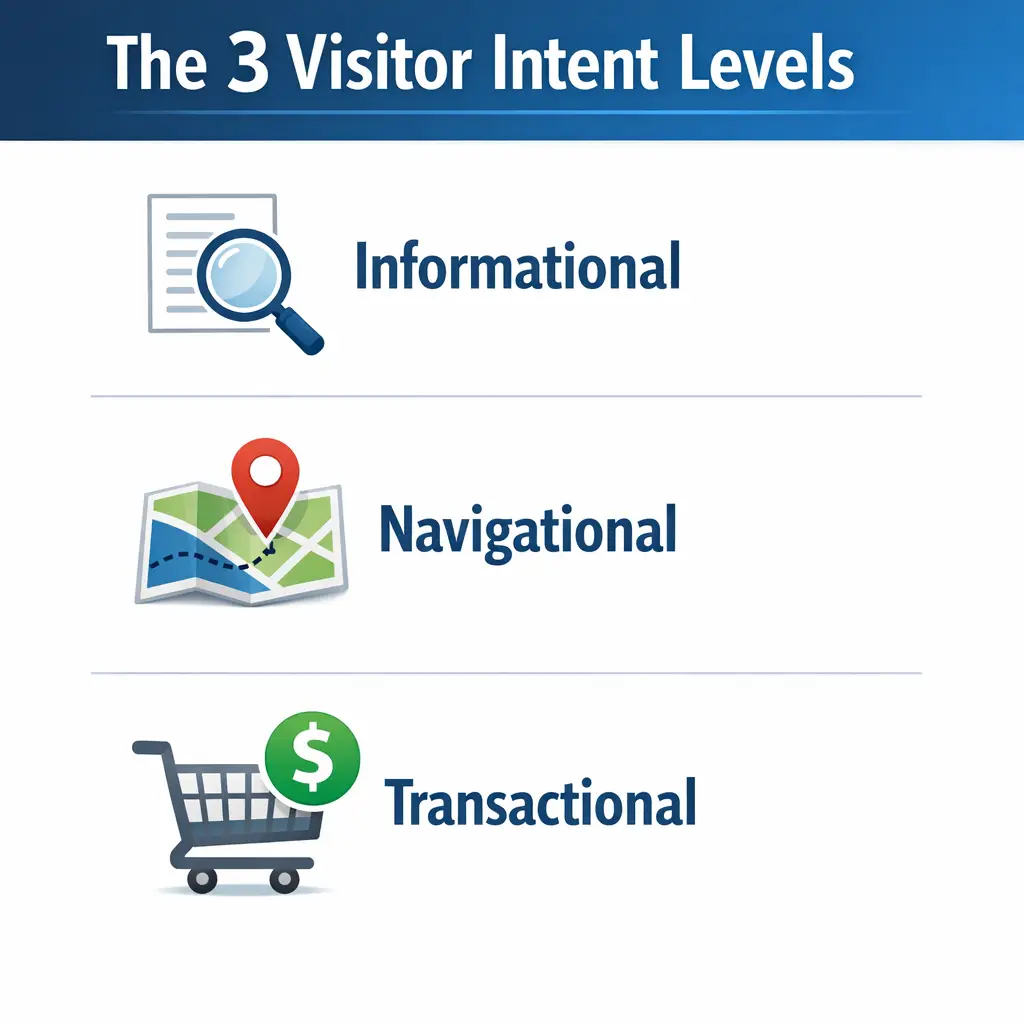
The architectural implication here is significant: serving cold, warm, and hot traffic effectively requires three distinct conversion pathways on the same website. These are not three separate websites. They are intentional structural decisions about what pages exist, how they link to one another, and what action each page is asking the visitor to take.
The Platform Decision: What Nobody Tells You About Technical Debt
Platform comparisons are everywhere. Most of them present the decision as a simple feature matrix: one platform is easier to use, another has more design flexibility, another is better for e-commerce. What these comparisons omit is the concept of technical debt — the accumulated cost of architectural shortcuts that look harmless at launch and become expensive liabilities at scale.
Here is a concrete example. A business owner chooses a drag-and-drop website builder because it is fast to set up and requires no developer. Two years later, that business has grown. They need custom functionality for booking, a more sophisticated blog structure for SEO, and the ability to integrate with their CRM. None of this is possible without rebuilding the site from scratch on a different platform.
The original “easy” choice has now created a forced migration — with all the costs in time, money, content restructuring, and potential SEO disruption that migration entails. This is the technical debt timeline that small business owners are almost never warned about. For a deeper look at why platform selection matters so much, the article Why WordPress Is the Smart Choice for Small Business Websites (And What Most Web Designers Won’t Tell You) walks through these tradeoffs in detail.
The Build-to-Migrate vs. Build-to-Stay Decision Framework
Before selecting any platform, a small business owner should answer two foundational questions:
1. What does this business look like in three years?
If you anticipate significant growth, multiple service lines, a content marketing program, or e-commerce capabilities, the platform decision needs to account for where you are going — not just where you are today. A platform that handles your current needs but hits a ceiling at moderate scale is not a neutral choice. It is a delayed cost.
2. Who will be managing this website after launch?
This is the operator skillset variable. Some platforms require ongoing technical maintenance — security updates, plugin management, hosting configuration. If the person managing your site is not comfortable with that level of involvement, a platform that demands it will either be neglected (creating security vulnerabilities) or will require ongoing developer fees that eliminate the cost advantage of the DIY approach.
The honest answer for most small businesses is that the platform decision is not primarily about features — it is about the realistic intersection of your growth trajectory and your team’s technical capacity.
Platform Considerations: A Functional Comparison
| Factor | Template-Based Builders | Developer-Built Custom Sites |
|---|---|---|
| Time to launch | Fast — days to weeks | Longer — weeks to months |
| Initial investment | Lower | Higher |
| Design flexibility | Constrained by templates | Fully custom |
| SEO architecture control | Limited | Full control |
| Scalability ceiling | Moderate — hits limits at growth stage | High — built to scale |
| Technical maintenance demand | Managed by platform | Requires ongoing developer or internal technical resource |
| Migration risk | High if outgrown | Low — built with longevity in mind |
| Content management ease | High | Depends on CMS chosen |
| Schema markup capability | Limited or absent | Full implementation possible |
| Custom conversion pathway design | Very limited | Fully achievable |
The table above is not an argument for one approach over another. It is a decision tool. The right choice depends entirely on your business’s specific growth context, operational capacity, and performance goals.
The SEO Architecture Problem: “SEO-Ready” Is Not the Same as “Built to Rank”
This distinction is one of the most commonly misunderstood aspects of web design for small businesses, and it has real consequences.
When an agency or platform describes a site as “SEO-ready” or “SEO-optimized,” they almost always mean it is technically crawlable — it has clean URLs, it loads at a reasonable speed, it does not have obvious indexing errors. This is a baseline requirement, not a competitive advantage. It is the equivalent of saying a car is “road legal.” True. Not impressive.
Being built to actually rank in competitive search results requires something different: structural topical authority.
What Topical Authority Means in Practice
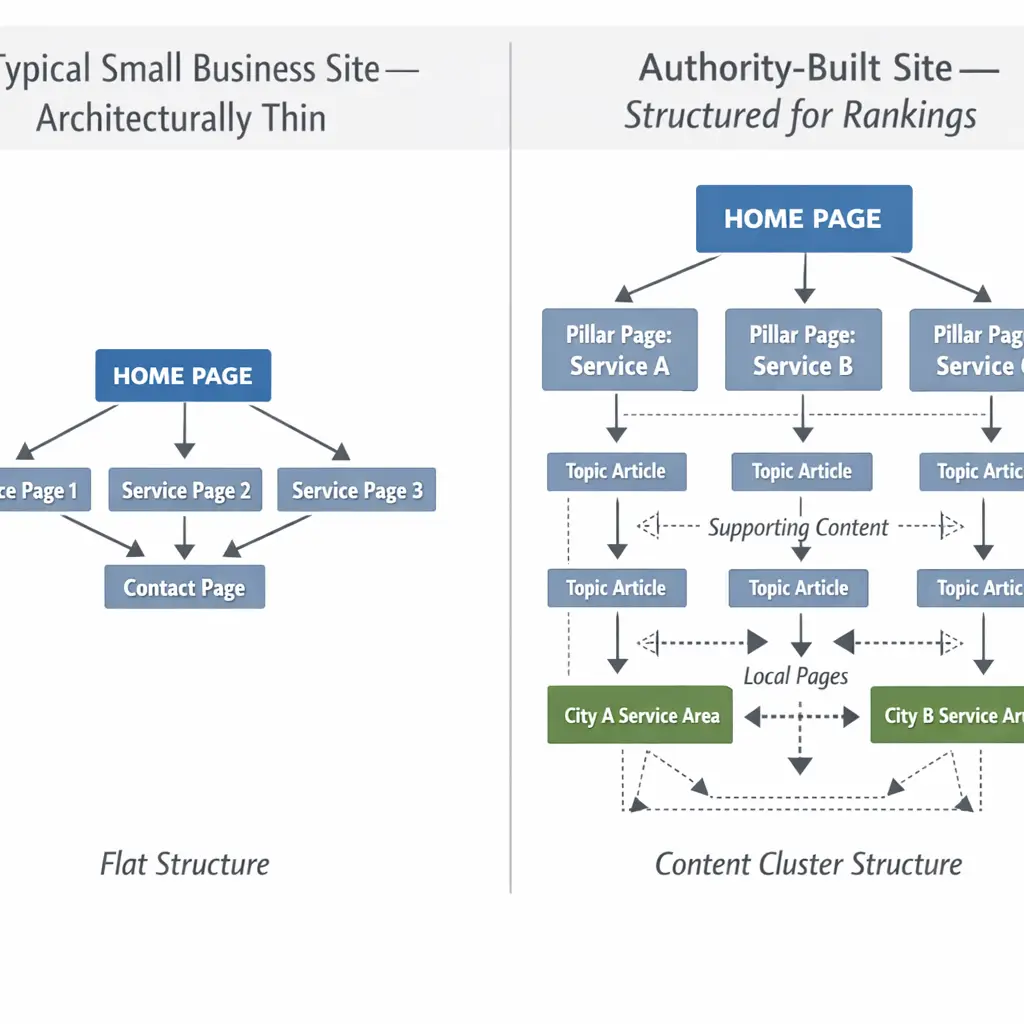
Search engines do not just evaluate individual pages in isolation. They evaluate the relationship between pages — whether a website demonstrates genuine depth and breadth of knowledge on a subject. A small business with five service pages and a homepage is telling Google it knows a little about a lot of things. A small business with structured content clusters — a pillar page on a core service, supporting articles addressing specific questions within that topic, and internal links that connect them logically — is demonstrating expertise.
The architectural difference between these two approaches is not about adding a blog. It is about making a deliberate decision, before the site is built, about how content will be organized, what topics will be owned, and how pages will link to one another to reinforce authority signals.
This is a design decision, not a content decision. And it has to be made before the first page is built.
Local SEO and Web Design: The Specific Signals That Matter
For small businesses serving a defined geographic area, the intersection of web design and local SEO is particularly important — and particularly misunderstood.
Embedding a Google Map on your contact page is commonly treated as the local SEO checkbox. It is not. The signals that actually influence whether your business appears in local search results are structural and require deliberate implementation during the design phase.
The critical local SEO architecture decisions include:
NAP consistency and structured data: Your business name, address, and phone number must appear in a consistent format across every relevant page, and must be marked up with LocalBusiness schema — structured code that tells search engines exactly what your business is, where it operates, and how to reach it. This is not a visual element. It is invisible to the human visitor and essential to search engine interpretation.
Service area page architecture: If your business serves multiple geographic areas, those areas need their own dedicated pages — not because it feels thorough, but because Google surfaces location-specific results based on whether a page explicitly addresses a geographic query. A single “We serve the entire region” sentence on your homepage does not accomplish this.
On-page signals for local intent queries: Pages targeting “near me” or city-specific queries require specific structural elements — the geographic qualifier in the page title, H2 headers, meta description, and naturally within the body content. This is not keyword stuffing. It is intent alignment between what the searcher types and what the page explicitly communicates.
These are not afterthoughts you add post-launch. They are architectural decisions that need to be built into the site’s structure from day one. The article What Local SEO Companies Won’t Tell You covers many of these structural decisions in greater depth and is worth reviewing before any web design project begins.
The Conversion Infrastructure Problem: What Happens After the Visitor Arrives
A well-designed website that drives qualified traffic still fails if the conversion infrastructure is absent or broken. Conversion infrastructure refers to the set of tracking, testing, and optimization systems that tell you what visitors are doing on your site — and allow you to improve it based on actual behavior rather than assumption.
Most small business websites launch with none of this in place. Analytics may be installed, but it is rarely configured to track meaningful events — form submissions, call button clicks, scroll depth, or time on key pages. Without this data, there is no way to evaluate whether the site is working, no way to identify where visitors are dropping off, and no rational basis for improvement decisions.
The First 90 Days Post-Launch: Your Highest-Leverage Window
The period immediately following a website launch is the most important and most neglected phase of any web design project. During the first 90 days:
- Search engines are actively recrawling and re-evaluating the site’s structure and content
- Initial conversion data begins to surface, revealing real behavioral patterns
- Quick iterative fixes — adjusting headline copy, repositioning a call-to-action, improving a page’s internal linking — have a disproportionate impact because the baseline is low and any improvement is measurable
Most small businesses treat launch as the finish line. In practice, it is the starting line. The agencies and business owners who understand this treat the post-launch period as a structured optimization phase, not an afterthought.
A basic post-launch accountability framework should include:
- Week 1–2: Verify all tracking is functioning correctly. Confirm form submissions are being captured, analytics events are firing, and search console is connected and showing no critical errors.
- Week 3–4: Review initial crawl data. Check for indexing issues, broken internal links, or pages that have been inadvertently blocked from search engines.
- Month 2: Review early behavioral data. Which pages have the highest exit rates? Where are visitors entering the site, and what is the path they take from there? Are conversion events occurring at expected rates?
- Month 3: Run the first structured optimization test. This may be as simple as revising the above-the-fold copy on your primary service page, adjusting the placement of a contact form, or adding a stronger trust signal to a page with a high bounce rate.
This framework does not require sophisticated tooling. It requires discipline and a clear understanding that a website is a living business asset, not a completed project.
Resolving Stakeholder Confusion Before the Project Begins
One of the most reliable predictors of a failed web design project is stakeholder misalignment — a situation where the business owner, sales team, and whoever manages content all have different and unspoken assumptions about what the website is supposed to accomplish.
The owner wants a site that reflects the brand’s premium positioning. The sales team wants a lead form above the fold on every page. The person who will manage content wants an easy-to-update blog. These are not mutually exclusive goals — but if they are never explicitly discussed and prioritized before the project begins, they create a design-by-committee dynamic that produces a site that satisfies no one and performs for no one.
The resolution is straightforward: before any design work begins, every stakeholder should be able to answer three questions with the same answer:
- Who is the primary visitor this website is designed for? (Specific demographic, intent level, and stage of the buying decision)
- What is the single most important action we want that visitor to take? (Not a list — one primary conversion goal)
- How will we know, in measurable terms, whether the website is achieving that goal? (A specific metric with a target — not “more leads” but “X form submissions per month at X% close rate”)
When everyone involved in the project can answer these three questions with consistency, the design brief becomes significantly sharper, the scope becomes more disciplined, and the outcome becomes more predictable.
What a High-Performing Small Business Website Actually Requires
Drawing together the concepts covered above, the differentiating characteristics of a small business website that generates measurable results are not primarily aesthetic. They are structural and strategic.
A site built to perform will exhibit the following characteristics:
- Intent-mapped information architecture — pages and content pathways designed to serve cold, warm, and hot traffic with different conversion goals
- Platform selection aligned with growth trajectory and operator capacity — not chosen by default or convenience, but as a deliberate long-term decision
- Structural topical authority — content clusters organized to signal expertise to search engines, not just individual pages optimized in isolation
- Local SEO architecture — LocalBusiness schema, NAP consistency, and service area pages built in from launch
- Conversion infrastructure — event tracking, form submission capture, and behavioral analytics configured before the first visitor arrives
- Post-launch optimization discipline — a defined 90-day review and iteration process, not a “launch and move on” mentality
- Stakeholder alignment on primary conversion goal — a single measurable outcome that every design decision is evaluated against
These are the decisions that separate a website that looks good from a website that works. And they are the decisions that most web design conversations — and most web design agencies — never address.
How Mongoose Digital Marketing Approaches Web Design for Small Businesses
At Mongoose Digital Marketing, web design is not treated as a standalone deliverable. It is treated as one integrated component of a broader growth strategy — and every design decision is made with the end goal in mind: more qualified leads, more conversions, and a measurable return on your investment.
Our process starts with the strategic questions that most agencies skip. We identify your primary audience, map their intent levels, establish the conversion goal hierarchy, and build the site architecture before a single visual element is designed. Local SEO architecture, schema markup, and analytics configuration are built in from the start — not added as afterthoughts.
We also believe that the agency relationship does not end at launch. Our post-launch support is structured around the 90-day optimization window, because that is where real performance gains are made and where we can demonstrate the kind of results that matter: leads in your pipeline, rankings moving in the right direction, and a website that earns its place as your hardest-working business asset.
If you are a small business owner ready to invest in web design that is built to perform — not just to exist — we would like to have that conversation. Contact Mongoose Digital Marketing for a free consultation, and let us show you what a strategically built website looks like in practice.
Strategic Recommendations for Small Business Web Design in 2026
The web design landscape is shifting quickly, and small businesses that make the right decisions now will have a meaningful advantage over competitors who are still treating their websites as static brochures. Here are three specific actions worth prioritizing heading into 2026.
1. Audit and implement AI-assisted chat for lead capture.
Tools like Tidio or Drift allow small businesses to deploy conversational capture on high-intent pages — service pages, contact pages, and pricing pages — without requiring a full-time staff member to manage responses. When configured correctly, these tools extend your conversion window beyond business hours and can significantly reduce the gap between a visitor’s interest and your first point of contact.
2. Prioritize Core Web Vitals as a standing performance benchmark.
Google’s performance signals continue to carry weight in local search rankings. Use Google Search Console alongside PageSpeed Insights to establish a baseline for your site’s loading performance, interactivity, and visual stability. Treat these metrics as quarterly benchmarks — not a one-time check — and ensure your web design partner has a clear process for maintaining them as your site evolves. If you suspect your current site may already be underperforming on technical benchmarks, the article The Small Business Technical SEO Audit: 10 Hidden Website Issues That Are Killing Your Google Rankings provides a practical framework for identifying and resolving those issues.
3. Invest in a localized content strategy tied to your service architecture.
In 2026, the small businesses winning in local search are not the ones with the most pages — they are the ones with the most strategically structured pages. Work with your web design and digital marketing partner to build location-specific service pages that are aligned with how your target audience is actually searching. This approach compounds over time and turns your site into a durable, long-term lead generation asset.
Frequently Asked Questions
What does a web design service for small businesses actually include?
A professional web design service for small businesses typically includes site architecture planning, visual design, copywriting or copy integration, mobile optimization, SEO foundation setup, and launch support. However, the most effective services go further — incorporating local SEO structure, analytics configuration, conversion goal mapping, and a post-launch review process. The deliverable is not just a finished website; it is a site built to attract the right traffic and convert that traffic into real business outcomes.
How long does it take to build a website for a small business?
Timelines vary depending on the size and complexity of the project, but most small business websites move through the discovery, design, development, and launch phases over several weeks. Projects that begin with a thorough strategic foundation — audience mapping, site architecture, and conversion goal alignment — tend to move more efficiently because the decision-making framework is already in place. Rushed timelines that skip the strategic phase often result in revisions, rework, and underperforming sites that require significant investment to correct.
Why is local SEO important in web design for small businesses?
Local SEO is not a feature you add to a website after it is built — it is a structural decision that should be made before the first page is designed. URL structure, heading hierarchy, schema markup, Google Business Profile integration, and location-specific page architecture all influence how search engines understand and rank your site for local queries. A website that is built without local SEO in mind from the start will almost always require costly remediation to compete in local search results.
How do I know if my current website is actually generating leads?
The clearest indicator is whether your website has defined conversion goals configured in an analytics platform and whether those goals are being tracked consistently. If you cannot answer questions like “how many visitors contacted us through the website last month” or “which pages are driving the most form submissions,” your site is not being used as a performance asset — it is being treated as a passive presence. A proper analytics setup, tied to your primary conversion goal, gives you the data needed to make informed decisions and improve results over time.
Conclusion
For small businesses that want a website built to generate real, measurable results — not just occupy space on the internet — the difference comes down to choosing a partner who understands both web design and the broader digital marketing strategy behind it. Mongoose Digital Marketing brings that integrated approach to every project, combining professional web design services with local SEO expertise to ensure your site is found by the right people and built to convert them into customers. If you are ready to treat your website as the growth asset it should be, Contact Mongoose Digital Marketing and let us start that conversation.