
Key Takeaways
- The discovery phase of a website design agency engagement — not the design itself — is the single greatest predictor of whether a project delivers measurable business results or collapses into revision cycles.
- Portfolio quality is a lagging indicator; evaluating an agency’s current process documentation and team structure reveals far more about what your project will actually look like.
- Platform lock-in is a real, financially consequential risk that most agencies will not voluntarily disclose before you sign a contract.
- Web design and web development are distinct disciplines requiring separate expertise, and conflating them is one of the most common reasons business owners end up with beautiful sites that underperform.
- A website launch is not the finish line — agencies that don’t build post-launch optimization into the engagement from day one are treating your site as a product, not a growth asset.
Choosing a website design agency is one of the highest-leverage decisions a business owner in Dayton, Kettering, or anywhere across the Miami Valley can make. Get it right, and your website becomes your best-performing sales asset — generating leads, ranking in search, and converting visitors into customers around the clock. Get it wrong, and you’re looking at sunk time, a site that underperforms, and the painful process of migrating away from a build that was never set up for growth.
The problem is that most of the information available on this topic doesn’t go deep enough to help you make a genuinely informed decision. Agency directories point you to star ratings. Portfolio galleries show you beautiful screenshots. YouTube videos walk you through how to start your own agency. None of it addresses the real mechanics of what separates an agency that drives results from one that delivers a finished website and disappears.
This guide does. Whether you’re a Beavercreek retailer evaluating your first professional web presence, a Centerville service business preparing to replace an aging site, or a Springboro company that’s been burned by an agency before, what follows will give you the strategic framework to evaluate, select, and manage a website design agency relationship with your eyes open.
What a Website Design Agency Actually Does — and What It Doesn’t
Before evaluating any agency, you need clarity on what you’re actually buying. The industry uses “web design” as a catch-all term that papers over a critical distinction most buyers never learn until it causes problems.
Web Design vs. Web Development: A Distinction That Matters
Web design encompasses the visual and user experience layer of a site: information architecture, wireframing, interface design, typography, color, layout, and the overall logic of how a user moves through the site. This is a strategic and creative discipline.
Web development is the technical execution layer: writing the code, configuring databases, building server-side logic, integrating third-party tools, and ensuring the site actually functions as designed. This involves front-end development (what the browser renders) and, for more complex builds, back-end development (server logic, databases, APIs).
These are not the same skill set. Some agencies house both under one roof with dedicated specialists for each. Others have designers who can build simple sites using platforms like WordPress but lack the development depth for custom functionality. Others outsource one or both disciplines to contractors or offshore teams without making this transparent.
Why does this matter to you? Because if the agency you hire doesn’t clearly separate these responsibilities — or doesn’t have genuine depth in both — you’ll discover the gap at the worst possible moment: when a feature needs to be built, when a bug appears after launch, or when your site needs to scale.
Questions to ask any agency:
– Who on your team handles design, and who handles development?
– Are those team members full-time employees or contractors?
– What happens if the developer you assign to my project leaves the agency?
The Services a Full-Service Agency Should Provide
A legitimate website design agency offering full-service capability should cover:
| Service Area | What It Includes | Why It Matters |
|---|---|---|
| Discovery & Strategy | Stakeholder interviews, analytics audit, UX competitive analysis, conversion architecture planning | Sets the entire foundation for the project — skipping this phase guarantees misalignment |
| UX & Information Architecture | Sitemap development, user journey mapping, wireframing | Determines whether users can actually find what they need |
| Visual Design | Interface design, brand alignment, responsive layout design | Affects credibility, trust, and on-page engagement |
| Front-End Development | HTML/CSS/JS build, CMS integration, responsive implementation | Determines load speed, accessibility, and search engine crawlability |
| Back-End Development | Custom functionality, database architecture, API integrations | Required for anything beyond a standard informational or marketing site |
| SEO Foundation | On-page structure, schema markup, Core Web Vitals optimization, metadata | A site that can’t be found isn’t generating leads regardless of how good it looks |
| Analytics & Tracking Setup | GA4 configuration, conversion event tracking, heatmap installation | Without baseline tracking, post-launch optimization is guesswork |
| Post-Launch Support | CMS training, bug resolution SLA, performance monitoring | Determines whether you’re left alone after launch or supported through the growth phase |
An agency that glosses over any of these areas during a sales conversation — particularly discovery and post-launch support — is telling you something important about how they operate.
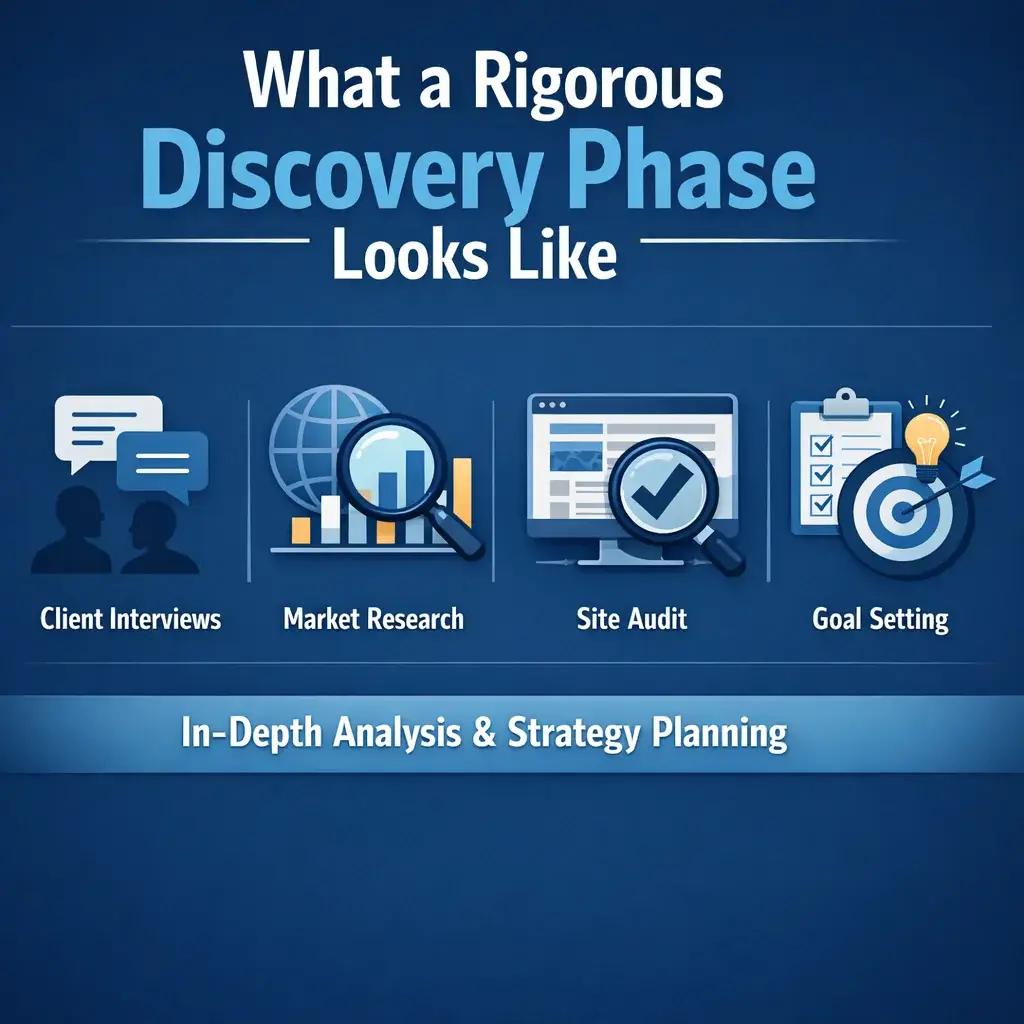
The Discovery Phase: Where Agency Value Is Won or Lost
This is the most underappreciated aspect of any agency engagement, and it’s where the quality gap between strategic agencies and production shops is most visible.
A production shop asks you what you want and then builds it. A strategic agency asks why you want it, who it’s for, what behavior it needs to drive, and what your current data says about what’s working and what isn’t — before a single design decision is made.
What Skipping Discovery Actually Costs You
When an agency skips or rushes discovery, the downstream effects are predictable:
- Scope creep — Stakeholders surface requirements mid-project that a thorough discovery would have captured upfront, triggering change orders and timeline extensions.
- Revision cycles — Without agreed-upon user journey logic and conversion goals, design feedback becomes subjective. Rounds of revisions that could have been avoided multiply.
- Post-launch underperformance — A site built around aesthetic preferences rather than behavioral data may look excellent and generate no leads. This is far more common than the industry likes to admit.
- Misaligned measurement — If nobody defined what success looks like before the build started, nobody knows whether the finished product achieved it.
Discovery Questions That Separate Strategic Agencies from Order-Takers
Use these during your agency evaluation calls. A strategic agency will answer them fluently. An order-taking shop will pivot quickly to talking about design aesthetics or their portfolio.
- “Walk me through your discovery process. What deliverables does it produce, and how do those inform the design phase?”
- “What data do you review from a client’s existing site before designing a new one?”
- “How do you map the conversion architecture before wireframing begins?”
- “How do you handle it when stakeholders within our organization disagree on priorities?”
- “Can you show me a discovery deliverable from a past project — a sitemap, a user journey map, or a competitive UX analysis?”
If an agency can’t answer these questions with specificity, or if they try to position discovery as an optional add-on, you have your answer about their strategic depth.
Why Portfolio Quality Is a Lagging Indicator
Every directory, every agency showcase, and every vendor recommendation points you toward portfolios as the primary evaluation mechanism. This is understandable — portfolios are visual, easy to assess, and immediately compelling. It’s also a flawed primary evaluation strategy.
A portfolio shows you what an agency was capable of producing 12 to 24 months ago, under different team compositions, often on different budgets, frequently with brand assets provided by the client’s own design team. What it doesn’t show you is what your project will actually look like — who will work on it, how decisions will be made, and whether the process will be collaborative or chaotic.
The Portfolio Inflation Problem
Portfolio inflation is real and rarely discussed. It occurs when an agency showcases work in which the client’s internal team, external brand consultants, or previous agencies did the heavy creative lifting. The agency handled the build, not the strategy. The result looks stunning in a portfolio but reflects the client’s capability, not the agency’s.
You can’t reliably identify inflated portfolio entries from looking at the work. The better diagnostic is asking the agency to walk you through their specific contribution to a project — what strategic decisions they made, what they pushed back on, what they would do differently.
What to Evaluate Instead
| Evaluation Factor | Why It Matters | What to Ask |
|---|---|---|
| Current team structure | Who actually works on projects today — not who pitched you | “Will the person leading my project be on this call? Can I meet them?” |
| Process documentation | Does the agency have a published methodology? Can they articulate it? | “Can you walk me through your project process from kickoff to launch?” |
| Past decision logs | Can they explain why specific design decisions were made on past projects? | “On this project in your portfolio, what conversion problem were you solving with that layout?” |
| Post-launch performance data | Do they know how their sites perform after launch? | “Can you share performance benchmarks from a site you launched in the past 12 months?” |
| Recency of work | How recent are the portfolio pieces, and do they reflect current capabilities? | “What was the most recent project you completed, and can you tell me about it?” |

The Platform Lock-In Risk No Agency Will Volunteer
This is the conversation almost no agency initiates before you sign a contract — and it’s one of the most financially consequential issues you can face as a business owner in Huber Heights, Miamisburg, or anywhere else in the region.
When an agency builds your site, the technology choices they make determine your long-term independence. Some of those choices constrain your ability to edit your own content, integrate new marketing tools, or switch agencies in the future without an expensive migration.
What Platform Lock-In Looks Like in Practice
- Proprietary theme frameworks: The agency builds on a theme structure only they know how to modify. Simple changes require you to call them and pay for their time.
- Heavily customized page builders: Visual builders like Divi or Elementor, when heavily customized, create databases of shortcodes and proprietary data structures that don’t translate cleanly to other systems.
- Agency-controlled hosting with CMS access restrictions: Your site lives on their servers, and your access to the underlying files is deliberately limited.
- Headless CMS setups with undocumented custom APIs: Powerful for performance, but if the documentation exists only in the minds of the agency’s developers, you’re dependent on them indefinitely.
None of these architectures are inherently wrong. Some of them are the right technical choice for specific projects. The problem arises when the choice is made for the agency’s convenience rather than your independence — and when nobody discloses the implications before you sign. If you’re concerned about which platform gives you the most long-term control and flexibility, the article Website Creators: What Platforms Hide From You breaks down exactly what the major CMS options don’t advertise upfront.
Questions to Ask Before Signing Any Contract
- “Who owns the website files after launch — us or the agency?”
- “Can we take the site to another host or agency if we choose to in the future?”
- “What CMS will the site be built on, and will we receive training on editing it ourselves?”
- “If we part ways, what does the handover process look like, and what do we receive?”
- “Are there any ongoing fees required to maintain functionality you’re building in?”
Agencies that are genuinely client-first will answer these questions without hesitation and often proactively cover them. The best agencies build sites on documented, open platforms and provide meaningful CMS training at launch — because they understand that an empowered client is a long-term client, not a dependent one.
How to Evaluate an Agency’s Strategic Depth — Not Just Their Sales Pitch
The agency sales call is a performance. That’s not a cynical observation — it’s a structural reality. The people on the call are often the most experienced and polished communicators in the organization. Their job is to make you feel confident. Your job is to see past the presentation and evaluate the underlying operational reality.
Red Flags That Sound Like Green Lights
Some of the most reassuring things agencies say during a sales process are actually warning signs when examined carefully:
“We’ve worked with businesses just like yours.”
Ask for specifics. Which businesses? What results did they achieve? Can you speak with that client directly? Vague similarity claims are a substitute for demonstrable, relevant experience.
“Our process is very collaborative.”
This sounds ideal. But what does it actually mean? How many rounds of revisions are included? Who has final decision authority when feedback conflicts? What’s the documented process for resolving disagreements? “Collaborative” without structure is just another word for revision hell.
“We’ll make sure you love the final product.”
Aesthetic satisfaction is not a business outcome. A site you love that generates no leads has failed. Push back: “What does success look like in measurable terms, and how will we track it?”
“We use the latest AI tools to speed up delivery.”
This may be true and valuable — but ask what phases those tools are applied to, who reviews the output, and whether AI-assisted content or design is disclosed to you. Efficiency tools can reduce timelines appropriately; they can also mask reduced strategic investment in your project.
The Agency Staffing Model Question
Ask directly: “Will my project be handled by full-time employees, contractors, or offshore partners?”
There is no universally correct answer. A hybrid staffing model can work well when managed with transparency and strong project management. But a project managed by a rotating roster of offshore contractors with no continuity of institutional knowledge about your brand is a materially different engagement than one handled by a dedicated in-house team — and the sales call won’t surface that distinction unless you ask.
Post-Launch: Why the Launch Is the Beginning, Not the End
The website launch is not the destination. It’s the baseline. The moment a site goes live, it begins generating data about user behavior, conversion rates, traffic sources, and technical performance — data that should immediately feed into an optimization cycle.
Agencies that treat launch as the end of their responsibility are delivering a product, not a growth partnership. The distinction matters enormously for the return you’ll see from your investment.
What a Performance-Oriented Post-Launch Plan Includes
- Analytics baseline documentation: Before the site changes again, the agency should capture baseline metrics — organic traffic, conversion rate by page, bounce rate by channel, and page load performance scores.
- Conversion event verification: Every lead form, phone number click, booking widget, and CTA should be tracked as a conversion event in GA4. If it isn’t tracked, it didn’t happen in data terms.
- First-month performance review: A structured review of early data, identifying any UX friction points that emerged under real traffic conditions.
- A/B testing roadmap: For key conversion pages, there should be a hypothesis-driven testing plan to improve performance beyond the launch baseline.
- SEO monitoring: Rankings, indexation status, Core Web Vitals scores, and crawl errors should be monitored and addressed in the weeks following launch.
If you ask an agency about their post-launch process and they describe it primarily as a bug-fix window, you have a clear signal about how they think about your site’s lifecycle. For a deeper look at what separates sites that keep improving from those that stagnate, the article Conversion Rate Optimisation: Stop Doing It Wrong covers the structured approach to turning post-launch data into measurable performance gains.
What the Right Agency Relationship Looks Like for Dayton-Area Businesses
The Miami Valley business landscape — from the manufacturing and logistics operations around Huber Heights and Miamisburg to the professional services concentration in Centerville and Beavercreek, to the retail and restaurant ecosystem in downtown Dayton — is diverse enough that no single website template or agency approach fits every business.
The agencies worth working with in this market understand that distinction. They don’t build the same site structure for a Kettering med spa that they’d build for a Springboro B2B software company. They ask about your specific customer acquisition channels, your local search competitive landscape, and your capacity to produce ongoing content — and they design a web presence that accounts for all of it.
That specificity of thinking is what separates an agency that helps you grow from one that delivers a finished file and sends an invoice.
At Mongoose Digital Marketing, our approach to every website engagement starts with understanding your business outcomes first. Design follows strategy. Development follows design. And the launch triggers an optimization cycle, not a closeout invoice. If you’re ready to talk about what a results-driven web presence looks like for your specific business in the Dayton area, start with a free consultation and bring the hard questions — we’ll give you straight answers.
Strategic Recommendations for 2026
As the web design landscape continues to shift, Dayton-area businesses that plan ahead will be better positioned to outperform competitors who treat their websites as static assets. Here are three specific moves worth prioritizing in the coming year:
1. Invest in AI-Assisted Personalization Tools
Platforms that adapt on-page content, calls-to-action, and navigation paths based on visitor behavior and traffic source are no longer reserved for enterprise budgets. Tools like Mutiny, Optimizely, or HubSpot’s smart content features are increasingly accessible to mid-market businesses and can meaningfully improve conversion rates for sites already generating solid traffic. If your agency isn’t discussing personalization as part of your 2026 roadmap, raise it directly.
2. Prioritize Core Web Vitals as a Competitive Differentiator
Google’s page experience signals are only becoming more influential in local search rankings. Businesses in competitive Dayton-area markets — particularly in professional services and healthcare — should commission a technical performance audit and treat the findings as a roadmap item, not a nice-to-have. Agencies that build on modern frameworks with performance baked in give you a structural advantage that’s difficult for slower-moving competitors to close quickly. The article Web Design Best Practices for SEO in 2026 outlines the specific technical standards your site should meet heading into the year ahead.
3. Build a Structured Content Refresh Cycle
The websites that consistently outperform in organic search aren’t necessarily the ones that launched most recently — they’re the ones that update, expand, and improve content on a predictable schedule. Work with your agency or content partner to establish a quarterly content audit process that identifies underperforming pages, updates outdated information, and adds depth to topics where you have genuine authority. For Dayton businesses competing in regional search, this compounds over time in ways that one-time launches simply cannot replicate.
Frequently Asked Questions
How do I know if a website design agency understands my local market in Dayton?
Ask them directly about businesses they’ve worked with in the Miami Valley region and what specific challenges those clients faced. A capable local agency should be able to speak to the competitive landscape in submarkets like Centerville, Beavercreek, or Kettering without prompting — and they should ask you equally specific questions about your customer base, service area, and local competitors before ever discussing design.
What should I expect from a website design agency after my site launches?
Post-launch support should go beyond fixing bugs. A results-oriented agency will monitor Core Web Vitals performance, track keyword rankings and indexation, analyze early user behavior data, and bring optimization recommendations based on what real traffic reveals. If an agency frames the launch as the finish line, that’s a meaningful signal about how they’ll serve your business long-term.
How long does a professional website design project typically take?
Timelines vary significantly based on the scope of the project, the complexity of functionality required, and how quickly your team can provide content, feedback, and approvals. A focused small-business site may move from strategy to launch in six to ten weeks, while a more complex site with custom integrations, e-commerce functionality, or a large content library may take several months. The agencies worth working with will give you a realistic timeline upfront and explain what drives it — not simply tell you what you want to hear.
Should my Dayton business work with a local agency or a national firm?
Both can produce quality work, but there are real advantages to working with an agency that understands the regional market, is reachable during your business hours, and has a stake in your local success. A national firm may bring broad capabilities, but a locally rooted agency tends to ask better questions about your specific customer geography, your regional competitive landscape, and the nuances of your market — factors that shape strategy well before they shape design.
Conclusion
For businesses across Dayton, Kettering, Beavercreek, and Centerville, the difference between a website that generates leads and one that simply exists often comes down to the agency relationship behind it — specifically, whether strategy drives the work or whether aesthetics do. Mongoose Digital Marketing proudly serving the Dayton area brings a process built around your business outcomes first, with web design and local SEO strategy that’s shaped by your market, your customers, and your growth goals. If you’re ready to have that conversation, Contact Mongoose Digital Marketing and let’s talk about what your web presence should actually be doing for your business.