
Key Takeaways
- An integrated marketing company manages strategy, creative, media, and web development under one roof, which keeps attribution unified and holds a single partner accountable for the whole system rather than individual channel metrics.
- “Local” agency knowledge translates into a material strategic advantage when your target customers are concentrated in the Miami Valley; it matters far less when your audience is national and execution infrastructure is what actually determines results.
- Agency credentials measure different dimensions of quality: platform certifications signal technical proficiency, client satisfaction ratings signal service delivery, and culture awards signal internal stability, treating them as equivalent leads to poor selection decisions.
- Dayton-area businesses at different growth stages need fundamentally different things from a marketing partner; the right agency fit at startup stage is rarely the right fit at regional expansion stage.
- A marketing company that cannot explain how its services interact as a system is selling a menu, not a strategy.
Choosing a marketing company in Dayton comes down to three decisions that most buyers conflate into one: whether you need integrated or specialist support, whether local market knowledge is a functional advantage for your specific audience, and whether a given agency’s accountability structure aligns with your business outcomes. Get those three right and the selection becomes straightforward. Skip them and you end up comparing logo walls and credential badges, which tells you almost nothing about whether an agency will actually grow your business.
The Dayton market has more than 20 agencies listed across directories like ClearlyRated, ranging from boutique specialists to full-service firms with decades of history. The options are real. The frameworks for evaluating them are largely absent from the agencies’ own content, which is precisely where this guide fills the gap.
Illustration, not a photograph of a completed client project.
Why Integration Is a System Question, Not a Service List
Every marketing agency in Dayton presents a list of services. Web design, SEO, PPC, social media, branding, the menus are nearly identical across the top competitors. What those lists never explain is why the services are more valuable together than they are separately, and when that integration actually matters for a buyer.
Here is the logic that competitor content leaves out: when strategy, creative, media buying, and web development exist inside separate vendors, attribution breaks down. Each vendor optimizes for its own channel metrics rather than a shared business outcome. Your SEO agency reports keyword rankings. Your PPC agency reports cost per click. Your web designer reports bounce rate. Nobody owns the number that actually matters: qualified leads converted into revenue.
A single integrated agency holds all the variables. When a campaign underperforms, there is one team examining whether the landing page, the ad targeting, the keyword match type, or the offer itself is the problem. When it overperforms, the same team knows which inputs to scale. That is the actual case for integration, and it only applies if the agency genuinely runs those functions as a connected system rather than as parallel service lines that happen to share a billing relationship.
Before engaging any marketing company in Dayton, ask this directly: how do your SEO and PPC teams share data, and how does that data inform web design decisions? The answer will tell you immediately whether integration is a practice or a positioning statement. For a deeper look at what this coordination should look like in practice, the article What Does a Digital Marketing Agency Do for Local Businesses? breaks down the functional responsibilities buyers should expect from a genuinely integrated partner.
Have a question about marketing company dayton? Send a message with the situation you are working through and the decision you need help with. Ask for a written explanation of possible next steps.
When “Local” Is a Real Advantage and When It Is Not
Dayton agencies consistently use geographic identity as a trust signal. Being based in the Miami Valley is treated as self-evidently valuable. It is not always. Local market knowledge creates a genuine strategic advantage in specific, testable conditions.
Local knowledge matters when:
- Your target customers are geographically concentrated in the Dayton metro, Kettering, Beavercreek, Centerville, Huber Heights, Miamisburg, or Springboro areas
- Consumer behavior in your category is shaped by local factors that a distant agency would need months to learn
- Your media strategy includes channels where local relationships affect placement quality or cost efficiency
- Your SEO strategy depends on capturing local search intent tied to specific Miami Valley neighborhoods or service areas
Local knowledge adds limited value when:
- Your target audience is distributed nationally and local consumer behavior patterns are not your primary variable
- Your marketing challenge is primarily technical (site speed, structured data, conversion rate optimization) where geography is irrelevant
- Your paid media campaigns target by industry or intent signals that apply equally across markets
The question to ask an agency claiming local advantage: what does your Dayton-specific knowledge actually change about the strategy you would build for my business? A vague answer about relationships and community roots is not a strategy. A specific answer about search behavior patterns, competitive landscape in your category, or local media dynamics is. The article on Digital Marketing Dayton OH: Local Strategies That Work outlines what genuine local strategic thinking looks like in practice for Miami Valley businesses.
How to Weight Agency Credentials Correctly
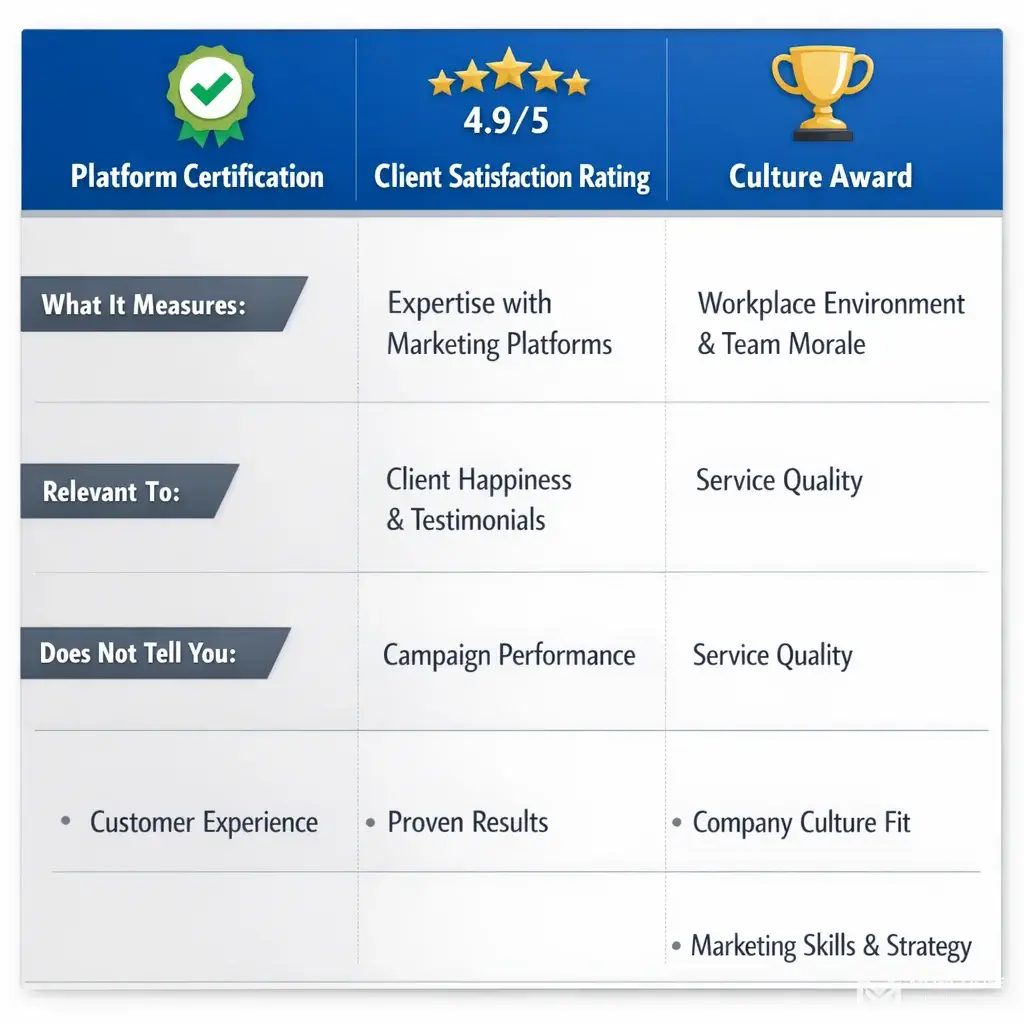
Illustration, not a photograph of a completed client project.
Credentials appear across nearly every agency website in the Dayton market. Google Partner status, BBB recognition, best-places-to-work designations, five-star review counts. The mistake buyers make is treating these as a uniform quality score. They measure entirely different things.
| Credential Type | What It Measures | Relevant When | Does Not Tell You |
|---|---|---|---|
| Google Partner Status | Platform proficiency in Google Ads products | Your primary need is paid search performance | Whether strategy quality or creative is strong |
| Client Satisfaction Rating (e.g., ClearlyRated) | Service delivery experience across clients | You want to assess communication and reliability | Whether their channel expertise matches your needs |
| BBB Ethics Award | Business conduct and complaint resolution | You are concerned about contractual fairness | Technical capability or marketing effectiveness |
| Best Places to Work | Internal culture and employee retention | Agency stability and low staff turnover matter to you | Results delivered to clients |
| Industry Awards (e.g., AAF Dayton) | Creative quality as judged by peers | Brand and creative output quality is a priority | ROI generated for clients |
Weight credentials by the problem you are trying to solve. If your business needs qualified leads from paid search, platform certification is a relevant signal. If you have been burned by agencies that go dark after onboarding, client satisfaction scores matter more than any creative award. The two are not interchangeable. For guidance on applying this same logic specifically to selecting an SEO partner, the article How to Choose a Local SEO Company That Actually Works walks through the evaluation criteria that separate technical proficiency from marketing effectiveness.
Matching Agency Type to Business Stage
The Dayton agency market spans firms with deep enterprise relationships and boutique shops built for local service businesses. Neither is universally better. The right fit depends on where your business is in its lifecycle.
Early-stage businesses typically need a foundation: a website that converts, local SEO that captures demand that already exists, and clear tracking so you know what is working. An agency with a broad enterprise client base may not have the operational model or attention allocation to serve a business at this stage well.
Growth-stage businesses expanding across the Miami Valley or into adjacent markets need an agency that can scale campaigns systematically, build authority across multiple service areas, and report on performance in a way that informs real budget decisions. This is where integrated capability starts to generate compounding returns.
Established businesses with existing brand recognition and marketing infrastructure often need an agency to identify specific performance gaps, refine conversion rates, or extend reach into new channels, not rebuild everything from the ground up.
None of this is complicated, but it is entirely absent from most agency conversations in Dayton. A marketing company that recommends the same service package to a new contractor and a regional healthcare provider is selling, not advising.
What a Real Engagement Looks Like
Agencies in the Dayton market describe services. Almost none describe what an engagement actually requires from a client, how decisions get made, or how performance gets reviewed. That gap creates misaligned expectations and disengaged clients.
A well-structured agency engagement typically involves:
- A defined discovery phase where the agency audits your current digital presence, reviews competitor positioning, and identifies the gap between where you are and where your target audience is looking for you
- A strategy document that connects your business goals to specific measurable outcomes, not just activity metrics
- Clear ownership of each deliverable: what the agency controls, what the client provides, and what requires both
- A reporting cadence tied to decisions, not just numbers. Monthly reports that show traffic going up without connecting that traffic to leads or revenue are not useful performance reviews
- A defined review cycle where strategy is adjusted based on what the data shows, not just renewed on the same terms
At Mongoose Digital Marketing, we work with businesses across Dayton, Kettering, Beavercreek, Centerville, Huber Heights, Miamisburg, and Springboro to build that kind of engagement from the first conversation. If you want to understand what a tailored strategy would look like for your business specifically, start with a free consultation and we will walk through your current digital position honestly.
Frequently Asked Questions
How do I know whether a Dayton marketing agency is managing my channels as a system or just selling individual services?
Ask one question during the evaluation: how does work in one channel change decisions in another? A genuinely integrated agency will describe a specific mechanism, for example, how search query data from paid campaigns informs which organic content topics to prioritize, or how landing page performance data triggers copy revisions rather than budget cuts. If the answer is a general statement about collaboration or communication, the services are parallel, not integrated. That distinction matters most when you need to understand what drove a lead, not just that traffic increased.
Is hiring a Dayton-based marketing company better than working with a national agency?
It depends entirely on where your customers are. If your audience is concentrated in the Miami Valley, Kettering, Beavercreek, Centerville, Huber Heights, Miamisburg, Springboro, and surrounding communities, a local agency’s familiarity with search behavior patterns, competitive dynamics, and local media can materially improve strategic decisions. If your audience is regional or national and your challenge is primarily technical execution, geographic location is a secondary consideration. The honest answer is that “local” is a real advantage for some briefs and an irrelevant variable for others. Treat it accordingly.
What should I actually look at when comparing credentials across Dayton marketing agencies?
Match the credential to the problem you are trying to solve. Platform certifications, like Google Partner status, signal technical proficiency in paid media, relevant if search advertising is your priority. Client satisfaction ratings from third-party directories signal how agencies handle communication, timelines, and service delivery, relevant if you have been burned by poor account management. Culture and workplace awards signal internal stability and lower staff turnover, relevant if consistent team continuity matters to your engagement. No credential type tells you whether an agency will grow your specific business; they each answer a narrower question.
At what point should a growing Dayton business reconsider its current marketing agency relationship?
There are three common inflection points. First, when your business has grown beyond the original scope of the engagement and the agency’s reporting still reflects your earlier stage goals rather than your current ones. Second, when you cannot get a clear answer about which marketing inputs are driving qualified leads versus which are generating activity without business impact. Third, when you are expanding into adjacent service areas, moving from Dayton into surrounding communities or new Ohio markets, and your current agency has no demonstrated approach for scaling local authority systematically. Growth changes what you need from a marketing partner; the right fit at startup stage is rarely the right fit at the regional expansion stage.
Conclusion
Selecting a marketing company in Dayton is not primarily a research task, it is a diagnosis task. The question is not which agency has the longest client list or the most credentials displayed on its homepage. The question is whether a given agency’s structure, integration model, and accountability system match the specific problem your business needs to solve right now.
The Dayton market offers genuine options across the spectrum, from boutique specialists to full-service firms with deep local roots. What most of those options share is a reluctance to tell you when they are not the right fit. That is why the evaluation frameworks in this guide matter more than the agency profiles themselves.
If you are working through that decision for a business in Dayton, Kettering, Beavercreek, Centerville, Huber Heights, Miamisburg, or Springboro, Mongoose Digital Marketing is available to walk through your current digital position honestly, including whether integrated support is what your situation actually calls for.