
Key Takeaways
- AI search tools like Google AI Overviews, ChatGPT, and Perplexity draw heavily from third-party sources including BuildZoom, permit records, and directory listings, meaning your website alone does not determine whether AI recommends your contracting business.
- Entity consistency, the alignment of your business name, services, location, and contact details across every platform, only becomes the deciding factor in AI recommendations when two competing contractors are roughly equal in Google authority.
- Call tracking and a structured intake question asking how a new client found you are more reliable indicators of AI-driven leads than web analytics, because most users who receive an AI recommendation call directly without clicking through to your site.
- Ranking on the first page of Google remains the single highest-leverage action for appearing in AI search results, because AI tools index and surface the same authoritative signals Google rewards.
- No marketing agency, tool, or tactic can guarantee placement in AI-generated recommendations, and any vendor claiming otherwise is making a promise the technology does not support.
A homeowner in Beavercreek types a question into ChatGPT: “Who is the best licensed general contractor near me for a basement renovation?” They read the answer, see two or three business names with a short explanation of why each was recommended, and then they call. They never visit a single website. Your Google Analytics shows nothing. But a competitor just picked up a qualified lead because an AI decided their business was the cleaner, more credible answer.
That scenario is happening right now in the Dayton metro area, and it changes the way contractors need to think about their digital presence. Not dramatically, not overnight, but in ways that compound quietly until the gap between you and a better-positioned competitor becomes very difficult to close.
This article explains exactly how AI search works for contractors, which signals matter most, where the real leverage points are, and how to measure something that most analytics platforms are not built to track.
How AI Search Tools Actually Find and Recommend Contractors
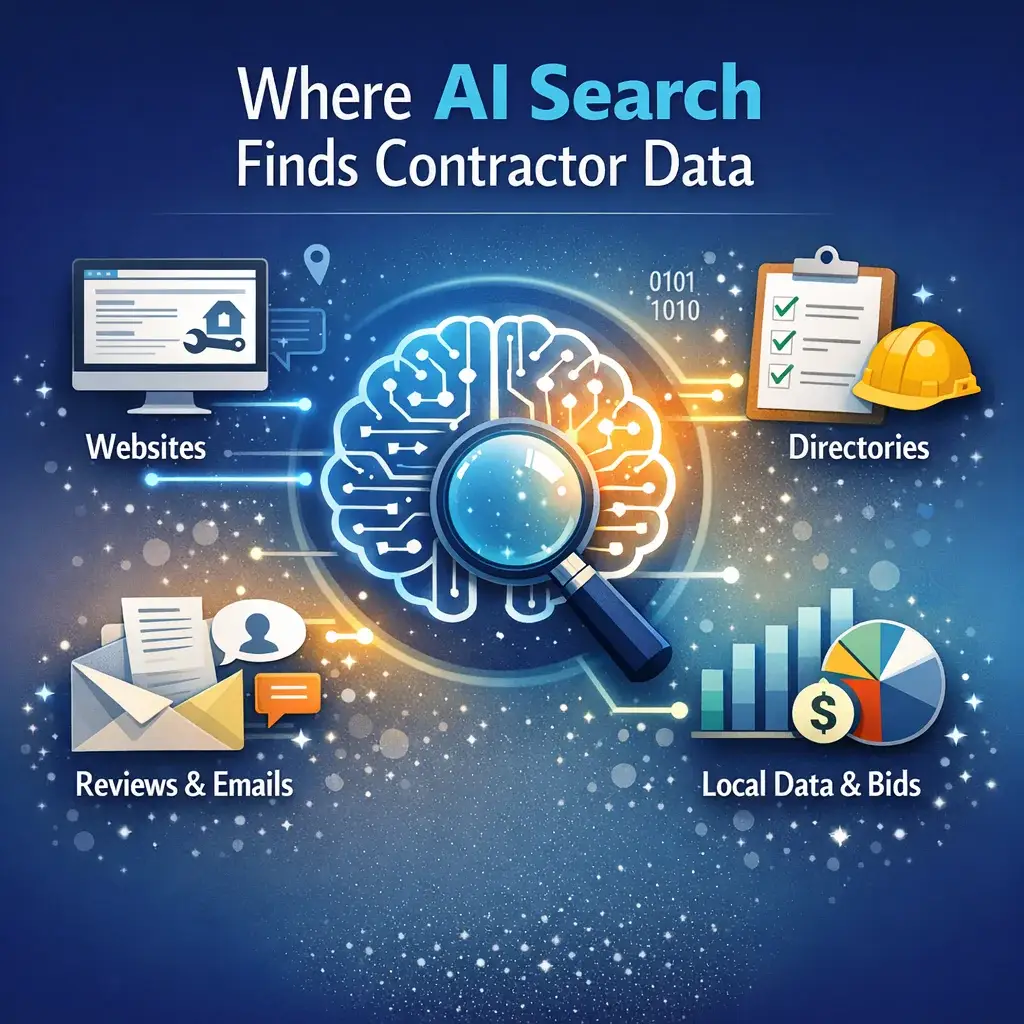
AI search tools are not running their own independent research. Google AI Overviews, ChatGPT, Perplexity, and similar platforms are pulling from indexed web content, third-party directories, review platforms, public records, and structured data, then synthesizing that information into a recommendation. The output looks conversational, but the inputs are the same signals that have always driven local search authority.
The practical implication is straightforward: if you dominate Google for your service and geography, AI tools will generally find you. The reverse is also true. If Google cannot confidently confirm who you are, what you do, and where you do it, AI tools face the same ambiguity and will default to a competitor whose profile is cleaner.
The Sources AI Tools Actually Cite
Real-world testing of AI contractor searches has revealed that recommendations frequently reference sources that most contractors have never audited. These include:
- BuildZoom profiles, which aggregate contractor license data and past project permits
- Public permit records, which serve as third-party verification that a contractor has actually completed work in a given area
- Houzz listings, including photos, reviews, and project descriptions
- Facebook business reviews, which AI tools treat as independent corroboration separate from Google reviews
- General business directories such as Angi, HomeAdvisor, and the Better Business Bureau
The significant gap in most contractor marketing advice is the assumption that your website is the primary lever. It is an important lever, but the live evidence shows that AI recommendations are often driven by the weight of corroborating third-party signals. A contractor who has never claimed their BuildZoom profile or allowed permit records to go unverified is ceding AI visibility to whoever has a more complete off-site footprint.
The Entity Consistency Principle, Applied Correctly
Competitors in this space frequently tell contractors to “keep your information consistent across platforms.” That advice is correct but incomplete. The more useful version explains when entity consistency work delivers the highest return.
Here is the decision rule that gets skipped:
Entity consistency work has the highest ROI when you are already ranking on page one of Google but not appearing in AI recommendations. If you are not yet on page one, Google authority work comes first. Entity cleanup is not a substitute for search authority; it is a refinement tool for contractors who already have it.
The reason is structural. When two contractors in Kettering or Centerville are roughly equal in Google authority, AI tools look for the cleaner entity signal to break the tie. That is the moment when inconsistencies in your business name, a mismatched phone number on a directory, or a service description that conflicts across platforms can cost you the recommendation. Until you reach that competitive threshold, the same energy applied to your Google Business Profile, review acquisition, and content depth will produce a larger outcome. Understanding how local SEO in Dayton works and how Google rankings are determined is essential before investing heavily in entity cleanup.
What an Entity Audit Actually Covers
An entity audit for a contractor means checking the following for consistency and completeness:
| Data Point | Where to Check | Common Problems |
|---|---|---|
| Business name | GBP, website, Angi, BBB, Houzz, BuildZoom | Abbreviations, DBA mismatches, punctuation variations |
| Phone number | GBP, website footer, all directories | Old numbers still live on directory sites |
| Service area | GBP, website service pages, directory profiles | GBP says Dayton; website lists only Springboro |
| License number | GBP, BuildZoom, state contractor board | Missing from most profiles, high AI verification value |
| Business category | GBP primary and secondary categories | Too broad or misaligned with actual service mix |
| Review platforms | Google, Facebook, Houzz, BBB | Unresponded reviews, conflicting business descriptions |
| Permit history | BuildZoom, local municipality records | Never claimed or verified, appearing incomplete |
The highest-risk inconsistencies are those involving your license number and permit history, because these are the data points AI tools use to verify that a contractor is real, active, and credible. A clean website with a missing or unverifiable license trail reads as a weaker entity than a modest website backed by a strong public permit record.
Need a hand with this in Dayton, Kettering and the Triad? Call (937) 848-0086 or request a free estimate. Honest answers, no pressure.
Why Review Patterns Matter More Than Review Volume
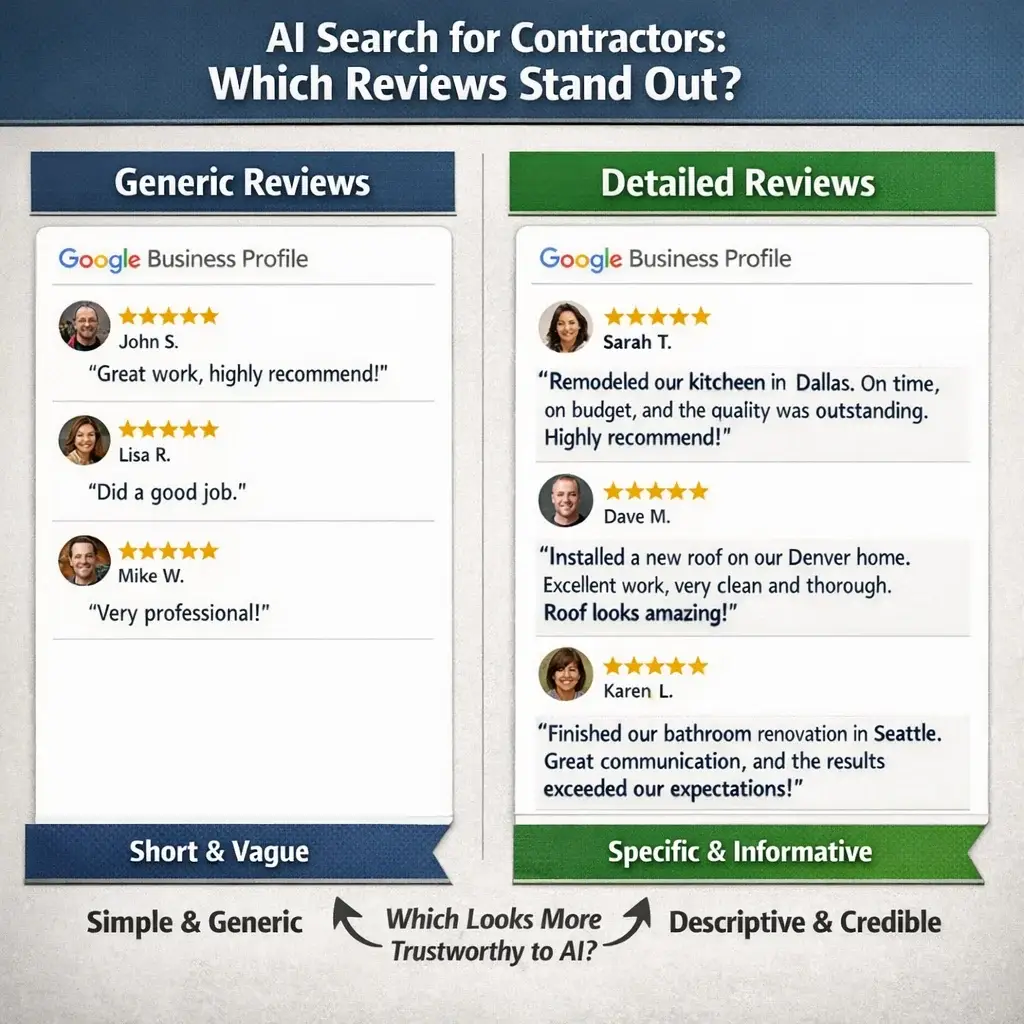
The mechanism behind AI’s use of reviews is rarely explained clearly. AI tools do not simply count stars or total reviews. They identify patterns across review text. A contractor with 40 reviews that consistently mention “on time,” “clean work site,” and “communicated well through the whole project” presents a much stronger AI-readable signal than a contractor with 90 reviews that offer no consistent themes.
This is pattern density, and it is directly readable by natural language processing. When an AI tool summarizes why a contractor in Miamisburg or Huber Heights is worth recommending, it is drawing from the language that appears repeatedly across multiple independent reviews. That summary language becomes part of the recommendation itself.
The practical consequence is that review acquisition strategy should include guiding satisfied clients toward specific, descriptive feedback rather than generic praise. “Great job” does not contribute meaningfully to an AI-readable pattern. “They handled our full bathroom remodel in Centerville, pulled all the permits, finished on schedule, and the tile work was exactly what we specified” contributes substantially. This principle sits at the heart of local SEO optimization strategies that actually drive rankings for service businesses in competitive markets.
Measuring AI-Driven Leads When Analytics Cannot See Them
The Pew Research data cited in recent industry analysis found that when AI summaries appear in search results, users clicked traditional results only 8 percent of the time, compared to 15 percent without a summary. Users clicked sources within the AI summary itself only 1 percent of the time. That data point has a direct consequence for contractor marketing: most AI-driven leads will arrive as phone calls with no referral source recorded in your analytics.
This means that low AI-referred sessions in Google Analytics does not indicate that AI is not recommending your business. It may indicate that AI is recommending you and users are calling directly.
The most reliable measurement tool for AI visibility is not a dashboard. It is a well-structured intake question asked to every new lead: “How did you hear about us?” The answer options should include specific AI tools by name alongside the standard options. Over a 90-day period, the pattern in those intake responses will tell you more about your AI search visibility than any analytics report.
Call tracking with a dedicated phone number added to your website and GBP provides a secondary layer of measurement, capturing calls that come after a user sees your number in an AI result without clicking through to your site.
The Contractor AI Search Checklist: Where to Start
Contractors serving the Dayton area, including communities like Springboro, Miamisburg, Kettering, and Beavercreek, can approach AI search readiness in a prioritized sequence rather than attempting to address everything simultaneously.
Start with the actions that affect Google authority first, because those have the widest impact across both traditional and AI search:
- Claim and fully complete your Google Business Profile, including services, service area, business hours, and license information
- Build consistent five-star review patterns with descriptive, specific language
- Ensure your website has dedicated service pages that answer real buyer questions with specificity about process, geography, and outcomes
- Add LocalBusiness and Contractor schema markup to your website to make your entity explicitly machine-readable
Then address off-site entity completeness:
- Claim your BuildZoom profile and verify your license and permit history
- Audit your top ten directory listings for name, phone, and service area consistency
- Respond to all reviews across every platform, including Facebook and Houzz
- Check your state contractor board listing for accuracy and completeness
Finally, install measurement infrastructure before you need it:
- Add an AI-specific option to your intake question process
- Deploy call tracking on your primary contact number
- Review intake data every 90 days to identify emerging referral patterns
The contractors who will build the strongest AI search presence in the Dayton metro over the next two years are not the ones rushing to game a new algorithm. They are the ones building the cleanest, most verifiable, most corroborated contractor entity across every platform where AI tools look for answers. That work is also the work that drives Google rankings, generates more reviews, and produces more qualified leads through every channel simultaneously. It compounds because it is real.
Mongoose Digital Marketing works with contractors across the greater Dayton area to build digital marketing strategies that perform across both traditional and AI-driven search. If you want a clear picture of where your current online presence stands and where the highest-leverage opportunities are, start with a free consultation.
Frequently Asked Questions
What is AI search and how is it different from traditional Google search?
AI search refers to tools like ChatGPT, Google’s AI Overviews, and Perplexity that generate direct, conversational answers to user questions rather than returning a list of links. Instead of a homeowner clicking through several websites to compare contractors, an AI tool synthesizes information from across the web and names specific businesses it considers credible and well-documented. For contractors, this means the game has shifted from ranking on page one to being the entity an AI confidently recommends when someone asks who to hire.
How does an AI tool decide which contractor to recommend?
AI tools build their answers from patterns they detect across multiple sources simultaneously. They look at how consistently your business information appears across directories, review platforms, your website, and licensing databases. They weigh whether your reviews are detailed and specific, whether your website clearly describes your services and geographic coverage, and whether independent sources corroborate what you claim about your own business. The more complete and consistent your presence across all of these signals, the more confidently an AI tool can surface your name as a trustworthy answer.
Does my Google Business Profile still matter if AI search is growing?
Yes, and arguably more than ever. Your Google Business Profile is one of the most authoritative data sources AI tools pull from when evaluating local contractors. A fully completed profile with accurate service areas, detailed service descriptions, updated business hours, and a strong pattern of recent reviews signals credibility to both Google’s own AI Overviews and third-party AI tools that index publicly available business data. Neglecting your profile now creates gaps that will become more costly to close as AI-driven search continues to grow. The article on SEO in Dayton, Ohio and local strategies that actually work covers how profile authority feeds into broader search visibility for local businesses.
How long does it take to see results from building an AI search presence?
AI search optimization is not a quick-fix tactic, it is infrastructure work that compounds over time. Some improvements, like correcting inconsistent directory listings or adding schema markup to your website, can begin influencing how AI tools interpret your business within weeks. Building a body of detailed, recent reviews and establishing corroborating signals across multiple platforms typically takes several months of consistent effort. Contractors who start this work now are positioning themselves ahead of competitors who will still be reacting when AI search becomes the dominant way homeowners find and vet local service providers.
Mongoose Digital Marketing works with contractors across Dayton and Centerville who want their online presence to hold up under the scrutiny of both traditional search engines and the AI tools that are rapidly reshaping how homeowners find and hire local professionals. If you’re ready to understand exactly where your digital presence stands and what it would take to become the contractor AI tools recommend in your market, give us a call at (937) 848-0086 or Contact Mongoose Digital Marketing, we’re glad to take a look.