
Key Takeaways
- A roofing company blog built around 70% evergreen topics and 30% seasonal content compounds traffic over time, while a purely seasonal blog requires constant new output just to hold its position.
- Blog topics fall into three distinct buyer stages: informational (awareness), comparative (consideration), and transactional (decision), and each stage calls for a different call-to-action strategy.
- Publishing content in interlinked topic clusters, rather than as isolated posts, is the architecture Google’s current ranking model rewards with topical authority.
- Local SEO value from blog content comes from substantive geographic relevance built into the body of the post, not from inserting a city name into a generic title.
- Roofing companies serving both residential and commercial clients should structure blog content into separate, interlinked categories rather than mixing audiences in a single undifferentiated feed.
A roofing company’s blog is either a lead-generation asset or an ignored corner of the website. The difference between those two outcomes has almost nothing to do with how many topics you publish and almost everything to do with which topics you choose, in what order you publish them, and how they connect to each other. Most roofing blogs fail not because they lack content, but because the content was chosen at random, published without a sequencing strategy, and treated as a checklist rather than a funnel.
This guide gives roofing companies, and the marketers who support them, a practical framework for selecting and organizing blog topics that drive search traffic and convert that traffic into service calls. It addresses the strategic decisions that generic topic lists never touch: how buyer intent should govern topic selection, how to build content clusters instead of isolated posts, and how to make local relevance substantive rather than cosmetic.
Why Topic Selection Strategy Matters More Than Topic Volume
The dominant approach to roofing blog content online is the mega-list: 50 ideas, 100 ideas, 251 ideas. Volume is treated as the goal. It is not. Publishing 100 disconnected posts on 100 different keywords produces far weaker results than publishing 10 tightly organized topic clusters, each covering a subject from multiple angles with posts that link to each other.
Google’s current ranking model evaluates topical authority. A website that covers roof ventilation comprehensively, from the mechanics of soffit-to-ridge airflow to the signs of inadequate attic ventilation to the cost factors involved in a ventilation upgrade, signals deep subject matter expertise. A website that publishes one post about ventilation and moves on to something unrelated signals breadth without depth. Topical authority clusters win rankings; isolated posts compete on individual keyword strength alone, which is a harder and slower path for a local service business.
The second reason topic strategy matters more than volume is compounding value. Evergreen posts, those that answer questions that remain relevant regardless of season or year, continue accumulating search traffic, backlinks, and ranking strength over time. A post titled “How Long Does a Roof Last?” published today will still generate leads three years from now with no additional investment. A post titled “Spring Roof Inspection Checklist” spikes in April and drops off in June. A blog built primarily on evergreen content builds a growing asset. A blog built primarily on seasonal content requires constant production just to maintain the same traffic level.
The practical ratio: aim for roughly 70% evergreen topics and 30% seasonal. When publishing seasonal content, publish it six to eight weeks before the relevant season begins, because ranking takes time and a post published in December about winter roof prep has already missed the window.
Mapping Topics to Buyer Stages
Every search query that reaches a roofing blog carries an implied buyer stage. Treating all blog traffic as equivalent is one of the most common and costly mistakes in roofing content strategy.
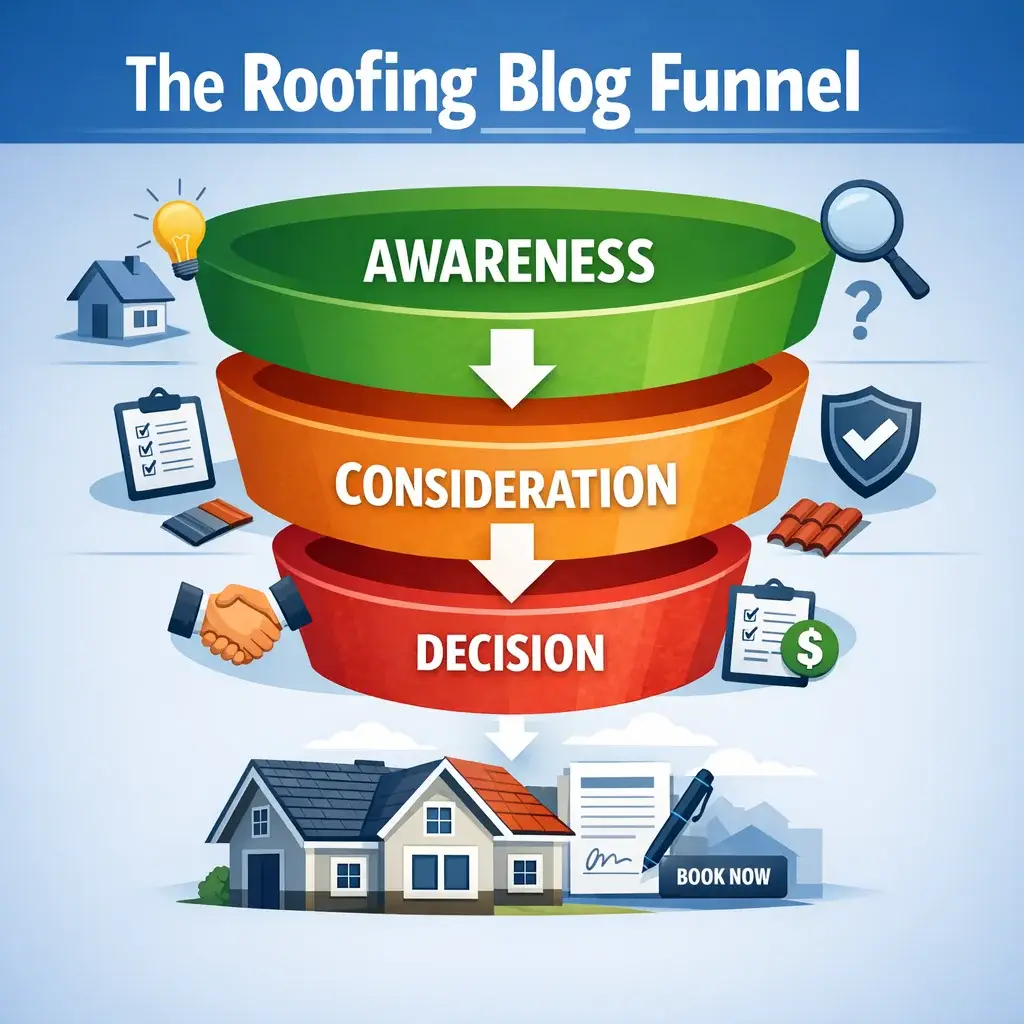
The three stages work as follows:
Awareness (Informational intent): The reader is researching a topic, often years before a purchase. They want to understand something. Examples: “How long does a roof last?” or “What are the different types of roofing materials?” These posts attract high traffic volume but low immediate conversion probability. The right call-to-action for these posts is low-commitment: a link to a free inspection offer, a downloadable maintenance checklist, or a guide to the next stage of their research.
Consideration (Comparative intent): The reader is evaluating options and getting closer to a decision. They are comparing materials, weighing repair against replacement, or deciding between contractors. Examples: “Architectural shingles vs. three-tab shingles: what is the difference?” or “Roof repair vs. full replacement: how to decide.” These posts attract moderate traffic with significantly higher purchase intent. CTAs here should direct toward a consultation or an inspection request.
Decision (Transactional intent): The reader is ready to hire someone. They are looking for a specific contractor or confirming that the one they found is trustworthy. Examples: “Roofing contractor in Dayton OH” or “How to choose a roofing company.” These posts should carry a direct, prominent call-to-action: request a quote, call today, schedule your inspection.
Publishing content across all three stages and matching the CTA to the stage is what converts a blog from a traffic source into a lead funnel. For a deeper look at how this fits into a complete search strategy, the article on SEO for roofing companies covers the broader ranking and lead-generation framework roofing businesses need to understand.
Need a hand with this in Dayton, Kettering and the Triad? Call (937) 848-0086 or request a free estimate. Honest answers, no pressure.
Topic Cluster Architecture for Roofing Companies
Rather than listing 50 ideas, the following framework organizes roofing blog topics into clusters. Each cluster has a pillar topic, which is a comprehensive, longer-form post that targets a broad keyword, and a set of supporting posts that cover specific angles and link back to the pillar.
Cluster 1: Roof Replacement
Pillar topic: The Complete Guide to Roof Replacement for Homeowners
Supporting posts:
– How to tell if you need a full replacement or just repairs
– What to expect during a roof replacement: timeline and process
– Roofing material comparison: asphalt shingles, metal, and flat roofing
– How long does a new roof last? (by material type)
– Questions to ask your roofer before signing a contract
Cluster 2: Roof Repair and Damage
Pillar topic: Roof Repair: When to Act, What to Fix, and What to Watch For
Supporting posts:
– 8 signs your roof has storm damage
– What causes roof leaks and how professionals find them
– Flashing failure: the most overlooked source of roof leaks
– Roof repair vs. replacement: a decision guide for homeowners
– Why temporary patch repairs can create long-term problems
Cluster 3: Roofing Materials
Pillar topic: Roofing Materials Compared: Performance, Longevity, and What Suits Your Home
Supporting posts:
– Architectural shingles vs. three-tab: what the difference means for your roof
– Metal roofing for residential homes: pros, tradeoffs, and what to know
– TPO and flat roofing systems: a guide for homeowners and property managers
– How to choose roofing materials that match your home’s structure
– What roof color does to attic temperature and energy use
Cluster 4: Maintenance and Inspections
Pillar topic: Roof Maintenance Guide: What to Inspect, How Often, and Why It Matters
Supporting posts:
– How often should a roof be inspected?
– What a professional roof inspection covers (and what to ask for)
– Gutters and roof health: how they connect
– Attic ventilation and its effect on roof lifespan
– Fall and spring maintenance checklist for homeowners
Cluster 5: Commercial Roofing
Pillar topic: Commercial Roofing: Systems, Maintenance, and What Property Owners Need to Know
Supporting posts:
– Flat roof maintenance for commercial buildings
– How to evaluate a commercial roofing contractor
– TPO vs. EPDM: commercial flat roofing systems compared
– Roof coatings for commercial properties: what they do and when they make sense
– How to build a preventive maintenance schedule for a commercial roof
The DIY Content Decision
There is a genuine strategic choice roofing companies need to make deliberately about DIY content. Two schools of thought exist in the industry, and they are not compatible.
The first treats DIY-oriented content as a traffic opportunity. Posts like “DIY roof inspection checklist” or “How to find a roof leak yourself” attract significant search volume from homeowners who want to handle things independently. The conversion rate on this traffic is low.
The second treats DIY content as audience misdirection. A roofing company’s blog should attract people who intend to hire a roofer, not people who want to avoid it. From this perspective, DIY topics waste content resources on an audience that will not convert.
The most effective resolution is a post format that captures both audiences: “DIY vs. Professional Roof Repair: How to Decide.” This post serves the homeowner who is genuinely on the fence, provides real decision criteria rather than a sales pitch, and ranks for both DIY-intent and hire-intent queries simultaneously. It treats the reader as capable of making a good decision with the right information, which builds the trust that eventually produces a call.
Making Local SEO Substantive
Inserting a city name into a generic blog title is cosmetic localization. “Roof Repair Tips for Dayton Homeowners” that contains the same content as a generic roof repair post does not earn local ranking strength. Google evaluates whether the geographic reference is meaningful to the content, not whether it appears in the title.
Substantive local blog content earns its geographic relevance by being genuinely different from a non-local version of the same post. For roofing companies serving the Dayton, Kettering, Beavercreek, Centerville, Huber Heights, Miamisburg, and Springboro areas, this means connecting roofing topics to the actual conditions, housing types, and service realities of the region rather than appending a city name to a national template.
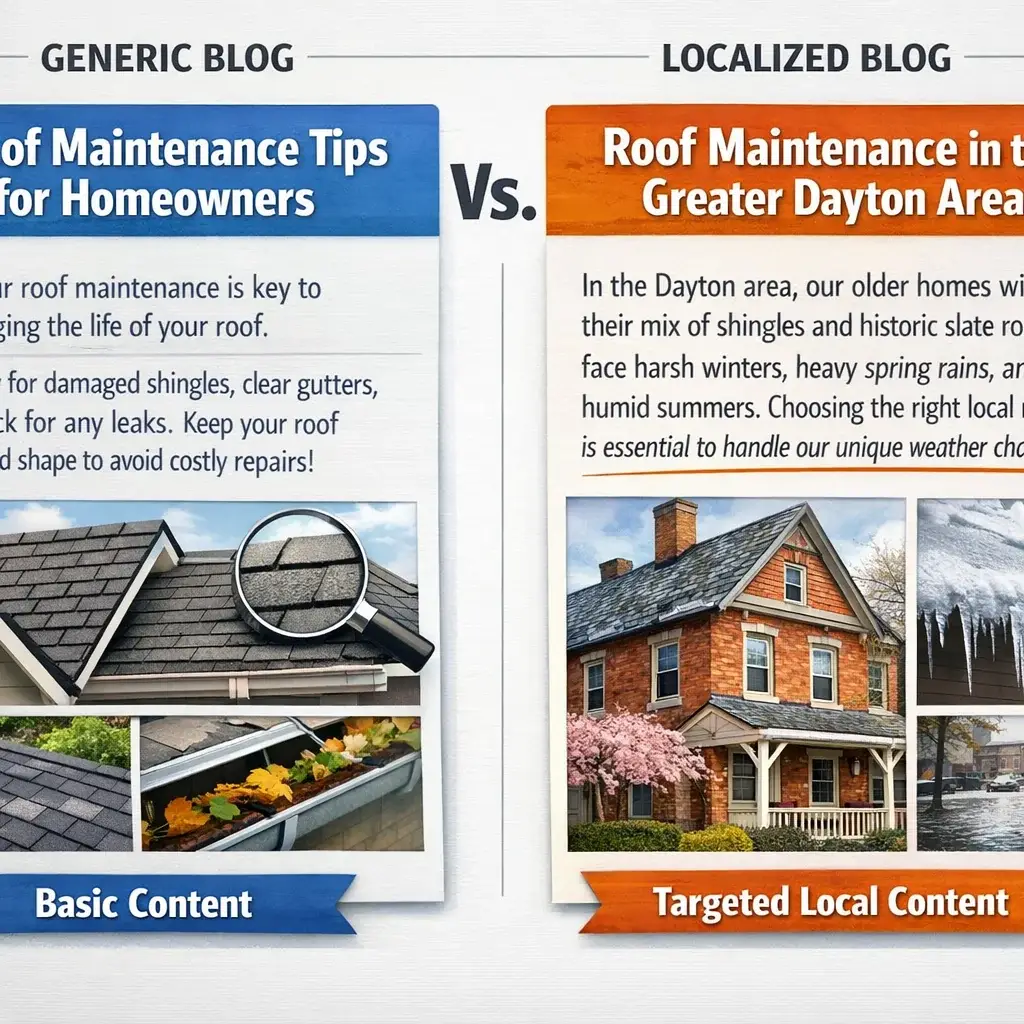
Local content signals that strengthen geographic relevance include references to the specific service areas the company covers, mentions of material choices or roof types commonly found in local housing, and discussion of the inspection or maintenance concerns that apply to the region’s actual conditions. When a blog post could have been written by a roofing company in any state, it provides no local SEO value regardless of what city appears in the title. The article on blog writing for Kettering, OH and local SEO breaks down exactly how this kind of substantive local content strategy is built in practice.
A Topic Selection Framework for Roofing Companies
Use this reference table to evaluate any candidate blog topic before committing to it.
| Evaluation Criterion | What to Ask | Why It Matters |
|---|---|---|
| Buyer stage fit | Is this an awareness, consideration, or decision topic? | Determines CTA type and conversion expectation |
| Evergreen or seasonal | Does this topic have year-round relevance or a seasonal peak? | Affects long-term traffic compounding vs. spike-and-decay |
| Cluster assignment | Which pillar page does this support? | Ensures internal linking and topical authority building |
| Local relevance | Can this be made substantively local, not just cosmetically? | Determines local SERP eligibility |
| Audience segment | Does this serve residential, commercial, or both? | Prevents mixed messaging and supports category structure |
| Search intent alignment | Does the post content match what the query actually demands? | Mismatched intent earns high bounce rates, not conversions |
| Competitive gap | Is there a ranking opportunity or is this fully saturated? | Prioritizes effort toward achievable positions |
Residential and Commercial: Structuring a Mixed-Audience Blog
Roofing companies that serve both homeowners and commercial property managers face a content organization challenge that most topic guides ignore. Publishing residential and commercial content in a single undifferentiated blog feed creates a mixed signal for readers and dilutes topical authority signals for search engines.
The solution is category-based blog structure. Residential and commercial content should live in separate blog categories, ideally with category pages that function as lightweight pillar pages in their own right. Posts within each category should link to each other and to the relevant category page. When a piece of content is genuinely relevant to both audiences, a version for each is more effective than one post trying to serve both.
This separation also supports more targeted calls-to-action. A residential homeowner and a commercial property manager have different decision processes, different time horizons, and different concerns about liability and maintenance. Blog content that speaks directly to one of them outperforms content that addresses neither clearly.
A roofing company that approaches its blog with this kind of intentional architecture, organized by clusters, calibrated to buyer stage, built on a foundation of evergreen content, and grounded in substantive local relevance, is building a lead-generation asset that compounds in value over time. That is a fundamentally different outcome than a list of 100 topics published without strategy, and the difference shows up directly in rankings, traffic quality, and phone calls.
Frequently Asked Questions
How many blog posts does a roofing company need to publish before seeing results from search traffic?
There is no fixed number, but consistency and topic coherence matter more than volume. A roofing company that publishes a smaller number of well-structured, strategically clustered posts will typically outperform one that publishes a high volume of disconnected topics. Most roofing blogs begin to show meaningful organic traction after several months of consistent, intent-aligned publishing combined with a solid internal linking structure.
Should a roofing company blog about topics that are not directly related to roofing?
Generally, no. Topical authority in search is built by depth within a subject area, not by breadth across unrelated ones. A roofing blog that wanders into unrelated home improvement topics dilutes the relevance signals that help search engines understand what the site is actually about. Staying focused on roofing, exterior building systems, and closely related subjects like ventilation or attic performance keeps those signals clean and concentrated.
What is the difference between a blog post and a pillar page on a roofing website?
A pillar page is a comprehensive, authoritative resource that covers a broad topic at a high level and links out to more specific cluster posts for deeper detail. A blog post typically addresses a narrower question or subtopic and links back to the relevant pillar page. Together they form a content cluster, which signals topical depth to search engines and gives readers a logical path to follow based on how much detail they need.
How does local content improve a roofing blog’s performance in search?
Search engines give significant weight to geographic relevance when ranking local service businesses. Blog content that addresses locally specific conditions, such as how regional weather patterns affect certain roofing materials or how local building codes influence installation requirements, signals to search engines that the business has genuine authority within a specific service area. That kind of substantive local relevance performs better than simply inserting city names into otherwise generic content.
Roofing contractors in the Dayton area who want their blog to actually generate leads, not just fill a page, need a content strategy built around how local homeowners search and what moves them to call. Mongoose Digital Marketing proudly serves Dayton, Kettering, Beavercreek, Centerville, and the surrounding communities with digital marketing built specifically for contractors who want results they can measure. Reach out at (937) 848-0086 or Contact Mongoose Digital Marketing to talk through what a focused content strategy could do for your roofing business.