
Key Takeaways
- A website built for a Dayton defense contractor near Wright-Patterson AFB requires fundamentally different architecture, trust signals, and conversion logic than a site built for a Miami Valley home services company — a one-size-fits-all approach directly undermines lead generation in both cases.
- Google’s local 3-pack rankings are determined by structured data markup, Google Business Profile optimization, and NAP citation consistency — not by how visually impressive a website looks in a portfolio screenshot.
- Core Web Vitals scores and mobile performance benchmarks are direct ranking factors in Google’s local search algorithm; listing “responsive design” as a feature without measurable performance data is not a meaningful quality signal.
- Post-launch maintenance — including WordPress security patches, plugin updates, SSL management, and hosting infrastructure — accounts for the majority of small business website failures in the 12 months after a site goes live.
- A web design agency that cannot show you verified traffic data, local search rankings, and conversion outcomes for its past clients is showing you aesthetics, not evidence.
Choosing a website design agency in Dayton, Ohio should not feel like picking a favorite paint color. It is a business decision with direct consequences for how many leads your phone generates, how your company ranks when someone in Kettering or Beavercreek searches for what you sell, and whether the site you pay to build is still working reliably two years from now.
The problem is that most businesses approach this decision with the wrong criteria. They look at portfolio screenshots, read a few testimonials, and compare service lists that are nearly identical from one agency to the next. That process produces a visually acceptable website that may or may not rank, may or may not convert visitors, and almost certainly has no strategic architecture behind it.
This guide gives you the decision-making framework that most agencies — and most articles about web design agencies — deliberately avoid providing. We will cover what Dayton’s specific industry landscape demands from a web design partner, what technical benchmarks actually separate good work from average work, and the exact questions you should ask before signing anything.
Why Dayton’s Business Landscape Demands Industry-Specific Web Design
Dayton is not a generic mid-sized Midwest city from a web design strategy perspective. It has three well-defined industry concentrations that each require a different website architecture to generate leads effectively. An agency that builds the same structural template for every client — regardless of whether that client serves aerospace contractors or residential HVAC customers in Huber Heights — is optimizing for its own production efficiency, not your revenue.
Defense and Aerospace Contractors Near Wright-Patterson AFB
The business ecosystem surrounding Wright-Patterson Air Force Base is substantial and concentrated in specific zip codes spanning Beavercreek, Fairborn, and Riverside. Companies in this space — whether providing engineering services, IT support, facility management, or specialized manufacturing — are selling to government procurement officers and prime contractor program managers.
This audience evaluates vendors through an entirely different lens than a typical B2B buyer. A website serving this sector needs to communicate the following immediately and without ambiguity:
- Past performance credibility — relevant contract history, clearance capabilities, and NAICS codes that align with target opportunities
- Compliance signals — CAGE code visibility, SAM.gov registration confirmation, and any relevant certifications (ISO, CMMC, ITAR) surfaced prominently, not buried on an “About” page
- Security and trust aesthetics — clean, structured, minimalist design that reads as professional and operationally serious; elaborate animations and aggressive sales language actively undermine trust in this sector
- Contact architecture designed for procurement — not a generic “Get a Quote” form, but capability statement downloads, RFI response prompts, and direct points of contact with titles
An agency that has never worked with a defense sector client will not know any of this. The result is a website that looks fine on a screen and generates zero relevant inquiries.
Healthcare-Adjacent Businesses in Kettering and Beavercreek
The concentration of healthcare providers, medical practices, mental health services, and health-adjacent businesses around Kettering Health and Premier Health campuses creates a dense competitive landscape with specific compliance considerations.
Websites in this space operate under scrutiny that does not apply to other industries. Contact forms that capture health-related information need HIPAA-conscious architecture — this includes how form data is stored, transmitted, and handled by third-party tools like chat widgets or marketing automation platforms. An agency that installs a standard contact form plugin without addressing data handling is creating liability exposure, not just a design choice.
Beyond compliance, healthcare-adjacent users respond to specific trust signals:
- Provider credentials and board certifications surfaced visibly
- Patient privacy statements accessible without hunting
- Booking and intake workflows that minimize friction while maintaining professionalism
- Google review schema markup that surfaces star ratings directly in search results — a proven conversion factor for patients choosing between comparable providers
Skilled Trades and Home Services Across the Miami Valley
This is the highest-volume competitive category in the greater Dayton market. Plumbers, electricians, HVAC technicians, roofers, and general contractors in Miamisburg, Centerville, Springboro, and across the Miami Valley are fighting for the same local search real estate against dozens of competitors.
For this audience, the website’s job is to convert a person who has an immediate problem into a phone call within seconds of landing on the page. The conversion architecture is completely different from the defense or healthcare models:
- Phone number displayed above the fold in a large, tappable format on mobile
- “Same-day estimate” or “24/7 emergency service” CTAs in the hero section, not below the fold
- Google review count and average rating visible immediately — social proof is the primary trust mechanism for residential service buyers
- Service area pages built for every major suburb (Kettering, Beavercreek, Centerville, Huber Heights, Miamisburg, Springboro) with genuine geographic content, not duplicate pages with city names swapped in
- Schema markup implementing LocalBusiness structured data with service type, area served, and review aggregation
An agency building a home services website in Dayton without this architecture is building a digital brochure. Brochures don’t answer the phone.

The Technical Benchmarks That Actually Determine Local Search Rankings
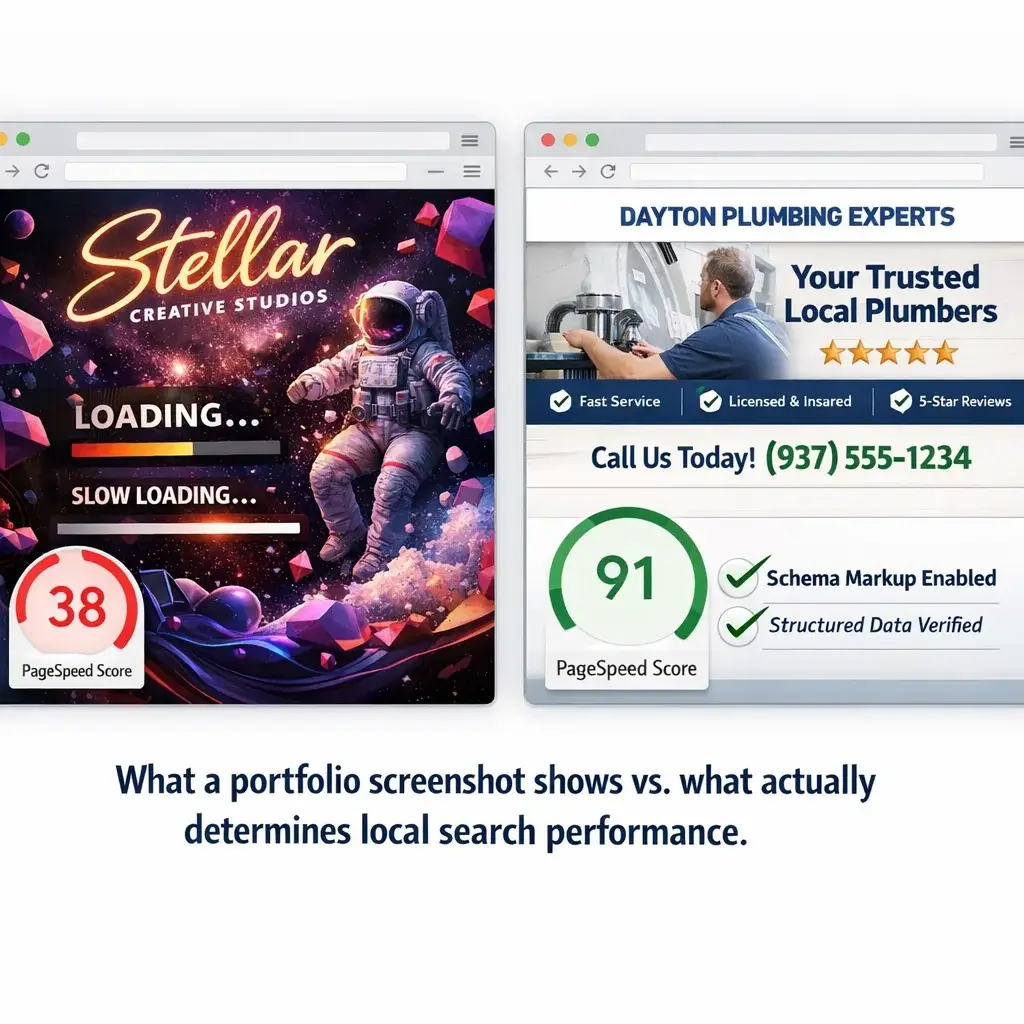
Portfolio screenshots tell you what an agency’s work looks like. They tell you almost nothing about whether that work performs. Before you evaluate any web design agency in Dayton, you need to understand the technical factors that Google uses to determine whether your site ranks locally — because most agencies are not having this conversation with you.
Core Web Vitals Are Not Optional
Google’s Core Web Vitals are a set of measurable performance signals that directly affect search rankings. They are not aesthetic preferences — they are quantified thresholds that Google has baked into its ranking algorithm. The three primary metrics are:
- Largest Contentful Paint (LCP): How long it takes for the main content of a page to load. Google’s threshold for a “good” score is under 2.5 seconds. Sites loading between 2.5 and 4 seconds are rated “needs improvement.” Above 4 seconds is a ranking liability.
- Interaction to Next Paint (INP): How quickly a page responds to user interaction. Under 200 milliseconds is the “good” threshold.
- Cumulative Layout Shift (CLS): How much the page visually shifts while loading — the jarring experience of elements jumping around before they settle. A score under 0.1 is acceptable; above 0.25 is a problem.
You can test any agency’s current or past client websites using Google PageSpeed Insights (pagespeed.web.dev) at no cost. Enter a URL and within seconds you have real Core Web Vitals data. If an agency’s client sites are scoring in the red or yellow on mobile, that agency’s technical output is not meeting Google’s standards — regardless of how the sites look.
This is a direct, verifiable test that takes two minutes. Run it before any sales conversation goes further. For a deeper breakdown of what these signals mean for your site’s rankings, the article Web Design Best Practices for SEO in 2026 covers how technical performance requirements are evolving and what Dayton businesses should be building toward.
How the Local 3-Pack Rankings Actually Work
When someone in Centerville searches “HVAC repair Centerville OH” or a business owner in Beavercreek searches “commercial cleaning Dayton,” the three businesses that appear in Google’s map pack results are not there because their websites are visually appealing. They are there because of a combination of factors that a web design agency should be building into every local business site from day one:
Google Business Profile optimization is a prerequisite. Service categories, business description, service areas, and regularly updated photos all influence GBP ranking. A web design agency that does not discuss GBP optimization as part of its service offering is delivering an incomplete local digital presence. The article Google Business Profile Optimization Tips That Actually Work covers the specific steps that move the needle on map pack visibility for local businesses.
NAP citation consistency — name, address, and phone number appearing identically across all online directories — directly affects local authority. This includes Dayton-specific directories, chamber listings, and industry-specific platforms. Inconsistent NAP data sends conflicting signals to Google’s local algorithm and suppresses map pack visibility.
Structured data markup — specifically LocalBusiness schema — tells Google’s crawlers exactly what your business does, where it serves, what its hours are, and how to interpret the site’s content in relation to local geographic entities. A site without this implementation is competing in the local pack with one hand tied behind its back.
On-page geographic entity association means that your website’s content explicitly and naturally references the service areas, neighborhoods, and landmarks that Google associates with local relevance. This is not keyword stuffing — it is strategic content architecture. A site that never mentions Kettering, Springboro, or Huber Heights in its actual content is invisible to users searching from those communities.
The Questions to Ask an Agency Before You Hire
Most business owners walk into agency conversations without a framework for evaluating technical competence. Here is a direct set of questions that will immediately distinguish strategic partners from execution shops:
| Question | What a Strong Answer Looks Like | Red Flag Response |
|---|---|---|
| Can you show me PageSpeed scores for sites you’ve built? | Shares specific URLs and scores; most pass Core Web Vitals on mobile | “Our sites are mobile-friendly and responsive” |
| How do you implement local SEO during the build? | Describes schema markup, GBP integration, NAP strategy, service area pages | “We optimize your site for search engines” |
| What platform do you build on and why? | Gives a reasoned answer based on client goals, not preference or familiarity | “We use [platform] for everything” |
| What happens after launch — who manages updates and security? | Has a defined maintenance process, SLA for security patches, hosting infrastructure details | “That’s up to you once it’s live” |
| Can you show me traffic and ranking outcomes for past clients? | Provides Search Console or GA4 data, not just screenshots | Shows portfolio images only |
| How do you define success for this project? | Names specific KPIs — leads, calls, ranking terms, conversion rate | “A beautiful website that represents your brand” |
| Do you handle Google Business Profile as part of local strategy? | Yes, and explains how GBP integrates with the site build | “That’s a separate service” or blank stare |
The Portfolio Gallery Trap and How to Avoid It
Every web design agency in Dayton leads with portfolio screenshots. This is the least useful signal available to a business owner making a real investment decision, and understanding why requires a brief explanation of what a screenshot cannot show you.
A visually polished website that loads in 5.8 seconds on mobile, has no structured data, and was built on a page builder plugin that stopped receiving security updates in 2023 is not a good website. It is a liability dressed as an asset. A more modest-looking site that loads in 1.4 seconds, has full LocalBusiness schema implementation, passes all Core Web Vitals thresholds, and generates consistent inbound calls is performing its actual function.
Screenshots show you the dress. They don’t show you the engine.
The Actual Evaluation Checklist
When an agency shows you its portfolio, do not stop at the visual. Run this process on two or three of the sites they present:
Step 1 — PageSpeed Insights test: Go to pagespeed.web.dev and enter the client site URL. Look at the mobile score specifically. Core Web Vitals should pass (green) across LCP, INP, and CLS. A site scoring below 50 on mobile has measurable performance problems that hurt its rankings and user experience.
Step 2 — Google Rich Results Test: Go to search.google.com/test/rich-results and enter the URL. Check whether LocalBusiness schema or other relevant structured data is implemented. The absence of schema on a local business site is a technical gap that directly impacts local search visibility.
Step 3 — Mobile Usability Check: Use Google Search Console’s mobile usability data if accessible, or test the site on an actual mobile device. Is the phone number tappable? Does content reflow correctly? Are buttons large enough for thumb navigation? “Looks okay on a phone” is not the same as passing Google’s mobile usability standards.
Step 4 — Local Visibility Check: Search Google for the business name plus its city and primary service. Does the site appear? Does it appear with review stars in the results? Is there a functioning Google Business Profile linked to it? If an agency built a site that doesn’t appear cleanly in local search for its own client’s business name, that is significant information.
Step 5 — Content Assessment: Read one or two pages of the site’s actual copy. Is there specific geographic reference? Does the content address real customer questions or is it generic placeholder language about “high-quality service”? Thin content is a documented Google ranking liability.
Post-Launch Reality: The Conversation Most Agencies Skip
The build phase of a website project receives nearly all of the attention in any agency sales conversation. The post-launch reality — what happens to your site after it goes live — receives almost none. This is where small business websites most commonly fail, and it is a direct reflection of whether an agency is oriented toward your long-term success or just the project completion invoice.
WordPress Security and Maintenance
The majority of small and mid-sized business websites run on WordPress. WordPress is a powerful, flexible platform when properly maintained. It is also the most targeted CMS for automated exploits — and the most common source of business website failures. The article WordPress Web Design for Small Businesses: Honest Guide breaks down what responsible WordPress management actually looks like and what to expect from an agency that takes platform security seriously.
WordPress security requires active management:
- Core software updates, typically monthly or more frequent
- Plugin updates that must be tested against the active theme and other plugins before deployment
- Abandoned plugins — those no longer receiving developer updates — represent active security vulnerabilities that must be identified and replaced
- SSL certificate renewal, typically annual, with monitoring to ensure no lapse occurs
- Regular off-site backups with tested restore procedures
- Uptime monitoring with immediate notification of downtime
An agency that delivers a WordPress site without a defined maintenance plan is handing you an asset that will degrade over time, accumulate security debt, and eventually either get hacked or break under a plugin conflict — at which point you will pay emergency rates to fix a problem that routine maintenance would have prevented.
Ask every agency: What is your post-launch maintenance offering? What is your response time if the site goes down? What happens if a plugin update breaks a core function? The answers to these questions tell you whether you are engaging a partner or completing a transaction.
Hosting Infrastructure Decisions
Where your website is hosted directly affects its speed, security, and reliability — all of which affect both user experience and search rankings. Shared hosting environments that pack hundreds of sites onto a single server produce slower load times and higher vulnerability exposure compared to managed cloud hosting or dedicated environments.
A web design agency in Dayton that recommends hosting without explaining the infrastructure tradeoffs — or that pushes you toward a hosting option because of its own affiliate relationship rather than your performance needs — is not acting as a strategic partner.
The hosting conversation should include:
- Server location relative to your primary user base (US-based servers for Dayton local businesses)
- Managed vs. unmanaged environments and who handles server-level security
- CDN (Content Delivery Network) implementation for faster asset delivery
- Backup frequency and recovery procedures
- Scalability in the event of traffic spikes
What a Discovery Process Reveals About an Agency’s Strategy
A web design agency that moves directly from your first conversation to design concepts without a structured discovery phase is an execution shop. It is producing a website based on aesthetic preferences rather than business objectives.
A strategic discovery process — the kind that produces sites that actually generate leads — covers the following ground before a single design element is selected:
Business objective mapping: What specific outcomes does this website need to produce? Phone calls? Form submissions? Appointment bookings? E-commerce transactions? These are not interchangeable, and each requires different design, layout, and CTA architecture.
Audience persona analysis: Who is actually visiting this site, and what are they looking for when they arrive? A Beavercreek defense contractor’s audience behaves entirely differently from a Springboro homeowner looking for a roofer. The site structure should reflect that difference.
Competitive landscape review: What sites are currently ranking for the target terms? What do they do well? Where are the gaps? This analysis informs both content strategy and design differentiation.
Analytics baseline establishment: If there is an existing site, a proper discovery phase reviews current Google Analytics and Search Console data before recommending changes. Redesigning a site without reviewing its existing traffic sources, top-performing pages, and conversion data is how agencies accidentally destroy organic rankings that took years to build.
Conversion goal configuration: Every tracked action on the new site should be mapped before launch — calls, form completions, chat initiations — so that from day one you have data on whether the site is performing against its objectives.
An agency that cannot describe its discovery process in specific terms is telling you something important about how it will approach your project.
Choosing the Right Website Design Agency in Dayton, Ohio: The Bottom Line
Dayton businesses have real options when it comes to web design partners. The decision criteria that most business owners default to — visual portfolios, local name recognition, price comparison — are the least predictive of whether that agency will actually grow your business.
The criteria that matter are technical performance, local SEO integration from the build phase, industry-specific strategy, post-launch support infrastructure, and a willingness to define success in measurable terms before the project begins.
Mongoose Digital Marketing works with Dayton-area businesses across these exact dimensions — not because it makes for good marketing language, but because a website that does not rank, does not convert, and does not stay secure is not an asset. It is overhead.
If you want a direct conversation about what your specific business in Dayton, Kettering, Beavercreek, or anywhere in the Miami Valley actually needs from a web presence — not a sales pitch, but a grounded assessment of where you are and what would move the needle — we offer a free consultation with no obligation. Come prepared with questions. We will be.
Strategic Recommendations for Dayton Businesses Heading Into 2026
The web design and digital marketing landscape shifts quickly, and the decisions Dayton businesses make in the next twelve months will have compounding effects on their online visibility for years to come. Three specific priorities deserve attention before the new year.
1. Core Web Vitals Monitoring as a Standing Practice
Google’s page experience signals are not a one-time checkbox. As browser standards evolve and third-party scripts accumulate on live sites, performance scores degrade. Tools like Google Search Console’s Core Web Vitals report and PageSpeed Insights should be reviewed on a scheduled basis — not just at launch. Businesses that treat technical health as an ongoing discipline, rather than a launch-day milestone, consistently outperform those that don’t in competitive local search results.
2. Google Business Profile Integration with Website Strategy
For Dayton-area businesses competing in local search, the relationship between your Google Business Profile and your website content is more consequential than most agencies communicate. Structured service pages, consistent NAP data, and locally relevant content that mirrors your GBP categories create a reinforcing signal that improves map pack visibility. In 2026, businesses that treat their website and GBP as a unified local presence rather than separate assets will have a measurable advantage in Miami Valley search results.
3. First-Party Data Collection Infrastructure
As third-party cookie deprecation continues to reshape digital advertising, Dayton businesses need websites built to capture and leverage first-party data — email subscribers, CRM integrations, and on-site behavioral signals — rather than relying entirely on platform-dependent audience targeting. This means building contact forms, lead magnets, and newsletter pathways into the site architecture from the beginning, not retrofitting them later.
Frequently Asked Questions
What makes a website design agency in Dayton, Ohio different from a national firm?
A Dayton-based agency brings direct familiarity with the local market — the competitive landscape in neighborhoods like Kettering, Beavercreek, and Centerville, the industries that drive the Miami Valley economy, and the search behavior of local buyers. That context shapes better decisions about site architecture, keyword targeting, and content strategy. A national firm building a templated site without that local grounding can produce something that looks polished but fails to compete in the specific searches your customers are actually running.
How long does a professional website design project typically take?
Project timelines vary depending on the scope of the build, the complexity of the content, and how quickly client feedback is provided during the review phases. A straightforward small business website generally moves faster than a multi-service site with custom functionality, location pages, and integrated conversion tracking. A reputable agency will give you a realistic timeline during the discovery phase — and flag the factors on both sides of the relationship that affect how closely that timeline holds.
Will my new website be optimized for search engines from the start?
It should be, but this is a question worth asking explicitly before signing any agreement. SEO-integrated web design means technical fundamentals — site speed, mobile responsiveness, crawlable architecture, proper heading structure, and metadata — are built in from the beginning rather than treated as a separate service added after launch. Agencies that treat SEO as an optional add-on are describing a build process that will require expensive remediation work later.
What should I expect from a website agency after my site launches?
Post-launch support is where the quality difference between agencies becomes most visible. At minimum, you should expect clear documentation of what has been built, a defined process for requesting changes, ongoing security and software updates if your site runs on a CMS, and some mechanism for reviewing how the site is performing against the goals established before launch. An agency that goes quiet after handing over credentials has not actually finished the job.
Conclusion
For businesses across Dayton, Kettering, Beavercreek, and Centerville, choosing a web design partner is ultimately a decision about who understands both the craft and the local context well enough to build something that works — not just something that looks like it should. Mongoose Digital Marketing combines technical web design with local SEO strategy and honest, measurable accountability because that combination is what actually moves the needle for Miami Valley businesses. If you’re ready to have a straightforward conversation about what your web presence needs to do and whether it’s doing it, Contact Mongoose Digital Marketing today.