
Why Most Small Business PPC Campaigns Fail (And What Actually Fixes Them)
Every week, small business owners launch Google Ads campaigns with genuine optimism and watch their budget disappear with little to show for it. The clicks come in. The conversions don’t. And the conclusion — almost always wrong — is that PPC doesn’t work for businesses like theirs.
It does work. The problem is almost never the platform. It’s the strategy underneath it.
PPC advertising for small businesses is one of the most powerful growth channels available when it’s built on the right foundation. It delivers immediate visibility, precise targeting, and a direct line between ad spend and measurable revenue. But it also rewards sophistication. The business owners who win with paid search aren’t the ones who set the highest bids — they’re the ones who understand how the system actually functions and build their campaigns accordingly.
This guide goes well beyond the standard introductory coverage. You won’t find vague advice about “choosing relevant keywords” or generic reminders that you “only pay per click.” What follows is a practitioner-level breakdown of the strategic decisions, structural choices, and technical prerequisites that separate campaigns that generate real returns from those that quietly drain budgets.
If you’re a small business owner evaluating PPC for the first time, or reassessing why a previous campaign underperformed, this is the starting point that most guides never reach.
What PPC Actually Is — And What the Auction Mechanics Really Mean
Pay-per-click advertising is a model where businesses pay a fee each time a user clicks on a displayed ad. In Google Ads — the dominant platform for most small businesses — those ads appear in search results, across partner websites, on YouTube, and throughout the broader display network.
The foundational mechanic is an auction. Every time someone searches on Google, an automated auction determines which ads appear, in what order, and at what cost. Your bid is part of that equation, but it’s not the whole story.
The Modern Ad Rank Formula: Not What You Think
Most introductory PPC content describes Ad Rank as “your bid multiplied by your Quality Score.” That description was accurate roughly a decade ago. The current model is considerably more complex, and small businesses making bidding decisions based on the simplified version will consistently underbid on high-value opportunities.
Modern Ad Rank incorporates:
- Bid amount — your maximum cost-per-click or target-based automated bid
- Quality Score components — expected click-through rate, ad relevance, and landing page experience
- Auction-time quality signals — real-time contextual factors Google evaluates at the moment of each search
- Device type — mobile vs. desktop searches carry different auction weights
- Location context — where the user is searching from affects your competitive position
- Search query context — the specific phrasing used, even within the same keyword, influences rank
- Expected impact of ad extensions — sitelinks, callouts, and structured snippets affect your rank independent of your bid
- Expected format impact — how your ad’s visual presentation is predicted to affect performance
The practical implication for small businesses: a competitor with a lower bid can consistently outrank you if their auction-time signals are stronger. This means structural and creative quality is a direct financial lever — not a secondary consideration.
The Prerequisite Nobody Mentions: Conversion Tracking
Before discussing keywords, ad copy, or campaign structure, there is one non-negotiable foundation that must be in place. Running PPC without properly configured conversion tracking is not a beginner mistake — it’s a strategic failure that guarantees poor results regardless of how well everything else is built.
Conversion tracking tells Google what actually matters to your business. Without it, the platform has no idea whether the clicks it’s sending you are generating leads, phone calls, form submissions, or purchases. It’s operating blind — and so are you.
Why Smart Bidding Fails Without Data
Google’s automated bidding strategies — Target CPA, Target ROAS, and Maximize Conversions — are genuinely powerful tools when they have sufficient data. When they don’t, they become expensive experiments run at your expense.
These algorithms require a meaningful volume of conversion events to optimize effectively. A campaign launched with automated bidding and zero conversion history will spend its learning period making bidding decisions based on statistical noise. The result is inconsistent performance, wasted spend, and a campaign that never exits the learning phase with reliable signal.
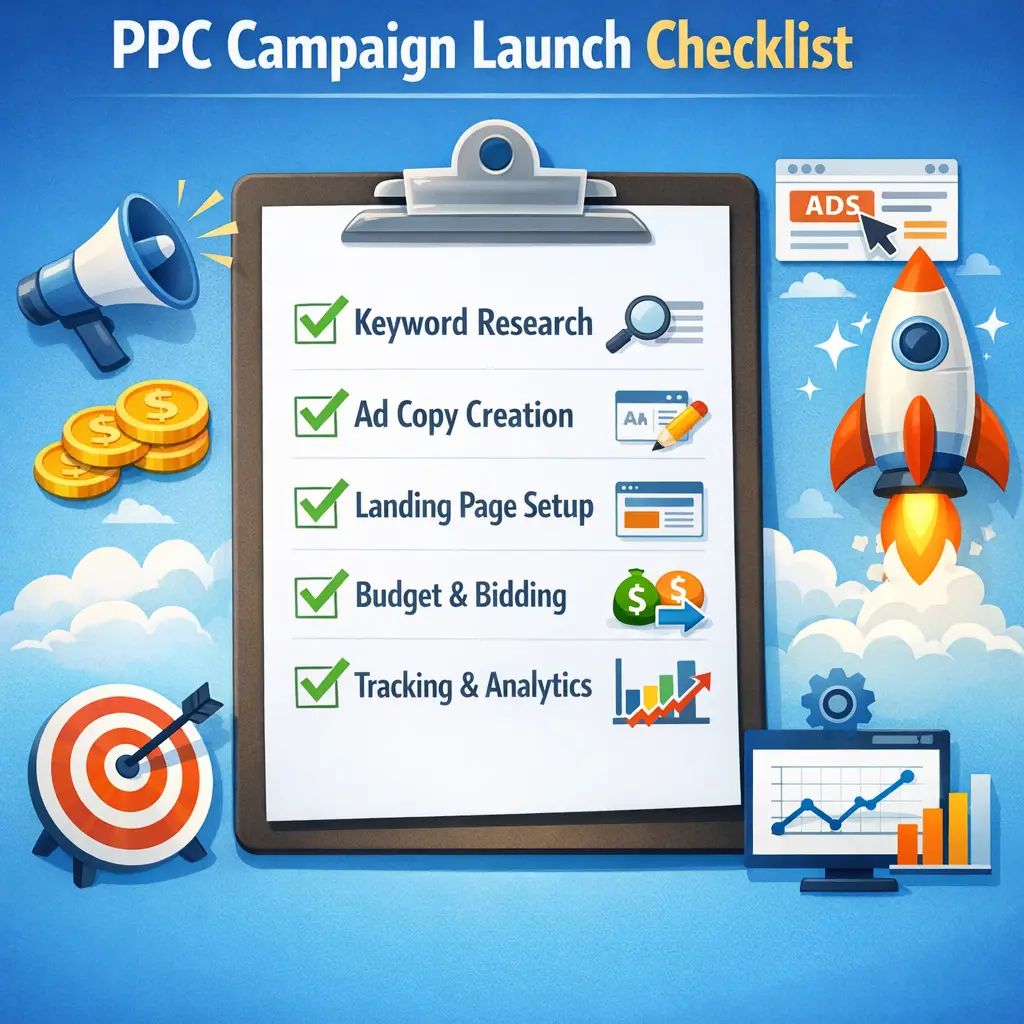
The correct sequence is:
- Configure your conversion tracking (Google Ads conversion tag, GA4 integration, or third-party call tracking)
- Verify that conversions are firing accurately before spending
- Run the campaign on manual CPC or Maximize Clicks until you have a statistically meaningful conversion baseline
- Transition to Smart Bidding strategies once the algorithm has real data to learn from
Micro-Conversions: A Strategy for Low-Volume Businesses
Small businesses in niche markets or low-transaction industries face a legitimate challenge: their conversion volume may never be high enough to feed Smart Bidding effectively based on macro-conversions alone (completed purchases, submitted lead forms).
The solution is micro-conversion tracking. These are lower-funnel engagement signals that indicate meaningful user intent without requiring a completed transaction:
- Scroll depth past a defined threshold on a key page
- Time on site exceeding a set duration
- Video engagement (25%, 50%, 75% completion)
- Form interaction (field focus without submission)
- Click-to-call button activation
- PDF download or resource access
Feeding these signals into your conversion tracking setup gives Google’s algorithm the data density it needs to optimize, while your campaign simultaneously builds toward the macro-conversion data that eventually takes over as the primary signal. For a deeper look at how to turn those signals into business outcomes, the article on conversion optimization: beyond the basic CRO playbook covers the structural decisions that make landing pages and conversion funnels work harder for paid traffic.
Attribution: The Hidden Distortion
The default attribution model for many Google Ads accounts still uses last-click attribution, which assigns full conversion credit to the final ad a user clicked before converting. For small businesses running campaigns across multiple intent stages, this systematically undercredits upper-funnel keywords — making it appear that awareness-level campaigns are performing poorly when they’re actually initiating the journeys that lower-funnel ads close.
Before drawing conclusions about which campaigns are working, audit your attribution model. Data-driven attribution, where available, distributes credit across the full conversion path and produces a far more accurate picture of what’s actually driving results.
Search Intent Architecture: The Strategic Layer Most Campaigns Skip
Here is the most common reason small business PPC campaigns fail at the structural level: they treat all keywords as interchangeable. A campaign built without intent architecture is a campaign built to waste money.
Search intent describes the underlying goal behind a user’s query. Google classifies search intent across four primary categories, and the stage a user is in at the moment they search determines what kind of response they’re actually looking for — and how likely they are to convert.
The Four Intent Stages and Their PPC Implications
Informational intent — The user wants to learn something. They’re not ready to buy.
– Example: “how to winterize outdoor pipes”
– PPC implication: Clicks from these queries rarely convert to leads or sales. Running transactional ads against informational queries produces poor Quality Scores, high bounce rates, and wasted spend.
Navigational intent — The user is looking for a specific brand or website.
– Example: “[your business name] plumbing”
– PPC implication: Branded search campaigns protect your brand from competitor conquesting and are highly cost-efficient for businesses with existing brand awareness.
Commercial investigation intent — The user is comparing options and moving toward a decision.
– Example: “best emergency plumber in [city]” or “licensed plumber vs. handyman for pipe repair”
– PPC implication: High value, competitive. Ad copy should emphasize differentiators, credentials, reviews, and guarantees rather than generic service descriptions.
Transactional intent — The user is ready to act right now.
– Example: “emergency plumber near me” or “plumber available tonight [city]”
– PPC implication: Your highest-converting, highest-priority keyword tier. Landing pages must be frictionless and conversion-optimized. Call extensions and location assets are essential.
Building Intent-Segmented Campaign Structure
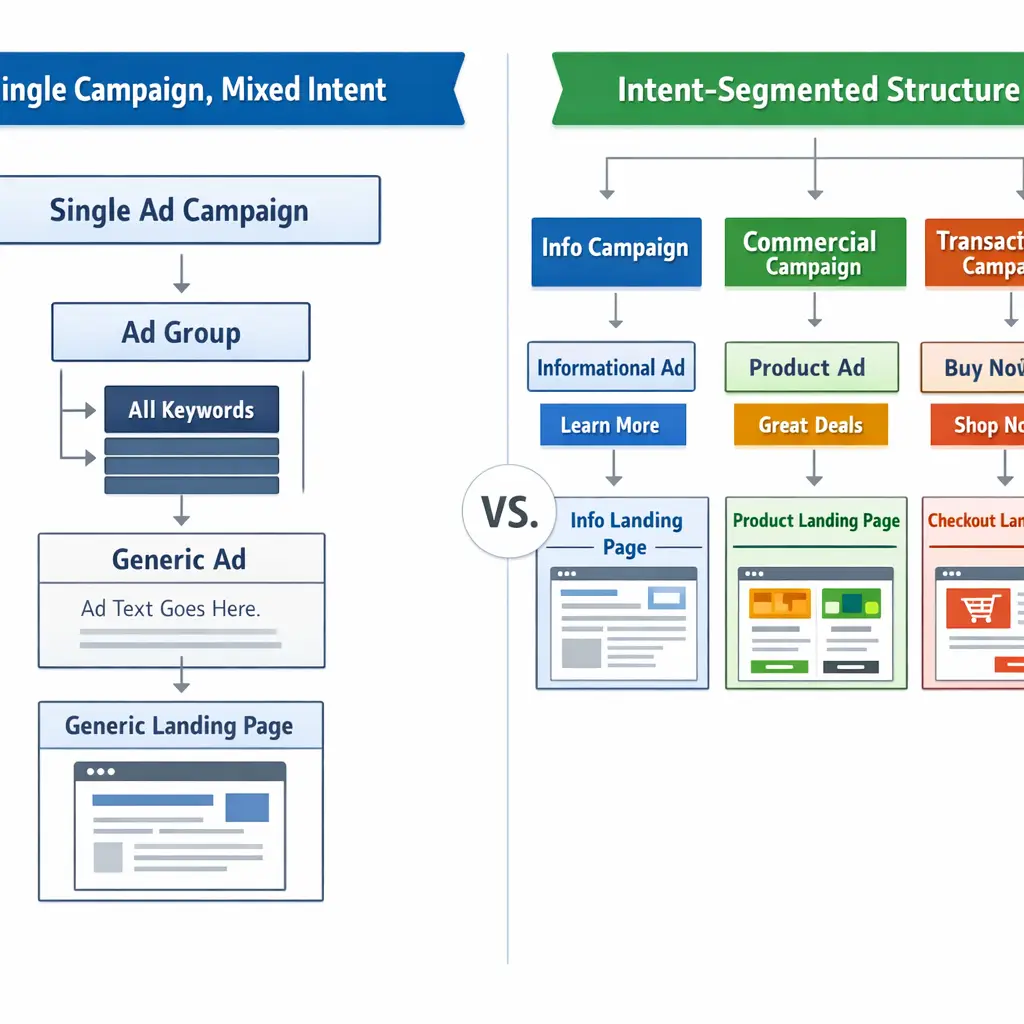
The strategic execution is straightforward once you understand the framework: build separate campaigns or tightly structured ad groups around intent tiers, not just topic categories.
A local plumbing business running a single campaign mixing informational, commercial, and transactional keywords will produce muddled performance data, inconsistent Quality Scores, and landing pages that satisfy no one. Segmented by intent, the same budget produces significantly better conversion rates because every element of the campaign — keyword, ad copy, landing page — is aligned to what the user is mentally prepared to do.
This alignment is also a financial mechanism. Google’s Quality Score calculations reward intent match between query, ad, and landing page. Higher Quality Scores lower your cost-per-click and improve your ad position — making intent architecture a direct lever on campaign efficiency.
Keyword Match Types: The Decision That Determines Where Your Budget Goes
This is one of the most consequential decisions in any Google Ads account, and it is almost entirely absent from introductory PPC content. Understanding keyword match types is not optional — it determines whether your budget reaches the searches you want or funds a wide range of tangential queries you never intended to target.
Match Type Breakdown
| Match Type | Syntax Example | How It Works | Risk Profile |
|---|---|---|---|
| Broad Match | plumber | Ads may show for any query Google considers related, including synonyms, related topics, and loosely connected searches | High — can trigger on irrelevant queries at scale |
| Phrase Match | "emergency plumber" | Ads show for searches containing the phrase’s meaning, in roughly that order, with additional words before or after | Moderate — better control, still requires active negative keyword management |
| Exact Match | [emergency plumber near me] | Ads show only for that specific query or close variants with the same meaning | Low — maximum control, lowest reach |
The Negative Keyword Layer
Recommending negative keywords without explaining match types first is a structural error in most PPC education — because they’re two sides of the same coin. Negative keywords exclude your ads from queries you don’t want to trigger. Without a proactive negative keyword strategy, broad and phrase match campaigns will reliably spend a portion of their budget on irrelevant traffic.
For a small business with a focused service offering, the negative keyword list should be built before the campaign launches, not reactively after wasted spend. Common negative keyword categories include:
- DIY and informational modifiers — “how to,” “DIY,” “myself,” “free,” “tutorial”
- Job-seeking intent — “jobs,” “careers,” “salary,” “how to become”
- Competitor brand names — unless running a deliberate competitor conquesting strategy
- Irrelevant geographic terms — cities or regions outside your service area
- Low-intent qualifiers — “reviews for,” “what is,” “definition of”
Campaign Structure: SKAGs vs. STAGs and Why It Matters for Small Businesses
Ad group structure is one of the most directly controllable variables affecting Quality Score — and by extension, your cost-per-click and ad position. Yet it receives almost no attention in standard introductory PPC content.
The historical best-practice approach was the Single Keyword Ad Group (SKAG) model, where each ad group contained one keyword in multiple match types, allowing for hyper-specific ad copy tailored to that exact query. SKAGs delivered exceptional Quality Scores and precise control but required significant account management overhead to maintain at scale.
The more current and practical approach for most small businesses is the Single Theme Ad Group (STAG) model, which groups tightly related keywords sharing the same user intent and landing page destination into a single ad group. This approach is more manageable, works well with Responsive Search Ad formats, and still achieves the relevance alignment that Quality Score rewards — without the operational complexity of maintaining dozens of individual keyword ad groups.
SKAG vs. STAG: Practical Comparison
| Factor | SKAG | STAG |
|---|---|---|
| Control level | Maximum — one keyword per ad group | High — tightly themed keyword clusters |
| Quality Score optimization | Excellent — ad copy matches query exactly | Very good — copy aligns with intent theme |
| Management overhead | High — scales poorly for small teams | Moderate — more manageable for small businesses |
| RSA compatibility | Limited — RSAs are designed for variation | Strong — RSA headline variety maps naturally to theme |
| Recommended for | High-volume accounts with dedicated management | Small to mid-size businesses managing their own campaigns |
| Negative keyword need | Extreme — cross-ad-group traffic must be tightly controlled | Moderate — still required but less complex |
For most small businesses, a STAG approach with disciplined negative keyword management and intent-aligned ad copy produces excellent results without demanding the account management capacity that SKAGs require.
Ad Copy That Actually Converts: Frameworks Over Formulas
The standard ad copy guidance in most PPC content boils down to: include your keyword, write a clear headline, add a call to action. That’s technically not wrong — it’s just not enough.
Ad copy that drives meaningful conversion rates is built around a strategic framework, not a checklist. Two frameworks that consistently produce results in small business PPC:
Problem-Agitate-Solution (PAS)
PAS is a copywriting structure that leads with the user’s problem, amplifies why that problem matters, then presents your service as the resolution.
Applied to a transactional search query like “water heater not working”:
- Problem headline: Water Heater Failure? Same-Day Repair Available
- Agitate: No hot water disrupts everything. Our licensed technicians diagnose and fix fast.
- Solution CTA: Book your repair online — trucks available today.
This structure works because it meets the user at the emotional state their search reveals, rather than opening with a generic service description.
Query Mirroring
Responsive Search Ads allow you to submit multiple headlines and descriptions that Google assembles dynamically. One of the highest-impact strategies within RSAs is query mirroring — writing headlines that reflect the exact language of your target queries, including location modifiers and urgency signals.
If users are searching “licensed electrician [city] free estimate,” a headline that reads “Licensed Electrician in [City] — Free Estimate” will outperform a headline reading “Professional Electrical Services” because it matches the user’s mental pattern more precisely, driving higher click-through rates and signaling ad relevance to Google’s Quality Score algorithm.
RSA Pin Strategy
Within Responsive Search Ads, you have the option to pin specific headlines to specific positions. This is a tool most small businesses don’t use — but it gives you control over which message always appears in your most prominent ad position. Pinning your strongest, most differentiated value proposition to Headline 1 ensures your core message is never absent from an ad combination, regardless of what Google assembles from your remaining assets.
When PPC Delivers Poor Returns: An Honest Assessment
Most PPC content is uniformly promotional about the channel’s potential. A genuinely useful guide acknowledges the conditions under which PPC will underperform — because running a campaign in the wrong context is worse than not running one at all.
Scenarios Where PPC Is a Poor Fit
Undefined customer lifetime value — If you don’t know what a customer is worth to your business over time, you can’t set a rational target cost-per-acquisition. Without that anchor, you have no framework for evaluating whether a campaign is generating profit or consuming it.
Undefined conversion tracking (see above) — Launching PPC without conversion tracking configured is not a starting point; it’s a liability. The data you need to make any meaningful optimization decision does not exist.
Highly commoditized local markets with paper-thin margins — In markets where multiple competitors offer identical services and price is the only differentiator, PPC can generate clicks without generating profit. If your conversion rate and average transaction value can’t support the cost of acquisition at competitive CPCs in your vertical, the math doesn’t work regardless of how well the campaign is built.
No conversion-optimized landing page — Sending paid traffic to a general homepage is reliably inefficient. If the infrastructure to receive and convert paid traffic isn’t in place, the campaign spend is funding traffic that has nowhere productive to go.
Businesses still defining their audience — PPC performs best when you know who you’re targeting, what they need to hear, and what action you want them to take. A business still working through those fundamentals will struggle to build campaigns that resonate.
PPC and SEO: The Cross-Channel Relationship Small Businesses Ignore
For small businesses operating with defined budgets, the relationship between paid search and organic search strategy is not a secondary consideration — it’s a central one. Running PPC and SEO in isolation, without coordinating their inputs and outputs, is a common and costly oversight.
Using PPC Data to Accelerate SEO Decision-Making
SEO content strategies operate on long timelines — months before rankings move and months more before traffic compounds. PPC operates on days. A small business can run a targeted paid search campaign for a defined test period, evaluate which keywords actually drive conversions (not just clicks), and use that validated data to prioritize an SEO content strategy around proven commercial terms.
This inverts the traditional approach of committing to months of SEO work based on search volume estimates and then discovering which terms actually convert. PPC provides conversion signal that keyword research tools simply cannot. If you’re building that organic foundation alongside your paid campaigns, the article on affordable SEO for small businesses: what actually works outlines the specific tactics worth prioritizing.
Keyword Cannibalization: When Paid and Organic Compete
If your business already ranks in the top organic positions for a given keyword, running PPC on that same term requires a deliberate justification. In some cases, holding both a paid and organic position does increase total click share — particularly for high-value commercial terms. In other cases, the incremental traffic from paid doesn’t justify the spend, and the budget is more productively directed toward terms where you have no organic presence.
The analysis worth running: compare the organic click volume you’re already receiving on strong-ranking keywords against the incremental paid traffic the same keyword would generate. The result tells you whether you’re expanding reach or duplicating it.
Branded PPC: When It Makes Sense
Bidding on your own brand name is a question that small businesses frequently mishandle. The argument for it: competitor conquesting campaigns can place a rival’s ad above your organic listing on branded searches, diverting traffic you’ve earned. A branded campaign is relatively inexpensive and highly efficient since conversion intent on branded searches is high.
The argument against it: if you hold a dominant organic position for your brand name, face no meaningful competitor conquesting threat, and have limited budget, branded PPC may simply be bidding for traffic you would have received anyway. Audit your branded search impression share before committing budget to brand campaigns.
Search Impression Share as a Prioritization Tool
Search impression share — the percentage of auctions where your ad was eligible to appear that you actually showed up in — is one of the most underused diagnostic metrics in small business PPC. A low impression share on high-value transactional keywords tells you that your budget or bid strategy is leaving significant competitive coverage on the table. That same metric applied across both paid and organic channels can reveal where a small business has the highest-leverage opportunity to invest — whether through increased PPC budget, an SEO push, or both.
Building a PPC Foundation That Compounds Over Time
Effective PPC advertising for small businesses is not a set-and-forget tactic. The campaigns that produce consistently strong returns are those built on deliberate structural choices, maintained with disciplined optimization routines, and informed by clean conversion data from the start.
The businesses that struggle with PPC almost always share a common characteristic: they started with the platform before establishing the strategic foundation beneath it. Keywords were chosen without intent analysis. Campaigns launched without conversion tracking. Ad copy was written to describe the business rather than match what users were actively searching for. Structure was an afterthought rather than a primary design decision.
The gap between average PPC results and strong PPC results is not primarily a budget gap. It’s a strategy gap — one that Mongoose Digital Marketing is built to close.
If you’re ready to build a paid search campaign that generates real, measurable results for your business, contact our team for a free consultation. We’ll audit your current setup or help you build the right foundation from scratch — no generic templates, no guesswork.
For additional guidance on building a complete digital presence alongside your PPC strategy, the Google Ads Help Center provides platform-level documentation that complements the strategic framework covered here.
Strategic Recommendations for 2026
As the paid search landscape continues to shift toward automation, audience-first targeting, and cross-channel attribution, small businesses that build on the right tools and workflows now will have a meaningful advantage heading into 2026. Here are three specific recommendations worth acting on.
1. Prioritize First-Party Data Collection Before Third-Party Signals Erode Further
Browser-level tracking restrictions and evolving privacy regulations have made third-party cookie data increasingly unreliable. Small businesses should focus on building first-party data assets — email lists, CRM integrations, and customer match audiences — and connecting those assets directly to their Google Ads or Microsoft Ads accounts. Enhanced Conversions, Google’s privacy-safe conversion matching tool, is worth implementing now if it isn’t already in place. It fills attribution gaps that standard tag-based tracking increasingly misses.
2. Integrate Google Analytics 4 With Your Paid Campaigns as a Core Diagnostic Layer
GA4’s event-based data model and its predictive audience capabilities are significantly more useful for PPC optimization than its predecessor — but only when configured correctly. Small businesses running paid search in 2026 should ensure GA4 is fully linked to their ad accounts, key events are marked as conversions, and audience segments are being exported back to the ad platform for bid adjustments. This creates a closed loop between behavioral data and campaign performance that surface-level platform reporting cannot replicate.
3. Test Performance Max Campaigns With Defined Asset Groups and Clear Conversion Goals
Performance Max has matured considerably since its initial rollout, and in 2026 it is no longer practical to ignore it — particularly for local service businesses with defined geographic targets. The key to making it work at the small business level is strict asset group segmentation by service category, properly configured conversion goals, and regular search term report audits to identify irrelevant traffic patterns. Treat it as a complement to tightly controlled Search campaigns rather than a replacement for them, and apply budget controls that allow meaningful data collection without over-committing before performance signals are established.
Frequently Asked Questions
Is PPC advertising worth it for small businesses with limited budgets?
Yes — but the answer depends heavily on how the campaign is structured. PPC is not inherently expensive; it is proportional to how competitive your target keywords are and how efficiently your campaign converts clicks into inquiries or sales. Small businesses with well-defined service areas, clear conversion goals, and tightly themed ad groups consistently see strong returns even with modest monthly investment. The risk is not in the channel itself — it’s in running a poorly structured campaign that wastes spend on irrelevant traffic. A properly built PPC foundation gives small businesses the ability to scale up or pull back based on real performance data rather than guesswork.
How long does it take for a small business PPC campaign to show results?
Most campaigns begin generating measurable click and impression data within the first few days of launch. However, meaningful optimization — the point at which you have enough conversion data to make reliable bid, keyword, and landing page decisions — typically requires several weeks of consistent traffic. The timeline depends on your search volume, how competitive your market is, and whether conversion tracking was configured correctly from day one. Businesses that launch with clean tracking and a solid campaign structure reach that optimization threshold significantly faster than those who build the foundation after the fact.
What is the difference between broad match, phrase match, and exact match keywords in Google Ads?
These are keyword match types that control how closely a user’s search query must align with your keyword before your ad is eligible to appear. Exact match is the most restrictive — your ad shows primarily when the search closely mirrors the keyword itself. Phrase match allows for additional words before or after your keyword. Broad match gives Google the most latitude to match your keyword to related queries, which can generate high volume but also significant irrelevant traffic if not managed carefully with negative keywords. For small businesses, a strategy that leads with phrase and exact match keywords — supported by a disciplined negative keyword list — typically produces more efficient results than relying on broad match without strong conversion data to guide Google’s automation.
How do I know if my PPC campaign is actually working?
The clearest indicator is whether your campaign is generating verified conversions — phone calls, form submissions, purchases, or other actions that represent real business outcomes — at a cost that makes sense relative to the value of that customer. Clicks and impressions alone are not indicators of success. If your conversion tracking is configured correctly, you should be able to trace revenue or leads back to specific keywords, ads, and campaigns. Metrics worth monitoring alongside conversion volume include conversion rate, cost per conversion, impression share on your highest-intent keywords, and quality score trends. If any of these signals are consistently moving in the wrong direction, that is a structural or strategic problem — not simply a budget problem. For businesses that want to go further, our PPC advertising management services are built around exactly these performance diagnostics.
Conclusion
Small business PPC advertising rewards the businesses that treat it as a system rather than a shortcut — and building that system correctly from the start is exactly where Mongoose Digital Marketing focuses its work. Whether you need a paid search strategy built from the ground up or an existing campaign audited and restructured for better performance, our team brings the same disciplined, data-driven approach to every engagement. If you’re ready to stop guessing and start generating measurable results from your ad spend, Contact Mongoose Digital Marketing to get started.