
Key Takeaways
- Service area businesses (SABs) in Ohio — HVAC, pest control, landscaping, home inspection — face distinct Google Business Profile challenges that standard local SEO advice for brick-and-mortar locations does not address, including hidden address configuration and proximity calculation differences.
- Google’s local pack rankings shift based on where the searcher is physically located, meaning an Ohio service business that ranks first from its own address may be invisible to potential customers in adjacent suburbs like Pickerington, Gahanna, or Springboro.
- Ohio’s seasonal climate cycle creates predictable, measurable windows — HVAC demand peaks in May and September, roofing inquiries surge April through June — when GBP activity recency has the highest compounding effect on local prominence scores.
- Ohio’s contractor licensing ecosystem, including regional home builder associations and county-level trade groups, contains institutional backlink sources that outperform generic citation directories for local prominence scoring but are almost never claimed by service businesses.
- Zip code–level rank tracking tools such as Local Falcon’s grid-based tracking reveal the actual geographic distribution of your local pack rankings across a metro area — a diagnostic most Ohio service businesses have never run.
If you’re a service business in Dayton, Kettering, Beavercreek, or any of the surrounding communities along the I-75 and US-35 corridors, there’s a version of local SEO you’ve probably been sold that sounds reasonable but leaves serious performance on the table. Claim your Google Business Profile. Keep your name, address, and phone number consistent. Add some photos. Collect reviews.
That’s not wrong. It’s just the floor, not the ceiling.
The service businesses that dominate local search in the greater Dayton metro — the ones that generate steady inbound calls from Centerville, Miamisburg, and Huber Heights without paying for every click — are operating a more sophisticated system. They understand that the Map Pack and organic search rankings are governed by related but distinct signals. They understand that their GBP ranking in Springboro is not the same ranking they hold in Beavercreek, even if both towns sit inside their defined service area. And they’ve built their online presence around that reality rather than assuming one good profile covers the whole territory.
This guide is written for service business owners and operators who are ready to move past the checklist and build a local SEO system that actually accounts for how Google works in Ohio’s multi-suburb metro markets.
Why Standard Local SEO Advice Underserves Ohio Service Businesses
Most local SEO content is written for a generalized audience. It assumes your business has a storefront that customers visit. It assumes your competitive landscape looks roughly like every other mid-size American city. And it rarely distinguishes between the mechanics of ranking in a single-downtown market versus ranking across a fragmented suburban corridor.
The Dayton metro doesn’t fit that template. You’re not operating in a compact urban center with clear geographic edges. You’re operating in a network of distinct suburbs — each with its own search behavior, its own competitive density, and its own population of searchers who are looking for exactly what you offer. Centerville and Kettering share a border, but a cleaning company that ranks well for “house cleaning Centerville” is not automatically visible to a searcher in Kettering.
This geographic fragmentation is the defining challenge of local SEO for Ohio service businesses, and it demands a different approach.
The SAB Architecture Problem: When You Don’t Have a Storefront
The majority of service businesses in the Dayton area — HVAC contractors, pest control companies, landscapers, home inspectors, mobile pet groomers, window cleaners — are service area businesses. They drive to the customer. They may operate from a home address, a small warehouse, or a vehicle. They have no retail location that customers visit.
Google’s local algorithm was built with storefront businesses in mind. SABs are accommodated but not fully optimized for. Understanding exactly how Google treats your GBP listing as an SAB is not optional knowledge — it directly affects whether you appear in the Map Pack at all.
Hidden Address Configuration and What It Costs You
When you configure your GBP as a service area business and hide your address, you’re making a trade. You protect your home or operational address from public display, but you lose the proximity anchor that Google uses to calculate your relevance for nearby searches. Google’s distance signal — one of the three core Map Pack ranking factors alongside relevance and prominence — becomes harder to calculate when your physical location isn’t disclosed.
This doesn’t mean hiding your address is always wrong. For businesses operating from residential addresses, the alternative (a home address appearing publicly on Google Maps) creates its own problems. But you need to understand what you’re trading and compensate for it through other signals.
The SAB configuration decision framework:
| Business Situation | Recommended GBP Configuration | Primary Trade-off |
|---|---|---|
| Home-based, no client visits | Full SAB, hidden address | Weaker proximity signal; compensate via content and citations |
| Commercial address, clients visit | Hybrid listing, address shown | Stronger proximity signal; Map Pack eligibility in immediate area |
| Shared commercial space, no signage | SAB or hybrid depending on verification | Risk of suspension if address fails Google’s verification standards |
| Multiple technicians, wide area | SAB with specific city targeting | Avoid radius-only configuration where possible |
| Operated from vehicle only | SAB, hidden address | Must rely heavily on service area content and behavioral signals |
Service Area Configuration: Cities vs. Radius
Inside your GBP service area settings, you have a choice: define your service area by specific cities and zip codes, or draw a radius around your location. This choice has real ranking consequences that most GBP setup guides never explain.
Specific city and zip code targeting sends clearer topical signals to Google about where you serve. When a searcher in Miamisburg types “HVAC repair near me,” Google can evaluate your service area city list and confirm or discount your relevance to that search. A radius setting requires Google to make an inference about whether your center point and the defined radius actually align with where that searcher is located — a less precise signal.
The practical recommendation: configure your GBP service area using specific city and zip code entries for every community you actively serve. For the Dayton metro, that means individually listing Dayton, Kettering, Beavercreek, Centerville, Huber Heights, Miamisburg, Springboro, Oakwood, Vandalia, Englewood, Xenia, and any other communities where you want to be found. Do not rely on a single radius to do this work.
The Three-Factor Map Pack Model and Where Ohio SABs Struggle
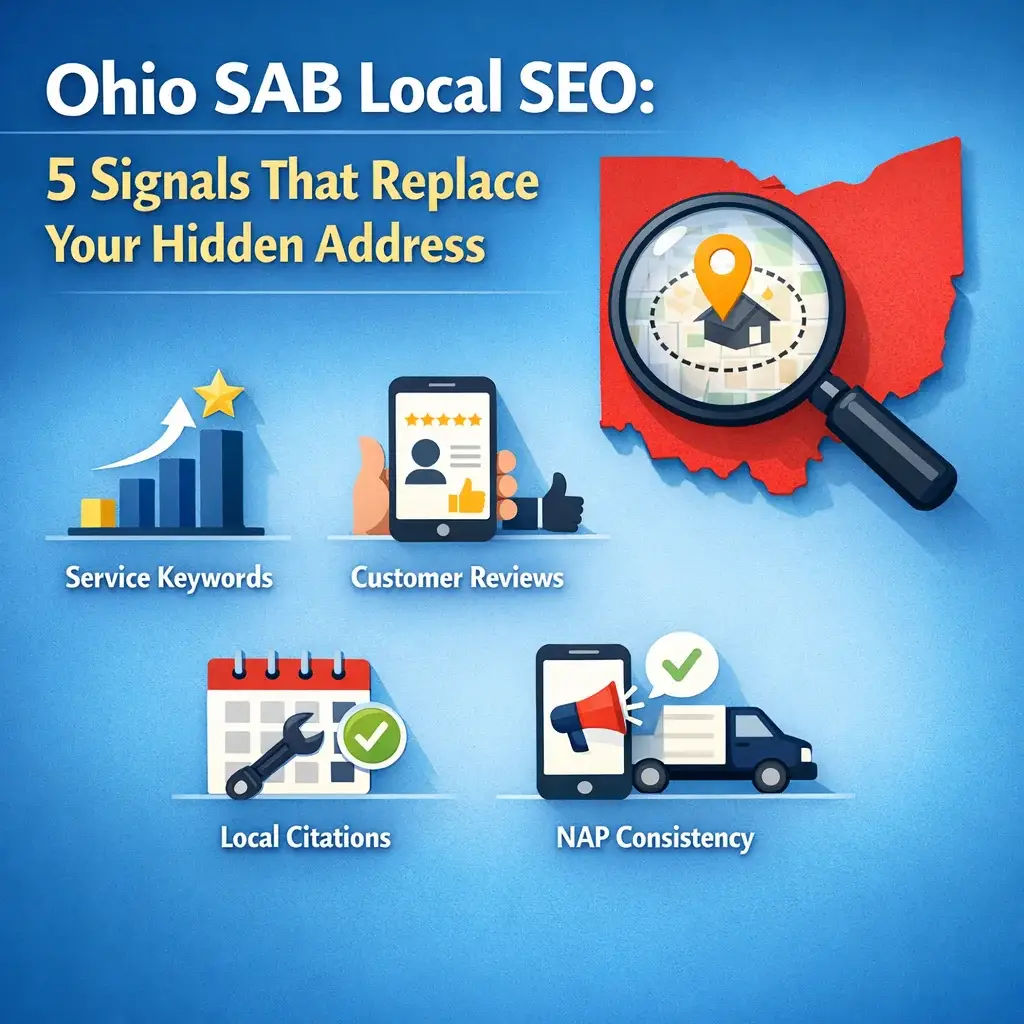
Google’s local pack algorithm evaluates three factors: relevance, distance, and prominence. Every optimization decision you make should map to one of these three levers. Understanding which lever is weakest for your business determines where your effort belongs.
Relevance is how well your GBP profile, website content, and overall online presence match what the searcher is looking for. This is where category selection, service descriptions, and website content work together.
Distance is the proximity of your business location (or defined service area) to the searcher. For SABs with hidden addresses, this is the hardest factor to maximize and the most important to compensate for elsewhere.
Prominence is Google’s assessment of how well-known and reputable your business is, based on links, reviews, citations, and behavioral signals from users interacting with your profile.
Most SABs in the Dayton metro have adequate relevance — they’ve selected a reasonable primary category and added basic service descriptions. Their distance factor is constrained by geography and configuration choices. The lever with the most room for improvement, and the one that competitors most consistently underinvest in, is prominence.
Reverse-Engineering Your Competitors’ Category Strategy
Before touching your own GBP category selection, run a competitive category audit. Search your primary service keyword in Google Maps from different locations within your target area. Click through to the top three Map Pack results. Use a tool like GMBspy (a Chrome extension) or simply view the page source and search for “category” to identify which primary and secondary categories your top-ranking competitors have selected.
You’re looking for two things:
Category consistency — If all three top competitors are using the same primary category, that category is likely the correct signal for your service type in this market. Diverging from it without strong justification introduces relevance risk.
Secondary category gaps — Competitors sometimes leave relevant secondary categories unclaimed. If you offer both HVAC service and indoor air quality testing, but your top competitors only claim HVAC categories, adding air quality categories creates a relevance signal they don’t have for those adjacent searches.
This audit takes under an hour and gives you a data-grounded starting point rather than a guess.
Geographic Rank Volatility: The Problem Ohio Service Businesses Don’t Know They Have
Here is a reality that most service business owners in the Dayton area have never confronted: your Google Maps ranking is not a single number. It’s a distribution.
Your business might rank second in the local pack for a searcher located in Centerville, third for a searcher in Springboro, and outside the top seven for a searcher in Beavercreek — even if all three locations fall within your defined service area. This geographic rank volatility is driven by Google’s real-time proximity weighting, which adjusts your ranking based on the physical location of each individual searcher.
If you check your rankings from your home or office address, you’re seeing your rank for searches originating from that single location. You are not seeing your rank across the full geographic area you’re trying to serve. For most service businesses, there is a significant gap between these two numbers.
How to Diagnose Your Geographic Rank Distribution
Grid-based rank tracking tools solve this problem by simulating searches from multiple geographic points across your target area and mapping where you rank at each point. Local Falcon is the most widely used tool for this purpose. It generates a visual heat map showing your rank position at grid intersections across a defined area — you can set the grid to cover the entire Dayton metro and see, at a glance, where you’re winning, where you’re losing, and where you’re invisible.
The diagnostic process:
- Configure a Local Falcon grid centered on your primary service area with a grid spacing appropriate for suburban density (0.5 to 1 mile between points works well for the Dayton metro)
- Run the scan for your two or three highest-priority keywords
- Identify the zip codes or neighborhoods where your rank drops below position three — these are your coverage gaps
- Examine what competitors are filling those positions in those specific locations — their GBP configuration, website content, and review volume will tell you what signals are driving their advantage there
The coverage gaps you identify through this diagnostic become your content and citation roadmap. A consistent rank drop in Beavercreek searches, for example, suggests your website may lack Beavercreek-specific content depth, your citation profile may not include Beavercreek-relevant directories, or a local competitor has stronger proximity or prominence signals in that area specifically.
Building Location Content That Actually Differentiates
Creating location-specific pages for Kettering, Beavercreek, Centerville, Miamisburg, Springboro, Huber Heights, and your other service communities is standard local SEO advice. The execution gap — and where most service businesses produce content that fails to rank — is in differentiation.
A location page that simply replaces the city name in a template (“We provide HVAC service in Kettering. Call us for HVAC in Kettering today.”) sends thin content signals. Google’s quality assessment systems are effective at identifying near-duplicate pages with minimal unique value. These pages may index but rarely rank with authority.
Location pages that earn rankings contain genuinely differentiated content. For Ohio service businesses, differentiation sources include:
- Local housing stock characteristics — Beavercreek has significant neighborhoods of mid-century ranch homes, which have specific HVAC ductwork configurations. Centerville has substantial growth in newer construction. These are real differentiating facts that a local service expert can speak to authentically.
- Service-specific local demand context — Springboro is a growing residential community with active new construction, which creates different pest control pressure patterns than the established neighborhoods of Kettering.
- Local regulatory or permit context — Some Ohio municipalities have specific permit requirements for HVAC installations, electrical work, or structural modifications. Mentioning local permit coordination is a genuine service differentiator and a content signal that non-local competitors can’t replicate.
- Community-specific trust signals — Affiliations with local organizations, service on community projects, or recognition from community bodies specific to that municipality.
The Hub-and-Spoke Content Architecture
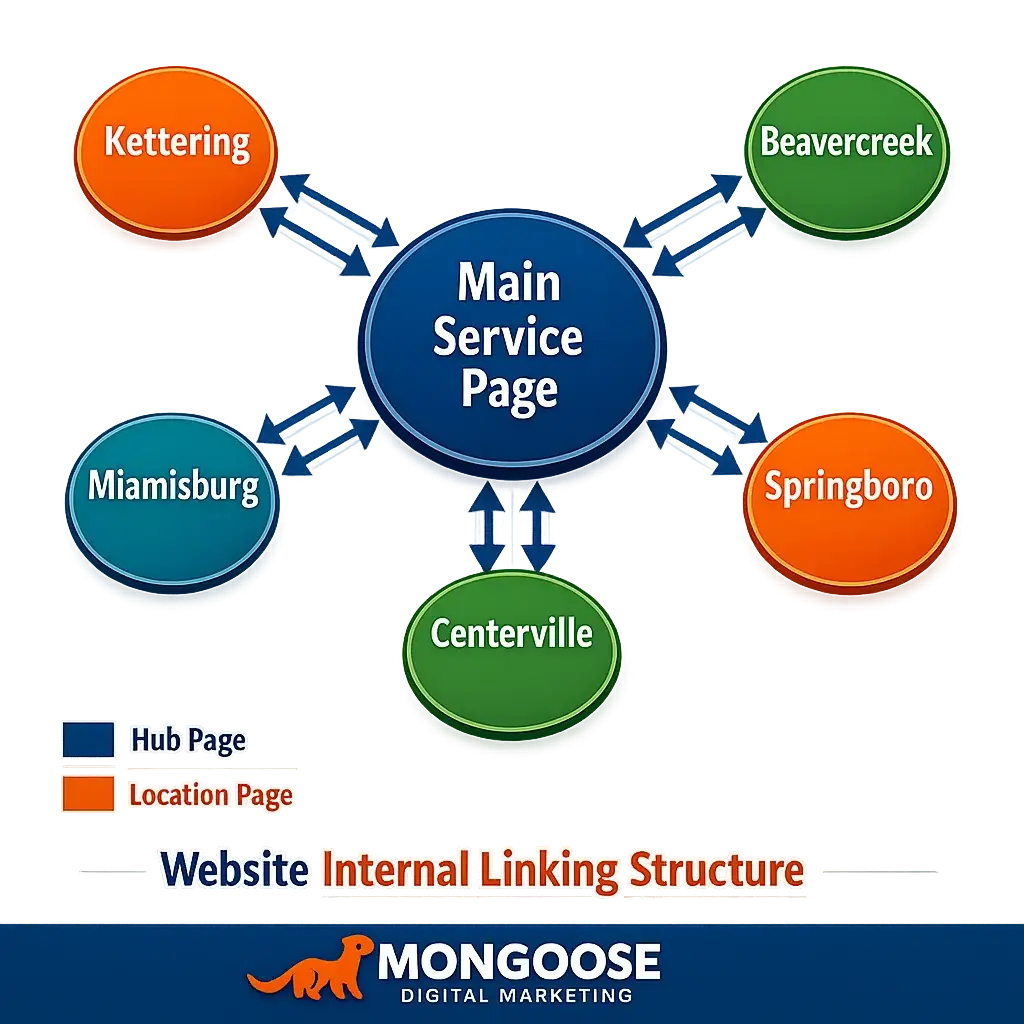
Individual location pages perform better when they’re part of a deliberate internal linking structure rather than isolated pages. The hub-and-spoke model positions a core service page (the hub) as the primary ranking target for your highest-volume service keyword, with location-specific pages (the spokes) feeding authority into the hub through internal links while also targeting lower-volume, higher-conversion local searches independently.
For a Dayton-area HVAC company, this might look like:
- Hub:
/hvac-repair-dayton-ohio/— targets the highest-volume regional keyword - Spokes:
/hvac-repair-kettering/,/hvac-repair-beavercreek/,/hvac-repair-centerville/, etc. — each targets a suburb-specific keyword and links back to the hub
Each spoke page links to the hub. The hub links to each spoke. Google reads this structure as a signal of topical authority across the service category and geography, not just individual keyword relevance. For a deeper look at how this kind of content architecture connects to broader lead generation, the article on how SEO blogs generate leads — not just traffic is worth reviewing.
Ohio’s Seasonal Demand Cycle as a GBP Signal Engineering Tool
One of the most underused advantages available to service businesses in the Dayton area is the predictability of Ohio’s seasonal demand curve. The climate creates a reliable annual rhythm of service demand that, if matched with deliberate GBP activity, compounds your prominence signals precisely when they have the highest impact.
Google’s local algorithm weights recency of profile activity. A GBP profile with recent posts, fresh photos, and new reviews carries stronger behavioral signals than a profile that has been static for 60 days. This recency weighting matters most during high-traffic periods — when impression volume is high and click-through rates are closely watched.
The insight: if you enter a seasonal demand peak with a recently active, engagement-rich profile, you capture a higher share of those impressions than a competitor whose profile hasn’t been touched in two months. High CTR during high-traffic windows compounds your prominence score over time.
Ohio service demand calendar for the Dayton metro area:
| Month | Peak Service Categories | GBP Action to Take 3–4 Weeks Prior |
|---|---|---|
| March | Landscaping, gutter cleaning, window washing | Post winter damage content, update service descriptions, photo refresh |
| April | Pest control, roofing inspection | Post pre-season offers (non-discount framing), seed Q&A with seasonal pest questions |
| May | HVAC cooling season prep, deck/patio | Post AC tune-up content, request reviews from spring customers |
| June | Roofing (post-hail season peak), exterior painting | Publish hail damage assessment content, update roofing service photos |
| August | Back-to-school home services (cleaning, organization) | Post back-to-routine content, update service descriptions |
| September | HVAC heating season prep, chimney, fireplace | Post furnace inspection content, seed heating-season Q&A |
| October | Landscaping (fall cleanup), gutter cleaning | Post fall cleanup content, refresh exterior photos with fall imagery |
| November–December | Holiday lighting, weatherization, insulation | Post energy efficiency content, request year-end reviews |
The mechanism behind this calendar is not complicated — it’s disciplined execution of timing that most competitors ignore because their GBP posting is reactive rather than planned.
Ohio Institutional Backlinks: The Acquisition Strategy Most Service Businesses Skip
Generic citation directories — Yelp, Angi, HomeAdvisor, Yellow Pages — matter for NAP consistency and baseline presence. They do not materially move your prominence score in competitive local searches because every one of your competitors has the same citations. Prominence is comparative. What’s universal doesn’t differentiate.
What differentiates your link profile in the Dayton metro is institutional, geographically authoritative, industry-relevant links from sources your competitors haven’t claimed.
Ohio’s structured licensing and trade association ecosystem makes this achievable for almost any service category:
Ohio and regional institutional link sources for Dayton-area service businesses:
- Ohio Contractors Association — member directory with linked profiles for contractors across categories
- Building Industry Association of Dayton — regional home builder association with member listings
- Home Builders Association chapters — Montgomery County and surrounding county affiliates maintain member directories
- Dayton Area Chamber of Commerce — member directory; links from established chambers carry geographic and institutional authority
- Kettering, Beavercreek, Centerville, and Miamisburg local chambers — each suburb has its own chamber; multiple chamber memberships build a geographically distributed link profile across your service area
- Ohio Construction Industry Licensing Board — license verification pages; ensure your listing is complete and linked to your website where the system allows
- Ohio Licensed Electrical Contractors Association, Ohio Plumbing-Heating-Cooling Contractors Association — trade-specific membership directories
- Dayton Business Journal and Dayton Daily News small business sections — earned media mentions from regional news outlets produce links that no directory can replicate in terms of domain authority and editorial trust
The reason these links outperform citation directories for local prominence is not volume — it’s specificity. A link from the Building Industry Association of Dayton tells Google two things simultaneously: your business operates in the Dayton region, and your business is recognized by an industry-relevant institution in that region. Both signals directly feed the relevance and prominence factors that determine Map Pack positioning.
Acquisition is largely straightforward: most of these organizations offer standard membership with online directory listings. The barrier is not difficulty — it’s awareness that these sources exist and discipline to claim every one of them. Audit your current link profile against this list and identify what’s unclaimed. The gaps represent ranking opportunity your competitors have left open.
What “Complete” Actually Means for a Dayton-Area GBP Profile
Most GBP optimization checklists define completion as filling in the required fields. That’s a minimum, not a standard. A fully optimized GBP profile for a service business competing in the Dayton metro looks different.
Profile completeness audit checklist:
- Business name: Exact legal or DBA name only — no keyword stuffing, which violates GBP guidelines and can trigger suspensions
- Primary category: Verified against competitor audit (see earlier section)
- Secondary categories: All applicable service-adjacent categories claimed
- Service area: All target communities listed by city and zip code — not radius
- Phone number: Local Dayton-area number (not toll-free); consistent with website and all citations
- Website URL: Points to the most relevant page (homepage or primary service page), not a redirect chain
- Service menu: Every service you offer listed individually with a description; this feeds relevance for specific service searches
- Business description: 750 characters used in full; includes primary service keywords and geographic references without reading as keyword stuffing
- Photos: Minimum of 10 active photos; team photos, equipment, completed work; updated at least quarterly; geotagged metadata where possible
- Q&A section: 5–10 questions seeded by the business with authoritative answers covering common service questions and geographic coverage
- Posts: Active within the last 14 days; alternating between service updates, seasonal content, and review highlights
- Reviews: Response rate at or above 90%; response language includes natural service and location references
- Products/Services: Fully populated with descriptions and, where applicable, links to corresponding website service pages
- Booking/Appointment link: Configured if your business uses an online scheduling system
The Q&A section deserves specific emphasis because it’s consistently underused. You can seed your own questions and answers — this is explicitly allowed by Google. Questions like “Do you serve Springboro and Beavercreek?” answered with a detailed, authentic response covering your service area create both a user-facing information resource and a relevance signal for location-specific searches. For a comprehensive walkthrough of what a fully optimized profile looks like in practice, the article on Google Business Profile optimization tips that actually work covers the mechanics in detail.
Connecting GBP Optimization to Your Website: The Signals That Work Together
Your GBP and your website are not independent systems. Google evaluates the consistency and coherence between them as part of its relevance and trust assessment. Several specific connection points between the two directly influence your local pack and organic rankings.
Schema markup: LocalBusiness schema on your website’s homepage and contact page should mirror your GBP data exactly — same business name, phone number, address (or service area for SABs), and business hours. For service businesses, adding ServiceArea schema with the specific communities you serve reinforces the geographic signals your GBP is sending. hasOfferCatalog schema can enumerate your services in a format Google can parse programmatically.
NAP consistency audit: Run a citation audit using a tool like BrightLocal or Whitespark to surface every online mention of your business name, address, and phone number. Any inconsistency — a different phone number on an old Yelp listing, a slightly different business name on an industry directory — dilutes the trust signal that citation consistency is designed to build. Inconsistencies in the Dayton metro market are especially common for businesses that have changed addresses, changed phone systems, or rebranded.
Core Web Vitals and mobile performance: A majority of local service searches happen on mobile devices. Google’s mobile page experience signals — loading speed, interactivity, visual stability — factor into organic rankings and indirectly affect local pack performance through engagement metrics. A Dayton homeowner searching for an HVAC contractor on a phone in August is not going to wait four seconds for your site to load. Page speed is not an optional SEO consideration; it’s a conversion and ranking factor simultaneously.
Measuring What Actually Matters in Local SEO
Local SEO success for a service business is ultimately measured in phone calls, contact form submissions, and booked appointments — not rankings alone. Rankings are a leading indicator; revenue is the outcome. Build your measurement system around both.
Metrics to track monthly:
- GBP Insights: Impressions (searches and maps), direction requests, call clicks, website clicks, and photo views — segmented by week to identify seasonal patterns
- Calls from organic local search: Set up call tracking numbers specific to local search traffic; this isolates the revenue impact of your SEO investment
- Local pack position by zip code: Run your Local Falcon grid monthly and track movement across your target suburbs
- Organic keyword rankings: Track suburb-specific keywords (“pest control Beavercreek,” “HVAC repair Centerville”) in addition to broader Dayton-area terms
- Review velocity: New reviews per month by platform; track response rate and average rating trend
- Website organic traffic from local searches: Filter Google Analytics or Search Console data by geographic location to see which suburbs are generating the most website visits from local search
The connection between GBP behavioral signals and ranking is bidirectional: better rankings generate more impressions, more impressions generate more profile interactions, and more profile interactions (especially calls and direction requests) signal to Google that your business is the most relevant result for that search — reinforcing your ranking position. This is the compounding dynamic that makes consistent, disciplined local SEO investment significantly more valuable over time than any single optimization action.
Bringing It Together: A Local SEO System Built for the Dayton Metro
Local SEO for service businesses in the Dayton area is not a one-time project. It’s an ongoing system of interconnected signals — GBP configuration, website content architecture, institutional link acquisition, behavioral signal engineering, and geographic rank monitoring — that compound over time when maintained with discipline.
The businesses that dominate the Map Pack in Kettering, Centerville, Huber Heights, and Springboro aren’t there because they filled out their GBP profile once and hoped for the best. They’re there because they built a presence that tells Google the same coherent story from every direction: this business is relevant to this service, trusted by this community, and active in this market right now.
Every element covered in this guide maps to a measurable outcome. The SAB configuration decisions affect proximity signals. The location page architecture affects relevance signals. The institutional backlinks affect prominence. The seasonal GBP activity affects behavioral signal recency. The zip code–level rank tracking tells you where the system is working and where it needs attention.
That’s not generic local SEO advice. That’s a strategy built for how Ohio service businesses actually compete.
If you’re ready to audit where your current local SEO stands against this framework — and identify exactly which signals are costing you visibility in Beavercreek, Miamisburg, or wherever your coverage gaps are — Mongoose Digital Marketing offers a no-obligation consultation where we walk through your specific situation with the same analytical approach this guide describes.
Strategic Recommendations for 2026
The local SEO landscape continues to shift, and Ohio service businesses that stay ahead of the curve will be positioned to compound their existing visibility gains rather than play catch-up. Here are three specific areas worth prioritizing as you move into 2026:
1. Invest in GBP Photo and Video Intelligence with Canva or Similar Tools
Google’s visual content signals are maturing. Businesses that upload consistent, geotagged photos tied to real job completions — particularly in named neighborhoods like Kettering or Centerville — are seeing stronger behavioral engagement in the Map Pack. Use a visual content workflow that batches photo creation alongside completed jobs, ensuring you’re producing location-specific imagery at a cadence that reinforces activity signals throughout the year. Tools like Canva Pro make it straightforward to produce branded, professional visuals without requiring a dedicated design team.
2. Adopt a Local Rank Tracking Platform Built for Grid-Level Monitoring
Generic rank tracking that measures your position at a city level is no longer sufficient for competitive Ohio markets. Platforms like Local Falcon or BrightLocal offer grid-based tracking that shows exactly where your Map Pack visibility breaks down at the zip code or neighborhood level — whether that’s a dead zone in Huber Heights or a soft spot along the Miamisburg corridor. For 2026, commit to a monthly grid tracking routine that directly informs where you publish new content and where you pursue additional citation or link signals.
3. Build a Structured Review Response Protocol Using AI-Assisted Drafting
Review velocity and review response consistency are both behavioral signals that matter. AI-assisted drafting tools — including ChatGPT or similar platforms used with a disciplined prompt framework — allow service business owners or small teams to craft responses that naturally include service and location language without sounding formulaic. A structured protocol ensures no review goes unanswered, which matters both for Google’s engagement signals and for the prospective customers reading those exchanges before deciding to call.
Frequently Asked Questions
How long does local SEO typically take to show results for a service business in the Dayton area?
Most service businesses in competitive Ohio markets begin to see measurable movement in Map Pack rankings within three to five months of implementing a disciplined, multi-signal strategy. However, the timeline varies based on how well the Google Business Profile is currently configured, how much existing content infrastructure is in place, and how competitive the target service categories are in specific suburbs like Beavercreek or Centerville. Local SEO compounds over time — early months are about building foundational signals, while months four through twelve tend to produce the more visible ranking shifts.
Does a service area business in Ohio need a physical storefront to rank in the Map Pack?
No. Google’s local search system fully accommodates service area businesses that operate without a public-facing storefront. The key distinction is that SABs must configure their GBP correctly — hiding the physical address if they serve customers at client locations — and must define their service area geography accurately. Many of the highest-performing HVAC, plumbing, and landscaping businesses across the Dayton metro operate as SABs and rank consistently across multiple suburbs without a traditional office address listed publicly.
What is the most common local SEO mistake Ohio service businesses make?
The most common mistake is treating Google Business Profile optimization as a one-time setup task rather than an ongoing signal system. Businesses fill out their profile at launch, collect a handful of reviews, and then go quiet for months or years. From Google’s perspective, that inactivity is a signal — and competitors who post updates, respond to reviews, and add photos consistently will gradually displace dormant profiles in the Map Pack. The second most common mistake is creating no location-specific content on the website, leaving the business with no relevance signal for the specific suburbs where they actually want to rank.
Should every service area suburb have its own page on a Dayton-area contractor’s website?
In most cases, yes — provided those pages are built with genuine geographic substance rather than duplicated content swapped with city names. Well-constructed location pages that reference recognizable neighborhood details, local service context, and area-specific information create the relevance signals Google needs to understand that your business serves and understands a given community. A plumbing company serving both Springboro and Huber Heights, for example, benefits from dedicated pages for each area because the search intent, local landmarks, and community context genuinely differ between those markets. Thin or templated location pages, however, can do more harm than good and should be avoided.
Conclusion
For service businesses across the Dayton metro — from Kettering to Beavercreek — consistent, well-structured local SEO isn’t a marketing luxury; it’s the operational foundation that determines whether your phone rings when a nearby homeowner searches for exactly what you do. Mongoose Digital Marketing was built to understand how Ohio service businesses actually compete at the neighborhood level, which is why our approach goes deeper than generic best practices and into the specific signals that move the needle in your actual service area. If you’re ready to get a clear picture of where your local visibility stands and what it would take to improve it, we’d be glad to walk through it with you — Contact Mongoose Digital Marketing and let’s start the conversation.