

Key Takeaways
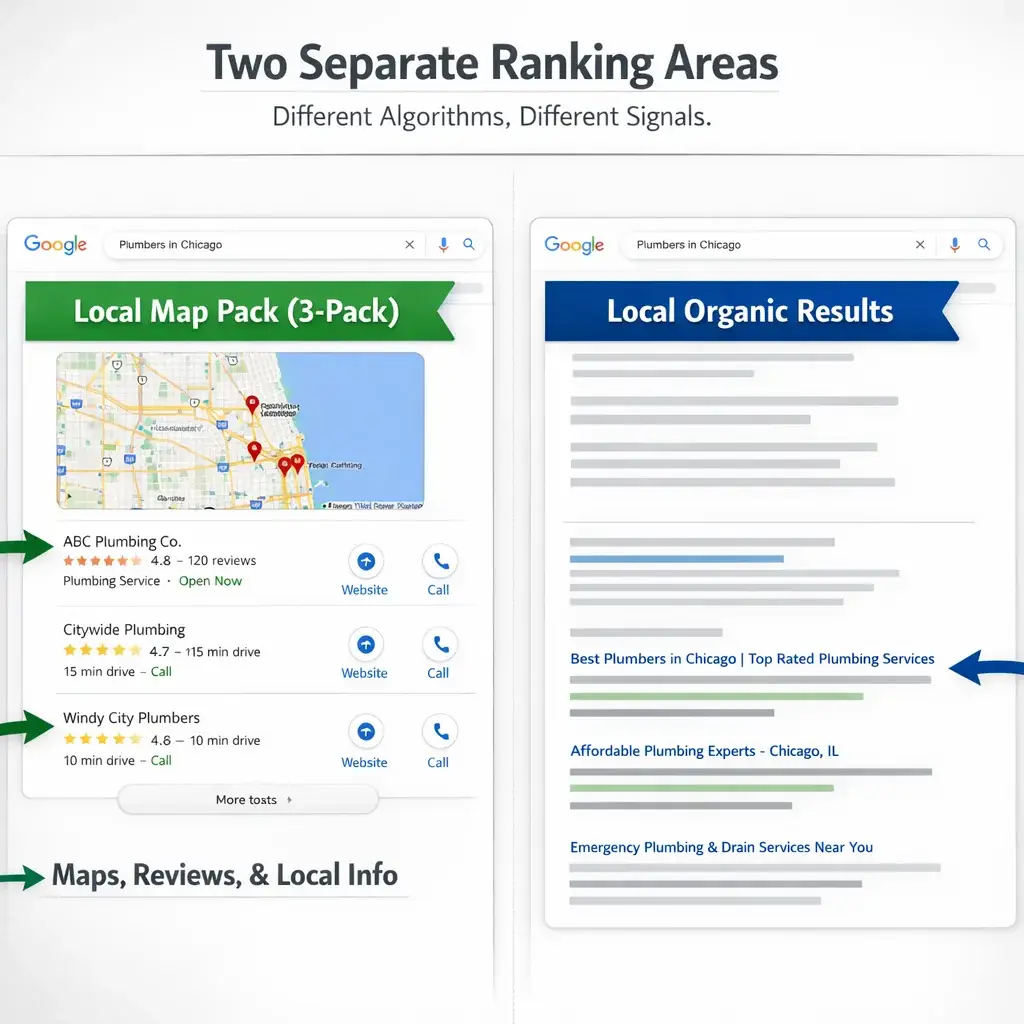
- The Google Local Map Pack and local organic results below it are governed by entirely different ranking signals, meaning a strategy that moves one will not automatically move the other.
- Proximity is the dominant signal for “near me” queries and cannot be engineered — a business physically located outside a target area is largely ineligible to rank in that area’s map pack regardless of optimization effort.
- Review velocity (the consistent rate of new reviews over time) carries more ranking weight than total review volume, and a burst of reviews followed by months of silence produces diminishing returns.
- For most established businesses, citation work in 2025 is a data correction problem, not an acquisition problem — conflicting records pushed by automated data aggregators can undermine hundreds of correctly built citations.
- Local SEO without conversion-focused page architecture produces traffic, not customers — ranking in Dayton’s local pack means nothing if visitors land on a page that fails to confirm your service area or show a phone number above the fold.
Local SEO services are one of the most sold — and most misunderstood — categories in digital marketing. Business owners in Dayton, Kettering, Centerville, and the surrounding communities are consistently told that local SEO is a checklist: set up your Google Business Profile, build some citations, collect reviews, add a few local keywords. Follow the list, rank higher, get more customers.
That framing is not wrong. It is just dangerously incomplete.
The agencies and businesses that consistently dominate the local search results in competitive markets are not following a checklist more diligently than everyone else. They understand that local SEO is a system — one where the signals interact with each other in specific ways, where proximity imposes hard eligibility limits before any optimization begins, and where getting one element right while ignoring another can produce no measurable movement at all.
This guide is built for business owners in the Dayton metro area who are serious about getting a real return from local search. It covers what most agencies will not tell you — not because the information is secret, but because explaining it thoroughly is harder than selling a standard package.
The Two Ranking Environments Most Local SEO Campaigns Ignore
Open Google and search for “HVAC repair Dayton OH.” You will see two distinct types of results before you reach the standard blue-link organic listings.
The first is the Local Map Pack — typically three business listings with a map, star ratings, and click-to-call buttons. The second is the local organic results that appear below it — traditional webpage listings that include the city name or service area in their content.
These two environments look adjacent. They are not the same.
What Governs the Local Map Pack
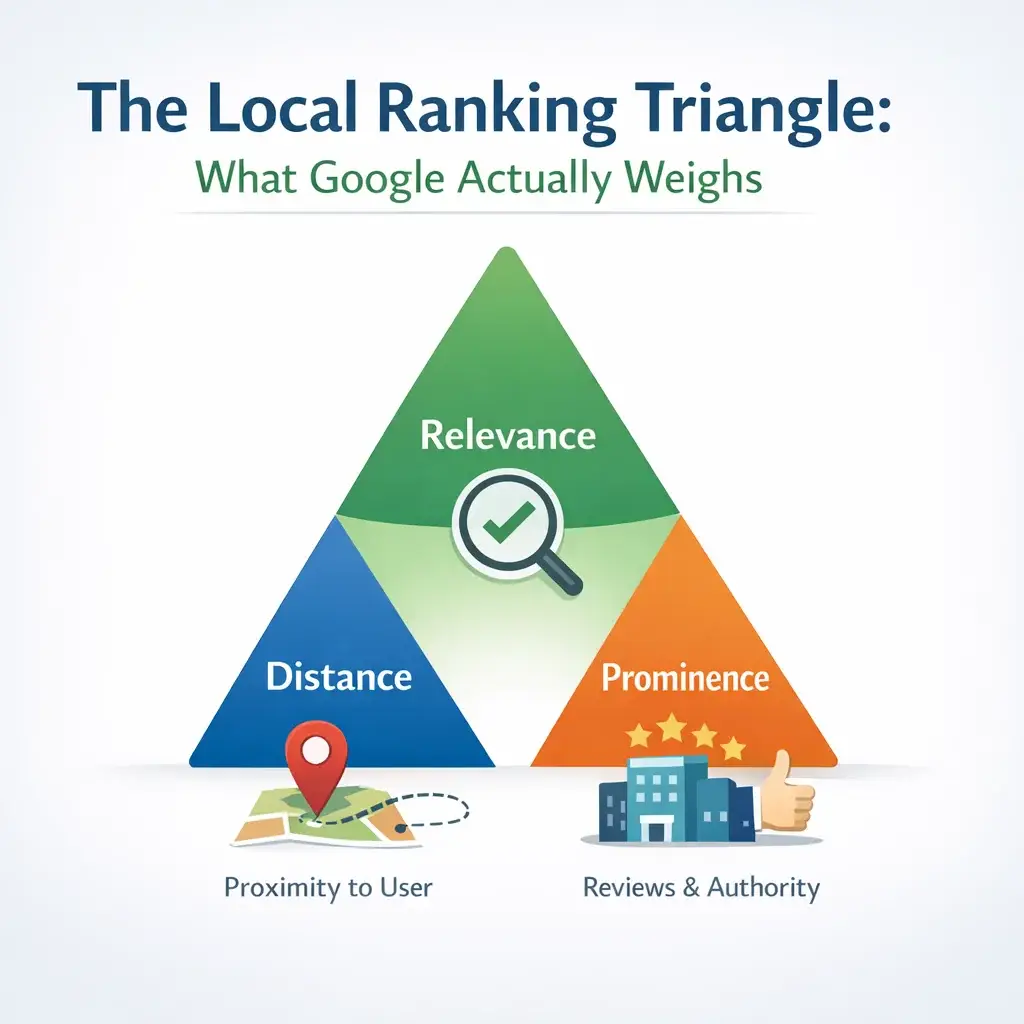
The Local Map Pack is driven primarily by three signals Google formally identifies: relevance, proximity, and prominence. What most content about local SEO does not tell you is that these three signals are not weighted equally, and one of them — proximity — operates more like a filter than a ranking factor.
For any search query that carries local intent (especially “near me” searches or city-name searches), Google uses the searcher’s physical location to establish a geographic radius. Businesses outside that radius are largely ineligible for map pack visibility regardless of how well-optimized their Google Business Profile is.
For Dayton-area businesses, this has a specific strategic implication: a business physically located in Miamisburg will not consistently appear in map pack results for searches originating in downtown Dayton, and vice versa. Before any optimization work begins, a geographic eligibility audit — mapping your verified business address against the actual search zones you want to target — is the first required step. Skipping it means optimizing for results you are physically unable to win.
Additional map pack signals include:
– Google Business Profile completeness and category selection (more on this below)
– Review signals — velocity, recency, and response patterns
– Behavioral signals — click-through rates, direction requests, and call clicks from the listing itself
What Governs Local Organic Results
Local organic rankings follow a different set of rules. Here, domain authority, topical relevance, backlink quality, and on-page content signals carry the weight. A business can rank well in local organic results from a city it does not physically occupy, provided it has sufficiently strong page-level relevance for that query.
This distinction matters when setting campaign priorities. A new business in Kettering with minimal domain authority should invest heavily in GBP optimization and review generation to chase map pack visibility — that path has a faster payoff. An established business with domain authority but weak GBP signals may be doing the opposite.
Running a single unified “local SEO campaign” without specifying which environment you are targeting is one of the most common ways businesses waste their optimization budget.
Google Business Profile: What Most Optimization Advice Gets Wrong
Google Business Profile (GBP) is the central hub of local map pack performance, and it is the part of local SEO that attracts the most generic advice. “Complete your profile,” “add photos,” “respond to reviews” — all of this is true and almost entirely insufficient.
Category Selection Is the Highest-Leverage Decision on Your Entire Profile
GBP allows businesses to select one primary category and multiple secondary categories. What most guides omit is that primary category selection carries a disproportionately large ranking weight compared to every other profile element.
Your primary category tells Google’s local algorithm what type of business you are — not what you offer, but what you are. This distinction matters because Google matches map pack listings to search intent by business type first, then refines by other signals. A Dayton plumbing company that selects “Plumber” as its primary category will consistently outperform one that selects “Home Services Company” for direct plumbing queries, even if both companies have identical review counts and equivalent GBP completeness elsewhere.
Secondary categories extend your eligibility for related searches — a plumber that also does water heater installation benefits from adding “Water Heater Installation Service” as a secondary category. However, adding irrelevant secondary categories to broaden reach is counterproductive and introduces a relevance dilution risk.
The Q&A Section Is an Indexable Content Asset
The Questions & Answers section of GBP is one of the most overlooked optimization opportunities in local search. Most businesses ignore it entirely, leaving it open for anyone — including competitors or frustrated customers — to post and answer questions without moderation.
What practitioners know: Google indexes GBP Q&A content, and questions seeded with target keywords (answered thoroughly by the business) contribute to both profile relevance and can appear in AI-generated search summaries. A Beavercreek landscaping company that seeds its Q&A with questions like “Do you provide lawn care services in Beavercreek and Centerville?” and answers them with specific, accurate information is building an indexable local content asset inside Google’s own platform. For a deeper look at how to structure this and other profile elements for maximum ranking impact, the article on Google Business Profile optimization tips that actually work covers the full tactical breakdown.
GBP Suspension Risk Is Real and Rarely Discussed
Aggressive GBP optimization creates suspension risk that most agencies simply do not address with clients. Specific behaviors that increase suspension probability include:
- Keyword stuffing in the business name field — adding descriptors like “Best Dayton HVAC Repair” to a business name that does not legally include those words violates GBP guidelines and triggers suspension risk
- Address manipulation for proximity advantage — using a virtual office or co-working address to establish presence in a target city without genuine physical operations
- Sudden, high-volume review acquisition — a spike in reviews that does not match historical velocity patterns can trigger Google’s review filter or flag the account
A suspended GBP listing does not just stop ranking — it disappears entirely from Google Maps and local results until reinstated, which can take weeks. Responsible local SEO means optimizing aggressively within the boundaries of GBP policy, not against them.
Citations in 2025: The Problem Is Upstream, Not in Your Directory Count
The standard agency pitch on citations goes like this: we will submit your business to hundreds of directories to build your local authority. This made strategic sense in 2014. In 2025, for most established businesses in the Dayton area, it is the wrong diagnosis for the actual problem.
How Data Aggregators Silently Undermine Your NAP Consistency
NAP consistency — matching Name, Address, and Phone Number across every online mention of your business — is a foundational local ranking signal. Google uses consistent NAP data to confirm a business entity is legitimate and precisely located.
The problem is that the internet’s local business data does not flow from business to directory. It flows from a small number of data aggregators — companies like Data Axle (formerly Infogroup), Neustar/Localeze, and Acxiom — that distribute business records to hundreds of directories, apps, GPS systems, and platforms simultaneously.
When your business moves, changes its phone number, or updates its name, these aggregators often retain and re-distribute the outdated record. Every time they push their data to a directory you have already corrected, your correction gets overwritten. The result is an endless cycle where a business submits to more directories to improve citations while a conflicting aggregator record continuously re-populates incorrect information downstream.
A business with 80 clean, consistent citations will outperform a business with 400 citations containing conflicting NAP data. Volume does not overcome accuracy.
The correct strategic priority is:
1. Audit current citation landscape to identify conflicting records
2. Trace conflicting data back to its aggregator source
3. Correct the record at the aggregator level — this requires direct submission to each aggregator’s data correction portal
4. Monitor for re-emergence of old data over subsequent months
Only after upstream aggregator records are clean does new citation building add meaningful value.
Review Signals: Why Velocity Beats Volume Every Time
If you search for “best restaurant in Centerville OH” and compare the top three map pack results, you will rarely find that the business with the most reviews is consistently ranked first. Review strategy in local SEO is more nuanced than raw count, and the businesses that understand this earn a durable advantage over competitors running periodic “get more reviews” campaigns.
The Velocity Signal and Its Decay Curve
Google’s local algorithm appears to weight review velocity — the consistent rate at which new reviews arrive — more heavily than accumulated total. A business that has collected 200 reviews over three years but received none in the last six months presents a different trust signal than a business with 45 reviews and a steady cadence of 4–6 new reviews per month.
This matters because many businesses run one-time review campaigns — a push to existing customers that generates a spike in reviews, followed by silence. The immediate ranking lift from that spike decays. Reviews collected three years ago contribute diminishing recency weight over time. The spike-and-silence pattern builds on an unstable foundation.
Building a Review Generation System vs. Running a Campaign
The practical implication is that review acquisition needs to be integrated into the customer workflow as a permanent operational process, not treated as a periodic marketing activity.
For a Springboro home services company, this might mean a text message sent automatically at job completion, asking for a review with a direct link. For a Huber Heights retail business, it might mean a printed receipt insert with a QR code. The mechanism matters less than the consistency — a system that generates 3–5 reviews per month every month outperforms any one-time campaign that generates 50 reviews and then stops.
A critical compliance note: review gating — the practice of filtering customers to only send review requests to those who express satisfaction first — violates Google’s review policy and can result in review removal or account penalties. Every customer interaction, positive or negative, should receive the same review request.
Service-Area Businesses: A Completely Different Strategic Problem
Every piece of generic local SEO content is written for a business with a physical storefront that customers visit. Plumbers, electricians, HVAC technicians, landscapers, and consultants — businesses that serve customers at the customer’s location — face a set of local SEO challenges that standard advice does not address.
The SAB Proximity Problem
Service-Area Businesses (SABs) on Google Business Profile have the option to hide their physical address and display only their service areas. This is correct practice for businesses that do not want to receive customer visits at their location — but hiding the address removes a proximity signal that map pack rankings depend on.
An HVAC company based in Miamisburg that hides its address and sets Dayton as a service area will struggle to consistently appear in map pack results for central Dayton searches, even though the company genuinely serves that area. The proximity signal that would anchor them in Dayton’s map pack is absent.
The strategic response to this limitation involves several components working together:
| Tactic | Purpose | Impact on SAB Rankings |
|---|---|---|
| Service area definition in GBP | Establishes geographic eligibility | Moderate — signals intent but not physical presence |
| Dedicated location landing pages | Builds organic relevance for each service city | High for local organic, moderate for map pack |
| Locally relevant backlinks | Builds prominence from within each service market | High — mitigates address-absence penalty |
| Schema markup with service area specification | Helps Google entity-match business to service zones | Moderate — supports organic visibility |
| Consistent NAP at registered address | Maintains the proximity anchor at home base | High — prevents conflicting signals |
The key strategic insight for SABs in the Dayton metro is that local organic results become a higher-priority target than the map pack, because organic rankings do not carry the same hard proximity dependency. A well-built location page for “HVAC repair Centerville OH” can rank in local organic results without a Centerville address — the map pack for that same search is much harder to crack without a verified address in the area. The article on local SEO for Ohio service businesses that actually works covers the location page architecture and backlink strategy SABs should be prioritizing in this environment.
The Conversion Architecture Problem Local SEO Always Ignores
Rankings are a means to an end. The end is customers — not visitors.
This distinction sounds obvious, but the overwhelming majority of local SEO campaigns are measured entirely on ranking position and organic traffic volume. The question of what happens after a Dayton-area prospect clicks through to your website is treated as someone else’s problem, typically handed off to a web designer with no connection to the SEO strategy.
This creates a specific and measurable failure mode: a business ranks in the top three of the local map pack for a high-intent query, drives meaningful traffic volume, and converts at 1–2% because the landing page fails to deliver what a local searcher needs in the first 10 seconds.
What Local Search Intent Demands at the Page Level
A user who clicks through from a local search result is not browsing. They are evaluating. Specifically, they need to resolve three questions immediately:
- Does this business serve my specific area? A page that mentions “Dayton” in its title but never confirms service coverage for Kettering, Beavercreek, or Springboro creates uncertainty for users in those communities.
- How do I contact them right now? A phone number that is not visible above the fold on mobile — where the majority of local searches occur — is a conversion failure by design.
- Can I trust this business? Reviews, certifications, years in operation, and local recognizability signals need to appear early in the page hierarchy, not buried in a footer.
Local SEO without conversion architecture is traffic generation for its own sake. The optimization of ranking signals and the optimization of user experience after the click need to be designed as a single system, not two separate workstreams. The article on conversion optimization: beyond the basic CRO playbook covers how to audit and rebuild page architecture so that local search traffic actually converts into customers.
Negative Local SEO and Ranking Volatility: The Risks Nobody Mentions
Local rankings are not static once earned. They are subject to continuous competitive pressure, algorithmic updates, and in some cases, deliberate interference from competitors.
Common Causes of Local Ranking Drops
Understanding what can cause a rankings decline is as important as understanding what builds them. The most frequent causes of unexplained local ranking drops include:
- Competitor spam reports on your GBP listing — any Google account can flag a business listing for guideline violations. Even baseless reports can trigger a manual review that temporarily suppresses visibility while Google investigates.
- NAP data re-contamination from aggregators — as described above, corrected citation data can be overwritten by aggregator pushes, gradually degrading NAP consistency and weakening local trust signals.
- Algorithm updates targeting local results — Google’s 2021 Vicinity update significantly reduced the radius at which businesses could rank for non-branded local queries. Businesses that had been visible across a wide metro area found their reach contracted significantly. Subsequent updates have continued to refine proximity weighting.
- Review velocity decline — a period of high review acquisition followed by a long gap can cause a gradual erosion of the recency component of review signals.
- GBP category changes — either by the business itself or, in some cases, suggested by Google’s automated systems — can alter relevance matching and produce unexpected ranking shifts.
Monitoring local rankings as a leading indicator rather than a lagging metric allows businesses to identify and respond to these dynamics before the traffic impact becomes significant.
What to Look for When Evaluating Local SEO Services
Not every agency offering local SEO services in the Dayton area is applying the same level of strategic depth. The difference between a vendor running a checklist and a partner building a system is visible — if you know what to ask.
Questions That Reveal Strategic Depth
A competent local SEO partner should be able to give specific, substantive answers to the following:
- Geographic eligibility: “Before we begin, will you audit whether our physical address is within the proximity range of our target search zones?”
- Map pack vs. organic: “Are you building this campaign to target the map pack, local organic results, or both — and how does the strategy differ for each?”
- Aggregator correction: “If our citation audit reveals conflicting records in upstream data aggregators, how do you correct those at the source?”
- Review strategy: “How will you build a review generation system rather than a one-time campaign?”
- Conversion architecture: “How does the SEO strategy connect to the page experience after the click?”
Agencies that respond to these questions with specific process descriptions are operating at a different level than those that respond with service feature lists.
Local search in the Dayton metro — across Kettering, Beavercreek, Centerville, Huber Heights, Miamisburg, and Springboro — is competitive in ways that basic optimization will not overcome. The businesses consistently appearing at the top of local results are not outworking their competitors on a checklist. They understand the system, they know which signals matter in which ranking environment, and they treat local SEO as a compounding strategic investment rather than a one-time setup task.
That is the standard Mongoose Digital Marketing applies to every local SEO engagement — not a template, but a strategy built around where your business is, who your customers are, and which ranking environments you are actually eligible to win.
Strategic Recommendations for 2026
As local search algorithms continue to evolve and competition in the Dayton metro intensifies, the businesses that gain ground will be those that act on the right priorities now. Three areas deserve focused attention heading into 2026:
1. Prioritize GBP Experience Signals
Google Business Profile is no longer a passive directory listing — it is a ranked entity that responds to engagement signals. Businesses should implement a structured approach to GBP posting cadence, Q&A management, and photo freshness. Tools like GBP Insights combined with third-party platforms such as BrightLocal give you the visibility to track how profile interactions correlate with ranking movement over time. This is not a set-and-forget task; it is an ongoing signal that requires a content calendar built specifically around local intent.
2. Conduct a Full Citation Ecosystem Audit
With AI-generated search surfaces and voice results pulling business data from upstream aggregators, inconsistent NAP records across Foursquare, Data Axle, and Neustar Localeze create compounding ranking liabilities. A professional citation audit — not just a surface-level scan, but a root-level correction across primary data sources — should be completed before any new optimization work begins. Services like Yext or Whitespark’s citation service can facilitate this, but the audit interpretation and correction strategy should be guided by someone with local SEO expertise specific to your market.
3. Build a Systematic Review Generation Process
Review velocity and recency are active ranking factors in the local map pack. Businesses relying on organic review accumulation are ceding ground to competitors running structured outreach. In 2026, the standard is a repeatable, compliant review request workflow integrated into your post-service communication — whether that runs through a CRM, an email sequence, or a text-based follow-up tool. The goal is consistency, not volume spikes that trigger platform scrutiny.
Frequently Asked Questions
What is local SEO and how is it different from general SEO?
Local SEO is the practice of optimizing a business’s online presence to appear in search results that are geographically relevant — particularly the Google map pack and local organic listings. Unlike general SEO, which focuses on ranking pages for broad keyword searches regardless of location, local SEO is built around proximity signals, Google Business Profile authority, local citation consistency, and location-specific search intent. For a business in Kettering or Beavercreek, local SEO means appearing when nearby customers are actively looking for what you offer — not just ranking nationally for a generic term.
How long does it take to see results from local SEO services?
Local SEO is not an overnight channel. Most businesses begin to see measurable movement in citation consistency and GBP visibility within the first sixty to ninety days. Competitive map pack rankings in markets like Dayton or Centerville typically require four to six months of consistent, structured effort — and sustained performance beyond that depends on ongoing optimization rather than a one-time campaign. The businesses that treat local SEO as a compounding investment rather than a short-term fix are the ones that hold top positions over time.
Does my business need a physical address to rank in local search results?
Yes. Google’s proximity algorithm gives significant weight to physical location relative to the searcher. A business with a verified, legitimate street address within or near the target search zone has a structural ranking advantage that service-area businesses operating without a public address cannot fully replicate. This does not mean service-area businesses cannot rank — they can — but the strategy differs meaningfully. Understanding your geographic eligibility before building a campaign is a foundational step that shapes every other decision.
What makes Mongoose Digital Marketing different from other local SEO agencies?
The difference is strategic depth applied to a specific market. Many agencies run the same checklist across every client regardless of location, industry, or competitive landscape. Mongoose Digital Marketing builds local SEO strategies around the actual ranking environments in the Dayton metro — accounting for the specific competitive dynamics in Kettering, Beavercreek, Centerville, Huber Heights, and surrounding communities. That means auditing geographic eligibility, distinguishing between map pack and local organic strategy, correcting citation data at the source, and connecting search visibility to conversion — not just traffic.
Conclusion
Local search in the Dayton area rewards businesses that understand the system — not just those running the most activity. Mongoose Digital Marketing proudly serving Dayton, Kettering, Beavercreek, and Centerville brings the strategic depth, market-specific knowledge, and structured processes that turn local SEO into a reliable source of qualified visibility rather than a recurring expense with unclear returns. If you are ready to find out where your business stands and what a real local SEO strategy looks like for your market, Contact Mongoose Digital Marketing to start the conversation.