
Key Takeaways
- Organic reach for Facebook business pages has declined to roughly 1–5% of followers, meaning small businesses that rely solely on organic Facebook posting are reaching a fraction of their own audience without a paid or cross-platform strategy to compensate.
- Platform selection for resource-constrained small businesses should account for content half-life — how long a post continues generating value after publishing — not just demographic overlap, because a platform with a longer content durability window often delivers compounding return on limited creative effort.
- The most common reason small business social media fails is not poor content quality but a misaligned content mix: most businesses produce almost entirely discovery-weighted content that earns likes and shares from people who will never buy from them.
- Converting social media followers into customers depends on engineering your profile as a trust asset — a first-time visitor should encounter visible, organized social proof within seconds of landing on your page.
- Businesses that define their goals in terms of follower growth while their actual revenue need is purchase intent are executing two fundamentally different strategies simultaneously, and neither one wins.
Social media marketing for small businesses gets discussed constantly and executed poorly almost as often. There is no shortage of advice — every marketing blog, business coach, and platform help center has published a guide telling you to “stay consistent,” “know your audience,” and “track your analytics.” The problem is not access to information. The problem is that most of that information is strategically shallow, written for a general audience, and disconnected from the real constraints that a small business owner in Dayton, Kettering, or Centerville actually faces when trying to grow online with limited time and a tight team.
This article is not a beginner’s checklist. It is a practitioner-level breakdown of why most small business social media strategies underperform, what the mechanics of effective social actually look like, and how to build a framework that connects your social presence directly to revenue — not just reach.
If you have already tried social media marketing and felt like you were putting in real effort without seeing real results, what follows is likely the explanation you have been missing.
Why Most Small Business Social Media Strategies Stall
The Wrong Audience Trap
Here is a pattern Mongoose sees consistently: a small business invests months building a social following. Engagement looks decent. Posts get likes. Occasionally something gets shared. And yet the phone does not ring any more than it did before.
The issue is rarely execution. It is audience composition.
Social platforms are optimized to maximize engagement, and engagement is maximized by content that entertains, inspires, or provokes — regardless of whether the people engaging are anywhere near a buying decision. A Springboro home services company that posts satisfying “before and after” renovation videos will attract homeowners from across the country who enjoy that content but will never hire a local contractor. A Beavercreek bakery that posts aesthetic food photography may accumulate thousands of saves from people who bake at home and have no intention of placing an order.
This is the Wrong Audience Trap. You build an audience. You just build the wrong one.
The root cause is a content strategy that is almost entirely weighted toward discovery content — content designed to reach new eyes and generate broad engagement — without a corresponding investment in consideration content and conversion content.
These three content types serve completely different functions:
| Content Type | Primary Goal | Audience Signal | Example Format |
|---|---|---|---|
| Discovery Content | Reach new audiences | Broad — high curiosity, low purchase proximity | Entertaining Reels, viral-format videos, shareable infographics |
| Consideration Content | Move interested users closer to buying | Mid-funnel — active research mode | Educational posts, FAQs, behind-the-scenes, testimonials |
| Conversion Content | Trigger a specific action | High purchase intent — ready or nearly ready | Limited offers, direct CTAs, client results, booking prompts |
Most small business social feeds are roughly 80–90% discovery content because that is what the algorithm rewards with reach and engagement signals. But reach from people who will never buy is a vanity metric. A balanced strategy intentionally programs all three content types in a ratio that matches your actual business objective — which, for most small businesses, is revenue, not impressions. For a deeper look at how to build this kind of intentional content mix, the Social Media Content Strategy That Drives Real Leads article breaks down the framework in detail.
Auditing your current content mix: Go back through your last thirty posts and categorize each one as discovery, consideration, or conversion. If more than 70% fall into discovery, your content calendar is optimized for platform metrics rather than business outcomes. That is the first thing to fix.
The Goal-Setting Problem Nobody Talks About
Every social media guide tells you to set SMART goals. Very few of them explain how easy it is to set the wrong goal entirely and build a competent strategy around it.
The most common version of this mistake looks like this: a small business sets a goal to grow followers from 500 to 2,000 over six months. They execute consistently. They hit the goal. Revenue does not move.
Follower growth and purchase intent are not the same thing, and they require different content strategies to achieve. Growing followers requires broad appeal, shareability, and discovery-weighted content. Generating purchase intent requires specificity, credibility-building, and content that speaks directly to a buyer’s specific problem and your specific solution for it.
If your business needs leads or sales in the next quarter — which is the actual need for most small businesses — your goal should be framed around conversion-adjacent metrics: website click-throughs from social, direct message inquiries, profile link taps, or content saves on posts with commercial intent. These metrics are far less exciting than follower counts but far more predictive of revenue impact.
Before you post another piece of content, answer this question directly: is the outcome I need from social media more followers, or more buyers? The answer determines everything about how your content calendar should be structured.
Platform Selection: The Dimension Everyone Ignores
Demographic Matching Is Necessary but Insufficient
The standard platform selection advice is to go where your audience already is. That logic is sound as far as it goes. A B2B services company in Miamisburg should weight LinkedIn differently than a boutique retail shop in downtown Kettering. Platform demographics matter.
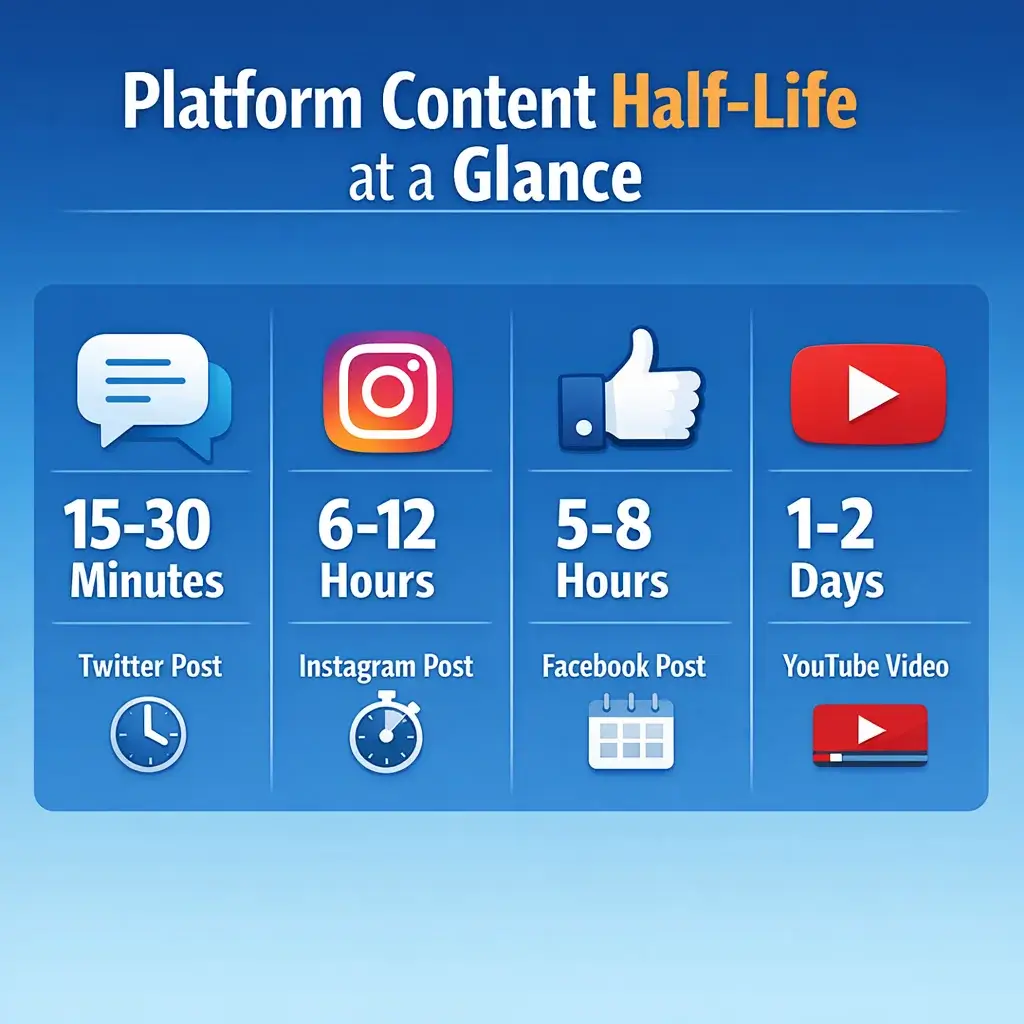
But demographic matching alone ignores a strategic variable that is arguably more important for resource-constrained small businesses: content half-life, or how long a piece of content continues generating value after you publish it.
Here is how dramatically that varies across platforms:
| Platform | Average Content Half-Life | Notes for Small Businesses |
|---|---|---|
| Instagram Stories | 24 hours | Disappears entirely; requires high-frequency production to maintain presence |
| Facebook Feed Posts | 3–5 hours | Organic reach for business pages has declined to 1–5% of followers |
| X (Twitter) | 15–30 minutes | Extremely low durability; volume-dependent model most small businesses cannot sustain |
| TikTok | Days to months | Algorithm can resurface content to new audiences long after posting; currently favorable to newer accounts |
| Instagram Reels | Days to weeks | Longer reach window than feed posts; favored by Instagram’s algorithm |
| Months to over a year | Search-driven platform with exceptional content durability; highly underused by small businesses | |
| YouTube | Years | Videos can rank in Google search indefinitely; highest long-term ROI for educational or demonstrational content |
| LinkedIn Articles | Weeks to months | Indexed by Google; durable for B2B service providers |
For a small business owner in Huber Heights who can realistically produce two to three pieces of content per week, the half-life dimension changes the strategic calculus entirely. Spending that capacity on Instagram Stories means your work disappears in 24 hours. Spending it on YouTube or Pinterest means it could still be driving traffic and inquiries twelve months from now.
This does not mean you should abandon platforms where your audience lives. It means you should factor content ROI horizon into your platform decision — an honest assessment of how long your business can invest in content production before you need to see measurable return. If you need results within 60 days, a Pinterest-first strategy is probably wrong for you. If you are building for 12-month compounding growth, a YouTube channel focused on locally relevant content may outperform any other investment you can make in social.
The Algorithm Environment Shift Most Guides Ignore
Recommending Facebook for small business community building without acknowledging the structural decline in organic reach is not just outdated advice — it is advice that will cause a business owner to misallocate time and resources.
Facebook organic reach for business pages currently sits at roughly 1–5% of your follower count. That means if you have worked hard to build 1,000 followers, a typical organic post reaches 10 to 50 people. This is not a temporary dip. It is a structural feature of a platform that monetizes through paid advertising.
This does not mean Facebook is useless for small businesses. It means the strategy for Facebook has changed: organic content on Facebook is primarily useful for retaining and warming existing customers and as a signal layer for Facebook’s paid advertising algorithm. Expecting organic Facebook posts to grow your customer base from scratch in 2025 is not a realistic strategy. If you are considering using Facebook’s paid side to compensate for organic decline, the Facebook Advertising Management: How Meta’s Algorithm Works article explains exactly how that system operates and what small businesses need to understand before spending.
TikTok currently operates on the opposite end of this spectrum. Its algorithm is heavily discovery-oriented, meaning it actively distributes content from accounts with small followings to large new audiences when the content performs well. For a small business in Centerville or Springboro that is willing to produce video content, TikTok’s current algorithmic environment is arguably the most favorable organic distribution channel available — particularly because it inverts the conventional “build your following first” model. The content can find the audience before the following exists.
Content-Market Fit: Why One Strategy Does Not Work for Every Small Business
The phrase “content-market fit” gets borrowed from the startup world, but it applies directly to social media strategy for small businesses. It describes the degree to which a content format naturally matches how your specific customer base makes buying decisions.
A local plumber in Dayton and a boutique candle brand in Kettering both “need social media” according to every generic guide. But their content physics are entirely different.
The plumber’s customer is not browsing Instagram hoping to discover a new plumbing company. They have a problem — a leak, a broken water heater, a slow drain — and they need a solution quickly. Social media for a home services business is primarily a trust and credibility channel, not a discovery channel. The job of the content is to ensure that when someone searches for a local plumber and finds your social profile, they see enough evidence of competence, reliability, and customer satisfaction to pick up the phone. Video walkthroughs of completed jobs, responses to customer reviews, and before-and-after documentation of real work serve that purpose.
The candle brand, on the other hand, operates in a discretionary purchase category where discovery and visual appeal are central to the buying trigger. Instagram and Pinterest are genuinely high-value platforms for that business because browsing behavior aligns with buying behavior in a way it simply does not for emergency home services.
The question to ask before building any content strategy is: how does my specific customer decide to buy what I sell, and where in that decision process does social media fit? The answer to that question should determine your platform selection, your content format mix, and how you measure success.
Engineering Your Social Profile as a Trust Asset
Why Engagement Alone Does Not Convert
The most repeated social media advice for small businesses is to engage with your audience. Respond to comments. Start conversations. Be human. All of that is genuinely good advice. But engagement alone does not close the gap between follower and customer.
What actually converts a social media follower into a paying customer for a small business is a specific mechanism: accumulated social proof encountered at the right moment in the buyer journey.
The pattern works like this. A potential customer in Dayton discovers your business — through a post, a share, a search, or a recommendation. They visit your profile. In the next 10 to 20 seconds, they are making an unconscious assessment: is this a real, trustworthy business that other real people have used and been happy with? If the answer is yes, purchase probability increases significantly. If the answer is uncertain, they leave and keep looking.
Most small business social profiles fail this 10-second audit not because they lack content, but because their social proof is scattered, buried, or absent. They engage reactively — responding to comments when they appear — rather than architecturally — deliberately building a profile environment where trust signals are visible, organized, and immediately persuasive to a first-time visitor.
Building a Profile That Closes the Trust Gap
Engineering your profile as a trust asset means treating your social presence as a conversion environment, not just a publishing channel. Here is what that looks like in practice:
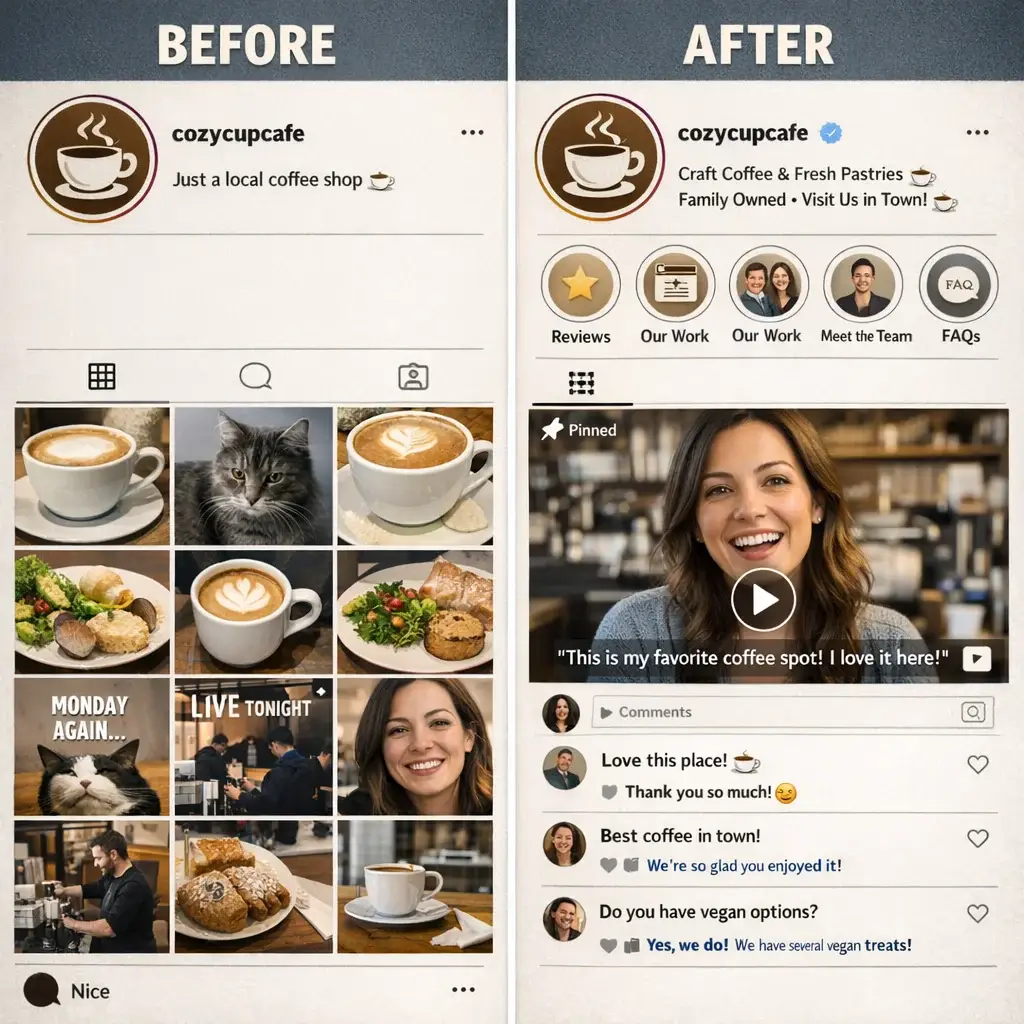
Pinned posts and featured content: On platforms that allow it (Instagram, Facebook, LinkedIn), the first content a new visitor sees should not be your most recent post — it should be your most trust-building post. Pin a strong customer testimonial video, a compelling results showcase, or a direct introduction to your business and what you do. First impressions on a social profile are controlled, not random, if you choose to control them.
Story Highlights (Instagram): These permanent collections are among the most underused trust-building tools available to small businesses. Organize highlights by category: customer reviews, completed work, team introductions, FAQs, and behind-the-scenes content. A new visitor who browses your highlights should come away with a clear, confident picture of who you are, what you deliver, and what your customers say about you.
Actively curating user-generated content: When customers tag you, share photos, or mention you in posts, re-sharing that content builds the visible density of social proof that reduces perceived risk for new visitors. This is not just about gratitude — it is a strategic trust-building mechanism. Businesses that consistently reshare customer-generated content build profiles that look trusted, not just claim to be trustworthy.
Visible conversation history: A profile where the business consistently responds to comments, answers questions, and acknowledges customer feedback demonstrates responsiveness and professionalism. For a small business competing against larger brands, visible responsiveness is a meaningful competitive differentiator.
Resource-Constrained Prioritization: What to Do When You Can Only Do One Thing Well
One of the most intellectually irresponsible gaps in standard social media advice is the complete absence of guidance for resource-constrained prioritization. Every guide is written as though the reader has a content team, a photographer, a video editor, and four hours per day to dedicate to social media. Most small business owners in the Dayton metro area have none of those things.
When time and creative capacity are genuinely limited, the question is not “which platforms should I be on?” The question is “where does one unit of effort produce the most measurable return for my specific business right now?”
A practical prioritization framework for time-constrained small businesses:
If you need results within 30–60 days: Focus on conversion content on one platform where your existing audience already lives. Do not try to build new audiences. Activate the audience you have with direct, offer-oriented, action-prompting content. Pair with a modest paid amplification budget if possible.
If you have 3–6 months and moderate consistency: Invest in a video-first strategy on TikTok or Instagram Reels. Short-form video currently has the best organic reach-to-effort ratio of any format. One well-executed video per week, consistently, will outperform five mediocre posts across multiple platforms.
If you are building for 6–12 month compounding return: YouTube and Pinterest offer the most durable content ROI of any social platform. A local business in Springboro or Centerville that produces 20 to 30 genuine educational videos or highly specific visual content pieces can build a searchable asset library that drives organic discovery for years.
If you have genuine content production constraints: Double down on social proof curation rather than original content creation. Reshare customer tags, request and post reviews, document real work with simple smartphone photography. Authentic evidence of real business activity consistently outperforms polished but impersonal branded content for local small businesses.
The worst outcome is splitting limited resources across five platforms and doing all of them at the level of effort that produces no measurable return on any of them. One platform, executed with genuine consistency and strategic intent, will always outperform a scattered multi-platform presence maintained at minimum viable effort.
Measuring What Actually Matters
Moving Beyond Vanity Metrics
Analytics guidance in most social media guides boils down to “check your insights.” That is the equivalent of telling someone to “look at the dashboard” without explaining which gauges matter and what they should be telling you to do differently.
Every metric you track should connect to a specific decision. If it does not change what you do next, it is not a useful metric to spend time on.
Here is a decision-focused metric framework for small businesses:
| Metric | What It Actually Tells You | Decision It Should Drive |
|---|---|---|
| Profile visits from posts | Whether content is generating genuine interest in your business | If low, your content is entertaining but not compelling enough to inspire further exploration |
| Link clicks / bio link taps | Whether visitors are taking the next step toward your website or offer | If low relative to reach, your call-to-action or offer alignment needs work |
| Saves | Whether content is perceived as personally valuable enough to reference later | High saves on educational content indicate strong consideration-stage interest |
| DM inquiries | Direct purchase intent signals | The highest-value conversion metric for most local service businesses |
| Follower growth rate | Audience expansion velocity | Useful context but not a primary revenue signal on its own |
| Reach from non-followers | Algorithm distribution to new audiences | Indicates content is performing well for discovery; monitor whether that reach is converting to profile visits |
| Engagement rate | Content resonance with your existing audience | Useful for content optimization; misleading if it rises on entertainment content with no commercial intent |
The critical analytical skill for small business social media is distinguishing between metrics that indicate content performance and metrics that indicate business impact. A post can perform exceptionally well by platform metrics — high reach, strong engagement, many shares — while contributing nothing to revenue because it attracted and resonated with the wrong audience.
Build the habit of asking, after every well-performing post: who specifically engaged with this, and are they the people who buy what I sell?
Connecting Social Media to Your Broader Marketing System
Social media does not operate in isolation, and treating it as a standalone channel is one of the consistent strategic mistakes that keeps small businesses stuck in effort-without-results cycles.
For businesses in the Dayton area, the most effective social media strategies function as components in an integrated system. Social content drives traffic to a website that is optimized to convert visitors. It builds the retargeting audiences that make paid advertising more efficient. It reinforces the brand credibility that improves SEO click-through rates. It generates the reviews and user-generated content that strengthen Google Business Profile performance. Understanding how these channels reinforce each other is covered in depth in the How to Build a Local Business Digital Marketing Plan article, which maps out the full integration architecture for small businesses.
A social media presence that is genuinely connected to your broader digital marketing infrastructure compounds in value over time. A social presence that operates independently tends to plateau — generating activity but not growth.
This is the difference between a social media strategy and a social media habit. Habits are reactive. Strategies are architected around specific outcomes, connected to other systems, and measured against business results rather than platform performance alone.
If your current social media activity feels disconnected from your actual business growth, the solution is not to post more. The solution is to step back and build the strategic architecture that turns posting into a system — one where every piece of content serves a defined function, every platform choice is justified by your specific resource situation and growth timeline, and every metric you track connects directly to a business decision.
That kind of strategic clarity is exactly what separates the small businesses in Dayton, Kettering, Beavercreek, and across the Miami Valley that grow through social media from those that stay busy without moving forward.
Final Strategic Recommendations for 2026
Building a social media system that actually connects to business growth requires more than good intentions and consistent posting. For small businesses ready to move from activity to outcomes, these three steps represent the highest-leverage actions you can take heading into 2026.
1. Audit Your Integration Points Before Adding New Channels
Before expanding your social presence to a new platform or increasing your posting frequency, conduct a simple integration audit. Trace the path from your most recent social media post to an actual business outcome. Does that post link to a landing page designed to capture interest? Does your website have retargeting pixels installed so that social visitors can be reached again through paid advertising? Is your Google Business Profile connected to the same content themes your social media reinforces? If you cannot trace a clear line from content to conversion infrastructure, adding more content will not fix the problem. Closing the integration gaps first will.
2. Commit to a Platform-Specific Content System, Not a Repurposing Habit
One of the most common efficiency traps in small business social media is the repurposing-everything approach — taking one piece of content and distributing it identically across every platform. In 2026, platform algorithms have become sophisticated enough to reward content that behaves natively on each channel. This does not mean creating entirely separate content for every platform. It means understanding what performs on each platform you have chosen, and building a lightweight content system — even a simple checklist or template — that adapts your core message to each environment. For most small businesses, this means committing fully to fewer platforms rather than spreading thinly across many.
3. Move Toward First-Party Data as Your Foundation
Social platforms can change their algorithms, restrict organic reach, or alter their advertising systems at any time — and they frequently do. The small businesses that build durable digital marketing systems in 2026 will be the ones that use social media to build assets they own: email lists, SMS subscriber lists, and segmented customer databases. Every social media strategy should include at least one mechanism for converting social followers into contacts you can reach independent of any platform. A lead magnet, a newsletter signup, a referral program — any of these serves as a bridge from platform-dependent reach to owned audience equity.
Frequently Asked Questions
How much time should a small business realistically commit to social media each week?
The honest answer is that the right amount of time is the amount you can sustain without it displacing higher-value business activities. For most small businesses, a focused and strategic approach requires less time than most owners assume — but that time needs to be intentional. Sporadic effort followed by long gaps is consistently less effective than a modest but regular cadence. Start with what you can maintain reliably, build the system around that constraint, and expand only when you have evidence that more output would produce more results.
Which social media platform is best for small businesses in Dayton?
There is no single correct answer, and any resource that tells you otherwise is oversimplifying the question. The right platform depends on where your specific customers spend their time, what content format your business can produce consistently, and what business outcome you are trying to drive. For many local service businesses in the Dayton area, a combination of Facebook for community engagement and Google Business Profile for search-driven visibility tends to outperform more effort spread across more platforms. But the starting point should always be your customer — not the platform with the largest general user base.
What is the difference between organic social media and paid social media, and which should a small business prioritize?
Organic social media refers to content you post without paying to distribute it — your reach depends on your followers and whatever algorithmic distribution the platform provides. Paid social media means you are investing to place content in front of audiences beyond your existing followers, with the ability to target by location, demographics, interests, and behaviors. For most small businesses, organic content builds credibility and community while paid social scales reach and drives specific conversion goals. The two work best together, with organic content informing what paid content you create and paid campaigns reinforcing the trust your organic presence builds.
How do I know if my social media strategy is actually working?
The most important question is whether your social media activity is contributing to measurable business outcomes — not whether your follower count is growing or your posts are receiving likes. Start by identifying the specific business result you want social media to influence: more website inquiries, more phone calls, more foot traffic, more email subscribers. Then work backward to identify which metrics on your platforms connect to those outcomes. Engagement metrics like reach and impressions are useful for diagnosing content performance, but they are not the finish line. If you cannot draw a line from your social activity to a business result, your measurement approach needs to be rebuilt before your content strategy does.
Ready to Build a Social Media System That Actually Grows Your Business?
Social media marketing works when it is built as a strategic system — not treated as an afterthought or a daily obligation to fill. For small businesses across Dayton and Kettering, the gap between businesses that grow through social media and those that stay busy without forward momentum almost always comes down to strategy, integration, and measurement. Mongoose Digital Marketing proudly serves small businesses in Dayton, Kettering, Beavercreek, Centerville, and throughout the Miami Valley — bringing the kind of local market knowledge and integrated digital strategy that connects social media to real business growth through services like social media management and local SEO. If you are ready to stop guessing and start building something that works, Contact Mongoose Digital Marketing to get started.