
Key Takeaways
- The Google Map Pack and organic blue-link results attract fundamentally different buyer intents — Map Pack clicks skew toward immediate purchase decisions, while organic rankings capture research-phase traffic, and Dayton businesses need separate strategies for each.
- Dayton’s SERP landscape for most commercial queries is heavily dominated by national directory aggregators like Clutch and DesignRush, meaning local businesses must build content architecture specifically designed to compete against — or appear within — these platforms.
- SEO timelines in competitive Dayton niches such as personal injury law, roofing, and HVAC realistically require six to twelve months before meaningful ranking movement, and any agency that implies otherwise is not being straight with you.
- Dayton’s three dominant economic sectors — defense and aerospace, healthcare, and consumer services — each require a structurally different SEO investment model, content depth, and success metric framework.
- A strong Google Business Profile is not a checklist item; it functions as a separate ranking system governed by proximity signals, behavioral engagement data, review velocity, and category selection strategy.
The Dayton SEO Reality Most Agencies Won’t Tell You
Walk through the websites of the top-ranking SEO agencies in Dayton and you’ll notice something. They all say the same things. Results-driven. Full-service. Client-centered. Data-backed. The language is polished, the case study numbers look impressive, and the free consultation button is impossible to miss.
What you won’t find is a straight answer to the questions that actually matter when you’re deciding where to invest your marketing budget.
What does the competitive search landscape actually look like for Dayton businesses in your specific industry? Are the rankings you’re paying to pursue the ones that convert customers, or just the ones that look good in a monthly report? What conditions would make SEO a poor investment for your business right now? And what actually happens between month one and month twelve of an engagement — not in a sales pitch, but in practice?
This article answers those questions directly. If you’re evaluating an SEO company in Dayton, Ohio, this is the context you need before you sign anything.
What Dayton’s Search Landscape Actually Looks Like
Most agency content about Dayton SEO treats the city as a backdrop — a few lines about Wright-Patterson Air Force Base, the healthcare corridor, and the outdoor recreation scene — and then pivots immediately to a service list. That approach signals one thing clearly: the agency understands Dayton as a geographic keyword, not as a market.
Understanding Dayton as a market means understanding its SERP topology.
The Directory Aggregator Problem
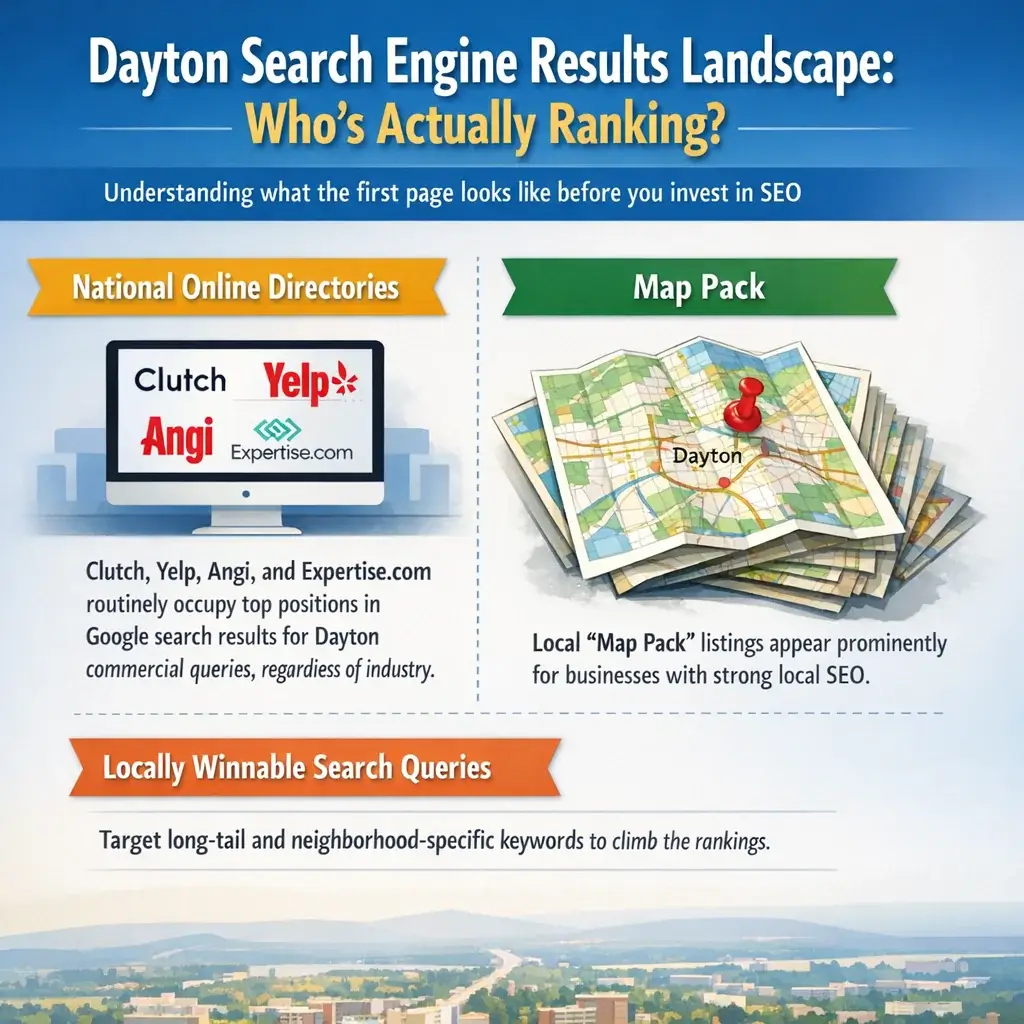
Search any high-intent commercial phrase in Dayton — “personal injury attorney Dayton Ohio,” “HVAC company Dayton,” “commercial roofing Dayton Ohio” — and examine the first page carefully. In most cases, positions one through five are occupied by a combination of national directory aggregators: Yelp, Clutch, DesignRush, Expertise.com, Angi, FindLaw, and Avvo depending on the industry. These are not Dayton businesses. They are national platforms that have built enough domain authority to outrank local operators on local queries.
This is the SERP topology problem that no Dayton SEO agency is talking about publicly, and it has direct implications for what your SEO strategy should look like.
There are two legitimate responses to directory aggregator dominance in a SERP:
Strategy A: Build for the positions that are actually winnable. Identify the specific queries where local businesses do rank on page one — often longer-tail, neighborhood-specific, or service-specific phrases — and build content architecture optimized for those terms. A roofing company in Kettering, for example, may have a much cleaner path to ranking for “roof replacement Kettering OH” than for “roofing company Dayton Ohio.”
Strategy B: Earn visibility within the directories themselves. Since directories occupy the positions you’re trying to reach, appearing prominently within those directories — through optimized profiles, accumulated reviews, and accurate business data — captures traffic from the very pages that are blocking your organic ranking. This is not a substitute for SEO; it’s part of a complete local search strategy.
An SEO company working in the Dayton market should be able to tell you, for your specific industry and service lines, which queries fall into which category — and build a roadmap that accounts for both.
Neighborhood and Suburb Targeting: A Meaningful Opportunity
Dayton’s metro structure — encompassing Kettering, Beavercreek, Centerville, Huber Heights, Miamisburg, and Springboro — creates a legitimate content differentiation opportunity that most local businesses underuse. Each suburb has distinct demographic characteristics: Beavercreek skews toward military and federal contractor households; Centerville and Springboro attract higher-income families and established professionals; Huber Heights has a strong working-class homeowner base.
These are not just geographic distinctions. They represent different search behaviors, different service needs, and different decision timelines. A roofing company, a medical practice, or a home services business that builds suburb-specific content — not thin duplicate pages with swapped city names, but genuinely differentiated content that addresses local context — competes in less crowded query spaces while building a more authoritative footprint across the metro.
Map Pack vs. Organic Rankings: The Distinction That Changes Everything
The single most important structural concept that Dayton business owners need to understand about local SEO is the difference between ranking in the Google Map Pack and ranking in traditional organic results. These are not two levels of the same system. They are two separate ranking systems, driven by different signals, attracting different searcher behaviors, and requiring different strategies to win.
How the Map Pack Works
The Map Pack — the block of three business listings that appears at or near the top of Google’s results for local queries — is governed primarily by:
- Proximity: How physically close the business is to the searcher’s location or the location specified in the query
- Google Business Profile (GBP) quality signals: Category selection accuracy, completeness of the profile, frequency of posts, photo engagement, and Q&A content
- Review signals: Volume, recency, average rating, and the presence of keyword-relevant language within review text
- Behavioral engagement data: The rate at which users click through, request directions, or call directly from the listing
- Citation consistency: Whether the business name, address, and phone number match precisely across all major data sources — Yelp, Apple Maps, Facebook, industry directories, and local chamber listings
How Organic Rankings Work
Organic rankings — the traditional blue-link results below the Map Pack — are governed by a different, though overlapping, set of signals:
- Domain authority and backlink profile: The quality and quantity of external sites linking to your domain
- On-page content quality and topical depth: Whether your content comprehensively and accurately addresses the searcher’s intent
- Technical site health: Page speed, mobile responsiveness, Core Web Vitals, crawlability, and structured data implementation
- User engagement signals: Bounce rate patterns, dwell time, and interaction depth
- Content freshness and update signals for time-sensitive query categories
What This Means for Dayton Businesses
The searcher who clicks a Map Pack listing is, statistically, further along in their buying decision. They’ve often already decided what they need — they’re deciding who to call. The searcher clicking an organic result is frequently still in research mode, comparing options, reading reviews, and building a shortlist.
This distinction should shape your entire conversion strategy:
| Metric | Map Pack | Organic Blue Links |
|---|---|---|
| Primary searcher intent | Immediate action / ready to contact | Research, comparison, evaluation |
| Primary conversion path | Phone call or direction request | Website visit → contact form or call |
| Primary ranking signals | GBP quality, proximity, reviews, citations | Domain authority, content depth, backlinks |
| Fastest to influence | GBP optimization, review strategy | Content creation, link building |
| Typical timeline to results | 4–12 weeks for competitive improvement | 6–18 months for meaningful ranking shifts |
| Best industries for dominance | Emergency services, restaurants, retail | Professional services, B2B, complex services |
| Landing page strategy | GBP profile is the landing page | Dedicated service and location pages |
| KPI to track | Calls, direction requests, GBP clicks | Organic sessions, time on page, form submissions |
An emergency plumber in Huber Heights should be building their entire local SEO investment around Map Pack dominance — because 90% of their customers are calling from the listing, not reading a blog post first. A commercial HVAC contractor targeting Wright-Patterson-area defense facilities, on the other hand, is dealing with a longer sales cycle where organic content — case studies, technical white papers, service area pages — does the actual conversion work. These are not the same strategy delivered at different volumes. They are structurally different approaches. For a deeper look at how these two channels can reinforce each other, the article How PPC and SEO Work Together to Grow Your Business is worth reading before you finalize your budget allocation.
Dayton’s Industry Mix and Why It Demands a Segmented SEO Approach
One of the most reliable ways to identify an SEO agency that doesn’t truly understand the Dayton market is to present them with your specific business and watch whether they modify their pitch or simply deliver the same framework they use for everyone.
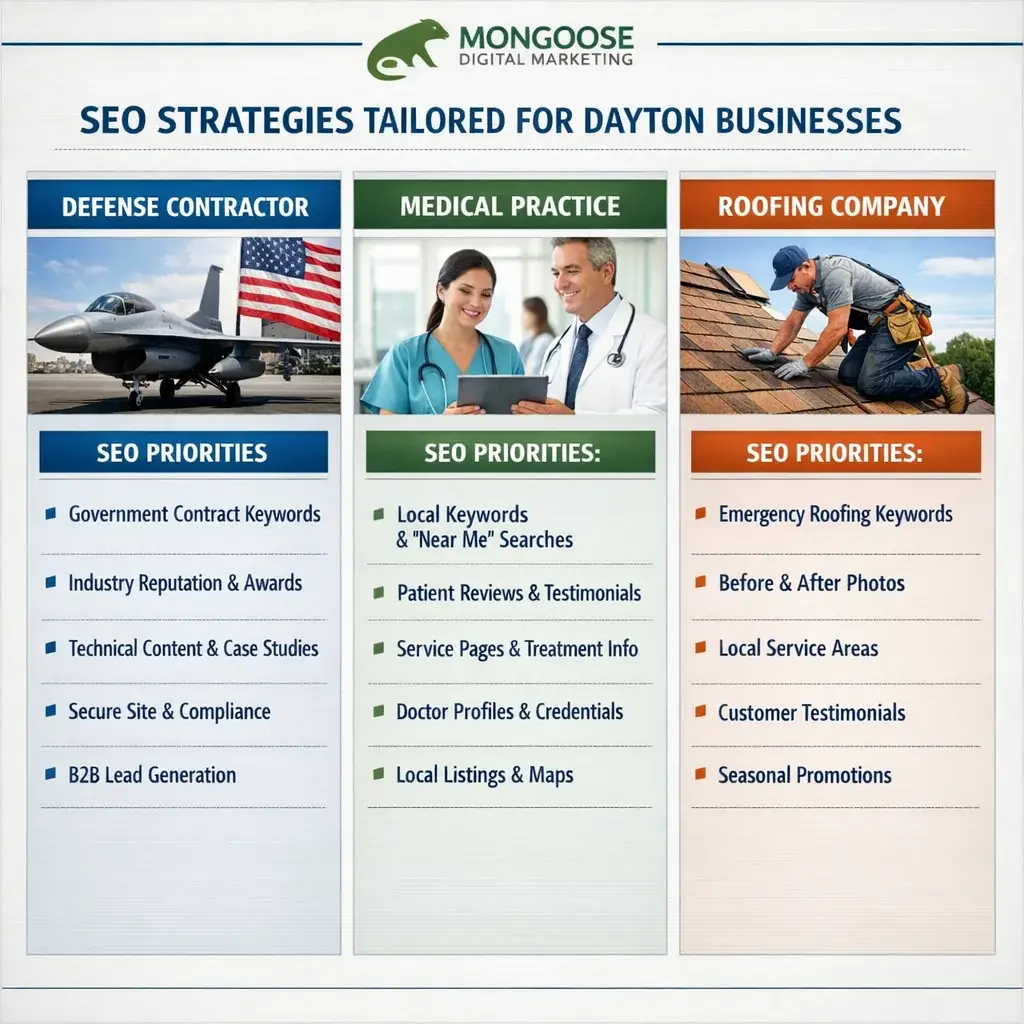
Dayton’s economic composition is genuinely unusual. It blends a significant defense and aerospace sector centered around Wright-Patterson Air Force Base, a major healthcare corridor anchored by Kettering Health and Premier Health, and a broad base of consumer-facing service businesses — roofing, landscaping, legal services, dental practices, and home improvement contractors — that make up the bulk of local search traffic. Each segment requires a fundamentally different SEO structure.
Defense and Aerospace Contractors
Companies supplying services or products to Wright-Patterson or to the broader federal contractor ecosystem face a distinctive SEO challenge: search volume for their specific service categories may be relatively low, but each engaged prospect represents significant deal value. In this environment, the SEO strategy is not about chasing traffic volume. It is about:
- Building deep topical authority in a narrow domain
- Creating content that demonstrates technical credibility to a sophisticated evaluator
- Generating the backlink profile that signals subject matter leadership — through trade publications, industry associations, and federal contractor directories
- Tracking KPIs like qualified inquiry rate and lead quality, not raw traffic growth
Ranking for “defense logistics consulting Dayton Ohio” with 50 monthly searches and converting two of those visitors into six-figure contracts is a better return than ranking for a generic term with 2,000 monthly searches and a 0.5% conversion rate. Volume is not the metric that matters in this segment.
Healthcare and Medical Practices
The healthcare SEO environment in Dayton operates under a specific set of Google content quality standards — YMYL (Your Money or Your Life) categories receive elevated scrutiny under Google’s quality rater guidelines, and E-E-A-T (Experience, Expertise, Authoritativeness, Trustworthiness) signals are weighted more heavily. For Kettering, Centerville, or Beavercreek medical practices, this means:
- Content must be authored or reviewed by credentialed practitioners, not generalist copywriters
- Backlinks from medical associations, hospital networks, and credible health publications carry disproportionate weight
- Patient review management is not optional — it directly affects both Map Pack ranking and organic trust signals
- Structured data markup (Schema) for healthcare providers — hours, accepted insurance, practitioner credentials — is a technical requirement, not an enhancement
Consumer Service Businesses
For the roofing company in Springboro, the personal injury attorney in downtown Dayton, or the HVAC contractor serving the Centerville-Miamisburg corridor, the SEO calculus is more conventional but still requires local specificity. These businesses are competing in the highest-volume, most directory-saturated SERPs in the Dayton market. The differentiating factors here are:
- Suburb-specific service pages built with genuine local content, not boilerplate
- Review velocity management — a consistent flow of new Google reviews, not a one-time burst
- Local backlink development through chambers of commerce, sponsorships, and regional news coverage
- GBP optimization treated as an ongoing operational priority, not a setup task
Honest SEO Timelines and the Conditions That Make It Harder
This section is the one that most agency content avoids entirely, because it introduces friction in the sales funnel. We’re including it because business owners making a significant investment deserve a realistic picture.
Realistic Timelines by Scenario
- New domain or website with minimal existing authority: Expect 9–18 months before meaningful organic ranking movement in competitive categories. This is not a failure of execution — it reflects how Google’s trust system works. New domains earn authority slowly.
- Established site with technical issues suppressing performance: An audit-and-fix engagement often produces faster early results because you’re removing obstacles rather than building from zero. Three to six months for measurable improvement is realistic in many cases.
- Competitive niches (legal, HVAC, roofing, insurance): These categories have well-funded incumbents with years of SEO investment behind them. Even with excellent execution, initial ranking gains will come in lower-competition query variations before moving up to the primary terms.
- Map Pack improvement: GBP and citation optimization can produce visible improvements in four to twelve weeks — faster than organic SEO — but proximity limitations mean a business located in Miamisburg will always struggle to dominate Map Pack results for searches anchored in downtown Dayton.
Conditions That Reduce SEO ROI
There are business situations where SEO investment, regardless of agency quality, will produce limited returns:
- Very low search demand for your service category: Some highly specialized B2B services simply have too little monthly search volume in the Dayton market to generate meaningful organic traffic. Paid channels or outbound may be better suited.
- Conversion problems independent of traffic: Sending more traffic to a website with a confusing user experience, slow load times, or an unclear value proposition will not improve your business results. SEO and conversion rate optimization must work together.
- Business model misalignment: If your service requires a consultative, relationship-driven sales process, organic traffic from informational queries may generate downloads and engagement but few qualified leads. The KPI framework matters as much as the strategy.
An SEO company worth working with will ask enough questions about your business model to identify these conditions before proposing a strategy — not after you’ve signed a six-month contract.
What a Genuine SEO Audit Reveals (vs. a Sales Document)
The “free SEO audit” offered by most agencies is a lead generation tool. It surfaces enough surface-level issues — missing meta descriptions, slow page speed scores, thin content flags — to justify a discovery call. A genuine diagnostic evaluation looks considerably deeper.
Technical SEO: What Actually Matters
- Crawlability and indexation accuracy: Are the pages you want Google to index actually being crawled? Are pages you don’t want indexed (thank-you pages, admin areas, duplicate content) properly excluded?
- Core Web Vitals performance: Largest Contentful Paint, Cumulative Layout Shift, and Interaction to Next Paint scores are now direct ranking factors — and most Dayton business websites built on shared hosting with unoptimized WordPress themes fail these benchmarks significantly.
- Internal linking architecture: How page authority flows through your site determines which pages rank. A flat site structure with no strategic internal linking wastes the authority your domain has earned.
- Structured data implementation: Schema markup for local businesses, services, FAQs, and reviews helps Google understand and display your content accurately — and influences how your listing appears in AI-generated search features that are increasingly reshaping Dayton search results.
- Mobile-first rendering: Google indexes the mobile version of your site. A site that looks fine on desktop but has a degraded mobile experience is being evaluated at its worst.
Content Architecture: Beyond Word Count
Content quality, as evaluated by Google’s Helpful Content System, is not a function of length. A 3,000-word page stuffed with keyword variations is not a high-quality page. The signals that actually influence content quality assessment include:
- Whether the content addresses the actual question behind the search query, not just the surface keyword
- Whether the page demonstrates first-hand experience or expertise — not just aggregated information available anywhere
- Whether users who land on the page engage with it or immediately return to search results (a strong negative signal)
- Whether the content is updated when the underlying facts change
Evaluating an SEO Company in Dayton: The Questions That Filter Out the Noise
When you’re sitting across from an SEO agency — whether in person in Dayton or on a video call — the quality of their answers to these specific questions will tell you more than any case study deck:
- “Show me the current SERP for my primary target keyword. Who is ranking, and why?” An agency that can’t do this on the spot, in real time, with specific analysis is operating on theory.
- “What conditions would make my business a poor candidate for organic SEO right now?” Any agency that says there are no such conditions is not being straight with you.
- “How do you distinguish between Map Pack and organic ranking strategy for my category, and which should we prioritize first?” Look for specificity tied to your business model — not a generic “both are important” answer.
- “What does success look like in month three versus month nine? What would make us revisit the strategy?” The answer reveals whether they think in milestones and accountability or in retainer renewal cycles.
- “How are you adapting your approach to Google’s AI Overviews and the changes in how local search results are structured in 2024–2025?” This question separates practitioners from template-followers.
If you want a structured framework for this evaluation process before you begin any agency conversations, the article How to Select a Local SEO Company (Without Getting Burned) walks through the due diligence steps in detail.
The Mongoose Approach to Dayton SEO
Mongoose Digital Marketing works with businesses across the Dayton metro — from Springboro to Huber Heights, from Beavercreek to Miamisburg — and the one constant across every engagement is that the strategy starts with your market reality, not a service package template.
That means a SERP analysis before a proposal. It means being honest when paid search or social media advertising will produce faster ROI than SEO for your specific situation. It means tracking the metrics that matter to your bottom line — qualified leads, phone calls, booked appointments, and revenue — not rankings in isolation.
If you’re ready to have a direct conversation about what SEO could realistically accomplish for your business in the Dayton market, we offer a no-commitment consultation. No pressure. Just analysis, honesty, and a clear picture of what a real growth strategy looks like for your specific situation.
Strategic Recommendations for Dayton Businesses in 2026
The local search landscape is shifting faster than most agencies are willing to admit. Here are three specific moves worth prioritizing as you head into 2026:
1. Invest in Structured Local Content Hubs
Generic service pages no longer hold authority the way they did even two years ago. The businesses gaining ground in Dayton’s competitive verticals are building genuine content depth — neighborhood-specific pages, locally relevant FAQs, and topic clusters that demonstrate expertise in their actual service area. Tools like Surfer SEO combined with direct SERP research for Dayton-specific queries will help identify the content gaps your competitors haven’t closed yet.
2. Prioritize Google Business Profile as a Living Asset
The Map Pack is not passive real estate. In 2026, GBP profiles that receive consistent updates — posts, photo uploads, Q&A management, review responses, and service detail refinement — outperform static profiles regardless of review volume. Treat your GBP the way you treat your website: as something that requires strategic attention, not a one-time setup.
3. Build for AI Overview Visibility, Not Against It
Google’s AI Overviews are pulling from sources that demonstrate clear, structured expertise on specific questions. The businesses that will benefit are the ones investing now in content that answers real customer questions directly, authoritatively, and with local context. This is not about tricking an algorithm — it’s about being genuinely useful in a way that machines can recognize and surfaces to users asking local intent questions in the Dayton market.
Frequently Asked Questions
How long does SEO typically take to produce results for a Dayton business?
Honest answer: it depends heavily on your competitive category, your existing domain authority, and how aggressive your strategy is. Most businesses in mid-competition Dayton verticals begin seeing meaningful movement in rankings and traffic within three to six months. Converting that visibility into consistent leads and revenue typically takes six to twelve months of sustained effort. Anyone promising significant results in thirty days is selling you something that won’t hold.
Is local SEO different from regular SEO, and does that matter for my Dayton business?
Yes, and significantly so. Local SEO focuses on ranking in geographically relevant results — the Map Pack, local organic results, and searches with explicit or implied location intent. For most Dayton businesses serving customers in a specific region, local SEO strategy is the priority, not broad national organic rankings. The tactics, signals, and success metrics are meaningfully different, and your agency should be treating them that way.
Should I choose SEO or paid search advertising for my Dayton business?
This is actually the right question to ask, and the honest answer is that it depends on your timeline, your competitive landscape, and your current online presence. SEO builds compounding long-term visibility but takes time. Paid search produces immediate traffic but stops the moment you stop spending. Many Dayton businesses benefit from running both in a coordinated strategy, but the right mix for your situation should come from a frank conversation about your goals — not a package recommendation made before anyone has looked at your market.
What should I look for when evaluating an SEO company in Dayton, Ohio?
Look for agencies that show you real SERP data for your market before they pitch you a solution. Ask whether they track metrics tied to your actual business outcomes — leads, calls, booked appointments — rather than rankings alone. Ask how they handle transparency when results are slower than expected. And be cautious of any agency unwilling to tell you when organic SEO might not be your best immediate move. Honest assessment upfront is a better signal than confident promises.
Conclusion
Dayton businesses — whether you’re operating in Kettering’s commercial corridors or serving residential customers across Centerville — deserve an SEO partner that understands this market at street level, not one applying a national template to a regional reality. Mongoose Digital Marketing was built to do exactly that: honest strategy, local expertise, and a genuine commitment to results that show up in your business, not just in a monthly report. If you’re ready to find out what a real SEO strategy could look like for your situation, Contact Mongoose Digital Marketing and let’s start with the facts.