

What Local SEO Actually Is — And Why Most Businesses Are Getting It Wrong
Every month, millions of searches happen with clear commercial intent attached to a geographic location. “Best accountant in Denver.” “Emergency HVAC repair near me.” “Italian restaurant open now.” These aren’t passive browsing sessions — they’re buying signals. And whether your business shows up to capture them or disappears into page two obscurity depends entirely on how well you’ve built your local search presence.
Local SEO is the practice of optimizing your business’s digital footprint so Google surfaces you prominently when potential customers in your area search for what you offer. That sounds straightforward. The reality is considerably more complex, and the gap between what most businesses think local SEO involves and what actually drives rankings is wide enough to cost you a significant volume of qualified leads every single month.
Most guides on this subject walk you through the same checklist: claim your Google Business Profile, keep your name and address consistent, get some reviews, add your city name to your website. That advice isn’t wrong — it’s just dangerously incomplete. It describes the floor, not the ceiling. And for business owners operating in competitive local markets, the floor doesn’t win you customers.
This guide is built for business owners who want to understand not just what to do, but why it works — and, critically, what separates businesses that dominate their local market from those that perpetually hover just outside the map pack.
How Google Actually Decides Who Appears in Local Results
To optimize intelligently, you need to understand the system you’re operating within. Google surfaces local businesses through two distinct result types: the local pack (also called the map pack — the block of three businesses with a map that appears above organic results) and organic blue link results further down the page. These are governed by overlapping but distinct ranking signals, which means your optimization strategy needs to address both.
Google’s official guidance identifies three factors that determine local pack rankings: Relevance, Distance, and Prominence. Every local SEO article on the internet lists these three factors. Very few of them explain how these factors actually interact — and that’s where most local SEO strategies fall apart.
The Three Ranking Factors Are Not Created Equal
The most important thing to understand about Relevance, Distance, and Prominence is that Google does not weigh them equally across all searches. The weight assigned to each factor shifts dynamically based on query intent classification — how Google categorizes the type of search being performed.
Google’s local algorithm processes queries into distinct intent buckets, and each bucket triggers a different weighting configuration:
| Query Intent Type | Example Queries | Dominant Ranking Factor | Secondary Factor |
|---|---|---|---|
| Transactional-Immediate | “emergency plumber near me,” “24-hour locksmith,” “urgent care open now” | Distance (heavily over-indexed) | Operational signals (hours, response time, recent reviews) |
| Transactional-Planned | “best wedding photographer in Austin,” “top-rated roofing company Chicago” | Prominence (review volume, authority, backlinks) | Relevance (category match, service specificity) |
| Navigational | “Starbucks near me,” “Nike store downtown” | Distance + Entity match (near-exclusive) | Minimal weighting elsewhere |
| Informational-Local | “how much does tree removal cost in Phoenix” | Relevance (content depth, topical authority) | Prominence |
This distinction has direct, actionable consequences. A plumbing company that fields a lot of emergency calls should structure its GBP and website signals very differently than a high-end kitchen remodeling firm whose customers spend weeks researching before making contact. The emergency plumber needs airtight proximity signals, verified hours, and a steady stream of recent reviews. The remodeling firm needs deep prominence signals — review volume, media mentions, backlink authority, and project portfolio content. Running both businesses through the same optimization checklist, as most guides recommend, means both businesses are operating at a fraction of their potential visibility.
The Entity Coherence Problem: Why NAP Consistency Misses the Point
Ask any local SEO professional what matters most, and “NAP consistency” will come up within the first 30 seconds. NAP — Name, Address, Phone number — should be consistent across every directory, citation, and web mention of your business. That’s accurate. It’s also an incomplete way to describe what Google is actually evaluating.
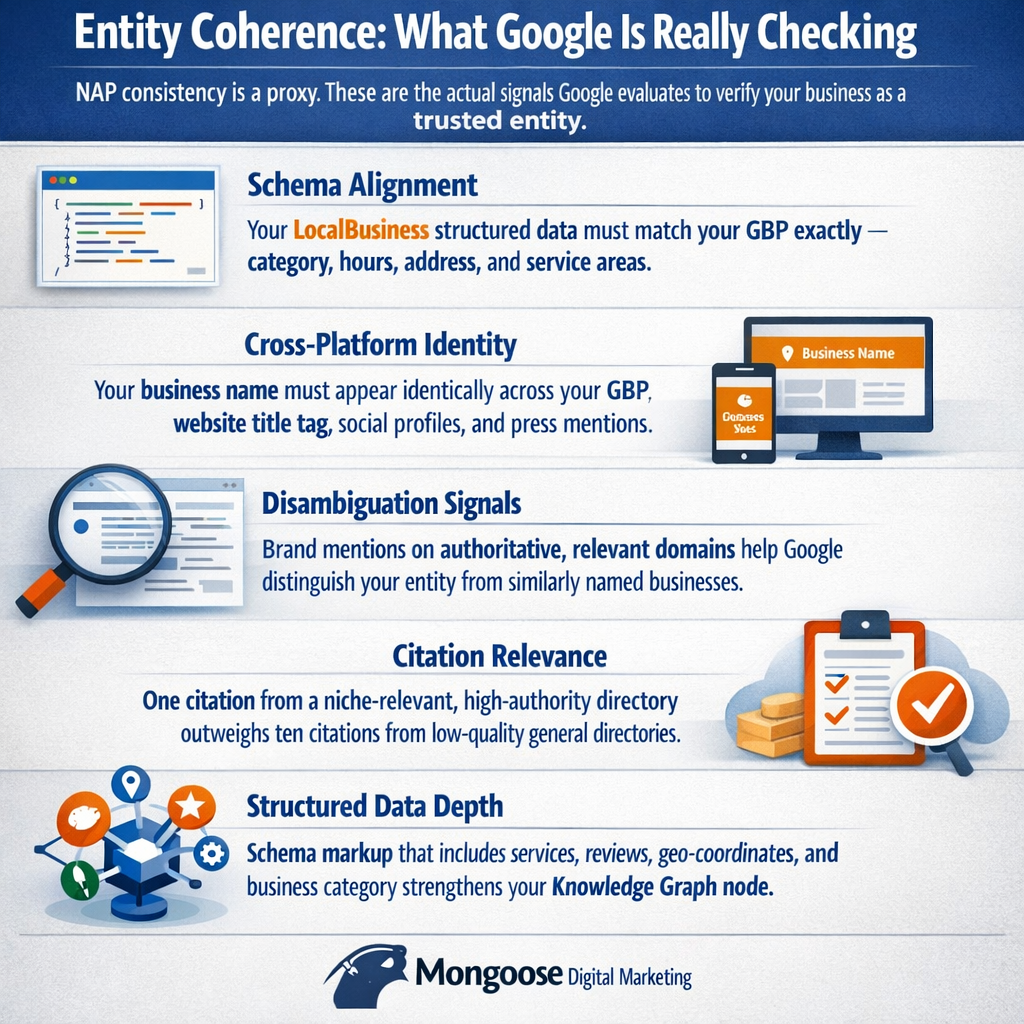
NAP consistency is a proxy signal. The underlying goal Google is pursuing is entity coherence: the ability to confidently resolve that all mentions of your business across the entire web refer to the same real-world entity. Google’s Knowledge Graph maintains a structured understanding of businesses as entities — connected nodes of information that include your name, location, category, services, operating hours, and relationships to other known entities.
When that entity picture is fragmented or ambiguous, Google doesn’t penalize you. It reduces your ranking ceiling. You can execute every other local SEO tactic correctly and still plateau because Google lacks the entity confidence to push you higher. For a deeper look at the specific signals that suppress rankings before you ever reach that ceiling, the article on what local SEO companies won’t tell you is worth reading alongside this guide.
Entity coherence goes considerably deeper than matching your address format across directories:
- Schema markup alignment: Your LocalBusiness structured data on your website must precisely match the information in your Google Business Profile — including business category, service areas, and hours. Discrepancies here create conflicting entity signals even if your visible NAP is identical everywhere.
- Cross-platform identity consistency: Your business name, as rendered in your GBP, your website’s title tag, your social media profiles, your press mentions, and your structured data, should be identical or so close that there’s zero ambiguity.
- Disambiguation signals: If your business name is a common phrase or shares terminology with other businesses — think “City Plumbing” or “Premier Dental” — Google needs additional surrounding signals to distinguish your entity from similarly named operations. This is where brand mentions on authoritative, topically relevant domains become critical.
- Wikidata and Wikipedia presence: For businesses of sufficient prominence, Wikidata entries provide machine-readable entity verification that Google’s Knowledge Graph can directly reference. This is underutilized even by sophisticated local SEO practitioners.
The practical implication: before you spend another hour building directory citations, audit the entity coherence of your existing presence. Conflicting signals from a dozen high-authority citations you already have will suppress your rankings more than 50 additional citations from weak directories will help them.
Google Business Profile: Beyond the Checklist
Google Business Profile (GBP) is the single most influential asset in your local SEO stack. Every competitor guide will tell you to “complete your profile.” That’s entry-level advice that stops well short of explaining how GBP signals actually function.
Google uses your GBP not primarily as an information display mechanism — it uses it as a trust verification system. The completeness and consistency of your profile signals to Google that your business is legitimate, active, and authoritative enough to recommend to searchers. Each field you complete, each attribute you select, each photo you add contributes to a cumulative trust score that influences your pack ranking.
Which GBP Fields Carry the Most Algorithmic Weight
Not all profile fields are equal. Understanding which fields Google weights most heavily allows you to prioritize your optimization effort:
Primary Business Category
This is the single most influential field in your GBP. Google uses your primary category to classify your business entity and determine which searches you’re eligible to rank for. Selecting an imprecise primary category — even a closely related one — can structurally limit your map pack eligibility for your most valuable queries. Research competitor categories using tools like GMBspy or Pleper before finalizing your selection.
Business Description
The description field is processed for semantic relevance signals. It’s not keyword stuffing territory — Google’s natural language processing is sophisticated enough to extract service and geographic relevance from naturally written content. Use it to clearly communicate your core services, your service area, and what differentiates your business.
Services and Products
These sections are heavily underutilized. Each service entry functions as a relevance signal for associated search queries. A plumbing company that lists “water heater installation,” “drain cleaning,” and “pipe repair” as distinct service entries creates discrete relevance signals for each of those query types — relevance that a generically described profile cannot achieve.
Review Recency and Response Rate
Google’s algorithm treats review signals as a freshness proxy for business health. A business with 200 reviews, the most recent of which is eight months old, will underperform against a competitor with 60 reviews and consistent weekly acquisition. Equally important: your response rate to reviews (both positive and negative) is an active engagement signal that contributes to prominence scoring.
Photo and Video Activity
Regular photo uploads signal an active, legitimate business. Google tracks upload frequency and categorizes photos (interior, exterior, team, products) as distinct entity signals. Businesses that upload consistently outperform dormant profiles even when the dormant profiles have more total photos.
The Review Velocity Problem Nobody Talks About
Every local SEO resource tells you to get more reviews. Very few address the risk embedded in how you get them.
Google’s algorithm is sensitive to unnatural review acquisition patterns. A business that generates three to five reviews per month for a year, then runs a one-time promotion that generates 40 reviews in a two-week window, triggers trust suppression signals. Google interprets sudden velocity spikes as potential manipulation — and the response is a quiet reduction in your ranking ceiling, not an obvious penalty that shows up in any dashboard.
The correct approach is building a steady-state review acquisition system: a repeatable process integrated into your post-transaction workflow that generates reviews at a consistent, sustainable rate. This means automated follow-up sequences, staff training on asking at the right moment, and friction reduction in the review process (direct GBP review links, QR codes on receipts). The goal is a slow, continuous flow — not campaigns. The article on Google Business Profile optimization tips that actually work covers the mechanics of building this kind of system in greater detail.
The Centroid Bias Problem: The Local SEO Obstacle Nobody Admits Exists
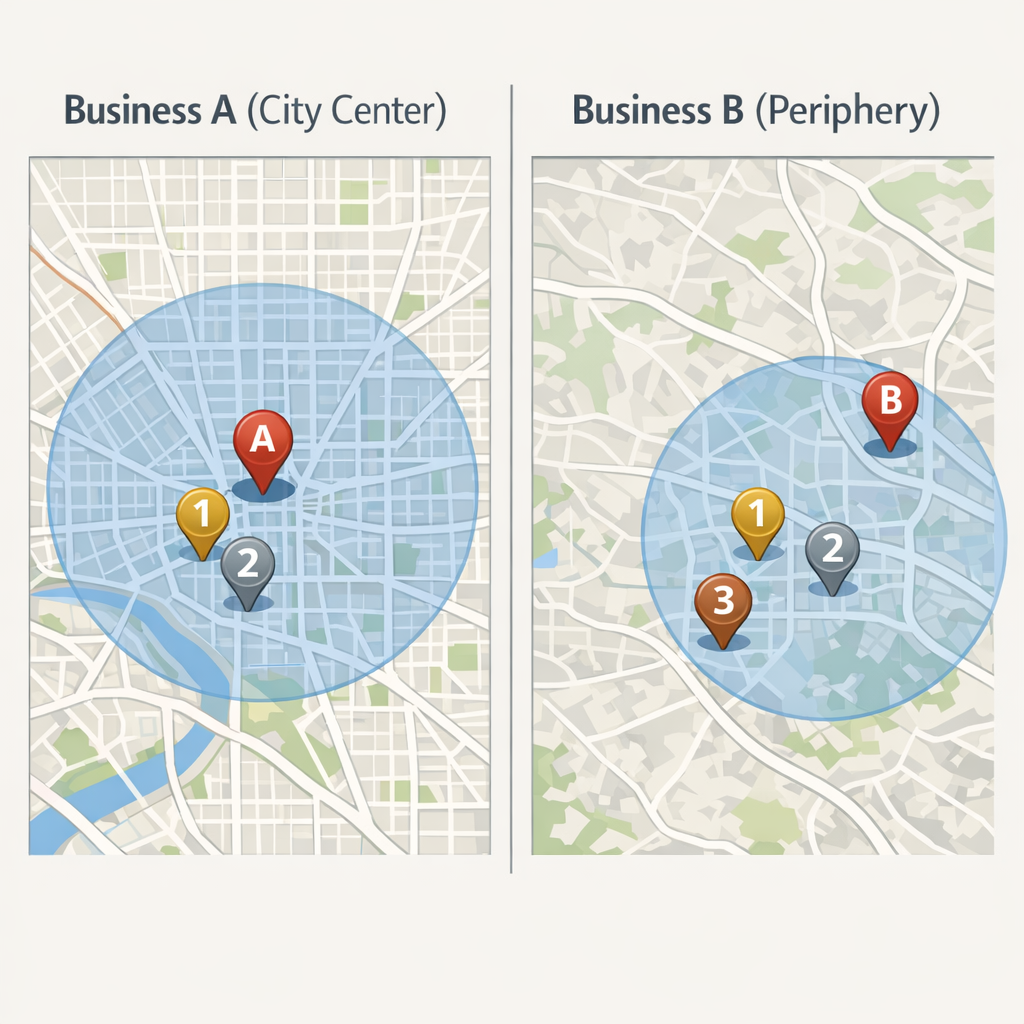
Here is the most honest thing any local SEO guide can tell you: if your business is located on the geographic periphery of the area you want to rank in, you are structurally disadvantaged — and no amount of optimization fully eliminates that disadvantage.
Google’s map pack has a documented centroid bias. Businesses located closer to the geographic center of a city or defined service area have a ranking advantage for broad, city-level queries that is baked into the algorithm’s distance weighting. A less-optimized competitor at the city center will frequently outrank a meticulously optimized business on the outskirts for searches like “plumber Chicago” or “dentist Dallas.”
This isn’t a flaw you can fix by getting more reviews or adding more schema markup. It’s a structural reality of how the distance factor operates.
What you can do is change the battlefield:
Neighborhood-Level Keyword Targeting
Instead of competing for “plumber Chicago” from a suburban location, build location-specific pages and GBP service descriptions optimized for the specific neighborhoods where your proximity advantage is genuine. “Plumber Wicker Park” and “plumber Logan Square” are searches where a well-optimized business located near those neighborhoods can win. Aggregate city-level searches may be high-volume, but neighborhood-level searches convert at higher rates because the intent is more specific.
Geographic Review Signals
Customers who reference their specific neighborhood in review text create geographic relevance signals that partially compensate for distance disadvantage. This can be encouraged naturally by prompting customers with context (“How did we do on your project in Oak Park?”) without scripting their reviews.
Precise Service Area Definition
GBP allows you to define service areas at the city, zip code, or neighborhood level. Businesses that use the default city-level setting miss the opportunity to establish precise geographic relevance for the sub-market areas where they actually have competitive proximity. Define your service areas as specifically as your operations genuinely support.
Hyper-Local Content Strategy
Publishing content that demonstrates genuine knowledge of specific neighborhoods, local landmarks, and community context builds topical geographic relevance that pure GBP optimization cannot replicate. A roofing company that publishes content about common roofing issues in homes built during specific eras of development in particular neighborhoods is signaling geographic expertise that competitors producing generic content cannot match.
Citations in the Modern Algorithm: Quality Has Replaced Quantity
Citation building — the practice of listing your business in online directories — was once the dominant local SEO tactic. Volume was the metric that mattered. The more directories your NAP appeared in, the stronger your local authority.
That era is functionally over.
Google’s current approach to citation signals prioritizes relevance over quantity. A single citation from a high-authority, niche-relevant directory (a regional business association, an industry-specific platform, a local Chamber of Commerce) carries more weight than 50 listings in low-quality general directories. More importantly, conflicting or inconsistent citations from low-quality sources can actively create entity ambiguity — the entity coherence problem described earlier — that suppresses rather than strengthens your rankings.
The modern citation strategy looks like this:
- Tier 1 — Core Platforms: Google Business Profile, Apple Maps, Bing Places, Yelp, Facebook, and any industry-dominant vertical directories (Healthgrades for medical, Avvo for legal, Houzz for home services). These are non-negotiable and should be maintained with precision.
- Tier 2 — Regional Authority: Local Chamber of Commerce, regional business journals, city-specific directories, and state licensing board listings where applicable. These carry strong geographic relevance signals.
- Tier 3 — Industry-Specific: Vertical directories and association listings specific to your industry. A landscaping company listed on the National Association of Landscape Professionals directory sends a stronger entity signal than the same company listed on 30 generic business directories.
- Deprioritize or Suppress: Bulk citation directories with no editorial standards, duplicate listings across the same platform, and any directory where your business information appears in a format that conflicts with your primary entity data.
The audit-first principle applies here as strongly as it does to entity coherence: identify and resolve conflicting existing citations before building new ones. A citation cleanup exercise typically delivers faster ranking improvements than adding new citations to an already-conflicted ecosystem.
How Your Website Influences Your GBP Rankings
One of the least-explained mechanisms in local SEO is the causal link between your website’s content and your Google Business Profile’s map pack rankings. Competitors advise adding location pages and local keywords to your website, but rarely explain why website signals affect GBP performance.
Google uses your website as a verification and amplification layer for your GBP entity. Your website content helps Google answer three questions:
- Is this business real and legitimate? A professional website with consistent NAP, LocalBusiness schema, and detailed service information reinforces the entity signals in your GBP.
- Is this business relevant to this query? Topically relevant content — service pages, location pages, and case study content — helps Google understand the full scope of what your business does and where it operates.
- Is this business authoritative? Backlinks from locally and topically relevant external sites function as third-party endorsements that contribute to your prominence score, which directly influences your map pack position.
The website-GBP relationship is bidirectional: your GBP drives traffic to your website, and your website’s authority and relevance strengthen your GBP’s ranking power. Treating them as separate assets to be optimized independently leaves significant ranking potential unrealized.
Location Pages Done Right
If your business serves multiple geographic areas, location-specific pages on your website are one of the highest-leverage tactics available. The key distinction: Google can identify thin, templated location pages that simply swap city names in otherwise identical content. These provide minimal ranking benefit and can trigger quality signals that suppress your domain’s overall authority.
Effective location pages demonstrate genuine geographic specificity:
– Service descriptions that reference local context (building codes, neighborhood characteristics, regional climate considerations)
– Locally sourced customer testimonials that reference the specific area
– Embedded Google Maps with accurate location data
– Internal links to relevant blog content that demonstrates local topical expertise
– LocalBusiness schema with area-specific service and geographic markup
AI Overviews and the Shifting Local Search Landscape
Local search is in a period of structural transition. Google’s AI Overviews are increasingly appearing for local and near-local queries, and the selection criteria for businesses featured in AI-generated summaries differ meaningfully from traditional map pack ranking signals.
AI Overviews for local queries appear to draw heavily from:
– Review sentiment analysis across multiple platforms (not just Google reviews)
– Content depth and topical authority on your website
– Entity confidence signals from structured data and Knowledge Graph coherence
– Third-party editorial mentions from authoritative local and industry sources
Critically, a business that ranks strongly in the map pack does not automatically appear in AI Overview summaries for the same queries. These are diverging result types governed by overlapping but distinct signals. The businesses appearing in AI Overviews for local queries tend to have stronger content depth, broader review platform presence, and more robust entity establishment than the map pack alone requires.
The practical implication: optimizing exclusively for the map pack, while still essential, is no longer sufficient to capture the full spectrum of local search visibility. Businesses that invest in genuine content authority, multi-platform review presence, and clean entity signals will be better positioned as AI Overviews continue to expand their footprint in local search results.
Strategic Recommendations for 2026
The local search environment heading into 2026 rewards businesses that treat visibility as a system rather than a checklist. Three specific investments will separate competitive operators from those chasing outdated tactics:
1. Adopt an Entity-First GBP Management Platform
Tools such as Semrush Local or BrightLocal now offer entity monitoring dashboards that track NAP consistency across citations, flag Knowledge Graph discrepancies, and surface review sentiment trends across platforms simultaneously. Moving beyond manual GBP management to a structured monitoring workflow is no longer optional for businesses operating in competitive local markets. These platforms also provide the audit infrastructure needed to catch entity signal drift before it suppresses rankings.
2. Build a Structured Review Diversification Program
With AI Overviews drawing from multi-platform review sentiment, a deliberate system for generating reviews across Google, Yelp, industry-specific directories, and emerging AI data sources (such as Bing Places, which feeds several AI assistants) is a direct competitive advantage. This means implementing post-transaction review request sequences, training customer-facing staff on review solicitation compliance, and monitoring response workflows across all platforms — not simply reacting to Google notifications.
3. Commission Locally-Embedded Content with Topical Cluster Architecture
Generic blog content no longer contributes meaningfully to local authority. The forward-looking investment is in content that ties genuine topical depth to geographic specificity — service explainers that reference local regulations, seasonal guides tied to regional conditions, and neighborhood-level resource pages that attract local editorial links. Pairing this with a formal internal linking architecture that connects location pages, service pages, and blog content creates the topical cluster signals that both traditional search and AI Overviews increasingly reward. For a broader look at how this kind of content strategy connects to pipeline growth, the article on SEO for lead generation in 2026 provides useful context.
Frequently Asked Questions
What is the most important ranking factor for local SEO in 2026?
There is no single dominant factor, but entity coherence — the consistency and completeness of your business information across your Google Business Profile, website, citations, and structured data — functions as the foundational layer on which all other signals depend. Without clean entity establishment, review volume, backlinks, and content quality deliver diminished returns. Businesses that prioritize entity health first, then layer in review acquisition and content authority, consistently outperform those that treat local SEO as a collection of isolated tactics.
How does proximity affect local search rankings, and can it be overcome?
Proximity to the searcher remains a significant algorithmic signal, particularly for map pack results. It cannot be entirely overcome, but its influence can be meaningfully mitigated. Businesses with stronger review velocity, higher review ratings, greater GBP completeness, and more robust on-page local relevance signals consistently outrank physically closer competitors who have weaker profiles. For businesses targeting areas beyond their immediate location, service area configuration, location-specific landing pages, and locally-embedded content are the primary levers for extending geographic reach.
Do online reviews actually influence local search rankings?
Yes, and their influence extends beyond simple star ratings. Google’s local ranking algorithm evaluates review quantity, recency, velocity of acquisition, keyword relevance within review text, and owner response patterns. Reviews are also increasingly important for AI Overview selection, where sentiment analysis across multiple platforms appears to influence which businesses are surfaced in AI-generated local summaries. A sustained review acquisition strategy, combined with consistent and substantive responses, contributes to both traditional map pack performance and emerging AI visibility.
What is the difference between map pack rankings and AI Overview appearances?
Map pack rankings are governed primarily by proximity, relevance, and prominence signals tied to your Google Business Profile and local entity footprint. AI Overviews for local queries operate on a partially distinct set of signals, weighing content depth, topical authority, multi-platform review sentiment, and Knowledge Graph entity confidence more heavily than the map pack alone requires. A business can rank in the top three map pack positions for a query while being entirely absent from the AI Overview for the same query. Capturing both result types requires investment in both GBP optimization and genuine on-site content authority.
How many location pages should a multi-location business create?
Each physical location with a verified Google Business Profile warrants a dedicated, substantive location page on your website. The critical qualifier is substantive — thin pages that change only the city name provide little ranking value and can dilute overall site authority. Each location page should include genuinely location-specific content: locally-sourced testimonials, area-relevant service descriptions, accurate structured data, and embedded maps. For service area businesses without physical locations, the calculus is different; pages should only be created for areas where the business can credibly demonstrate local relevance and service delivery.
Is local SEO still relevant as AI search tools become more prevalent?
Local SEO is not becoming less relevant — it is becoming more complex. AI search tools, including Google’s AI Overviews and third-party AI assistants, draw from the same foundational data sources that traditional local SEO builds: structured business data, review platforms, authoritative content, and entity signals. Businesses with well-optimized local presences are better positioned to appear in AI-generated responses, not worse. The strategic shift is that the practices which build AI visibility — content depth, entity coherence, multi-platform presence — require more deliberate investment than the minimum-viable GBP optimization that was sufficient in earlier search environments.
Conclusion
Local search has always rewarded businesses that present themselves with clarity, consistency, and genuine relevance to the communities they serve. That fundamental principle has not changed — but the systems required to execute it have grown substantially more sophisticated. The businesses that will lead their local markets through 2026 and beyond are those treating local SEO as an integrated discipline: entity management, review strategy, content authority, and structured data working as a coordinated system rather than a disconnected series of one-time optimizations.
If your local search presence needs a strategic assessment or you are ready to build a structured program around these principles, Contact Us to start the conversation.