Key Takeaways
- The Dayton metro spans Montgomery, Greene, Warren, and Clark counties — each with distinct Google Business Profile proximity weighting zones, requiring a multi-county citation architecture rather than a single-location SEO approach.
- “Full service SEO” only produces compounding returns when one team owns the integrated strategy across organic search, paid search, and content — siloed execution creates attribution gaps that cause businesses to misread what is actually driving revenue.
- Dayton’s three dominant economic verticals — healthcare, aerospace/defense, and home services — require fundamentally different SEO tactics; a strategy built for a Kettering medical practice will fail a Beavercreek HVAC contractor if applied without adjustment.
- Google’s AI Overviews are now appearing for a meaningful share of local intent queries, meaning Dayton businesses investing in SEO today need a partner actively building for AI-synthesized search results, not just traditional 10-blue-link rankings.
- Honest SEO timelines vary dramatically by vertical and competitive environment in Dayton — local pack movement for a suburban home services company may occur in 60-90 days, while a downtown law firm competing against regionally established domains may require 12-18 months of sustained effort.
There is a version of “full service SEO” that looks impressive on a proposal deck and produces very little in the real world. You have probably seen it: a list of services, a row of certification badges, a percentage gain pulled from an unnamed case study, and a vague promise about “getting your business to the top of Google.” Every agency in the Dayton market offers some variation of this pitch. Most of them deliver some variation of the same mediocre results.
This article is not that pitch.
What follows is an honest, practitioner-level breakdown of what genuine full-service SEO actually requires in the Dayton market — not the sanitized version, but the version that accounts for the Dayton metro’s multi-county geographic complexity, its distinct economic verticals, and the rapid algorithmic shifts that most local agencies have simply not kept pace with. If you are a business owner in Dayton, Kettering, Beavercreek, Centerville, Huber Heights, Miamisburg, or Springboro evaluating SEO partners, this is the framework you should be using to ask sharper questions.
Why the Dayton Market Is More Complicated Than Most SEO Agencies Admit
The Multi-County Problem Nobody Talks About
Most agencies that advertise “Dayton SEO” treat the market as a single geographic target. That framing is operationally wrong, and it costs their clients rankings and leads.
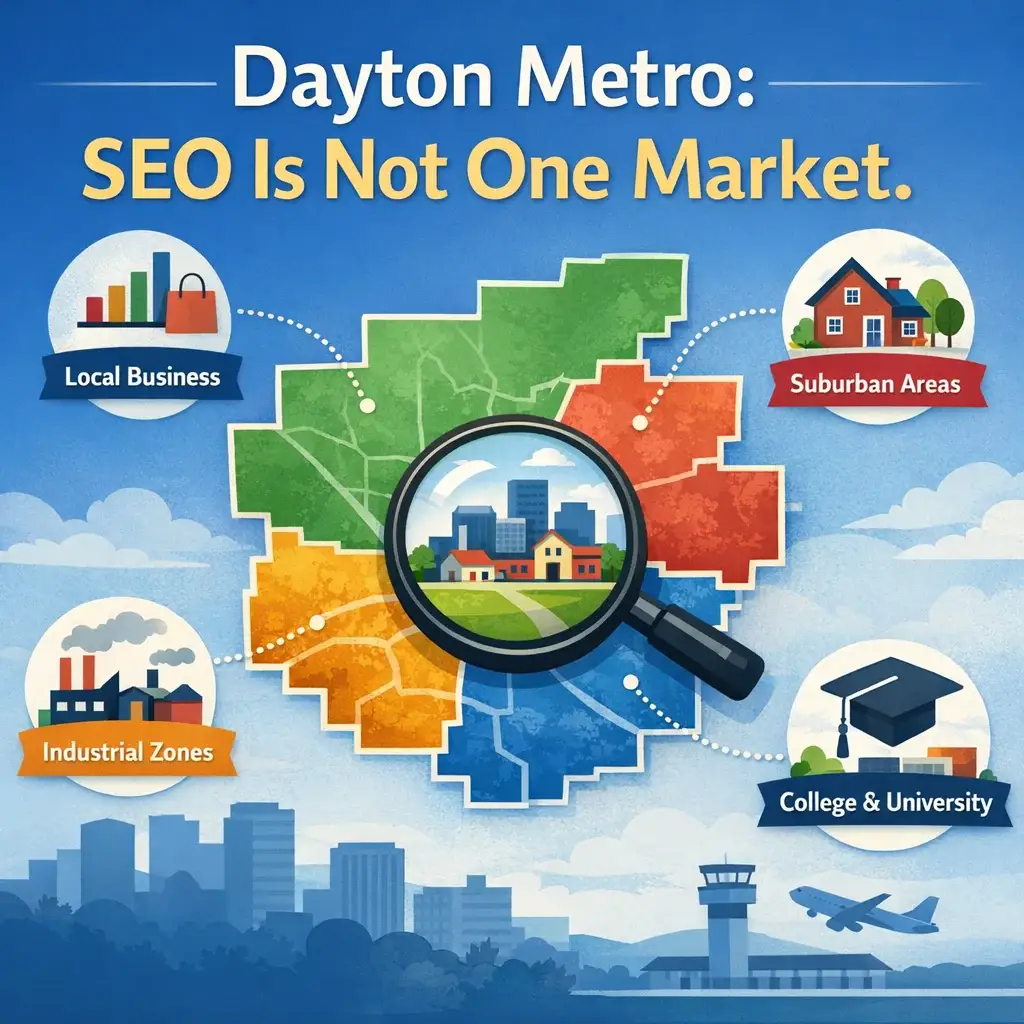
The Dayton metro is functionally a multi-county market. Montgomery County anchors the core — Dayton proper, Kettering, Huber Heights. Greene County covers a meaningfully distinct population base: Beavercreek, Fairborn, Xenia. Warren County pulls in Springboro and the southern corridor. Clark County encompasses Springfield to the northeast. These are not interchangeable zones on a map. From an SEO standpoint, each county represents a separate competitive environment with different characteristics:
- Google Business Profile proximity weighting operates on radial distance from a searcher’s location, not from a business’s primary address. A plumbing company based in Kettering does not automatically rank in Springboro’s local pack. Without a deliberate multi-location strategy, that coverage gap is a revenue gap.
- Hyperlocal competitor density varies significantly. A home services category in Beavercreek may have moderate local pack competition; the same category in Dayton proper may be saturated with regionally established operators who have been building citation authority for a decade.
- Consumer income profiles and conversion intent differ across the metro. Greene County’s demographics skew toward higher household incomes and higher rates of homeownership, which affects both the keywords users search and the landing page messaging that converts them.
A competent full-service SEO company should be building what practitioners call a multi-county citation architecture: consistent Name, Address, and Phone (NAP) data across authoritative directories for each relevant service area, paired with location-specific landing pages that are written for actual users in those zip codes — not thin duplicate pages with the city name swapped out. For a deeper look at how this works across Ohio’s regional markets, the article on local SEO for Ohio service businesses that actually works breaks down the county-level strategy in detail.
How Dayton’s Economic Verticals Change SEO Strategy Completely
Generic SEO agencies apply generic SEO playbooks. The problem is that Dayton’s three dominant economic verticals require approaches that are not just different in degree — they are different in kind.
Healthcare and Medical
Kettering Health and Premier Health are not just large employers. They are domain authority juggernauts. Their websites carry the kind of trust signals — institutional backlink profiles, decades of indexed content, massive topical depth — that a local medical practice simply cannot match through traditional keyword volume targeting. Trying to outrank Kettering Health for “orthopedic surgeon Dayton” by stuffing that phrase into a five-page website is not a strategy; it is a waste of budget.
What actually works in Dayton’s medical SEO environment is topical authority building: creating a content architecture that demonstrates genuine depth and expertise on a narrow specialty, so Google’s systems recognize the site as the authoritative source on that specific topic even if its overall domain authority is lower. A Kettering orthodontist, for example, might build content that thoroughly covers specific treatment concerns, age-specific orthodontic questions, and post-treatment maintenance — content that the major health systems do not prioritize because it is too niche for their broad audience. That specificity is the competitive opening.
Google’s E-E-A-T framework (Experience, Expertise, Authoritativeness, Trustworthiness) applies with particular force to healthcare content, which falls into what Google classifies as Your Money or Your Life (YMYL) territory. Author credentials, clinical accuracy, and transparent sourcing are not optional in this vertical — they are ranking factors.
Aerospace and Defense
Wright-Patterson Air Force Base anchors a B2B economy that behaves almost nothing like local consumer search. The search behavior in Dayton’s aerospace and defense sector is:
- Predominantly long-tail and specification-driven (“AS9100 certified machining Dayton Ohio” rather than “manufacturing company Dayton”)
- Conducted by procurement professionals and engineers with high technical literacy, not general consumers
- Influenced by government contractor compliance requirements that affect what a business can and cannot publish publicly
Standard local SEO tactics — review generation, Google Business Profile optimization, local pack targeting — are largely irrelevant for B2B aerospace suppliers. The real SEO opportunity lies in technical content that speaks directly to the procurement criteria buyers use, paired with precise keyword research that maps to RFQ (request for quote) stages rather than awareness-stage queries.
Home Services
Dayton’s homeownership rate sits above the national average, which creates one of the most intensely competitive local search environments in the metro: home services. HVAC, plumbing, electrical, roofing, and landscaping categories are packed with both regional franchises and established independent operators who have been accumulating Google Business Profile reviews for years.
In this vertical, Google Business Profile optimization and review velocity outperform traditional on-page SEO signals in direct conversion impact. A GBP profile with 200 recent, keyword-rich reviews in a concentrated service area will out-convert a website with technically perfect on-page SEO but a thin review profile. That does not mean on-page SEO is irrelevant — it means the integration between GBP performance and website authority is where the compounding effect happens, and agencies that treat those as separate workstreams are leaving conversion rate on the table. The article on Google Business Profile optimization tips that actually work covers the specific levers that drive local pack performance in competitive home services categories.
What “Full Service” Actually Means — And Why Most Agencies Get It Wrong
The Attribution Gap: The Real Cost of Siloed SEO
The phrase “full service” is one of the most overused and least defined claims in digital marketing. Most agencies that use it mean: we offer multiple services. What they do not mean — because they have not built the operational infrastructure to deliver it — is: we actively manage the integration between those services to prevent them from working against each other.
Here is what breaks when a full-service agency silos its SEO and PPC teams:
- Organic rankings directly affect Google Ads Quality Scores. Quality Score is Google’s assessment of an ad’s relevance and landing page experience. A landing page with weak SEO signals — thin content, slow load time, poor mobile experience — receives a lower Quality Score, which means higher cost-per-click and lower ad position. An agency whose SEO team has never talked to its PPC team will miss this leverage point entirely, and the client pays more for paid traffic than they should.
- An unoptimized Google Business Profile undermines strong on-page SEO. Local pack rankings and organic rankings pull from different algorithmic inputs. A business can have technically excellent on-page optimization and still be invisible in the local pack if its GBP has inconsistent NAP data, sparse category selections, or no photo activity. These are separate levers that need to be pulled in coordination.
- Content that is misaligned with keyword research produces traffic that looks good in a dashboard and converts at near-zero rates. This is one of the most common failures in full-service SEO: the content team produces articles that attract informational searchers who have no purchase intent, the SEO report shows “traffic up 40%,” and the business owner sees no corresponding increase in leads. The problem is not the traffic — it is the intent mismatch that nobody caught because the keyword research team and the content team were not talking.
A genuinely integrated full-service SEO approach means one accountable strategy layer that owns the relationship between organic search, paid search, content, and local presence — and actively monitors for the cross-channel conflicts that siloed teams routinely miss. The article on how PPC and SEO work together to grow your business details exactly how these channels should be feeding each other’s performance.
The Services That Belong in a Real Full-Service SEO Engagement
The table below breaks down what each component of a legitimate full-service SEO strategy delivers, how it integrates with other channels, and what a hollow version of each service looks like in practice.
| Service Component | What It Should Deliver | How It Integrates With Other Channels | Red Flag: What a Hollow Version Looks Like |
|---|---|---|---|
| Technical SEO | Core Web Vitals compliance, crawl efficiency, structured data implementation, site architecture that supports topical authority | Directly affects landing page Quality Scores in Google Ads; site speed affects conversion rates across all traffic sources | An audit delivered once, never revisited; AMP implementation cited as a current best practice |
| On-Page SEO | Search intent matching, semantic content structure, title/meta optimization aligned with actual conversion goals | Provides content foundation that PPC landing pages draw from; signals topical relevance that amplifies GBP authority | Keyword stuffing in headers; no discussion of intent alignment; optimizing for rankings without tracking conversion outcomes |
| Local SEO / GBP Management | Multi-location citation architecture, review velocity strategy, GBP category and attribute optimization, Q&A management | Local pack presence drives branded search volume that improves organic CTR; GBP reviews produce schema-eligible content | A one-time GBP setup with no ongoing management; treating all Dayton-area locations as a single citation cluster |
| Content Marketing | Topical authority content mapped to buyer journey stages, E-E-A-T signals for YMYL verticals, internal linking architecture | Feeds keyword intelligence back into PPC campaign structure; builds organic brand authority that reduces reliance on paid traffic over time | Blog posts written for traffic with no conversion intent mapping; no author credentials in healthcare or legal verticals |
| Link Building | Topically relevant referring domains, geographic authority from local publications and directories, deliberate link velocity that avoids spam signals | Amplifies on-page authority gains; domain authority improvements reduce PPC Quality Score penalties | Vague “high-quality backlinks” claims with no discussion of topical relevance, referring domain diversity, or link velocity patterns |
| PPC Integration | Keyword data from paid search informing organic strategy; landing page testing results fed back into SEO content decisions | Paid search data reveals high-converting keywords that should be prioritized in organic strategy; organic rankings reduce dependence on paid traffic for competitive terms | PPC and SEO operated by separate teams with no shared keyword or conversion data |
| Reporting and Attribution | Multi-touch attribution that connects organic, paid, and local channels to actual revenue outcomes | Unified dashboard that shows how channels interact, not just how each performs in isolation | Traffic and ranking reports with no connection to leads, calls, or revenue; vanity metrics presented without conversion context |
The Algorithm Reality Most Dayton SEO Agencies Have Not Caught Up To
What Changed in 2022-2025 and Why It Matters for Your Investment
An SEO strategy built on 2020-era best practices is not a neutral choice — it is an active liability. Three specific shifts have fundamentally changed what effective SEO looks like, and the absence of any discussion of these changes is a legitimate red flag when evaluating an agency.
Google’s Helpful Content System
Google’s Helpful Content updates (2022-2024) introduced a sitewide quality signal that penalizes websites producing content primarily for search engines rather than human readers. This is not a technical SEO issue — it is a content strategy issue. Websites with high volumes of thin, keyword-targeted pages that provide no genuine information depth have seen sustained organic traffic losses that technical optimization alone cannot recover. A competent SEO partner should be able to audit a site’s content portfolio for Helpful Content compliance, not just its metadata.
The March 2024 Core Update and Spam Policy Overhaul
Google’s March 2024 core update was one of the most consequential in years, specifically targeting scaled content abuse, site reputation abuse (parasite SEO), and expired domain exploitation. For Dayton businesses, the practical implication is that link building strategies that were defensible two years ago may now carry manual action risk. Any agency that cannot speak specifically to how its link building practices align with Google’s current spam policies should be pressed on this directly.
AI Overviews and the Restructuring of Local Search
This is the largest strategic blind spot in the Dayton SEO market, and every agency operating here needs to be asked about it directly.
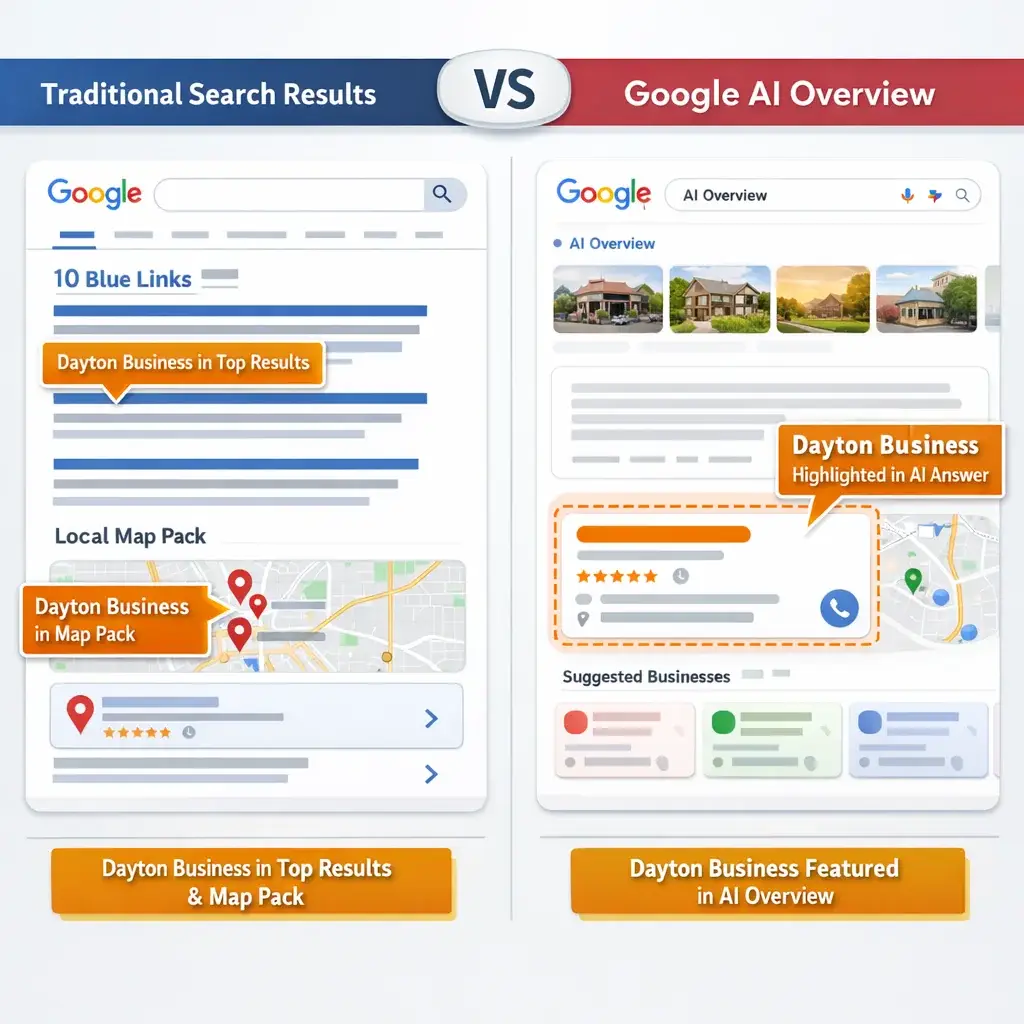
Google AI Overviews — the AI-generated summary boxes that now appear above traditional organic results for a growing share of queries — are not just an informational curiosity. They are actively restructuring click behavior for queries where your business needs to appear. For local service queries, the implications are still evolving, but the directional trend is clear: businesses whose content is structured to be cited by AI systems will maintain visibility; businesses whose content is not will see organic click-through rates decline even if their rankings technically hold.
What does “structured to be cited by AI” mean practically? It means content that directly and precisely answers specific questions, uses structured data markup to help crawlers understand entity relationships, and demonstrates clear authorship and source credibility. It is not a fundamentally different type of content — but it requires deliberate structural choices that most current local SEO content does not make.
Timeline Realism: What Honest SEO Looks Like in Dayton’s Competitive Landscape
One of the clearest signals that an agency is being straight with you is whether they give you an honest timeline framework — not a guarantee, but a realistic range based on what the competitive data actually shows.
Here is how SEO timelines actually vary across Dayton’s major verticals and sub-markets:
Home Services in Suburban Greene and Warren Counties
For an HVAC, plumbing, or landscaping company targeting Beavercreek, Centerville, or Springboro, local pack movement is achievable in a compressed timeframe relative to other verticals. The competitive environment in these suburban areas, while active, has not reached the saturation levels of Dayton proper. A well-executed GBP optimization combined with a targeted citation-building campaign can produce local pack movement within 60-90 days. Organic ranking gains for non-branded keywords typically follow over a 4-6 month horizon, with compounding returns beyond that.
Healthcare and Medical in Montgomery County
The established domain authority of Kettering Health, Premier Health, and their affiliated networks means that a local medical practice is not competing on a level field for broad clinical keywords. Realistic timelines here run 9-18 months for meaningful organic movement on competitive terms. The strategic approach — topical authority building in a narrow specialty — begins showing engagement signals (time on page, return visits, branded search growth) before it shows ranking movement, which can create a frustrating visibility lag that unsophisticated reporting will miss entirely.
Legal Services in Downtown Dayton
Dayton’s legal market includes well-established regional firms with domain histories stretching back to the early 2000s. Their backlink profiles and indexed content depth are not things a challenger closes in a quarter. An honest assessment for a law firm entering or rebuilding its SEO in this market is 12-18 months to compete meaningfully on primary practice area terms, with earlier wins achievable on long-tail, hyperlocal, or practice-specific niche terms that larger firms have not prioritized.
B2B and Aerospace/Defense Suppliers
B2B SEO timelines are governed less by local pack competition and more by content indexing cycles and referral domain acquisition. The low search volume of specification-driven keywords means that ranking movement may not be visible in typical rank-tracking dashboards for months — but the conversion value of a single qualified lead from a procurement officer often dramatically exceeds what a home services company earns from dozens of consumer leads. Patience and precise keyword targeting are non-negotiable in this vertical.
How to Evaluate a Full Service SEO Company in Dayton: The Questions That Separate Experts from Pretenders
Most agency evaluation conversations default to the wrong questions. “How many clients do you have?” and “Can you guarantee first-page rankings?” are questions that produce polished non-answers. Here are the questions that actually reveal whether an agency has the depth to serve a Dayton business effectively:
- How do you approach multi-county local SEO for a business that serves the full Dayton metro? Listen for specific mention of citation architecture, location-specific landing pages, and GBP service area configuration — not a vague answer about “targeting your area.”
- How have your strategies changed in response to Google’s 2023 and 2024 core updates? Any agency that cannot cite specific methodological changes in response to recent algorithm shifts is running an outdated playbook.
- How do your SEO and PPC teams share data? If the answer involves any variation of “they work separately,” you have found an integration gap that will cost you efficiency and attribution clarity.
- What does a realistic timeline look like for my specific vertical in this market? An expert will give you a range with a rationale. An agency looking to close a deal will tell you what you want to hear.
- How are you preparing client content for Google AI Overviews? This question alone will separate agencies operating in 2025 from those operating on a 2021 methodology.
Partnering With a Full Service SEO Company That Actually Integrates
The Dayton market rewards specificity. Businesses that treat this metro as a single, undifferentiated target — whether they are the business owner or the agency advising them — consistently underperform against operators who understand the county-by-county competitive dynamics, the vertical-specific ranking factors, and the algorithmic realities that define what “good SEO” means right now.
At Mongoose Digital Marketing, we build SEO strategies the way the market actually works: multi-county citation architecture for businesses serving the full metro, vertical-specific content strategies built around what Dayton’s actual search audience is looking for, and an integrated approach that connects organic search, paid search, and local presence under a single accountable strategy. We track what moves revenue — leads, calls, form submissions, and the conversions that actually matter — not just rankings and traffic numbers that look good in a report.
If your current SEO investment is not producing that level of clarity, the conversation starts with a free consultation. We will show you exactly where the gaps are and what a strategy built for this market actually looks like.
Strategic Recommendations for 2026
The SEO landscape heading into 2026 is not a continuation of where it was in 2023. Three specific investments will separate Dayton businesses that grow from those that stall.
1. AI Overview Optimization Audits
Google’s AI Overviews have fundamentally changed how informational queries resolve — and how much organic traffic ever reaches your website at all. In 2026, every serious SEO engagement should include a structured audit of how your content performs within AI-generated summaries. This means evaluating entity clarity, structured answer formats, and whether your content is written in ways that large language models can accurately cite and surface. Any full service SEO company that is not actively auditing for this is optimizing for a search results page that no longer exists.
2. Hyper-Local Content Systems Built for Multi-County Markets
The Dayton metro’s fragmented geography — spanning Montgomery, Greene, Warren, and Clark counties with meaningfully different competitive densities — makes generic local content strategies insufficient. In 2026, the businesses that rank across this metro will be operating systematic, hyper-local content programs: individual location pages built with genuine specificity, neighborhood-level service content, and citation ecosystems that reflect how residents in Kettering, Beavercreek, and Centerville actually search versus how someone in downtown Dayton searches. The technology to build and maintain this at scale now exists. The discipline to execute it correctly remains the differentiator.
3. Unified Search Intelligence Platforms
The separation between organic search data, paid search data, and local search performance data is becoming operationally untenable for businesses competing in mid-sized metros. In 2026, investing in a unified search intelligence platform — one that connects Google Search Console, Google Ads performance, local pack tracking, and conversion data into a single reporting environment — is not a luxury. It is the minimum viable infrastructure for making decisions that are not based on incomplete information. If your current agency is reporting on SEO and PPC in separate dashboards with no shared attribution model, you are making strategy decisions with half the evidence you need.
Frequently Asked Questions
What makes a full service SEO company different from a standard SEO agency?
A full service SEO company manages the complete search marketing ecosystem under one integrated strategy — organic search optimization, local SEO, content development, technical site health, and paid search — rather than treating each channel as a separate engagement. The practical difference for a Dayton business is attribution clarity and strategic alignment. When the team managing your Google Business Profile is also the team managing your paid search campaigns and your organic content strategy, the data flows in both directions and every channel informs the others. Fragmented agency relationships produce fragmented results because no single team has visibility into the full picture.
How long does SEO typically take to produce measurable results in the Dayton market?
Realistic timelines depend on your vertical, your current site authority, and how competitive your specific service area is within the metro. For most Dayton-area businesses entering a new SEO engagement, meaningful movement in local pack rankings and organic visibility typically begins to materialize within three to six months, with compounding growth continuing through months six to twelve and beyond. Highly competitive verticals — legal, home services, medical — operate on the longer end of that range. Any agency promising significant ranking improvements within weeks is either overstating what is achievable or defining “results” in a way that does not connect to revenue.
Should Dayton businesses invest in both SEO and PPC, or choose one?
For most Dayton-area businesses, the most effective approach is an integrated strategy that uses both channels in a coordinated way rather than treating them as competing budget priorities. Paid search delivers immediate visibility while organic authority builds over time. More importantly, the data from paid campaigns — which search terms convert, which landing page messages perform, which audience segments engage — directly informs how organic content should be structured and targeted. Businesses that run these channels in isolation consistently leave performance gains on the table. The question is not which channel to choose; it is whether your agency has the capability to run them in a way that makes each one stronger because of the other.
How does Mongoose Digital Marketing approach SEO for businesses serving multiple counties in the Dayton metro?
The Dayton metro presents a specific strategic challenge: meaningful population density and competitive dynamics across Montgomery, Greene, Warren, and Clark counties, with residents in each area searching in subtly different ways and encountering different competitive landscapes. Our approach involves multi-county citation architecture that establishes accurate and consistent local presence across each relevant geography, location-specific content strategies built around how people in Beavercreek, Centerville, Kettering, and surrounding communities actually search, and an integrated local and organic strategy that accounts for the fact that ranking well in one part of the metro does not automatically translate to visibility in another.
Conclusion
Businesses across Dayton, Kettering, Beavercreek, and Centerville deserve a search marketing partner that understands this market at the level of granularity it actually requires — one that connects local SEO and organic content strategy to outcomes that matter, not just metrics that look clean in a monthly report. Mongoose Digital Marketing was built to serve the Dayton metro with exactly that level of specificity, accountability, and integration. If you are ready to see what a strategy built for this market actually looks like, Contact Mongoose Digital Marketing to start the conversation.