

Key Takeaways
- Dayton’s proximity to Columbus and Cincinnati means Dayton businesses often compete in search results against larger-budget rivals from those metros, making precise local SEO signal-building a defensive necessity, not an optional add-on.
- Google Business Profile suspensions can occur minutes after successful postcard verification, as documented in the case of Kohl & Cook Law Firm at 6728 Loop Road, Dayton, OH, meaning GBP optimization without risk management is an incomplete strategy. (Source: https://support.google.com/business/thread/178156696)
- Duplicate GBP profiles sharing the same business name, phone number, and address can trigger automated “Deceptive content” flags and cause a profile to vanish from Google Maps entirely, even when no deception was intended. (Source: https://support.google.com/business/thread/446397893)
- Clutch lists 289 SEO companies serving Dayton, which makes a structured evaluation framework more valuable to buyers than any individual agency’s self-declared “best” claim. (Source: https://clutch.co/seo-firms/dayton)
- Effective SEO for Dayton businesses requires connecting technical fixes, local signal strength, and content strategy to measurable outcomes like leads and conversions, not just ranking positions.
A Dayton business owner searches for their own service category on Google. Their website exists, their Google Business Profile is verified, and they have been told they are “doing SEO.” But their phone is not ringing from organic traffic, and a Cincinnati-based competitor appears above them in Dayton search results for a service that requires physical proximity. That is not a hypothetical scenario. It is the predictable result of generic SEO advice applied to a market with specific competitive dynamics that most agencies never bother to explain.
This article explains what SEO experts in Dayton actually need to understand about this market, what separates a strategy that produces leads from one that produces reports, and how to evaluate any agency claiming to serve Miami Valley businesses.
Why Dayton’s Search Landscape Is Different From Generic SEO Advice
Most SEO content treats every local market as interchangeable. Rank for your city name plus your service category, optimize your Google Business Profile, build some citations. Done.
That playbook ignores a geographic reality that Dayton businesses face every day in their SERPs.
Dayton is positioned in Ohio alongside Cincinnati and Columbus, two larger metros that generate larger-budget competitors, stronger domain authorities, and more aggressive digital marketing spend from businesses that may appear in Dayton search results for any service category that does not strictly require a physical local presence.
The practical implication: a Dayton HVAC company, law firm, or dental practice is not only competing against other Dayton businesses. For non-hyper-local queries, they may be competing against Cincinnati and Columbus agencies, directories, and media properties with significantly more accumulated authority. Generic “rank for Dayton keywords” advice does not account for that pressure.
What does account for it is a more precise approach to local signal concentration. Understanding how Google rankings work for local SEO in Dayton is the foundation for building that kind of targeted strategy.
How Metro Proximity Changes Your Local SEO Priority List
When a larger metro competitor bleeds into your SERPs, the defensive mechanism is not more content. It is tighter geographic signal density. That means:
- Google Business Profile category precision: The primary GBP category directly influences which queries trigger a local pack result. Broad categories increase the pool of competitors. Precise categories reduce it and strengthen relevance signals for the queries that actually convert.
- Service area definition: Businesses that define Dayton, Kettering, Beavercreek, Centerville, Huber Heights, Miamisburg, and Springboro explicitly in their GBP service area send stronger geographic relevance signals than businesses using county-level or metro-level definitions.
- Citation consistency across local directories: Name, address, and phone number consistency across Dayton-specific directories, chamber of commerce listings, and regional platforms reinforces proximity signals that larger Columbus or Cincinnati competitors cannot easily replicate.
- Long-tail keyword clustering by neighborhood and suburb: Queries like “family dentist Centerville OH” or “HVAC repair Beavercreek” face far less competition from out-of-market businesses than broad category terms. Building content architecture around these tighter clusters is a Dayton-specific advantage larger metros cannot easily neutralize.
Have a question about seo experts dayton? Send a message with the situation you are working through and the decision you need help with. Ask for a written explanation of possible next steps.
The GBP Risk That No Dayton SEO Page Is Talking About
Every competitor page recommends Google Business Profile optimization. Almost none of them mention what can go wrong, and the documented cases from Google’s own support forums show the risk is real and consequential.
A law firm at 6728 Loop Road, Suite 204, Dayton, OH 45459, Kohl & Cook Law Firm, had its GBP profile suspended minutes after completing successful postcard verification. Despite submitting exterior photos, interior photos, a video walkthrough, and a utility bill, the profile remained in suspension. (Source: https://support.google.com/business/thread/178156696)
A separate documented case involving Kennard Music, a service-area business in Fairborn, OH, shows a different failure mode: the legitimate, actively managed profile was flagged for “Deceptive content” and suspended after the owner initiated Google’s official ownership recovery process to consolidate an older historical profile. When the ownership recovery process began, the legacy profile with six organic customer reviews disappeared from Google Maps entirely. The suspension flag was triggered by the system detecting two profiles sharing the same business name, phone number, and hidden base address, even though no deception was intended. (Source: https://support.google.com/business/thread/446397893)
These are not edge cases. They are documented patterns that any SEO expert working with Dayton businesses needs to understand before touching a GBP profile.
A Pre-Optimization GBP Risk Checklist
Before optimizing any Google Business Profile for a Dayton business, a competent SEO practitioner should work through the following:
| Risk Factor | What to Check | Why It Matters |
|---|---|---|
| Duplicate profiles | Search the business name on Google Maps and Google Search for any additional listings | Duplicate profiles sharing contact data trigger automated deceptive content flags |
| Historical profiles | Ask the business owner if any previous owners, employees, or agencies created profiles | Initiating ownership recovery on a hidden duplicate can suspend the active profile |
| Business name formatting | Confirm the name matches signage, registration, and official documents exactly; remove legal suffixes like “LLC” if not on signage | Mismatches between profile name and official documents are a suspension trigger |
| Verification method on record | Confirm how the profile was originally verified and whether that verification is still linked to an accessible account | Verification conflicts create ownership disputes that can freeze the profile |
| Service area vs. physical address settings | Confirm whether the business is a service-area business or a storefront; mixing these settings is a common profile instability cause | Incorrect address settings relative to actual business type can trigger policy reviews |
This checklist does not eliminate suspension risk entirely. What it does is surface the conditions that most commonly precede a suspension, so they can be resolved before optimization work begins rather than after a profile goes dark.
What “Technical SEO” Actually Means for a Dayton Business
Technical SEO is listed on every agency page in the Dayton market. The specifics are almost never explained. Here is what a technical SEO audit for Dayton businesses actually examines, and why each element affects the leads a business generates.

Illustration, not a photograph of a completed client project.
Google has reported that just a one-second delay in a site’s load speed can increase bounce rate by 123 percent. (Source: https://thriveagency.com/dayton-seo-company) A site audit is the diagnostic step that determines where technical work produces the highest return. For most Dayton small businesses, the highest-impact technical issues are page speed (particularly on mobile), indexation problems caused by robots.txt or noindex tags applied during development and never removed, and Core Web Vitals failures that penalize user experience scores relative to competitors.
Technical SEO without an audit is guesswork. The audit output is what determines which fixes to prioritize before investing in content or link building.
How to Evaluate SEO Experts in Dayton: A Buyer’s Framework
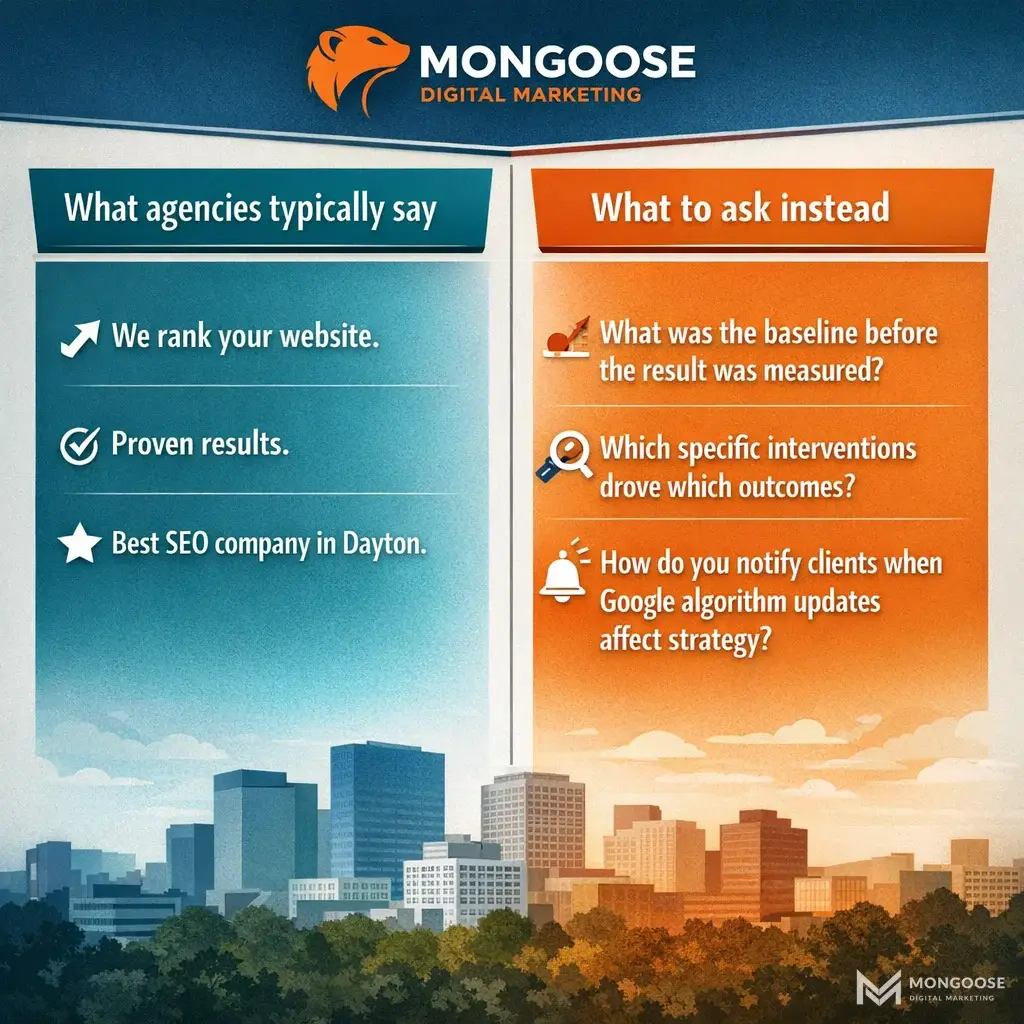
Clutch currently lists 289 SEO companies serving Dayton. (Source: https://clutch.co/seo-firms/dayton) When every agency on that list claims to be the best option, the claim itself carries no information. What carries information is the ability to explain methodology, not just results.
Illustration, not a photograph of a completed client project.
When evaluating any SEO agency for your Dayton business, ask for answers to the following questions before signing anything:
On methodology:
– What specific audit steps do you take before recommending any optimization work?
– How do you determine which keywords to target first, and what data sources do you use?
– What is your process for identifying and resolving GBP issues before beginning local SEO work?
On results claims:
– What was the baseline metric before the result you are citing was achieved?
– Over what time period did that result occur?
– Was the result consistent across the full engagement, or did it spike in a specific period?
On algorithm responsiveness:
– How do you notify clients when a core Google update affects their rankings?
– What changes in your approach when a client’s rankings drop after an update?
On local specificity:
– How does your strategy account for competition from Columbus and Cincinnati businesses appearing in Dayton SERPs?
– What GBP risk management steps do you take before optimizing a local profile?
An agency that can answer these questions with specific, documented responses is operating differently from one that answers with case study percentages and testimonials. When reviewing any agency’s cited results, the useful questions are always: what was the baseline, what was the time period, and what were the specific interventions? Without those details, percentage figures cannot be meaningfully evaluated or compared across agencies.
What a Dayton SEO Strategy Actually Looks Like in Practice
A strategy built for Dayton’s specific competitive environment has four connected components, each of which feeds the next.
1. Diagnostic audit first. Technical issues, GBP risk factors, existing ranking gaps, and competitor signal analysis come before any content or link work. Skipping this step means optimizing on top of unresolved problems.
2. Local signal concentration. GBP optimization, citation building, and service area definition focused on Dayton, Kettering, Beavercreek, Centerville, Huber Heights, Miamisburg, and Springboro. The goal is geographic specificity that larger-budget out-of-market competitors cannot easily replicate.
3. Content architecture around conversion-intent queries. Not just informational content for traffic, but pages structured around the specific queries that precede a phone call or form submission in each service category.
4. Reporting tied to business outcomes. Rankings are a leading indicator. Leads, calls, and conversions are the actual measure. Any reporting that stops at rankings without connecting to revenue-generating activity is incomplete.
If you are ready to have that kind of conversation about your Dayton business, contact Mongoose Digital Marketing for a free consultation and we will start with a diagnostic, not a sales pitch.
Frequently Asked Questions
How long does it take to see results from SEO in the Dayton market?
There is no honest universal answer, and any agency that gives you one without first reviewing your site’s current technical health, existing ranking positions, and competitive landscape is guessing. Generally, businesses with significant technical issues to resolve will see the longest delay before ranking improvements appear, because those problems need to be corrected before content or link work can produce results. Businesses in less competitive Dayton suburbs like Miamisburg or Springboro may see local pack movement faster than businesses targeting broad terms that bleed into Columbus and Cincinnati SERPs. The more useful question to ask any agency is not “how long” but “what specific milestones will indicate the strategy is working, and at what point?”
Can a Cincinnati or Columbus business legitimately outrank a Dayton business in Dayton search results?
Yes, and it happens regularly for service categories that do not strictly require physical proximity. For non-hyper-local queries, Google weighs domain authority, content depth, and relevance signals in ways that allow larger-budget out-of-market competitors to appear above local businesses. The defensive strategy is not to out-spend those competitors but to build geographic signal concentration they cannot easily replicate: precise GBP categories, explicit Dayton-area suburb targeting, citation consistency across local and regional directories, and content architecture built around the specific neighborhood and suburb-level queries that larger metros cannot credibly claim. This is why local signal concentration is a strategic priority, not a cosmetic add-on.
Is it safe to optimize a Google Business Profile that has already been verified?
It can be, but verification does not eliminate suspension risk, and the documented cases from Dayton-area businesses show that suspension can occur even after successful postcard verification. Before touching any profile elements, a competent practitioner should check for duplicate profiles sharing the same business name, phone number, or address; confirm whether any historical profiles exist from previous owners or agencies; verify that the business name on the profile matches signage and official documents exactly; and confirm whether the profile is correctly configured as a storefront or service-area business. Skipping this audit and proceeding directly to optimization is how legitimate, well-intentioned work can inadvertently trigger an automated policy flag.
What is the difference between ranking reports and actual SEO results?
Ranking reports show where your pages appear in search results for specific queries. That is a leading indicator, not an outcome. Actual results are the phone calls, form submissions, appointment bookings, and other conversion events that come from organic traffic. A business can rank on page one for a high-volume keyword and generate no leads if the keyword does not reflect purchase intent, if the landing page does not convert visitors, or if the traffic represents the wrong geographic audience. The reporting standard that connects to business outcomes tracks organic traffic by landing page, goal completions tied to organic sessions, and phone call attribution from local search, not rankings in isolation. If your current SEO reporting stops at keyword positions, you are missing the half of the picture that determines whether the investment is producing revenue.
Conclusion
The search results for any Dayton service category are not a neutral competition between businesses of equal standing. They reflect accumulated technical health, geographic signal strength, content depth, and the specific pressures that come from sitting alongside two larger Ohio metros. A business that understands those dynamics and builds its strategy around them has a structural advantage that generic SEO advice from agencies without market-specific knowledge cannot replicate.
The questions to ask are specific: what does the diagnostic reveal, what local signals are underdeveloped, what GBP risks exist before any optimization begins, and what does success look like in terms of leads rather than rankings. If those are the conversations you want to have about your Dayton, Kettering, Beavercreek, Centerville, Huber Heights, Miamisburg, or Springboro business, contact Mongoose Digital Marketing and we will start with the diagnostic.