
Key Takeaways
- SEO for Dayton businesses is not a single service but a sequenced set of tactics whose order depends on your domain’s current authority level, your Google Business Profile status, and the competitive density of your industry.
- Google Business Profile suspension triggered by routine actions like address changes or duplicate profile history is a documented, real risk that the Google Support forums confirm affects legitimate Ohio businesses, including one in Huber Heights. (https://support.google.com/business/thread/267605195/)
- A multi-asset SERP strategy, occupying organic listings, the local map pack, video results, and directory citations simultaneously, produces compounding visibility that no single ranking can replicate.
- The search query “SEO consultants Dayton” reflects a distinct buying intent: business owners often want strategic guidance and transparent decision logic, not just a task-execution service.
- Dayton’s diversified economy across aviation, healthcare, aerospace, and professional services means that the right SEO approach differs meaningfully by industry vertical, and a strategy built for a law firm will not transfer directly to an HVAC company or a manufacturer.
SEO consulting in Dayton is a narrower, more deliberate discipline than most agency pages suggest. The Miami Valley market is competitive across a wide range of industries, and the businesses that gain durable search visibility typically do so because someone made intelligent sequencing decisions early: fixing technical liabilities before building links, stabilizing a Google Business Profile before optimizing it, and targeting keyword segments where the competitive gap is actually closable. That kind of thinking is what separates a consulting relationship from a service subscription.
At Mongoose Digital Marketing, we work across Dayton, Kettering, Beavercreek, Centerville, Huber Heights, Miamisburg, and Springboro. The pattern we observe is consistent: businesses that struggle with SEO are rarely missing a tactic. They are missing the logic that connects tactics into a strategy built for their specific starting point.
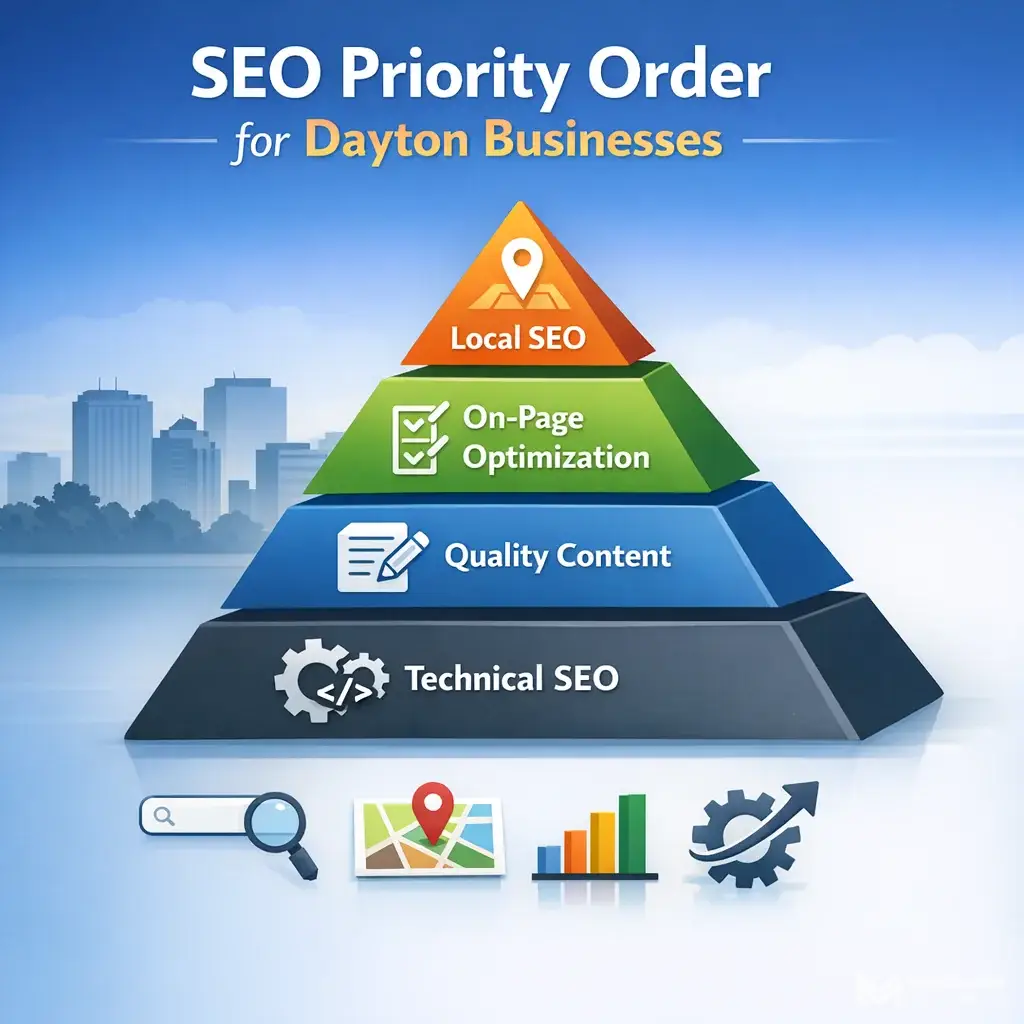
Illustration, not a photograph of a completed client project.
What “SEO Consulting” Actually Means for a Dayton Business
Most pages in this category describe a list of services. What they rarely describe is the decision logic behind which service applies to which business at which stage of growth. That gap in explanation is worth addressing directly.
An SEO consultant’s primary function is diagnostic before it is executional. Before any keyword is targeted or any link is built, a qualified consultant should be mapping three things:
- Where the business currently ranks and why
- What is preventing rankings from improving
- Which tactical sequence will produce the most leverage given current authority and competitive conditions
For a Dayton business with a relatively new domain and thin content, the answer almost never starts with link building. It starts with making the site technically sound and topically coherent. For an established business with solid on-page fundamentals but weak local pack visibility, the answer is different. The variables that change the answer include domain age, existing content depth, GBP status, review volume, competitor authority levels, and whether the target keyword set is locally competitive or nationally competitive.
No two Dayton businesses share the same combination of those variables. That is not a marketing claim; it is the reason a one-size approach consistently underperforms. Understanding what separates effective local tactics from generic execution is covered in depth in this article on local SEO in Dayton and how Google rankings work.
Have a question about seo consultants dayton? Send a message with the situation you are working through and the decision you need help with. Ask for a written explanation of possible next steps.
The Google Business Profile Risk That Most Agencies Do Not Discuss
Local SEO is consistently listed as a service on every Dayton SEO agency page. Optimizing a Google Business Profile is treated as a straightforward task: add photos, choose categories, collect reviews. The reality documented in Google’s own support forums is considerably more complex.
Google’s automated enforcement systems flag profiles for “Deceptive Content” in response to situations that look entirely routine from the business owner’s perspective. Documented cases include:
- A multi-location Ohio business (Dayton Barns & All-Steel Buildings, Huber Heights) that moved one location to a new address and had the profile suspended. The business owner reported: “We moved one of our locations to a new address in February. When moving the Business Profile listing to the new address, it suspended the profile. I was able to appeal the suspension… My suspension was denied and I am now unable to appeal again.” Documentation submitted included a signed lease agreement and utility bills, but reinstatement was not achieved through the standard appeals process. (https://support.google.com/business/thread/267605195/)
- A service-area business whose actively managed profile was suspended after initiating Google’s official ownership recovery process for an older duplicate profile, with no explanation from Google about what specifically was considered deceptive. (https://support.google.com/business/thread/446397893/)
These are not edge cases involving policy violations. They are legitimate businesses caught in automated enforcement systems that cannot distinguish between fraud and routine operational changes. The underlying trigger in both cases was the presence of overlapping profile data: same business name, same phone number, same address across multiple listings in Google’s backend.
The practical implication for any Dayton business owner is this: before you make any change to your Google Business Profile, including an address update, a category change, or an ownership transfer, you should understand whether duplicate profile history exists and how that history might interact with Google’s automated systems. That is the kind of pre-action advisory that distinguishes genuine consulting from checkbox optimization.
A suspension is not just an inconvenience. For a business that depends on map pack visibility for leads, a GBP suspension that cannot be reversed through the standard appeals process represents a material loss of revenue-generating infrastructure.
Multi-Asset SERP Strategy: Why One Ranking Is Not Enough
Ranking number one for a single keyword in Dayton is a meaningful outcome. It is not, however, a complete strategy. The search results page for most competitive local queries in the Miami Valley market now contains multiple asset types before a user reaches the first standard organic listing:
- A local map pack (3 businesses)
- Paid search ads
- Featured snippets or People Also Ask boxes
- Video results for applicable queries
- Local directory listings (Yelp, Angi, HomeAdvisor, industry-specific directories)
A business that occupies only one of these positions captures a fraction of the available clicks. A business that occupies multiple positions compounds its visibility and creates the perception of market authority that influences click behavior even before a user reads a single word of copy.
Executing a multi-asset strategy requires understanding that each position type is governed by different signals and operates on a different timeline.
| SERP Asset | Primary Ranking Signals | Approximate Time to Competitive Result |
|---|---|---|
| Organic listing | Domain authority, content depth, backlinks, technical health | 3 to 9 months depending on competition |
| Local map pack | GBP completeness, review volume and recency, proximity, citations | 2 to 5 months with active management |
| Featured snippet | Content structure, question-answer formatting, topical authority | Variable; often faster than organic for structured content |
| Video result | Video optimization, YouTube channel authority, thumbnail relevance | 1 to 3 months for lower-competition queries |
| Directory listing | Profile completeness, review quantity, NAP consistency | Weeks to appear; months to rank competitively |
The sequencing decision is not arbitrary. A business without GBP stability should not prioritize video strategy. A business with zero citations should not invest heavily in featured snippet optimization before local authority is established. The consultant’s job is to read the current state of a business’s search presence and identify which position type offers the most accessible leverage point given existing assets. The technical SEO services article for Dayton businesses breaks down how foundational issues often need to be resolved before any multi-asset strategy can gain traction.
How Industry Vertical Changes the Strategic Answer in Dayton
Dayton’s economy spans healthcare systems, aerospace and defense contractors, light manufacturing, professional services, home services, and retail. These industries do not behave the same way in search.
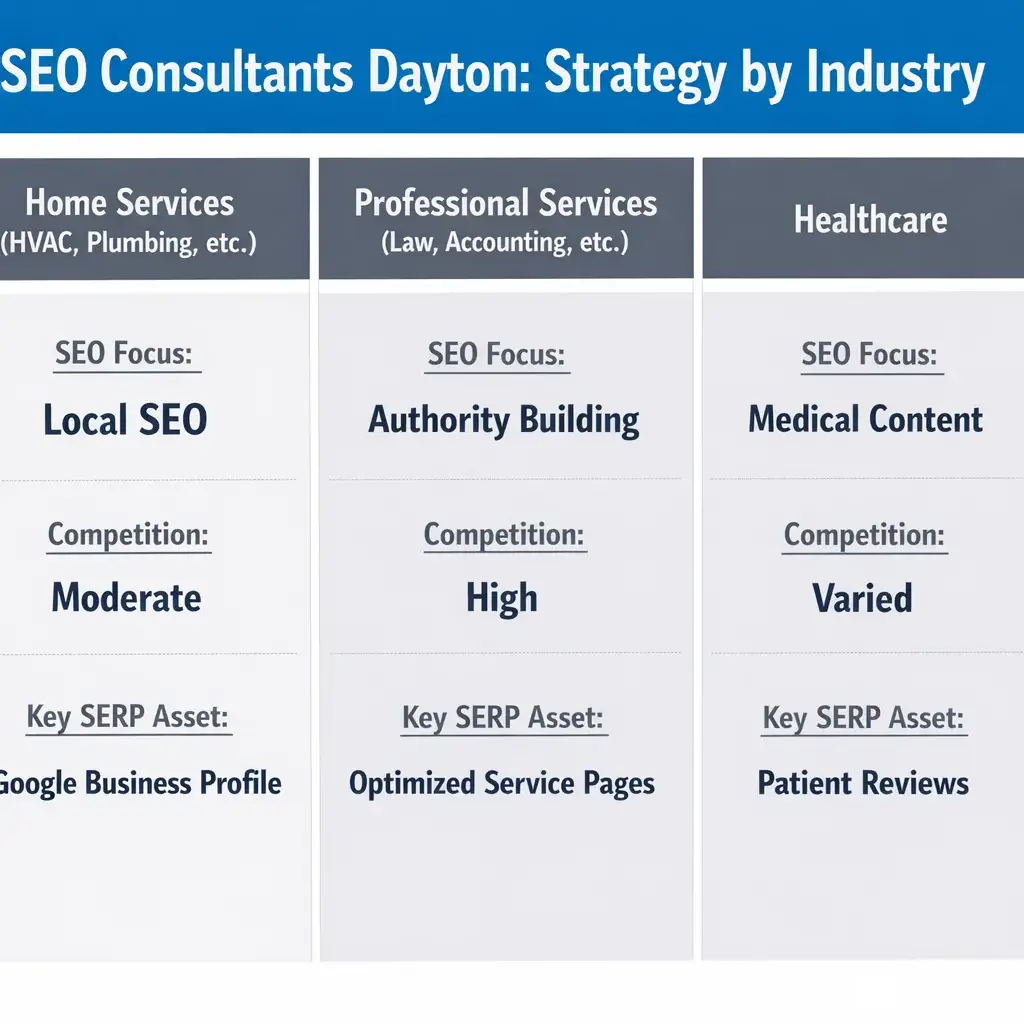
Illustration, not a photograph of a completed client project.
Consider the difference between a Dayton HVAC company and a Dayton commercial real estate attorney:
- The HVAC company competes for high-intent, emergency-driven keywords where local map pack visibility and fast page load speed on mobile are the dominant factors. Reviews and GBP recency matter more than content depth in this vertical.
- The commercial real estate attorney competes for lower-volume, higher-consideration keywords where content authority and trust signals like backlinks from legal directories and bar association resources carry more weight. The map pack is less dominant; long-form content and topical expertise are more important.
A strategy designed for one will not transfer to the other. The keyword sets, the content approach, the link targets, and the GBP optimization priorities are all different. This is not a complicated insight, but it is one that is almost never articulated in the Dayton SEO market, where the same standardized service menu is presented to every business regardless of vertical.
What to Evaluate When Choosing SEO Support in Dayton
Whether you are considering a full-service agency or an independent consultant, the diagnostic questions are the same. A provider who cannot answer these concretely is likely operating from a template rather than from analysis:
- Competitive baseline: What is the domain authority distribution among the top-ranking competitors for your target keywords, and where does your site currently sit relative to that range?
- GBP history review: Has anyone audited your Google Business Profile for duplicate listing history, ownership fragmentation, or prior suspensions before recommending optimization changes?
- Technical triage: Which technical issues on your site are actively suppressing rankings versus which are low-priority hygiene items? Not every technical problem has equal impact.
- Content gap identification: Where is your site’s content thin relative to the pages that currently rank above you, and what format of content would close that gap most efficiently?
- Link profile realism: What types of links are realistic to acquire for a Dayton business in your vertical, and what is the existing link profile of the competitors you need to surpass?
These questions do not have generic answers. They require looking at your specific site, your specific competitors, and the specific keyword landscape in your corner of the Dayton market. That is the starting point for work that actually moves rankings rather than work that generates reports.
If you are ready to move from activity to outcomes, contact Mongoose Digital Marketing for a direct conversation about where your Dayton business stands and what it would take to close the gap.
Frequently Asked Questions
How is an SEO consultant different from an SEO agency for a Dayton business?
The practical difference lies in what you are purchasing. An agency typically delivers a defined set of recurring tasks: monthly reports, link building quotas, content production schedules. A consultant’s primary function is diagnostic and strategic. The work starts with mapping why your current rankings are where they are, identifying which variables are suppressing improvement, and sequencing tactics in the order that produces the most leverage given your specific starting point. For some Dayton businesses, the right answer after a diagnostic is to engage ongoing execution. For others, the highest-value work is a clear strategy that internal staff or specialists can then implement. The consulting relationship is defined by decision logic, not deliverable volume.
Why does Google Business Profile optimization carry risks that most agencies do not mention?
Google’s automated enforcement systems flag profiles based on backend data patterns, not on the business owner’s intent or the legitimacy of the business. When a Dayton business changes an address, initiates an ownership transfer, or triggers a process that surfaces duplicate profile history, the automated system can interpret that activity as deceptive even when the business is operating entirely within Google’s guidelines. Documented cases in Google’s own support forums show that legitimate Ohio businesses have had profiles suspended after routine changes, with appeals denied. In one documented case from Huber Heights, a business reported: “We moved one of our locations to a new address in February. When moving the Business Profile listing to the new address, it suspended the profile. I was able to appeal the suspension… My suspension was denied and I am now unable to appeal again.” (https://support.google.com/business/thread/267605195/) The risk is real, it is not disclosed in standard agency service menus, and the consequence of a suspension that cannot be reversed through the appeals process is the loss of map pack visibility that may be generating a significant portion of a business’s inbound leads.
Does the right SEO strategy really differ that much between Dayton industries?
Yes, and the difference is not superficial. The variables that determine which tactics produce the most leverage shift meaningfully by industry. A home services business competing for emergency-intent keywords in Dayton depends heavily on Google Business Profile visibility, mobile page speed, and review recency. A professional services firm competing for consideration-stage queries depends more on content depth, topical authority, and trust signals from industry-relevant sources. The keyword volumes, the content formats, the link targets, and the GBP optimization priorities are all different. A strategy built for one vertical will not transfer to another without producing misdirected effort and slower results.
What should a Dayton business owner ask before engaging any SEO provider?
The most revealing questions are the ones that require analysis rather than general claims. Ask where your domain authority currently sits relative to the top-ranking competitors for your target keywords. Ask whether anyone has audited your Google Business Profile for duplicate listing history before recommending optimization. Ask which technical issues on your site are actively suppressing rankings versus which are low-priority items with minimal ranking impact. Ask what a realistic link profile looks like for a business in your specific vertical and what the gap is between your current profile and those of the competitors above you. If the answers are specific and grounded in your actual site and competitive landscape, the provider is working from analysis. If the answers are general claims about process and experience, they are working from a template.
Conclusion
SEO consulting in Dayton is ultimately a decision about whether the work you are funding is connected to the specific variables that explain your current rankings, or whether it is a generic execution plan that could have been built for any business in any market. The Miami Valley is a competitive, vertically diverse market where the gap between those two approaches shows up in results over time.
The businesses that build durable search visibility in Dayton do so because someone applied diagnostic thinking before executional effort: understanding the technical foundation before building links, verifying Google Business Profile stability before optimizing it, and identifying the keyword segments where the competitive gap is actually closable given current domain authority. That sequence is not a secret. It is simply the work that most service menus skip over.
If what you need is clarity on where your Dayton business stands and what it would actually take to move your rankings forward, contact Mongoose Digital Marketing to start that conversation.