Key Takeaways
- Google Ads puts a roofing company at the top of search results within 24 to 48 hours but stops generating leads the moment the budget runs out, while SEO builds compounding organic visibility that continues producing leads without paying per click.
- Roofing is one of the most expensive Google Ads niches in home services, with branded search campaigns delivering significantly lower cost-per-lead than non-branded search, meaning a company’s SEO-driven brand recognition directly reduces future paid ad costs.
- The Google Local Map Pack captures roughly 42% of all local clicks and cannot be purchased through ads; it is earned exclusively through SEO work including reviews, citations, and Google Business Profile optimization.
- SEO leads in roofing tend to carry higher close rates than paid leads, which means cost-per-lead comparisons between the two channels understate SEO’s true economic advantage when measured through to signed contracts.
- For most roofing companies in mid-size markets, the right answer is a sequenced strategy: Google Ads to generate immediate leads while SEO infrastructure is being built, with budget weight shifting toward organic as rankings and brand search volume grow.
For roofing companies in the Dayton area, the Google Ads vs. SEO decision comes down to two different questions: how fast do you need leads, and how long do you plan to be in business. This article breaks down how each channel actually works, what the benchmark data shows about performance differences between campaign types, and the three strategic relationships between the channels that most marketing content never explains.
How Each Channel Works and What It Cannot Do
Before comparing cost or performance, it helps to be clear about the structural difference between the two channels.
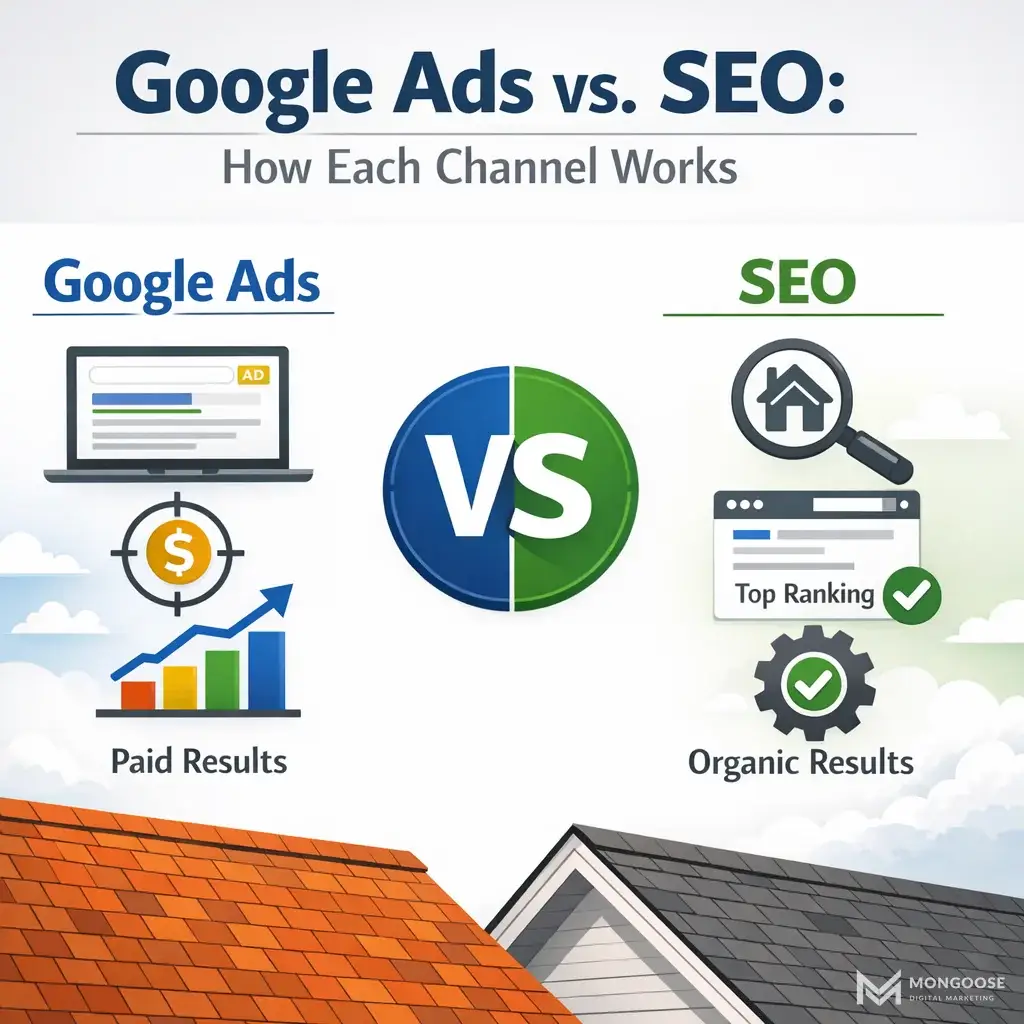
Google Ads is an auction. You bid on keywords, your ad appears at the top of search results, and you pay each time someone clicks. The moment your budget runs out or your campaign pauses, the visibility disappears. That immediacy is both the strength and the limitation.
SEO is an investment in search engine trust. You build pages that target specific search terms, earn authority through backlinks and local citations, optimize your Google Business Profile, and accumulate reviews. Google gradually increases your ranking as it determines your site is the most relevant, credible answer for a searcher’s query. The timeline is longer but the results do not disappear when you stop writing a check.
The map pack sits at the intersection of both: it appears at the top of local results, above most organic listings, and captures a large share of clicks from homeowners looking for a roofer nearby. That placement is earned through SEO, not purchased through ads. A well-optimized Google Business Profile with consistent citations and strong reviews is the path to that real estate, and no ad budget substitutes for it. (resonatingbrands.com)
Illustration, not a photograph of a completed client project.
What Google Ads Delivers That SEO Cannot
For a roofing company that needs calls this week, Google Ads is the only digital channel that delivers that speed. There are specific situations where paid search is not just useful but structurally superior:
Storm and emergency demand. When a severe weather event moves through the Miami Valley and homeowners start searching urgently for roof repair, that demand is time-compressed and location-specific. SEO cannot respond to it in real time. A roofing company with campaigns ready to scale spend quickly will appear at the top of those searches within hours. Organic rankings, no matter how strong, cannot pivot that fast. (resonatingbrands.com)
Keyword-level targeting. Paid search lets you buy visibility on the exact terms that signal purchase intent, whether that is roof replacement for a specific city or emergency roof leak repair. You control which searches trigger your ads, which searches do not, and how much each category of intent is worth to you.
Data for strategy. A well-run Google Ads campaign tells you which keywords produce calls, which landing pages convert, and what your cost-per-lead looks like across campaign types. That data directly informs SEO content decisions.
What SEO Delivers That Google Ads Cannot
Organic search generates leads that arrive without a per-click invoice. Once a page ranks for a high-intent term like “roof replacement Dayton OH,” every call from that ranking costs nothing in media spend. That structural advantage compounds over time.
Research cited by resonatingbrands.com indicates that 94% of users prefer organic listings over paid results, suggesting that homeowners who find a roofing company through organic search have already assigned some credibility before they make contact. Those leads tend to carry higher close rates, which matters more than it initially appears. If two channels deliver the same number of leads but one closes at a higher rate, the cost-per-signed-contract is different even if the cost-per-lead looks comparable on a spreadsheet.
The map pack reinforces this dynamic. Homeowners searching “roofer near me” in Kettering or Beavercreek see the map pack before they see organic listings or paid ads in many queries. That placement is owned, not rented, and it compounds in value as the Google Business Profile ages and accumulates reviews. For a deeper look at how to build and sustain that kind of visibility, the article on local SEO for roofing companies covers the full process from profile optimization to citation building.
Have a question about roofing company google ads vs seo? Send a message with the situation you are working through and the decision you need help with. Ask for a written explanation of possible next steps.
The Campaign Type Data Most Roofing Owners Never See
One of the most useful pieces of information in the Google Ads comparison is the performance difference between campaign types, specifically between branded and non-branded search. These are not minor variations.
According to SearchLight data tracking significant non-branded Google Ads spend across roofing contractors in Q1 2026, the cost-per-lead difference between branded and non-branded campaigns is substantial, with branded search delivering a dramatically higher return on ad spend. (webtonic.io)
| Campaign Type | Relative CPL | Key Characteristic |
|---|---|---|
| Non-Branded Search | Highest CPL | Broad audience targeting; highest spend share |
| Performance Max | Mid-range CPL | AI-managed; awareness and conversion mix |
| Local Services Ads (LSA) | Mid-range CPL | Pay-per-verified-lead; Google Guaranteed badge |
| Branded Search | Lowest CPL | Searchers already know your company name |
Non-branded search accounted for 89% of total roofing Google Ads spend in Q1 2026, confirming it is the primary acquisition channel despite higher per-lead costs. Branded search, by contrast, delivers the lowest cost-per-lead and the strongest return on ad spend of any Google Ads campaign type for established roofing companies. (webtonic.io)
The strategic implication that most content on this topic fails to draw out: the volume of branded searches in your market is a function of brand recognition, which is built through SEO and content, not through paid ads. A roofing company that invests in organic visibility is simultaneously increasing the pool of searchers who look up the company by name. When that pool grows, branded search campaigns become more efficient, lowering overall paid acquisition costs. The two channels are not independent: SEO investment directly reduces what a roofing company pays in its Google Ads account over time as branded search volume grows.
This is the feedback loop that changes the ROI calculation for both channels when you look at them together rather than separately.
The Website as Shared Infrastructure
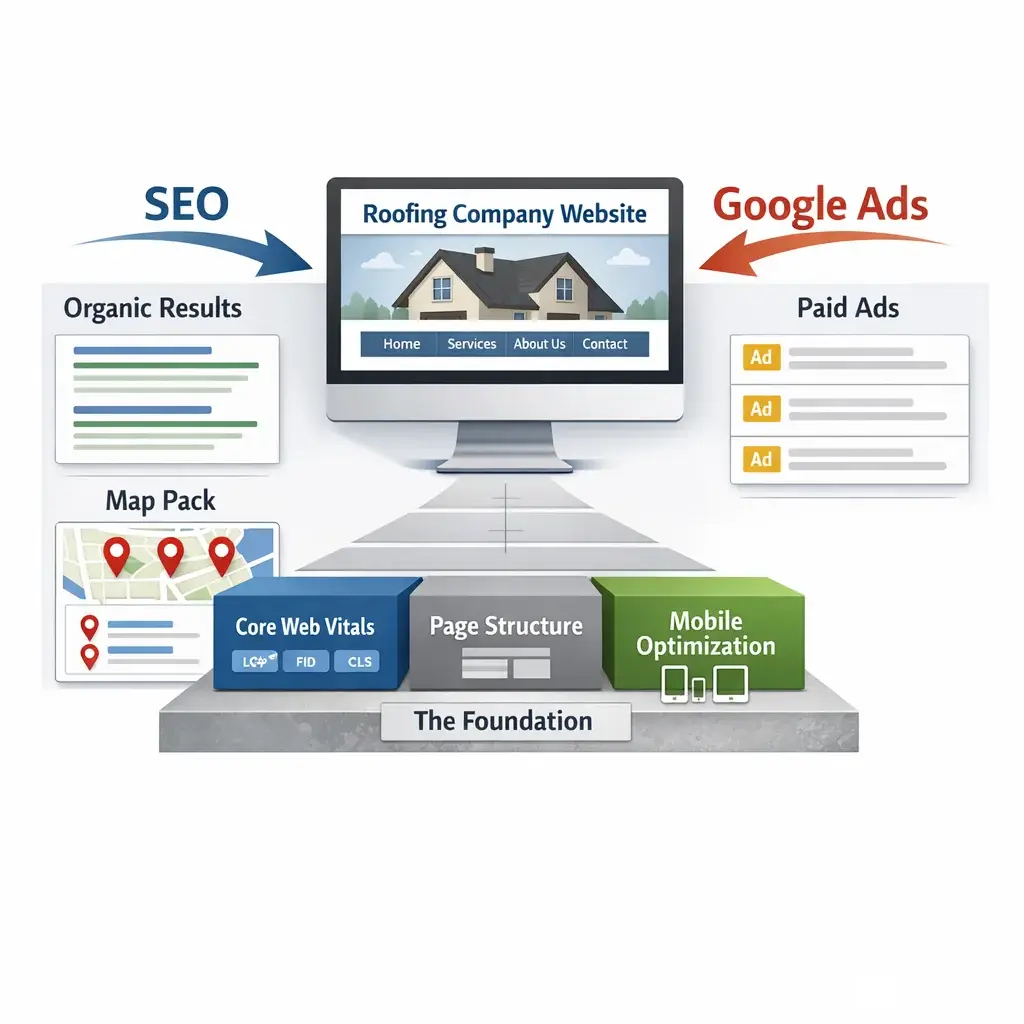
Most marketing discussions treat SEO and Google Ads as separate channels that happen to share the same general topic. The more accurate framing is that they share the same underlying infrastructure: the website.
Google’s Quality Score, which determines both where your ads appear and what you pay per click, is partially determined by landing page experience. A slow website, thin content, or poor mobile performance does not just suppress organic rankings. It actively raises cost-per-click by lowering Quality Score, which means worse ad placement at higher cost.
The technical SEO work that improves organic rankings, specifically Core Web Vitals compliance, mobile optimization, structured page architecture, and fast load times, simultaneously improves Quality Score for paid campaigns. A roofing company in Springboro or Miamisburg that invests in a technically sound, well-structured website is not doing two separate tasks when they optimize for SEO and prepare for ads. They are improving one shared asset that determines the performance ceiling of both channels. (pushleads.com)
This is not a minor optimization point. The spread between a well-managed roofing Google Ads account and a poorly managed one is substantial, and landing page quality and Quality Score are primary factors in that gap. (resonatingbrands.com)
Illustration, not a photograph of a completed client project.
The True Cost Comparison Requires Looking Past Cost-Per-Lead
Every published comparison between roofing SEO and Google Ads anchors on cost-per-lead as the definitive metric. It is a useful starting point but an incomplete endpoint.
Three factors consistently distort the CPL comparison in favor of paid ads when they should not:
Close rate differential. SEO leads in roofing tend to involve homeowners who have researched options, read reviews, and chosen to contact a specific company. That pre-qualification means higher close rates. A lead that costs more to acquire but closes at a higher rate can produce a lower cost-per-signed-contract than a cheaper lead that closes less often. (roofingroi.net)
Click fraud. Roughly 11 to 14% of Google Ads clicks are fraudulent based on independent analysis cited by resonatingbrands.com. Those clicks cost real money and produce no leads. That waste is embedded in every CPL figure for paid search but rarely disclosed in the comparison.
The unit problem. A contact form submission, a phone call, a booked appointment, and a signed contract are different units. When evaluating lead source performance, the only metric that connects directly to revenue is cost-per-collected-job. As ghostrep.ai notes in its roofing lead cost analysis, CPL and cost-per-sold-roof are entirely different units, and treating them as equivalent understates how much more expensive paid leads actually are when measured through to closed revenue. (ghostrep.ai)
This does not mean Google Ads is a poor investment. It means the comparison is more favorable to SEO than cost-per-lead figures alone suggest, and that roofing companies who rely only on CPL to make channel decisions are systematically underestimating the economic case for organic search. The article on roofing leads without paid ads goes deeper on how organic systems can sustain lead flow independent of ad spend.
The Sequencing Question: How to Actually Allocate Between Channels
Most content on this topic concludes with “run both channels together” and stops there. That recommendation is correct but not useful without a framework for how to sequence and weight the two channels.
A practical approach for most roofing companies looks like this:
Phase 1 (months 1 to 3): Google Ads provides immediate lead flow while the SEO foundation is being built. This includes technical site work, page structure, Google Business Profile optimization, and initial content. The ads are not a substitute for SEO; they are a bridge that keeps the pipeline full during the organic ramp-up period.
Phase 2 (months 3 to 6): SEO begins producing measurable ranking movement. The map pack becomes a focus as the Google Business Profile accumulates reviews and citation consistency improves. Google Ads remains active but keyword targeting begins to reflect data from organic performance.
Phase 3 (months 6 and beyond): As organic rankings stabilize and branded search volume grows, the cost efficiency of branded paid campaigns improves. Budget weight can shift toward sustaining SEO and running leaner branded paid campaigns rather than aggressive non-branded spend. The two channels begin reinforcing each other rather than operating in parallel.
The timeline for organic traction varies by market. Smaller Ohio markets with less competitive roofing landscapes move faster. Larger metros take longer. The variables that shorten or lengthen the SEO timeline include existing domain authority, content gap size relative to competing sites, citation consistency across local directories, and the quality and quantity of Google reviews compared to competitors. (pushleads.com)
For roofing companies serving Dayton, Kettering, Huber Heights, Centerville, and the surrounding Miami Valley communities, the channel mix and timeline should reflect the actual competitive density of that market, not a generic national average. Understanding how Google rankings work in Dayton is a useful starting point for calibrating those expectations accurately.
If you want a clear-eyed assessment of where your roofing company stands in organic search and what a combined strategy should look like for your specific market, contact Mongoose Digital Marketing for a free consultation.
Frequently Asked Questions
How long does it take for roofing SEO to start producing leads in the Dayton area?
Most roofing companies in mid-size Ohio markets see measurable ranking movement within the first three months of consistent SEO work, with page-one visibility for competitive terms typically arriving between six and twelve months. Markets like Dayton, Kettering, and the surrounding Miami Valley communities generally fall in the mid-range of that timeline. Factors that accelerate results include an existing domain with some age and authority, a fully optimized Google Business Profile, consistent citation data across local directories, and a review count that is competitive with other roofing companies already ranking in the map pack.
Can a roofing company run Google Ads and SEO at the same time, or does one interfere with the other?
The two channels do not interfere with each other, and in practice they reinforce each other when managed as a combined strategy. The technical SEO work that improves organic rankings, specifically page speed, mobile performance, and site structure, also improves Google’s Quality Score for paid campaigns, which affects both ad placement and cost-per-click. Running both channels simultaneously also allows Google Ads data, specifically which keywords produce actual calls, to inform which pages and terms the SEO strategy should prioritize.
Why do branded search campaigns on Google Ads produce lower costs than non-branded campaigns?
Branded search captures homeowners who have already encountered the company name and are searching for it directly. That prior awareness means the searcher has already made a preliminary trust decision before clicking. The result is a higher conversion rate from click to contact, which produces a lower cost-per-lead compared to non-branded campaigns targeting searchers who have no prior exposure to the company. Brand recognition is built over time through organic visibility, reviews, and content, which is why SEO investment directly influences the efficiency of a company’s paid campaigns as branded search volume grows.
Is the Google Local Map Pack the same as a paid Google Ad?
No. The map pack and paid search ads are separate placements governed by entirely different systems. Paid ads are purchased through Google’s auction and appear above the map pack in many queries. The map pack itself cannot be purchased. Placement there is determined by Google’s assessment of the Google Business Profile, the consistency and volume of local citations, the quantity and quality of reviews, and the overall authority of the associated website. No ad budget substitutes for that work, which is why strong map pack visibility is exclusively an outcome of SEO rather than paid advertising.
Conclusion
For roofing companies serving Dayton and the surrounding Miami Valley, the Google Ads versus SEO question is ultimately a question about time horizon and how the two channels interact as a business grows.
Google Ads delivers speed that organic search cannot match, and there are specific scenarios, storm response, new market entry, filling gaps during slow periods, where that speed is not just useful but necessary. SEO builds something that paid advertising cannot purchase: compounding organic visibility, map pack placement, and a growing pool of homeowners who search for a company by name, which in turn makes paid campaigns more efficient.
The channels are not rivals. The website that earns organic rankings is the same website that determines paid ad quality. The brand recognition that SEO builds is the same recognition that lowers branded search costs in Google Ads. Understanding that relationship changes how the return on each channel should be measured, and how budget decisions should be made over time.
For roofing companies in Dayton, Kettering, Beavercreek, Centerville, Huber Heights, Miamisburg, Springboro, and the broader Miami Valley area who want a clear picture of where they currently stand in local search and what a combined strategy should look like for their specific market, contact Mongoose Digital Marketing to start the conversation.