Key Takeaways
- Google Business Profile proximity to the searcher is the dominant Map Pack ranking factor, meaning a roofing company must actively build location-verified signals in each suburb it serves, not just optimize its primary listing.
- A service area page only earns its ranking when it can demonstrate genuine, location-specific proof of work: geo-tagged photos, local reviews, and neighborhood references tied to real completed jobs.
- Roofing homeowners move through at least four distinct search stages (symptom, diagnosis, provider, validation), and each stage requires different content architecture to capture and convert that traffic.
- Online reviews in roofing carry outsized weight not because of volume alone, but because of the specific trust signals they contain: mentions of workmanship quality, cleanup, communication, and whether the company honored its commitments.
- Legitimate roofing companies expanding into new service areas must frontload permanence signals in their SEO strategy to avoid triggering homeowner distrust and Google scrutiny of thin location pages.
Roofing is one of the highest-value, highest-stakes service categories in local search. When a homeowner in Dayton or Beavercreek needs a new roof, they are typically looking at a significant purchase decision with real consequences if they choose the wrong contractor. That dynamic shapes everything about how local SEO works for roofing companies: the competition is intense, the trust bar is high, and the organic ranking factors that matter most are not the same as they are for lower-stakes service businesses. Getting local SEO right in this space means understanding the mechanics behind the tactics, not just the tactics themselves.
Why Roofing Local SEO Works Differently Than Other Trades
Most service businesses benefit from straightforward local SEO: optimize your Google Business Profile, build some citations, get reviews, and rank. Roofing is more complex for two structural reasons.
First, roofing searches carry a disproportionately high level of homeowner skepticism. The industry’s history with storm chasers and transient contractors means that homeowners serving the Dayton metro, whether they are in Centerville, Huber Heights, or Miamisburg, actively look for reasons to disqualify a roofing company before they ever call. Every SEO touchpoint, your GBP listing, your homepage, your service pages, even your FAQ content, needs to be architected around eliminating those disqualifying doubts, not simply showcasing capabilities.
Second, roofing is a geographically dispersed service. Unlike a restaurant or retail shop where customers come to you, roofers go to the customer. This creates an inherent tension between where your business is physically located and where you need to rank. Understanding how Google resolves that tension is the foundation of an effective local SEO strategy.
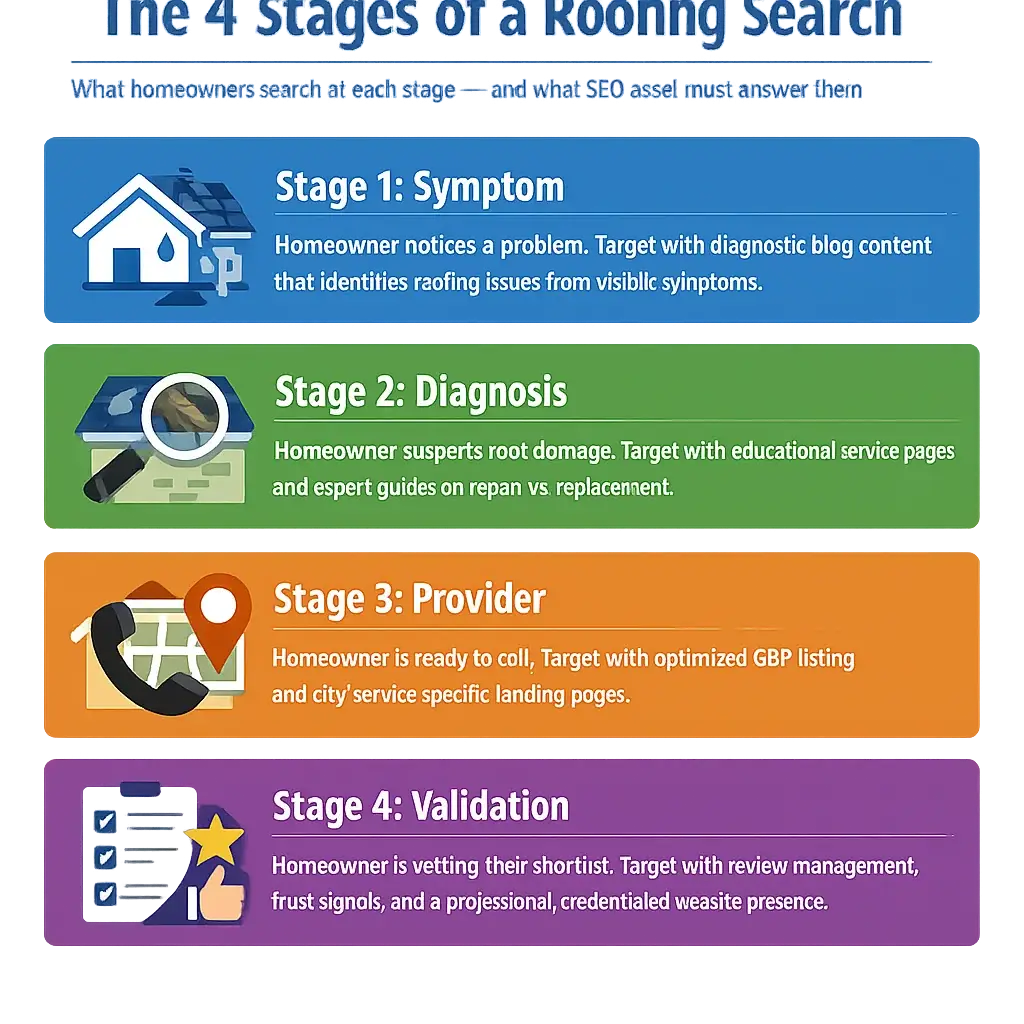
The Four Stages of a Roofing Search and Why They Require Different Content
Most keyword guides for roofing SEO split search intent into two buckets: buying intent and research intent. That binary is too simple. Roofing searches follow a more nuanced four-stage funnel, and each stage requires a distinct content approach.
Stage 1: Symptom searches. The homeowner notices a problem but has not yet identified it as a roofing issue. Searches like “ceiling water stain” or “roof leaking after heavy rain” fall here. Content targeting these searches should diagnose the symptom and establish your company as a knowledgeable resource.
Stage 2: Diagnosis searches. The homeowner suspects a roofing problem and wants to understand scope. Searches like “how to tell if roof needs replacement” or “roof damage after storm” are common here. Educational content with genuine roofing expertise performs strongly at this stage.
Stage 3: Provider searches. The homeowner is ready to contact contractors. “Roofing contractor Dayton OH,” “roof replacement Kettering,” and “emergency roofer near me” are classic provider-intent queries. This is where your service pages and GBP listing do the heavy lifting.
Stage 4: Validation searches. The homeowner has a shortlist and is vetting each contractor before committing. Searches like “[company name] reviews” or “best roofing companies Springboro OH” are common. At this stage, review content, BBB standing, and your website’s credibility signals close the deal or lose it.
A roofing company that only optimizes for Stage 3 leaves Stages 1, 2, and 4 entirely to competitors. The companies that dominate local search in the Dayton market are the ones that have content assets working at every stage.
Need a hand with this in Dayton, Kettering and the Triad? Call (937) 848-0086 or request a free estimate. Honest answers, no pressure.
Google Business Profile: The Mechanics Behind the Tactics
Every local SEO guide tells you to optimize your Google Business Profile. Very few explain why specific actions move the needle, so you end up with roofing companies uploading random photos without understanding what those photos actually do.
Proximity, Prominence, and Relevance
Google’s local ranking algorithm weighs three factors: proximity to the searcher, relevance of your listing to the search query, and prominence of your business online. Proximity is the factor most practitioners underestimate because it is largely outside your control in the traditional sense. If your roofing company’s physical address is in Dayton and a homeowner in Springboro searches “roofer near me,” you face a structural proximity disadvantage against a company physically located in Springboro.
This is not fatal, but it means your strategy in outlying suburbs must compensate through prominence and relevance signals. That is exactly what geo-tagged job photos accomplish when used correctly. When you photograph a completed job in Centerville, embed the GPS coordinates in the image metadata, and upload it to your GBP, you are providing Google with location evidence that your business actively operates in that area. This partially compensates for the proximity gap between your office address and that suburb.
The same logic applies to Google Posts. Consistent posting about completed jobs in specific communities, using neighborhood-level language, sends relevance signals that reinforce your service area claims. For a deeper look at how these local SEO optimization signals interact with Google’s ranking criteria, the mechanics extend well beyond the GBP itself.
What Your GBP Must Accomplish Beyond Basic Setup
GBP optimization for a roofing company is not a one-time task. It is an ongoing content channel. The listing elements that consistently influence local rankings include:
- Primary and secondary categories: “Roofing Contractor” as primary is standard, but secondary categories like “Roof Repair Service” and “Gutter Cleaning Service” expand your query coverage.
- Services section: Every service you offer, from full roof replacement to storm damage inspection, should be listed with a description. Google uses this content for relevance matching.
- Photo recency and volume: Google indexes photo upload dates. A steady cadence of new job photos (multiple per week during active seasons) signals an active, legitimate business. Stale photo libraries from three years ago underperform against competitors uploading fresh content regularly.
- Q&A section: You can seed your own questions and answers here. Use the validation-stage questions homeowners actually ask: “Are you licensed and insured in Ohio?” “Do you handle insurance claims?” “Do you offer a workmanship warranty?” These directly address disqualifying doubts.
- Review response quality: Responding to every review, not just the negative ones, demonstrates engagement. Responses that naturally incorporate service and location terms also carry secondary relevance signals.
The Trust Deficit as a Strategic Opportunity
The roofing industry’s reputation problem is well documented. Storm chasers and fly-by-night operators have conditioned homeowners in markets like Dayton and the surrounding communities to be skeptical by default. Most local SEO strategies treat this as a reputation management problem. It is actually a content architecture opportunity.
If you map the specific doubts a homeowner in Beavercreek or Miamisburg has when evaluating a roofing company, you can design your entire digital presence to answer those doubts in sequence. The doubts are predictable:
- Is this a local company with a permanent presence, or will they disappear after taking my money?
- Are they licensed and insured in Ohio?
- Do other people in my area vouch for their work?
- Will they handle the insurance claim process, or leave that burden on me?
- What happens if something goes wrong after the job is done?
Each of these doubts corresponds to a specific SEO asset and on-page element. License numbers displayed prominently on service pages address doubt two. Local reviews that mention specific neighborhoods address doubt three. A detailed warranty page addresses doubt five. When you align your content strategy with this verification sequence, you are not just building SEO assets, you are guiding homeowners through their natural evaluation process and reducing the friction at every stage.
| Homeowner Doubt | SEO Asset That Addresses It | Specific On-Page Element |
|---|---|---|
| Is this a legitimate local company? | GBP listing, Homepage | Local address, local phone number, Google Maps embed, years in business |
| Are they licensed and insured? | Service pages, Footer | Ohio contractor license number, insurance provider statement |
| Do locals vouch for them? | GBP reviews, Service area pages | Reviews mentioning specific neighborhoods, city-specific testimonials |
| Will they handle my insurance claim? | Dedicated service page | Step-by-step claim process content, insurance company experience |
| What if something goes wrong? | Warranty page, Homepage | Manufacturer warranty details, workmanship guarantee language |
Service Area Pages: Prioritization Before Content
The standard advice on service area pages (SAPs) is to create them for each suburb you serve and make the content unique. That advice skips the harder question: which suburbs earn a page, and in what order?
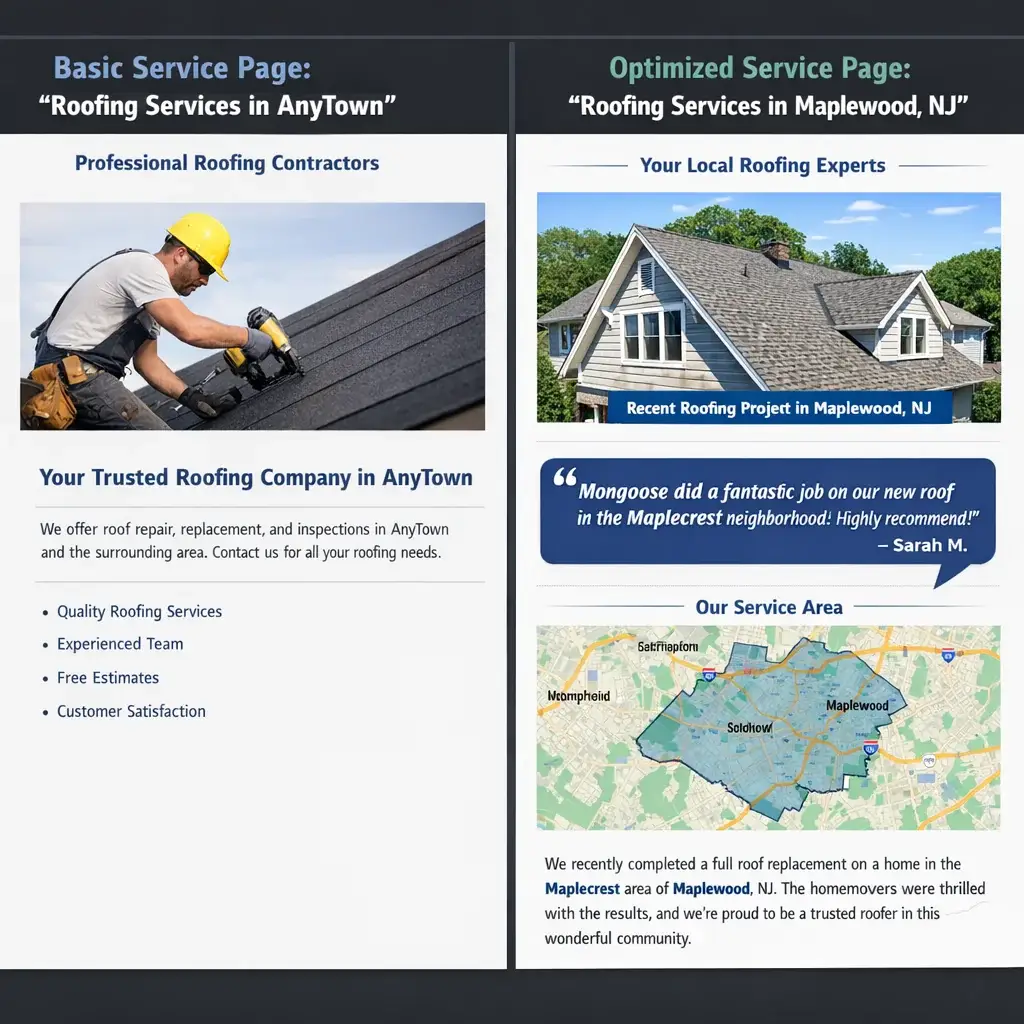
Creating SAPs speculatively, before you have actually served a market, is the fastest way to produce exactly the thin, city-swapped content that performs poorly and that Google has become increasingly effective at identifying. The underlying reason is that a well-performing SAP for a suburb like Kettering or Huber Heights needs location-verified proof of work to justify its existence. That means:
- Geo-tagged photos of completed jobs in that suburb
- Reviews that mention the specific neighborhood or city by name
- References to local landmarks, subdivisions, or community touchpoints that a company with genuine local experience would naturally include
A roofing company that has never done a job in Springboro cannot produce that content authentically, and generic content without those elements will not outrank a competitor who can.
The practical prioritization framework is straightforward: build SAPs in order of demonstrated service activity. If your job history shows thirty completed projects in Kettering, ten in Beavercreek, and two in Springboro, that is the order in which those pages should be built. Each page should be published only when you can supply the location-verified proof of work that gives it ranking potential.
What Genuinely Unique SAP Content Looks Like
Beyond photos and reviews, a service area page for a Dayton-area suburb should include:
- Neighborhoods and subdivisions within that city where you have completed work
- Any community involvement or local partnerships relevant to that area
- Service-specific content relevant to that community’s housing patterns, where you have direct job experience to draw from
- A locally-specific call to action with a local or trackable phone number
Review Strategy: Signal Quality Over Volume
Review volume matters, but it is a surface metric. What Google and homeowners actually evaluate is review content quality, specifically what those reviews say and how they say it.
Roofing reviews that carry the most weight for both ranking and conversion contain specific language about the experience: the crew’s professionalism, how cleanup was handled, whether the company managed the insurance claim, how long the roof has held up, and whether the company was easy to reach. A roofing company with forty reviews that collectively mention “communication,” “cleanup,” “insurance claim,” and “years later still no leaks” outperforms a competitor with eighty reviews that only say “great service, highly recommend.”
The practical implication is that your review acquisition process should prompt customers to share the specifics of their experience, not just their overall satisfaction. A follow-up message that asks “Would you mention what the crew did well and how the roof looks now?” produces richer reviews than one that simply asks for a star rating.
Review recency also matters. A steady cadence of new reviews signals an actively operating business. For a roofing company serving Dayton, Kettering, Beavercreek, Centerville, Huber Heights, Miamisburg, and Springboro, the goal is consistent acquisition across all service areas, not periodic bursts after a busy season.
Single-Location vs. Multi-Location SEO: The Third Pattern
The standard framework for roofing SEO distinguishes between single-location companies (one office, SAPs for surrounding suburbs) and multi-location companies (multiple offices, location-specific pages per market). Both are well-covered in most guides.
What those guides miss is the third pattern common in roofing: the legitimate company that expands into new markets following significant storm activity. This is structurally different from the storm-chaser scenario, but it looks similar to Google if the SEO strategy is not handled correctly.
When a roofing company from Dayton establishes a temporary presence in a new market, the very signals that prove legitimacy, a local address, a local phone number, established community presence, consistent NAP data across directories, take time to build. Expanding too quickly without those signals produces thin location pages that appear speculative, regardless of the company’s actual capabilities.
The strategic rule that follows: the faster a roofing company expands its service area, the more aggressively it must frontload permanence signals. That means establishing a verifiable local address before building location pages, acquiring local reviews in the new market before publishing that SAP, and maintaining consistent NAP data across every directory from day one of operating in that market. The SEO timeline in new markets should follow the business timeline, not precede it. Understanding what local SEO companies won’t tell you about rankings can help roofing companies avoid the most common mistakes when entering new markets.
For roofing companies in the Dayton area, the local SEO landscape rewards precision over volume. More pages do not outperform better pages. More reviews do not outperform more relevant reviews. And a fully optimized GBP does not compensate for the absence of genuine location-verified presence in the suburbs where your customers actually live. The companies that consistently win in local search are the ones that have aligned their SEO strategy with how homeowners actually evaluate and select a roofing contractor. That alignment is where measurable results come from. If you want a clear picture of where your current presence stands and where the gaps are, Mongoose Digital Marketing offers a free consultation to map exactly that.
Frequently Asked Questions
How long does it typically take for local SEO to produce results for a roofing company?
Most roofing companies begin to see measurable movement in local rankings within three to six months of consistent, well-structured effort. That window assumes a properly optimized Google Business Profile, accurate NAP data across directories, and location-relevant content on the website. Competitive markets and companies starting with significant gaps in their presence may take longer. The timeline is not arbitrary, it reflects how long it takes Google to accumulate enough consistent signals to trust a business’s local relevance.
Does a roofing company need a separate page for every city it serves?
Not necessarily, and in many cases, creating pages for every surrounding city does more harm than good. A location page earns its place when it reflects genuine business activity in that area, local reviews, verifiable presence, and content that addresses conditions specific to that community. Thin pages created simply to claim geographic coverage tend to dilute a site’s overall authority rather than expand it. Quality and specificity matter more than volume.
Why does Google Business Profile matter more than the company website for local roofing searches?
For searches with local intent, terms like “roofing contractor near me” or “roof repair in Beavercreek”, Google prioritizes its own local results, meaning the map pack, above traditional organic listings. A homeowner searching for help after a storm is far more likely to engage with a GBP listing than to scroll past the map results to find a website. The website supports and reinforces the GBP, but in most roofing-related local searches, the GBP is the first and sometimes only touchpoint a potential customer encounters.
How do online reviews actually affect local search rankings for roofers?
Reviews influence local rankings in two distinct ways. First, they contribute directly to how Google evaluates a business’s prominence and trustworthiness within a geographic area. Second, the language homeowners use in reviews, mentioning neighborhoods, describing specific problems, referencing seasonal conditions, adds location-relevant context that reinforces a company’s connection to that market. Review velocity, meaning a steady and ongoing stream of new reviews, also signals to Google that a business is actively operating, which carries more weight than a large number of older reviews accumulated years ago.
Roofing companies in Dayton and Kettering are competing in a local search environment where the details of execution separate businesses that get calls from businesses that get overlooked. Mongoose Digital Marketing works specifically with contractors in this region and understands the search behavior, seasonal patterns, and competitive dynamics that shape how homeowners in these communities find and choose a roofer. To find out exactly where your current presence stands, reach out at (937) 848-0086 or Contact Mongoose Digital Marketing for a free consultation.