

Key Takeaways
- SEO strategy for Dayton businesses must account for the market’s distinct industry clusters — aerospace, healthcare, and manufacturing — which drive B2B buyer cycles that demand different content structures than consumer-facing local services.
- Ranking effectively across Greater Dayton requires a hub-and-spoke geo-content architecture that covers Montgomery, Greene, Warren, and Miami counties without duplicating thin city pages that Google actively discounts.
- The single most common reason Dayton SEO campaigns underperform is misaligned prioritization — applying content creation to sites with broken technical foundations, or chasing authority links when the real constraint is thin on-page relevance.
- Local pack visibility in Dayton depends on a combination of Google Business Profile signals, review velocity, citation consistency, and behavioral data — not GBP optimization alone.
- A genuine SEO strategy answers why specific tactics are chosen in a specific order; a service catalog answers only what will be done, and the difference determines whether you grow or stall.
Most SEO agencies serving Dayton will hand you a list of services. Keyword research. On-page optimization. Technical audits. Link building. Content writing. It reads like a menu, and like a menu, it tells you what’s available — not what you should actually order or why.
That distinction matters more than most business owners realize. Dayton is not a generic mid-sized American city from a search competition standpoint. It is a market shaped by Wright-Patterson Air Force Base, major healthcare networks like Kettering Health and Premier Health, a deep manufacturing and logistics infrastructure, and a metro footprint that spans Kettering, Beavercreek, Centerville, Huber Heights, Miamisburg, Springboro, and Troy. Each of those factors changes the shape of a winning SEO strategy. None of them show up in a service catalog.
This guide is built for Dayton business owners who want to understand what a real SEO strategy looks like — not just what gets done, but how decisions get made and why the sequence matters as much as the tactics themselves.
Why “SEO Services” and “SEO Strategy” Are Not the Same Thing
The SEO industry has a language problem. Agencies use the word “strategy” to mean “here are the services we provide.” A genuine SEO strategy is something different: it is a diagnostic and prioritization framework that determines which levers to pull, in what order, based on the specific competitive position of your business right now.
Consider two Dayton companies — a residential HVAC contractor based in Kettering and a defense supply chain consultant serving clients near Wright-Patterson. Both might hire an SEO agency and receive identical service line items. Both would get completely the wrong result, because the strategic inputs are entirely different.
The HVAC contractor needs to dominate the local pack for proximity-based, high-urgency queries. Their buyer decides in minutes. The defense consultant needs to appear in front of procurement managers and program officers conducting weeks-long research. Their buyer reads white papers before they ever fill out a contact form.
Same services. Entirely different strategies. The agency that cannot articulate that difference is selling execution, not strategy.
The Dayton Market Segmentation Framework for SEO
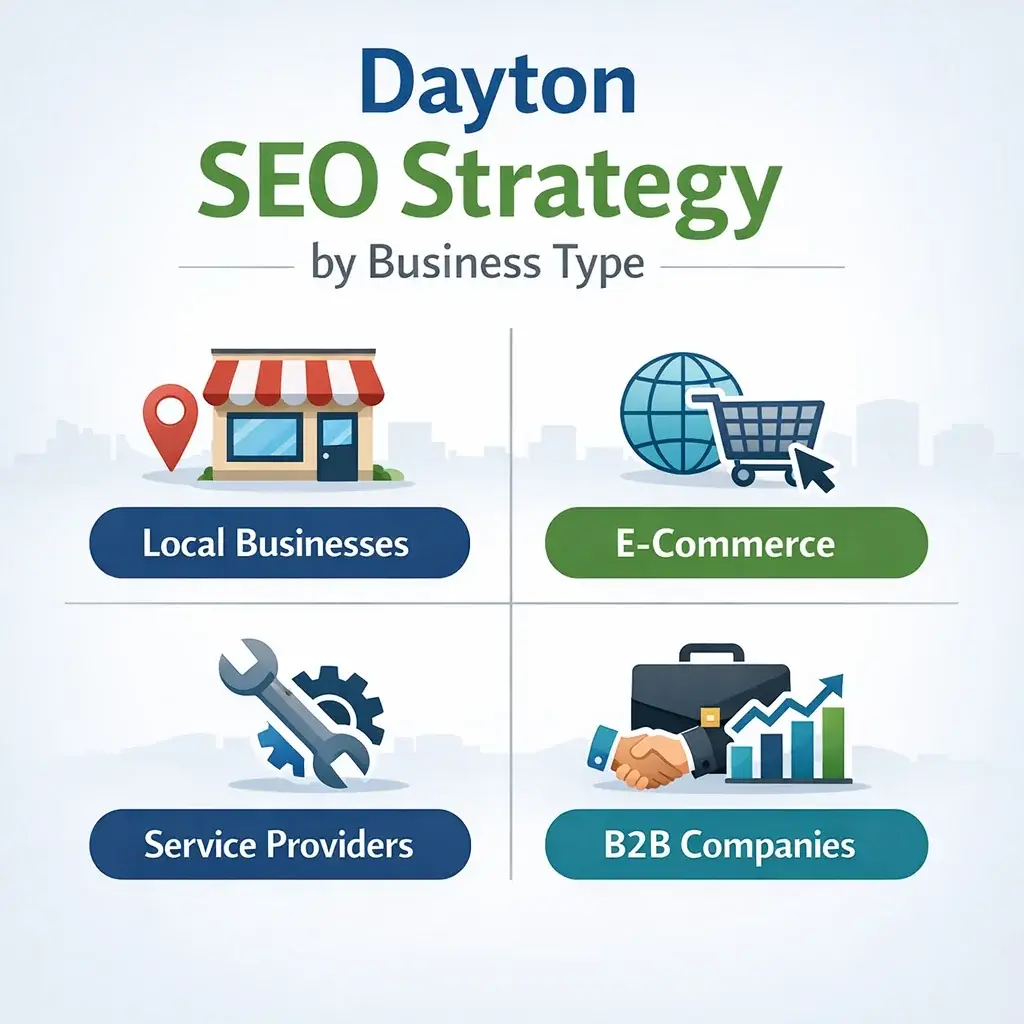
Before selecting a single tactic, a legitimate SEO strategy for a Dayton business starts with market segmentation. The Dayton metro is home to distinct business categories that each require a different strategic posture.
Consumer-Facing Local Businesses
This category includes home services, legal practices, medical and dental offices, and retail. The buyer is a local resident making relatively fast decisions. Search queries are proximity-driven and high-intent: “HVAC repair Kettering,” “dentist near Beavercreek,” “personal injury attorney Dayton.”
Strategic priorities:
– Local pack visibility through Google Business Profile signals
– Review velocity and sentiment management
– Service area page architecture covering the full Montgomery County region
– Citation consistency across directories
B2B Service Companies Tied to Dayton’s Industrial Base
Wright-Patterson AFB alone employs over 27,000 military and civilian personnel and generates substantial demand for defense contractors, engineering consultants, IT service providers, and logistics specialists. Kettering Health and Premier Health anchor a healthcare ecosystem that procures everything from staffing to medical device supply.
These buyers do not search like homeowners. They search like researchers. Queries are longer, more technical, and spread across weeks: “aerospace regulatory compliance consulting Ohio,” “ISO 9001 supplier Dayton,” “healthcare IT integration services.”
Strategic priorities:
– Informational and consideration-stage content targeting decision-maker research queries
– Thought leadership content that signals domain authority to both readers and Google
– Technical service pages with detailed scope-of-work specificity
– LinkedIn and organic search working in tandem for brand visibility
Regional Multi-Location and Retail Businesses
For businesses operating across multiple locations in the Greater Dayton metro — or retailers serving the broader Miami Valley — the strategic challenge is geographic coverage without content cannibalization.
Strategic priorities:
– Hub-and-spoke location page architecture (covered in detail below)
– Schema markup for multi-location businesses
– Consistent NAP data across all locations
– Category authority built on the core service or product pages
The Strategic Prioritization Model: Starting in the Right Place
The most expensive mistake a Dayton business can make is applying the right tactic to the wrong constraint. Most SEO campaigns that fail do not fail because the tactics were wrong in isolation — they fail because they were applied out of sequence.
Here is the triage model that determines which SEO lever to activate first:
Constraint #1: Weak Technical Foundation
Symptoms: Pages are not being indexed, load times are slow, crawl errors are present, mobile usability issues exist, duplicate content is diluting page authority.
Strategic response: Technical remediation before any new content investment. Adding content to a technically broken site is like filling a cracked bucket — the effort goes in, the results drain out. Crawl efficiency, Core Web Vitals, and indexation integrity are the floor, not a bonus. For a deeper look at what this process involves, the Technical SEO Services Dayton | Fix What’s Killing Rankings article breaks down exactly which technical issues cost Dayton businesses the most ranking ground.
Common Dayton scenario: Older business websites built on legacy platforms, especially common in manufacturing and professional services sectors that built their web presence before mobile-first indexing became Google’s standard.
Constraint #2: Clean Tech, Thin Content
Symptoms: The site is technically healthy. It crawls and indexes properly. But service pages are shallow — a paragraph of generic copy, no FAQ sections, no specificity about process, no address of the questions buyers actually ask before converting.
Strategic response: Targeted content expansion focused on bottom-of-funnel, high-commercial-intent queries first. “Dayton commercial HVAC maintenance contracts” converts at a far higher rate than “what is HVAC maintenance.” Prioritize revenue-adjacent content before educational content.
Common Dayton scenario: Professional services firms — attorneys, CPAs, consultants — that built a brochure-style website and have not updated service page content in years.
Constraint #3: Strong Content, Weak Authority
Symptoms: The site has well-written, comprehensive pages that accurately answer the queries they target. But rankings are stuck in positions 8–20 because the domain lacks inbound authority signals — few quality backlinks, minimal brand mentions, limited digital PR footprint.
Strategic response: Link acquisition and digital PR become the priority. This means pursuing genuine editorial placements, contributing to industry publications, earning local press coverage, and building relationships with adjacent businesses for legitimate cross-linking opportunities.
Common Dayton scenario: Newer professional service businesses or e-commerce companies that invested in strong site content early but have not built an off-site authority strategy.
Constraint #4: Brand New Site
Symptoms: No ranking history, minimal domain authority, no GBP reviews, sparse citations.
Strategic response: Local citation building and GBP optimization first. Target long-tail, low-competition queries in specific Dayton-area communities — “bookkeeping services Miamisburg,” “landscape design Springboro” — where competition is thinner. These early wins build foundational authority while broader keyword competitiveness is still out of reach.
| Business Situation | Primary Constraint | First Strategic Priority | Secondary Priority |
|---|---|---|---|
| Legacy site, no technical audit | Technical foundation | Crawl fixes, Core Web Vitals, mobile usability | On-page content refresh |
| Technically clean, thin pages | Content relevance | Bottom-of-funnel service page expansion | Local citation building |
| Strong content, stuck rankings | Domain authority | Link acquisition, digital PR | Content depth expansion |
| Brand new site | Trust and visibility | GBP optimization, citations, long-tail targets | Foundational service pages |
| Multi-location business | Geographic coverage | Hub-and-spoke geo architecture | Schema and structured data |
| B2B with long sales cycles | Funnel alignment | Informational content, consideration-stage pages | Thought leadership and off-site signals |
Local SEO in Dayton: What Actually Moves the Needle
The surface-level advice on local SEO — “claim your Google Business Profile and ask for reviews” — is not wrong, but it is incomplete in ways that cost Dayton businesses real ranking positions.
Understanding the Local Pack Ranking Factors
Google’s local pack is determined by three primary signal categories: relevance, distance, and prominence. Most agencies focus almost exclusively on relevance (GBP category selection, service descriptions) and ignore the more nuanced signals within prominence and the strategic implications of distance for a metro market like Dayton.
Relevance signals include:
– GBP primary and secondary category selections
– Service and product listings within GBP
– On-site content that mirrors the service language in GBP
– Keyword usage in review text (not solicited, but worth monitoring)
Distance signals create an important strategic reality for Dayton businesses: a business in downtown Dayton does not automatically rank in the Kettering local pack, even if they actively serve Kettering customers. This is not a problem to complain about — it is a problem to solve architecturally, through service area pages, satellite office strategies, and geo-targeted content.
Prominence signals include:
– Inbound link authority from locally relevant domains
– Review volume, recency, and response rate
– Citation consistency across aggregators (Yelp, BBB, Angi, industry directories)
– Behavioral signals: click-through rate from search results, direction requests, phone calls through GBP
“Near Me” vs. Geo-Modified Queries: A Critical Distinction
These two query types are often treated as identical by SEO agencies. They are not.
“Near me” queries (“HVAC repair near me”) are resolved almost entirely by proximity and GBP signals. Google determines the user’s location and surfaces businesses within a reasonable radius. Content on your website has limited influence here. GBP optimization, review strength, and physical proximity are the dominant factors.
Geo-modified queries (“HVAC repair Kettering OH”) introduce a different signal set. The user has explicitly named a location, and Google must now weigh GBP signals against on-site content signals, including the presence and quality of location-specific pages on your website.
For Dayton businesses serving communities across Montgomery, Greene, Warren, and Miami counties, winning geo-modified queries requires a deliberate location page strategy — not as a GBP substitute, but as a complementary on-site signal that reinforces geographic service area relevance. The article on Local SEO in Dayton: How Google Rankings Work goes deeper on how these signals interact across the Greater Dayton market.
The Greater Dayton Geo-Content Problem (And How to Solve It)
This is where most Dayton SEO campaigns make their most expensive mistake.
The typical approach looks like this: an agency creates 15 city pages — Kettering, Beavercreek, Centerville, Huber Heights, Miamisburg, Springboro, Troy, Fairborn, and so on — each one a near-identical copy of the service page with the city name swapped into the headline and a sentence or two of generic local color about parks or population.
Google has become extremely reliable at identifying this pattern. It is catalogued as thin content, and rather than helping you rank in those communities, it can actively suppress your site’s overall quality signals.
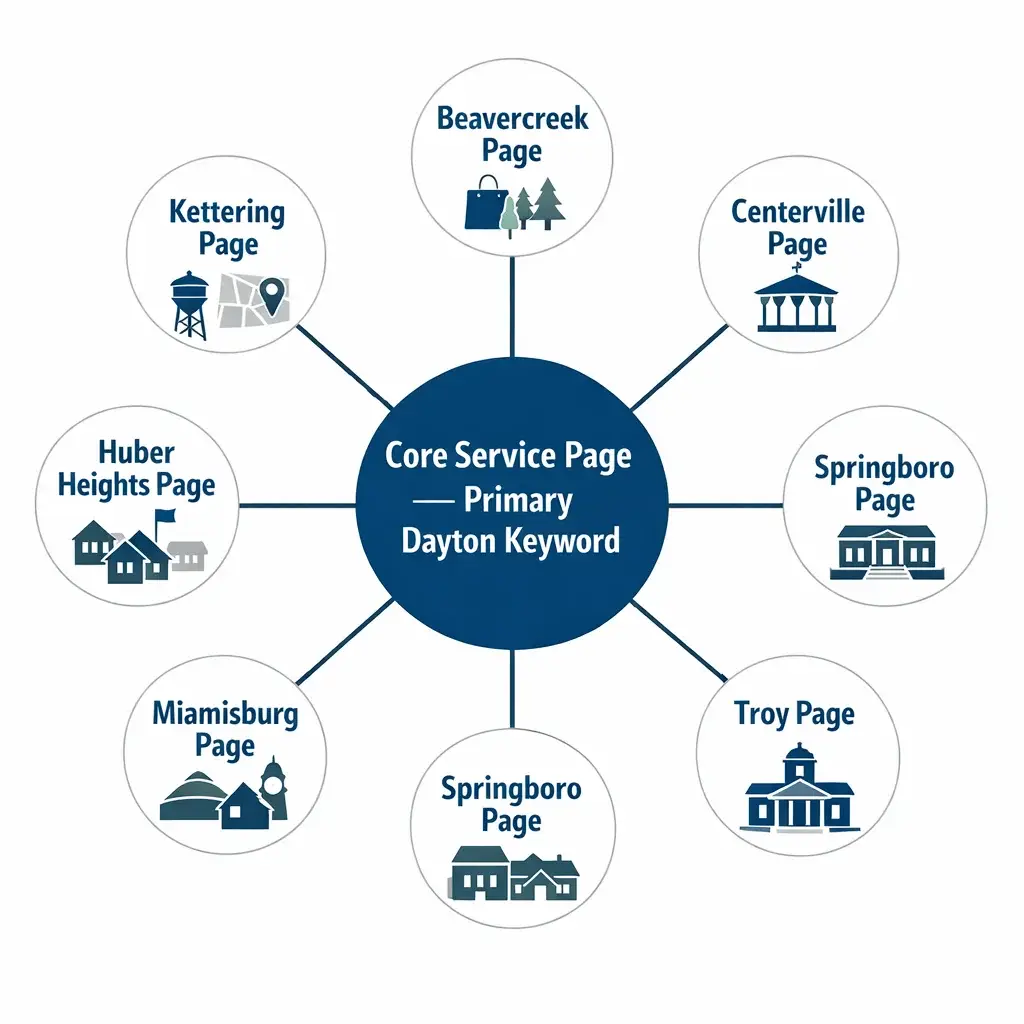
The Hub-and-Spoke Geo-Content Model
A genuine geo-content strategy for Greater Dayton is structured around differentiation, not replication.
The hub: Core service pages that build topical authority — comprehensive, specific, and strategically optimized for your primary service keywords. These pages earn authority that flows through the site.
The spokes: Location-specific pages that are genuinely differentiated by hyper-local content signals, including:
– References to local landmarks, business districts, or neighborhoods that a real customer in that community would recognize
– Area-specific customer scenarios (“We serve homeowners throughout Centerville’s Washington Township neighborhoods”)
– Locally relevant FAQ content that reflects real questions asked by residents in that community
– Structured data (LocalBusiness schema) that explicitly reinforces the service area
– Embedded maps and locally verifiable contact information
The strategic goal is pages that a resident of Springboro or Miamisburg would find genuinely more useful than a generic service page — not pages that exist purely to capture a keyword.
Search Intent Architecture: Mapping Your Site to the Buyer Journey
No competitor in the Dayton SEO space addresses this directly, and it is one of the highest-leverage concepts in modern SEO strategy.
Search intent architecture is the practice of deliberately structuring your website so that different pages capture different stages of buyer awareness — and connecting those stages in a logical flow that moves visitors toward conversion.
For a Dayton business, this looks like a three-layer structure:
Layer 1: Awareness-Stage Content
These are the informational queries — people researching a problem or category, not yet looking to hire. For a Dayton B2B IT company, this might be pages targeting “what is managed IT services” or “how to choose an IT provider for a small business.”
These pages are not conversion engines. They are trust-building assets that bring in early-funnel traffic and establish authority signals that benefit the entire site.
Layer 2: Consideration-Stage Content
The buyer knows what they need and is evaluating options. Queries here include comparisons (“managed IT services vs. in-house IT”), outcome-focused content (“benefits of outsourced IT for Dayton manufacturers”), and localized category pages (“IT services Dayton Ohio”).
These pages should include clear differentiation signals — case study references, methodology descriptions, and social proof elements — because the buyer is actively comparing providers.
Layer 3: Decision-Stage Content
The buyer is ready. They are searching for a specific provider or asking direct commercial questions. “Managed IT services company Dayton,” “best SEO agency Dayton Ohio,” “hire digital marketing agency Kettering.”
These are your core service pages. They need to answer the decision-stage buyer’s remaining questions directly — what specifically do you offer, who have you helped, what does the engagement look like, and how do they take the next step.
A site that only has Layer 3 content misses 60–70% of the organic search opportunity. A site that only has Layer 1 content generates traffic that never converts. The architecture that wins combines all three, with deliberate internal linking that guides readers from awareness to decision. The article on SEO for Lead Generation 2026: What Actually Drives Pipeline covers how this three-layer structure translates directly into measurable lead flow for service businesses.
What Sophisticated Dayton Business Owners Should Demand From an SEO Partner
The difference between a strategic SEO partner and a task vendor comes down to what they can explain before they start any work.
A genuine strategic partner should be able to answer:
– What is the specific constraint holding your site’s rankings back right now?
– Which keyword segments are realistically winnable in Dayton’s competitive landscape within a defined timeframe, and which require a longer authority-building runway?
– How will content priorities be determined — by volume alone, or by the intersection of search volume, commercial intent, and competitive difficulty?
– How will local pack strategy be coordinated with on-site SEO to cover Greater Dayton without creating thin content that damages overall quality signals?
– What does success look like at 90 days, six months, and twelve months — not in vanity metrics like impressions, but in leads, calls, and revenue-adjacent conversions?
If an agency cannot answer those questions in specific terms before the engagement begins, they are selling execution. Execution without strategy is activity — and activity without direction does not compound into growth.
At Mongoose Digital Marketing, every engagement starts with a diagnostic assessment of exactly these questions. The strategy comes first because the strategy determines everything that follows. If you are ready to have that conversation about your Dayton business’s specific position in the market, reach out for a free consultation. No templates. No service menus. Just a direct assessment of where you are and what it will actually take to grow.
Strategic Recommendations for Dayton Businesses in 2026
Three specific priorities should shape how Dayton business owners approach SEO strategy over the next year.
1. Invest in Topical Authority Mapping Before Adding More Content
The era of publishing individual blog posts in isolation is over. In 2026, search engines reward sites that demonstrate comprehensive expertise within a defined subject area. Before creating a single new page, work with your SEO partner to map out a complete topical cluster — identifying the core service pages, the supporting informational content, and the internal linking structure that ties them together. Dayton businesses that complete this mapping exercise first will build authority faster than competitors who continue publishing disconnected content.
2. Prioritize Google Business Profile as a Continuous Asset, Not a One-Time Setup
The local pack in Greater Dayton is increasingly competitive, and the businesses earning consistent visibility treat their Google Business Profile as a living content channel. In 2026, that means regular posts, updated service descriptions, active Q&A management, and a structured review acquisition process — not a profile that was set up two years ago and left unchanged. Businesses serving multiple areas like Kettering, Beavercreek, and Centerville need a deliberate strategy for how each location or service area is represented without duplicating content that weakens quality signals.
3. Implement Conversion Tracking That Connects SEO Effort to Actual Revenue
Most Dayton businesses are measuring SEO with the wrong instruments. Impressions and sessions describe activity. What matters is whether that activity produces calls, form submissions, and booked appointments. In 2026, the minimum viable measurement stack includes call tracking tied to organic search traffic, goal completions in Google Analytics 4 with proper attribution, and a clear baseline of what a converted visitor looks like for your specific business model. Without this infrastructure, there is no honest way to evaluate whether your SEO investment is performing — or to make informed decisions about where to direct future effort.
Frequently Asked Questions
How long does it take to see results from SEO in Dayton?
Meaningful results from a well-executed SEO strategy typically begin to appear within three to six months, with compounding gains building through the twelve-month mark and beyond. The timeline depends on where your site starts — a newer domain with minimal authority requires a longer runway than an established site that simply needs better content architecture and local optimization. What separates realistic timelines from unrealistic promises is the specificity of the plan: any partner who commits to exact ranking positions within a fixed number of days is overpromising. What a genuine strategy produces is a clear trajectory with defined milestones that connect SEO activity to business outcomes.
What is the difference between local SEO and general SEO strategy for a Dayton business?
General SEO focuses on rankings in standard organic search results and applies broadly to any business with a website. Local SEO specifically targets the map pack results and location-based queries that drive high-intent traffic from people searching within a geographic area — searches like “near me” or searches that include a city name like Dayton, Kettering, or Beavercreek. For most Dayton businesses, both dimensions matter and should be coordinated: the Google Business Profile strategy that drives local pack visibility and the on-site content strategy that captures broader organic traffic need to reinforce each other rather than operate as separate, disconnected efforts.
Why doesn’t ranking for high-volume keywords automatically mean more business?
Search volume measures how often a term is searched — it does not measure whether the people searching that term are likely to become customers. A keyword can generate thousands of monthly searches from people who are researching, comparing, or simply curious, and produce almost no leads for a local service business. A strategic approach prioritizes the intersection of volume, commercial intent, and competitive difficulty rather than volume alone. For Dayton businesses especially, a lower-volume keyword with clear buyer intent and manageable competition will consistently outperform a high-volume term where ranking is unlikely and conversions are rare even when it is achieved.
How does Mongoose Digital Marketing approach SEO differently from a standard agency?
The foundational difference is that strategy precedes execution. Rather than starting with a service package and fitting your business into it, Mongoose Digital Marketing begins every engagement with a diagnostic assessment of your specific competitive position, your site’s current constraints, and the realistic opportunity available in your market. That assessment shapes the priorities — which pages to build, which keywords to target, how to structure local coverage across Greater Dayton — before any implementation begins. The result is SEO work that is designed around your business’s actual growth objectives rather than a standardized checklist that looks the same for every client regardless of industry or market.
Conclusion
For Dayton businesses ready to move from activity to actual growth, the difference a strategic partner makes is measurable — in rankings that hold, leads that convert, and a clearer picture of what your SEO investment is actually doing. Mongoose Digital Marketing proudly serves Dayton, Kettering, Beavercreek, Centerville, and the surrounding communities, with local SEO strategy and content development built specifically around the Greater Dayton market rather than borrowed from a generic playbook. If you are ready for a direct, honest assessment of where your business stands and what it will take to grow, Contact Mongoose Digital Marketing to start the conversation.