
Why Running PPC and SEO in Silos Is Costing You More Than You Think
Most business owners approach PPC and SEO the same way they approach a toolbox — each tool has a specific job, you pick the right one for the task, and you put it back when you’re done. PPC gets traffic fast. SEO builds rankings over time. Simple enough.
Except that mental model is quietly draining your marketing budget and leaving significant growth on the table.
The reality that most agencies won’t tell you — because it requires actually running both channels simultaneously and reading the data across them — is that PPC and SEO are not parallel tracks. They are a feedback system. The data generated by one channel directly informs the performance of the other, and when you treat them as separate initiatives with separate teams, separate reports, and separate strategies, you break the loop.
What follows is a practitioner-level breakdown of how PPC and SEO compound when integrated properly: the frameworks, the data signals, the strategic decisions, and the common operational mistakes that keep businesses from capturing the full value of their search presence.
The Feedback Loop Architecture: How the Two Channels Talk to Each Other
Understanding the integration starts with understanding what each channel actually generates beyond its primary output.
PPC doesn’t just generate clicks. It generates conversion-qualified intent data at scale, faster than any organic testing cycle can match. Within weeks of a well-structured campaign, you have statistically meaningful information about which search queries are driving people to take action — not just visit, but convert.
SEO doesn’t just generate rankings. It generates sustained topical authority signals that tell Google your domain is a credible, trustworthy resource for a given subject area — signals that reduce your long-term cost of acquiring organic traffic.
When these channels share data, the compound effect is significant:
- PPC conversion data identifies which keyword clusters are worth the months-long investment of building organic content around
- Organic ranking data identifies which high-volume terms you can reduce paid spend on because you’re already capturing that traffic for free
- Combined, they let you make budget and content decisions based on evidence rather than assumption
This is the architecture most businesses never build — and the gap between those who do and those who don’t is measurable in both traffic and revenue.
Search Intent Arbitrage: Using PPC Data to Make Smarter SEO Investments
The standard advice you’ll find almost everywhere is “use PPC to test keywords before investing in SEO.” That’s directionally correct but operationally useless without a framework for what to do with that data.
Here’s how to actually execute it:
Reading PPC Match Type Data as an SEO Signal
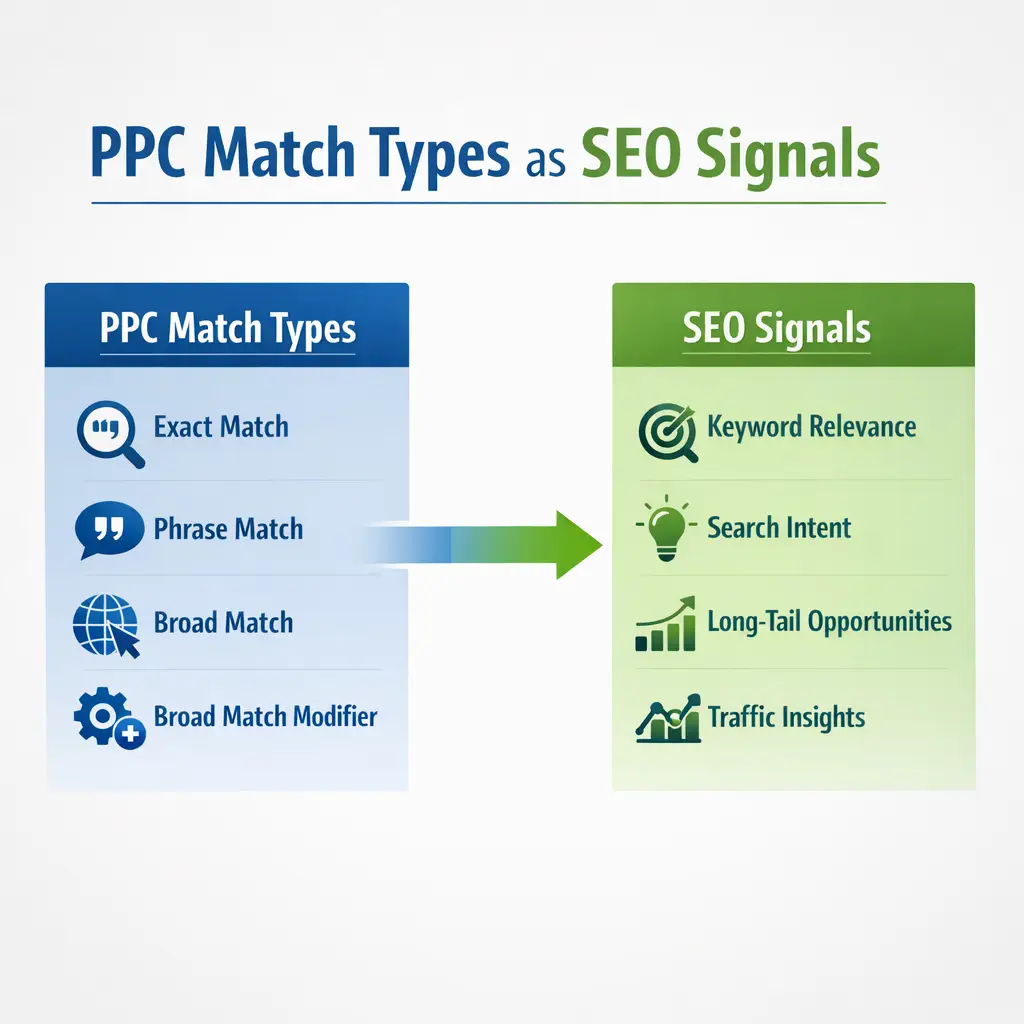
Not all converting keywords are equal signals for SEO investment. The match type through which a term converts tells you something specific about intent quality:
Exact match conversions are your highest-confidence SEO investment targets. When someone searches a precise phrase, clicks your ad, and converts, that’s a clear signal that the query carries commercial intent and that your offer aligns with it. These terms are worth building dedicated landing pages and content clusters around.
Broad match conversions are your content gap discovery engine. When a broad match campaign surfaces converting queries you hadn’t explicitly targeted, you’ve just identified organic content opportunities you didn’t know existed. These are often long-tail variations that competitors haven’t addressed either.
High-impression, low-CTR paid terms are your meta description optimization signals. If an ad is appearing frequently for a term but users aren’t clicking, the issue is often that your messaging isn’t matching the specific intent behind that query. The fix in PPC is ad copy. The fix in SEO is title tags and meta descriptions. The diagnostic is identical.
The Decision Framework: New Content vs. Paid Validation First
Before commissioning a new SEO content piece, every experienced practitioner asks: do we have enough evidence that this keyword drives qualified demand, or are we guessing?
Here’s a practical decision framework:
- High search volume + no PPC data: Run a short paid campaign targeting the term before investing in organic content production. Let conversion rate data validate demand.
- High search volume + strong PPC conversion data: Invest in long-form SEO content and topical cluster development. The demand is proven.
- Low search volume + strong PPC conversion rate: The term converts well but volume is limited. Build a targeted landing page rather than a full content series.
- Low search volume + poor PPC conversion: Deprioritize. Neither channel is worth significant investment here.
This framework eliminates the common mistake of spending months building SEO content around terms that turn out to have weak commercial intent.
SERP Real Estate Strategy: Owning Multiple Positions for High-Intent Terms
One of the most debated topics in integrated search strategy is whether you should bid on branded keywords when you already rank number one organically. Surface-level content almost always gives you the same non-answer: “it depends.” Here’s what it actually depends on.
When Double Presence Increases Total Click Share
Running paid ads alongside your organic rankings — a practice called SERP real estate stacking — makes strategic sense in specific scenarios:
- Competitive branded landscapes: If competitors are bidding on your brand name, a paid ad ensures your brand controls the top of the SERP. Without it, a competitor’s ad can appear above your organic result.
- High-intent commercial queries: For terms like “[your service] near me” or “[your brand] pricing,” the user is close to a purchase decision. Owning both positions increases the probability of capturing that click before they evaluate alternatives.
- Promotional messaging: Organic meta descriptions are relatively static. Paid ads let you push time-sensitive offers, seasonal promotions, or specific calls to action that your organic listing can’t carry.
When Double Presence Becomes Cannibalization
There are equally valid scenarios where paying for traffic you already own organically is simply waste:
- Dominant organic positions with low competitive threat: If you rank first organically for a non-branded informational query and no competitor is bidding on it, adding a paid overlay typically doesn’t increase total clicks — it just moves some of those clicks into a paid cost category.
- Low commercial intent queries: Running ads on informational terms where users aren’t ready to buy drives up spend without improving conversion rates.
The mechanism for making this decision with evidence rather than assumption is impression share data. If your organic listing already captures a high share of available impressions for a term and no competitive ads are displacing you, the incremental value of a paid ad on that term is low. If impression share is volatile and competitors are present, the paid layer serves a defensive function worth paying for.
The Quality Score and Core Web Vitals Convergence: One Page, Two Evaluations
This is the integration insight that almost no one in this space discusses, and it has direct operational implications for how you allocate technical resources.
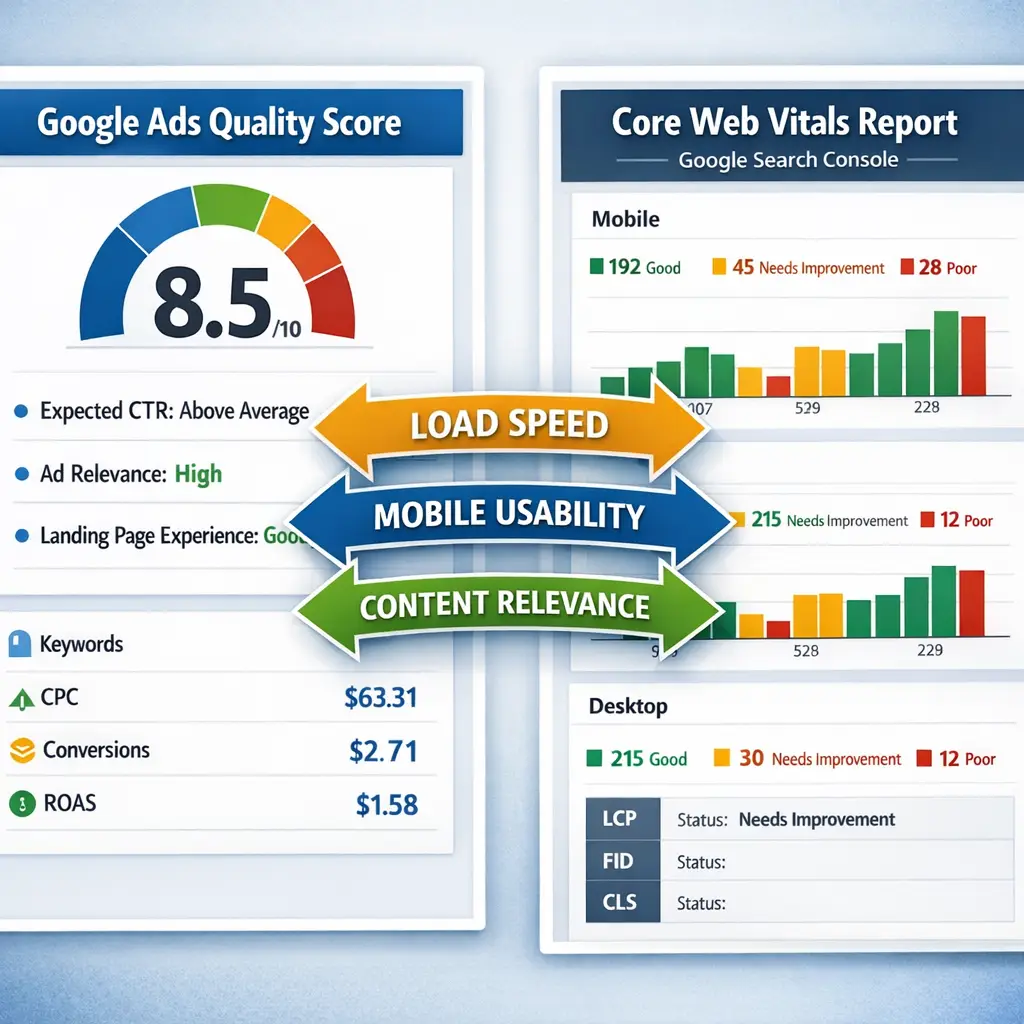
Google evaluates your landing pages through two distinct lenses simultaneously:
- Landing Page Experience — a component of PPC Quality Score in Google Ads, which affects your cost per click and ad rank
- Core Web Vitals — a set of user experience signals that function as an organic SEO ranking factor
The critical insight is that both systems are evaluating the same page attributes: load speed, mobile responsiveness, content relevance, and user engagement. A page that scores poorly on Core Web Vitals — slow to load, layout shifts on mobile, poor interactivity — will simultaneously carry a low Landing Page Experience score in Google Ads.
The Practical Implication for Your Budget
When PPC and SEO operate in silos, technical improvements to page experience get logged in whichever team’s report happens to track them — usually SEO. The PPC team rarely connects a drop in their Quality Score to a page load issue that the SEO team has flagged.
When teams share data, the return on a single page speed improvement is compound:
- Faster load time → improved Core Web Vitals → potential organic ranking improvement
- Faster load time → improved Landing Page Experience → lower cost per click in paid campaigns → more clicks for the same budget
That’s the same technical investment generating returns in two separate channels. Teams operating in silos capture half the value. Integrated teams capture both.
A practical operational rule: treat a low Landing Page Experience score in Google Ads as an SEO diagnostic alert. If Google is penalizing your page experience in the paid auction, it is almost certainly factoring those same signals into your organic ranking calculations. If you want a deeper look at the specific technical issues that suppress both scores, the Technical SEO Audit for Small Business: Fix What Matters article walks through the most common culprits and how to prioritize fixes.
Channel Interference and the Cannibalization Audit
One of the more counterintuitive concepts in integrated search strategy is channel interference — the phenomenon where aggressively scaling PPC on terms where you already rank organically can actually suppress your organic click-through rate, even when your organic ranking holds steady.
The mechanics are straightforward: paid ads consume above-fold SERP real estate. When your ad and your organic listing both appear on the same results page, a portion of users who would have clicked the organic result instead click the paid ad. You’re still getting the click — but you’re now paying for traffic you could have received for free.
This doesn’t mean you should stop bidding on terms where you rank organically. It means you need to run a paid-versus-organic overlap audit to identify where your paid spend is displacing organic conversions rather than adding incremental ones.
How to Conduct a Basic Overlap Audit
| Step | Action | Data Source | What You’re Looking For |
|---|---|---|---|
| 1 | Pull top converting PPC keyword list | Google Ads conversion report | Terms with strong paid conversion volume |
| 2 | Cross-reference against organic ranking report | Google Search Console | Identify terms where you rank in positions 1–5 organically |
| 3 | Segment overlap terms by competition level | Google Ads auction insights | Are competitors present in the paid auction for these terms? |
| 4 | Compare organic CTR before and after paid scaling | Search Console historical data | Look for organic CTR drops that correlate with paid impression increases |
| 5 | Calculate incremental conversion value | CRM or analytics platform | Determine whether paid conversions on these terms represent new customers or displaced organic ones |
Terms that appear in steps 1 and 2 — high-converting paid terms where you also hold strong organic rankings — require an intentional decision. If competitors are absent from the auction, reducing paid spend on those terms and allowing organic to carry the traffic is almost always the more efficient allocation. If competitors are bidding aggressively, the paid presence serves a defensive function and the spend may be justified.
Audience List Cross-Pollination: The Highest-Value Integration Tactic Most Businesses Skip
RLSA — Remarketing Lists for Search Ads — lets you adjust your paid search bids based on whether a user has previously visited your website. In isolation, it’s a useful retargeting lever. In the context of integrated PPC and SEO strategy, it becomes something more powerful.
When organic search is generating consistent traffic to your site, every one of those visitors is a potential RLSA audience segment. Here’s how to extract value from that:
Organic-to-Paid Audience Flows
- Organic blog readers who didn’t convert: Users who found you through informational SEO content are in an early research phase. Create an RLSA segment for these visitors and bid more aggressively when they later search commercial-intent terms. They already know your brand — your conversion rate on that second touch will be significantly higher than cold traffic.
- Organic category page visitors: Users who visited specific service or product category pages through organic search have demonstrated category-level intent. Build RLSA segments by page type and use them to serve highly relevant ads when those users return to search.
- High-engagement organic visitors: Define engagement thresholds — time on site, pages visited, specific actions taken — and create RLSA segments for organic visitors who meet them. These are your warmest prospects and warrant premium paid bid adjustments.
The reverse flow matters equally. Paid campaign audiences who converted can inform which organic content topics you invest in next. If a specific audience segment consistently converts on paid campaigns, producing SEO content that targets the search queries that audience uses in research phases builds a more complete capture funnel. The PPC Lead Generation: Get Qualified Leads That Convert article covers how to structure campaigns so the audience data you collect is actually usable for this kind of cross-channel application.
Attribution Model Conflicts: The Integration Problem Nobody Talks About
Here’s an operational reality that creates friction in almost every organization trying to integrate PPC and SEO: the two channels often live in separate attribution models, and those models tell contradictory stories about where revenue is coming from.
PPC teams typically work in last-click or data-driven attribution within Google Ads. SEO performance is measured through organic traffic and assisted conversions in analytics platforms. When a user finds you through organic search, leaves, returns via a remarketing ad, and converts, the PPC team claims the conversion. The SEO team’s content that initiated the journey gets no credit.
This isn’t just a reporting problem — it’s a budget allocation problem. Organizations that don’t resolve their attribution model conflicts systematically underfund SEO because the channel appears to drive fewer conversions than it actually does. PPC gets an outsized budget share because it captures last-click credit.
The resolution requires two things: a shared attribution framework agreed upon by both teams, and a platform that can track multi-touch journeys across both organic and paid touchpoints. The most defensible approach is a position-based or data-driven model applied consistently across both channels, with regular cross-channel reports that show assisted conversion paths rather than last-touch snapshots.
Until attribution is resolved at the organizational level, the “integration” conversation is mostly theoretical.
Negative Keyword Hygiene and Its Impact on SEO Content Strategy
A PPC problem that silently damages SEO strategy when teams don’t talk to each other: negative keyword contamination.
When PPC campaigns lack disciplined negative keyword management, ads serve against irrelevant or low-intent queries. Campaign managers add negative keywords to stop wasting budget. But in many organizations, those negative keyword lists never get communicated to the SEO content team.
The result: the SEO team continues to optimize content for terms that the paid data has already demonstrated carry poor commercial intent. They’re building organic rankings for queries that the PPC team has learned — through real conversion data — are not worth targeting.
The fix is operationally simple: negative keyword lists should be reviewed jointly by PPC and SEO teams on a regular cadence. A negative keyword in PPC is almost always a signal that the underlying query has low commercial value, which should recalibrate SEO content priorities accordingly.
Building the Integrated Search System: What This Looks Like in Practice
Pulling these concepts together requires structural changes in how campaigns are managed and reported — not just tactical coordination.
The foundations of an integrated system:
- Shared keyword universe: A single master keyword list segmented by intent tier (informational, navigational, commercial, transactional) that both PPC and SEO teams reference when making investment decisions
- Cross-channel conversion reporting: Analytics configuration that tracks organic-assisted and paid-assisted conversions in the same view, using a consistent attribution model
- Joint monthly review cadence: A structured meeting where PPC performance data — specifically converting queries, Quality Score trends, and auction insights — is reviewed alongside SEO ranking and traffic data
- Unified audience library: A shared set of audience segments built from both organic and paid traffic data, available to the paid campaigns team for bid adjustment and retargeting
- Page experience as a shared KPI: Core Web Vitals and Landing Page Experience tracked together, with technical improvements logged against both channels’ performance metrics
None of this requires new technology. It requires treating PPC and SEO as one interconnected system rather than two separate line items on a marketing budget.
When that structural shift happens, the growth arithmetic changes. Improvements in one channel amplify results in the other. Budget allocation becomes evidence-based rather than habitual. And your search presence — paid and organic combined — starts building compound returns instead of running two independent campaigns that occasionally happen to appear on the same results page.
Strategic Recommendations for 2026
The coordination principles outlined above are only as effective as the tools and workflows supporting them. Three specific investments will have the highest practical impact for teams looking to operationalize PPC and SEO integration heading into 2026.
1. Adopt a unified search intelligence platform.
Tools like Semrush, Ahrefs, or Moz have evolved well beyond rank tracking. Their current capability sets — particularly keyword intent classification, SERP feature analysis, and competitor visibility scoring — make them legitimate shared infrastructure for both paid and organic teams. The specific platform matters less than the commitment to using one source of truth rather than siloed reporting tools that produce incompatible data sets.
2. Implement server-side tagging for more reliable conversion data.
Browser privacy changes and increased ad blocker adoption have degraded the accuracy of client-side tracking in ways that quietly distort both PPC optimization and SEO attribution. Moving to server-side tag management through Google Tag Manager’s server container or a comparable solution restores data fidelity at the point where both channels depend on it most — conversion reporting.
3. Build a structured content-to-landing-page handoff process.
One of the most consistently missed integration opportunities is the gap between content that ranks organically and the paid landing pages built around the same queries. In 2026, the competitive advantage belongs to teams that use organic engagement data — time on page, scroll depth, on-site search behavior — to inform paid landing page design before those pages go live. This requires a documented handoff process, not just good intentions between teams.
Frequently Asked Questions
Can a small business benefit from running PPC and SEO at the same time, or should one come first?
Both channels can run concurrently, and for most small businesses, the combination produces better results than sequencing them. PPC generates immediate visibility and conversion data while SEO builds long-term organic authority. The paid data — specifically which queries convert and which messaging resonates — directly shortens the trial-and-error period in SEO content development. Starting with one channel in isolation means forfeiting months of cross-channel learning.
How do I know if my PPC and SEO teams are actually working together effectively?
The clearest signal is whether they share data. If your SEO team has never reviewed a PPC search terms report, and your paid team has never looked at which organic pages generate the most assisted conversions, the channels are operating independently regardless of how coordination is described internally. A practical test is to ask both teams to name the top five converting queries from the other channel. If neither can answer, integration work is overdue.
Does running paid ads affect organic search rankings?
Paid ads do not directly influence organic rankings — Google has been explicit about this separation. The indirect effects, however, are real and significant. PPC campaigns drive traffic that generates behavioral signals like click-through rate and session engagement, which are factors associated with organic ranking performance. Paid activity also accelerates brand recognition, which increases branded organic search volume and direct traffic over time. The relationship is indirect but consequential.
What is the biggest mistake businesses make when managing PPC and SEO separately?
The most costly mistake is allowing the two channels to bid against each other by targeting the same high-intent queries with paid campaigns while simultaneously investing SEO resources in ranking for those same terms — without any coordination about where the conversion rate data lives or how page experience improvements are being shared. This creates duplicated effort, inflated costs, and missed insight. The fix is not eliminating one channel but establishing a shared reporting layer so both teams are making decisions from the same evidence.
Conclusion
Getting PPC and SEO to work as a single, compounding system is exactly the kind of strategic integration that Mongoose Digital Marketing is built for — whether that means restructuring paid search campaigns, developing SEO content strategies grounded in real conversion data, or building the reporting infrastructure that connects both channels. If your current search presence feels like two separate efforts pulling in different directions, that’s a solvable problem. Get a Free Estimate and let’s map out what a coordinated approach looks like for your business.