
Why Your Website Isn’t Ranking (And What Actually Fixes It)
Most business owners trying to improve their website’s SEO are working from the same incomplete playbook: publish content, add keywords, get some backlinks, and wait. If that approach were sufficient, every business that followed it would be on page one. They’re not — and the reason comes down to a fundamental misunderstanding of how Google’s systems actually evaluate and rank websites.
SEO is not a checklist. It is an interconnected system where technical foundations, content architecture, authority signals, and behavioral data all interact. Pull one lever without understanding how it connects to the others, and you can spend months producing content that never ranks, building links that don’t move the needle, or optimizing pages that Google can’t even properly crawl.
This guide is written for business owners who are serious about growing their organic search presence and want to understand the mechanics behind the results — not just the surface-level tactics. We’ll cover what the majority of SEO guides get wrong, what Google is actually measuring, and how to build a strategy that compounds over time.
The Foundational Mistake: Treating SEO as a Page-Level Problem
The single most common error in SEO strategy is optimizing individual pages in isolation while ignoring what the entire site communicates to Google at the domain level.
Google’s systems don’t evaluate your website one page at a time and then average the scores. They assess your domain’s topical authority — the degree to which your entire site demonstrates consistent, deep expertise within a specific subject area. This is the architecture behind Google’s Knowledge Graph, and it has profound implications for how you build and organize your content.
Here’s what that means in practice: a well-optimized article about “commercial roofing maintenance” on a general home improvement blog will consistently underperform a less-polished article on a website that exclusively covers commercial roofing topics, backed by ten interconnected supporting articles on related subtopics. The dedicated site has established topical authority. The general blog has a single data point Google can’t confidently associate with the subject domain.
The Content Cluster Model: How to Signal Domain Ownership to Google
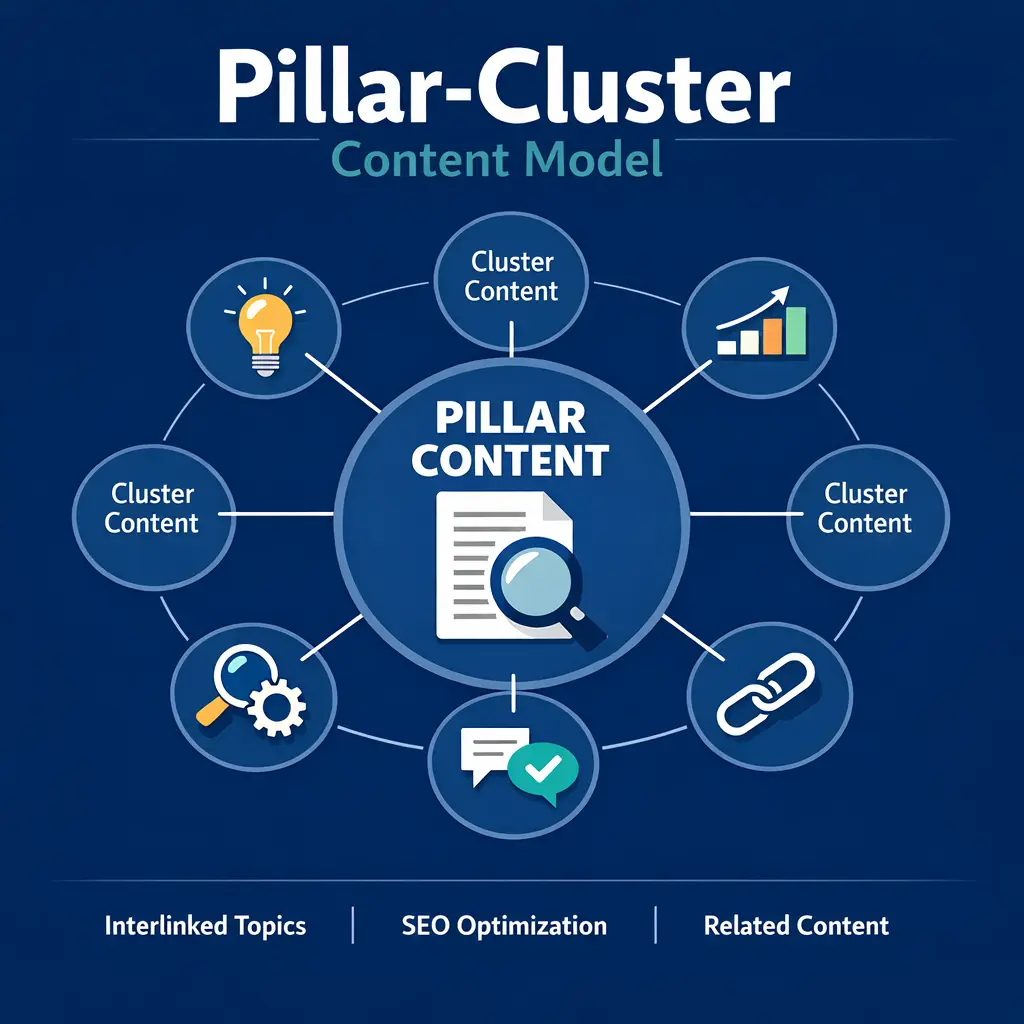
The solution to this problem is a deliberate content architecture known as the pillar-cluster model. Rather than publishing standalone articles on loosely related topics, you build a structured network:
- The pillar page addresses a broad topic comprehensively — covering it with enough depth that it functions as the authoritative reference point for that subject on your domain.
- Cluster pages each address a specific subtopic in granular detail, with internal links pointing back to the pillar and cross-linking to related clusters where relevant.
- The internal linking structure acts as a signal map — it tells Google’s crawlers how your content is organized and reinforces the semantic relationship between pages.
This architecture does something that standalone content cannot: it makes your domain associated with a topic entity inside Google’s Knowledge Graph, rather than just matching keyword strings on individual pages. That entity association is what drives consistent, compounding rankings over time.
A new website with twelve tightly interconnected articles on a single niche, built around this model, can and does outrank established sites with hundreds of scattered posts. The volume of content is far less important than the coherence of its architecture. For a deeper look at how content structure translates into measurable lead flow, the article on SEO for lead generation in 2026 breaks down exactly how pipeline-driving authority gets built at the domain level.
Technical SEO: The Infrastructure Your Rankings Are Built On
Content quality means nothing if Google can’t efficiently crawl, index, and interpret your pages. Technical SEO is the foundation — and it’s where many business websites have silent, invisible problems that suppress rankings across the entire domain.
Crawl Budget: The Concept Most Guides Never Mention
Every website has a crawl budget — a finite allocation of crawl capacity that Googlebot will spend on your domain per day. For small sites with under 100 pages, this rarely becomes a constraint. For growing businesses with product pages, blog archives, tag pages, filtered URLs, and pagination, crawl budget management becomes mission-critical.
When Googlebot wastes its crawl allocation on low-value or duplicate URLs — paginated archive pages, faceted navigation combinations, URL parameters that create near-duplicate content — it has less capacity to discover and index your new, high-value pages. The result: content you published weeks ago still isn’t indexed, while your competitors’ new pages appear in results within days.
Crawl budget optimization actions:
– Implement noindex directives on paginated archive pages, tag pages, and filtered URLs that generate low-value duplicate content
– Consolidate duplicate or near-duplicate pages using canonical tags to direct crawl equity toward the preferred version
– Audit your XML sitemap to ensure it contains only indexable, canonical URLs — not redirects, noindexed pages, or 404s
– Use Google Search Console’s Crawl Stats report to identify which sections of your site are consuming the most crawl activity and whether Googlebot is encountering errors at scale
Core Web Vitals: Speed as a Ranking Signal with Specifics
Page speed has been a ranking signal for years, but Google’s Core Web Vitals framework elevated the precision of how performance is measured. The three metrics that directly influence rankings are:
| Metric | What It Measures | Target Threshold | Common Causes of Failure |
|---|---|---|---|
| Largest Contentful Paint (LCP) | How long it takes for the largest visible content element to load | Under 2.5 seconds | Unoptimized images, slow server response, render-blocking resources |
| Interaction to Next Paint (INP) | How quickly the page responds to user interactions | Under 200 milliseconds | Heavy JavaScript execution, excessive third-party scripts |
| Cumulative Layout Shift (CLS) | How much the page layout shifts unexpectedly during load | Under 0.1 | Images without defined dimensions, dynamically injected content, web fonts |
These are not abstract targets. Pages that fall into the “Poor” range for any of these metrics receive a direct ranking disadvantage in competitive SERPs. Measure your current performance using Google’s PageSpeed Insights tool, then prioritize LCP improvements first — they typically have the largest impact and often stem from a manageable set of causes like image format, server response time, and render-blocking scripts.
Mobile Indexing: Why Your Desktop Site Is Now Secondary
Google operates on a mobile-first indexing basis, meaning the mobile version of your website is what Google’s systems use to determine your rankings — for all users, including desktop. If your mobile experience is degraded — slower load times, truncated content, tap targets that are too small, content hidden behind interactions — your rankings reflect that degradation, regardless of how polished your desktop site is.
Audit your mobile experience with the same rigor you’d apply to desktop. Specifically:
– Ensure all content visible on desktop is also accessible (not just present) on mobile — hidden content in collapsed accordions or tabs carries less indexing weight
– Verify that structured data markup on your mobile pages matches what’s on desktop
– Confirm that internal links in your mobile layout point to the same destinations as desktop — inconsistencies confuse crawlers
On-Page Optimization: Beyond Keywords in the Right Places
On-page SEO at the surface level — keywords in title tags, headers, and body copy — is table stakes. Every competitor you’re up against is doing this. The differentiation comes from understanding the why behind these practices and applying the deeper mechanics.
Search Intent: Not Static, Not Simple
Search intent is the dominant purpose behind a query — what the user actually wants to accomplish. Google classifies intent across four primary categories: informational (learning something), navigational (finding a specific site), commercial (researching options before buying), and transactional (ready to act). Matching your content to the correct intent category is the baseline requirement for ranking.
What most guides omit is that intent is not fixed. Google continuously re-evaluates the dominant intent for any given query based on aggregate user behavior signals — click-through rates, dwell time, and what users do after visiting a result. This creates intent drift: a phenomenon where content that perfectly matched intent at the time of publication gradually falls out of alignment as user behavior evolves.
A practical example: a query that historically returned long-form comparison guides may, over 18 months, shift toward returning quick-answer tables as user behavior signals that people want faster access to comparative data. Your long-form guide — unchanged since publication — now mismatches the dominant intent signal even though the keyword and topic are identical.
How to monitor for intent drift:
– Track SERP volatility for your target keywords using monitoring tools that surface significant result changes
– When you detect major SERP reshuffling for a keyword you’re targeting or ranking for, audit the new first-page results: has the dominant content format shifted? Are video carousels appearing where they weren’t before? Are featured snippets now favoring a different structure?
– Update content format and structure in response to evolved intent — not just the information itself. A page that was a narrative guide may need restructuring as a comparison table or step-by-step format to realign with current intent signals
This is why a “publish and move on” content strategy consistently degrades over time. Maintenance is not optional; it is a core part of the ongoing work.
Title Tags, Meta Descriptions, and Header Structure: Precision Over Volume
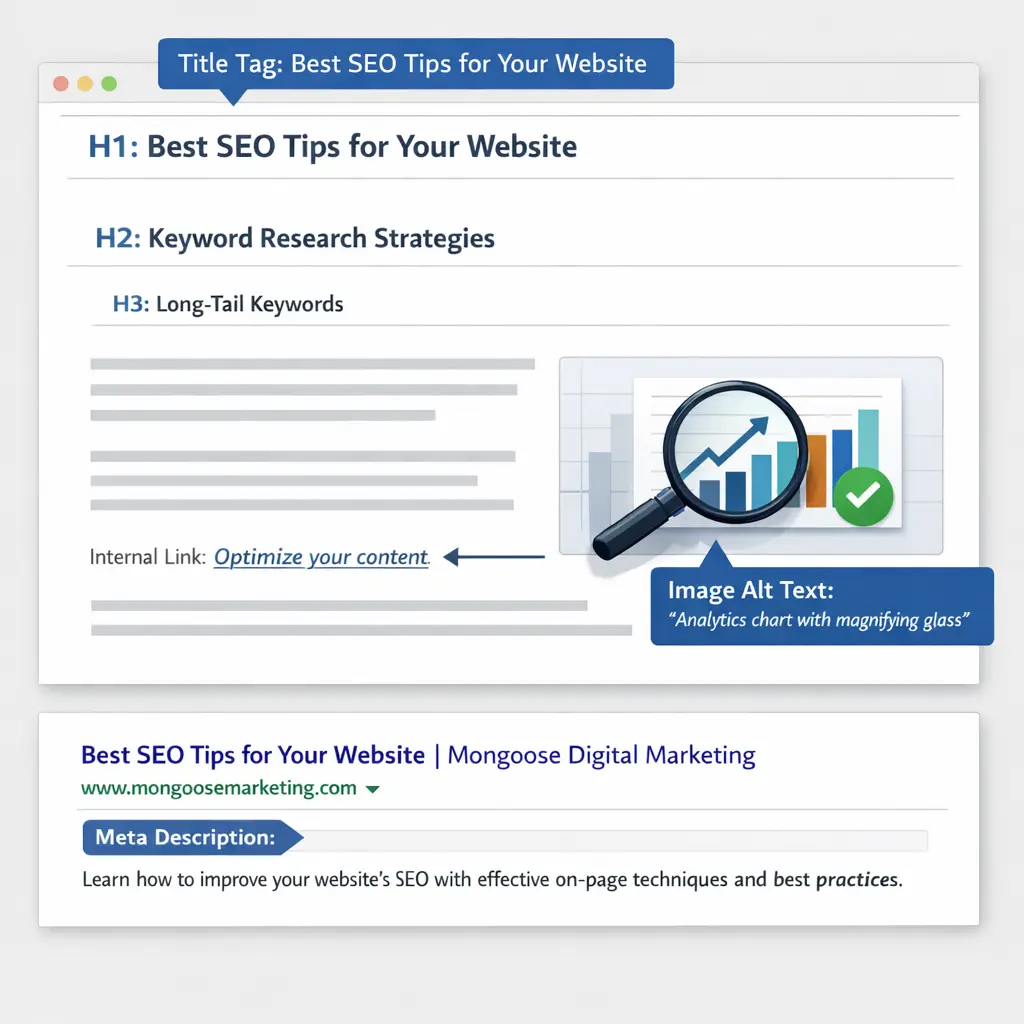
Title tags remain one of the highest-weighted on-page signals Google uses for relevance assessment. They should:
– Lead with the primary keyword where it reads naturally — front-loading it marginally increases its weight
– Stay within approximately 55–60 characters to avoid truncation in SERPs (Google measures in pixels, not characters, but 60 characters is a reliable practical ceiling)
– Communicate a clear value proposition beyond just the keyword — what makes this page the right result?
Meta descriptions are not a direct ranking factor, but they directly influence click-through rate — and CTR is a behavioral signal that Google uses to validate whether a result belongs in its position. A well-written meta description that accurately previews the page content and matches the user’s intent at query time improves clicks, reduces pogo-sticking, and signals relevance through user behavior.
Header structure (H2, H3, H4) serves two parallel purposes: it organizes content for human readers and it provides semantic structure that helps Google’s NLP systems map the topical territory your page covers. Use headers to address related questions, subtopics, and entities that a comprehensive treatment of the subject would naturally include — not just to repeat the primary keyword in different phrasings.
E-E-A-T: How Google Operationalizes Credibility
Google’s E-E-A-T framework — Experience, Expertise, Authoritativeness, and Trustworthiness — is the quality evaluation model that governs how human Search Quality Raters assess pages, and it increasingly informs the signals Google’s automated systems are trained to identify. Understanding it at the surface level (“be authoritative, write expert content”) is not enough. Understanding how Google operationalizes it gives you actionable implementation steps.
The Three-Layer Entity Optimization Framework
Google doesn’t evaluate authority the way a human reader does — intuitively, based on writing quality. It evaluates it through entity recognition: the process of connecting your authors, your brand, and your content to known entities within its Knowledge Graph.
Layer 1: Author entities
Implement author schema markup on content pages, linking to verifiable professional profiles — LinkedIn, published bylines on industry publications, or other credentialed online presence. Google’s Search Quality Evaluator Guidelines explicitly instruct human raters to assess who produced the content and whether that person has demonstrable expertise in the subject matter. An anonymous article and a bylined article from a credentialed practitioner are evaluated differently in the quality assessment pipeline. This distinction is most consequential on YMYL (Your Money Your Life) pages — any content touching health, financial, legal, or safety decisions — where Google applies its highest scrutiny.
Layer 2: Brand entities
Ensure your brand name appears consistently across your website’s Organization schema markup, your Google Business Profile, industry directory listings, and any press or publication mentions. For local businesses, NAP (Name, Address, Phone) consistency across the web is a foundational local SEO signal. For businesses of all types, brand name consistency across the web builds the entity recognition that signals legitimacy to Google’s systems.
Layer 3: Content-topic entity alignment
Google’s NLP systems evaluate pages not just for keyword presence but for the presence of semantically related entities — the concepts, terms, and references that a genuinely comprehensive treatment of a topic would naturally include. Use semantic analysis tools to identify which entities Google associates with your target topics, and ensure your content addresses them in context. This is not keyword stuffing; it is contextual completeness — and it’s one of the clearest signals to Google’s systems that your page genuinely covers the subject domain rather than targeting a keyword string in isolation.
Link Building: Why Volume Is the Wrong Metric
Backlinks remain one of Google’s most powerful ranking signals, but the advice to “get links from reputable websites” is a dramatic oversimplification that leads to wasted effort and, in aggressive implementations, active penalties.
What Actually Makes a Backlink Valuable
The quality of a backlink is determined by a combination of factors that most acquisition strategies don’t account for:
Topical relevance of the linking domain: A link from a website that operates in your industry or covers your subject area is worth considerably more than a link from an unrelated high-authority domain. Google’s systems assess the contextual relationship between the linking domain and the linked content. A plumbing company getting a link from a home improvement publication is a strong topical signal. The same company getting a link from a technology news site carries less semantic relevance — even if the technology site has a higher domain authority.
Editorial vs. manufactured links: Google’s link evaluation systems are trained to distinguish between links that appear organically because another site found your content genuinely valuable, and links that were placed, bought, or otherwise engineered. Editorial links — where a site voluntarily references your content as a source or resource — carry the strongest signals. Manufactured link schemes carry risk that increases as Google’s detection capabilities improve.
Link velocity: The rate at which your backlink profile grows is itself a signal. A sudden, sharp increase in inbound links — particularly from unrelated domains — can trigger algorithmic scrutiny. Sustainable link acquisition that grows at a consistent, earned rate aligns with how genuine authority accumulates.
Internal link equity distribution: This is where most businesses leave significant ranking potential unrealized. PageRank — Google’s foundational measure of page authority — flows through internal links just as it flows through external backlinks. A page with strong external backlinks can hemorrhage that authority if internal linking is poorly structured: orphaned pages that receive no internal links, excessive authority distribution to low-value pagination pages, or failure to link from high-authority pages to the pages you most want to rank. Auditing and restructuring internal links is often the fastest way to improve rankings across an existing site with an established backlink profile. If you haven’t systematically addressed this yet, the technical SEO audit for small business article walks through exactly which issues to prioritize and in what order.
Measurement: The Signals That Tell You Whether It’s Working
SEO without measurement is renovation without a blueprint. The metrics you track determine whether you’re making decisions based on real performance data or assumptions.
Prioritize these signals in your reporting framework:
- Organic impressions and clicks (Google Search Console) — the most direct view of how Google’s systems are presenting your content and how users are responding to it
- Average position by page and keyword — position movement is a leading indicator of ranking trajectory, often before traffic changes become visible
- Core Web Vitals pass rates — available in Search Console’s Page Experience report, showing what percentage of your URLs meet the threshold benchmarks
- Index coverage — how many of your pages are indexed vs. excluded, and the specific reasons for exclusions
- Click-through rate by page — low CTR at high positions signals a mismatch between your title/meta and user intent; this is often a faster fix than technical or content changes
What you should not optimize for as a primary metric: raw keyword rankings tracked in isolation. Rankings fluctuate by location, device, personalization, and SERP feature presence. Organic traffic growth and conversion contribution from organic sessions are the metrics that connect SEO performance to actual business outcomes.
Building an SEO System That Compounds Over Time
The businesses that achieve durable search visibility aren’t running one-off campaigns. They are operating an ongoing system with three integrated components:
- Architecture — a deliberate content cluster structure that builds topical authority at the domain level, with new cluster pages continuously expanding coverage of the subject domain
- Maintenance — regular audits that identify intent drift, crawl inefficiencies, indexing gaps, and technical performance regressions before they become ranking liabilities
- Authority acquisition — consistent, topically relevant link acquisition paired with strategic internal link equity distribution
Each component reinforces the others. Strong topical authority makes your content more likely to earn editorial links. Strong backlink profiles flow more equity through a well-structured internal architecture. Consistent technical health ensures that authority signals reach the right pages efficiently.
If your current SEO effort is focused on any one of these three components in isolation, you have identified why the results aren’t compounding the way they should.
Mongoose Digital Marketing builds SEO strategies that address all three layers — tailored to your specific industry, audience, and growth targets. If you want a clear picture of where your site stands and what’s holding it back, start with a free consultation and we’ll show you exactly what the data reveals.
Strategic Recommendations for 2026
As search continues to evolve toward AI-assisted results, entity-based relevance, and increasingly competitive SERPs, the following three moves will separate sites that grow from sites that stagnate.
1. Conduct a Content Audit with Intent Re-Alignment
Use a combination of Google Search Console and a crawl tool like Screaming Frog to map every indexed page against its current ranking queries. Flag pages where the query intent and the content format no longer match. In 2026, intent drift is accelerating as AI Overviews reshape what users expect before they click. Pages that answered the right question three years ago may now be answering the wrong version of it.
2. Build or Formalize a Topical Cluster Architecture
If your site is still organized around flat, disconnected blog posts or service pages, restructure around pillar content supported by tightly scoped cluster pages. Tools like Semrush’s Topic Research or Ahrefs’ Content Gap analysis can surface the subtopics your competitors are covering that you are not. This is where compounding authority is built — not from individual posts, but from documented subject-matter depth across an entire cluster. The article on how to outrank competitors with SEO goes deeper on exactly how to use competitive gap analysis to identify where your cluster architecture has holes.
3. Prioritize Core Web Vitals and Mobile-First Performance Monitoring
Google’s ranking infrastructure continues to weight page experience signals. Use PageSpeed Insights and Chrome User Experience Report data to identify real-world performance gaps — particularly on mobile. Interaction to Next Paint (INP), which replaced First Input Delay as a Core Web Vital, is still undermonitored on most sites and represents a tangible technical advantage for teams that address it early.
Frequently Asked Questions
How long does it typically take to see results from SEO improvements?
Most sites begin seeing measurable movement in organic traffic and rankings within three to six months of implementing foundational changes — technical fixes, content improvements, and initial link building. However, meaningful compounding results, where authority accumulates and traffic grows consistently month over month, typically develop over a twelve-month horizon. Competitive industries and newer domains tend to require more time, while sites with existing authority can see faster responses to well-targeted optimizations.
What is the difference between on-page SEO and technical SEO?
On-page SEO refers to the content and structural elements visible within a page itself — titles, headings, body copy, internal links, and how well the content matches user intent for a target query. Technical SEO addresses the underlying infrastructure of your site — crawlability, indexability, site speed, mobile usability, Core Web Vitals, and how efficiently search engines can access and interpret your pages. Both are necessary. Strong content on a poorly crawled site will underperform, and a technically clean site with weak content will not rank for competitive queries.
How do backlinks still factor into SEO in 2026?
Backlinks remain one of the most significant signals Google uses to assess a page’s authority and trustworthiness. What has changed is the emphasis on relevance and editorial context. A link from a topically related, authoritative publication carries substantially more weight than a high volume of links from unrelated or low-quality sources. The focus in 2026 should be on earning links that a real editor chose to place because your content was genuinely useful — not on accumulating volume through tactics that search engines have become increasingly effective at discounting.
Should every business invest in SEO, or are there situations where it may not be the right fit?
SEO is most effective for businesses where potential customers are actively searching for the product, service, or information they offer. If your audience uses search to discover or evaluate solutions in your category, organic visibility has a compounding return that most paid channels cannot match over time. However, businesses that need immediate lead volume, are operating in extremely low-search-volume niches, or are pre-product may find that other channels deserve priority first. A realistic assessment of your search demand, competitive landscape, and timeline expectations is the starting point for determining how much weight SEO should carry in your overall marketing mix.
Conclusion
Building sustainable search visibility requires the kind of integrated, ongoing strategy that connects technical SEO, content architecture, and authority development into a single system — and that is exactly what Mongoose Digital Marketing is built to deliver. Whether you need a comprehensive SEO audit to uncover what’s holding your site back or a long-term content and link-building strategy designed around your market, the work starts with understanding where you actually stand. If you’re ready to see what the data reveals about your site’s potential, Contact Mongoose Digital Marketing and we’ll put together a clear, honest picture of what’s possible.