
Why Your Local Business Social Media Isn’t Converting (And What Actually Fixes It)
Most local business owners are not failing at social media because they aren’t posting enough. They’re failing because they’re running a national brand playbook inside a zip code.
The generic advice is everywhere: post consistently, use the 80/20 rule, engage with your followers, try Reels. That advice isn’t wrong — it’s just incomplete in a way that specifically hurts local businesses. A national e-commerce brand can absorb weak content strategy because it casts a wide enough net. A local HVAC company, restaurant, or law firm in a defined geographic market does not have that luxury. Every missed connection is a competitor’s opportunity.
This guide is built around the mechanics that actually differentiate high-performing local social media strategies from the noise. We’re going beyond content calendars and platform demographics to address the three things competitors almost never discuss: how local algorithms actually respond to geographic content signals, how to measure the connection between a post and a walk-in customer, and how to build a community that grows your reach without requiring you to be on your phone every hour of the day.
If you’ve been treating social media as a broadcast channel, this changes the way you think about it.
The Fundamental Mistake: “Local” Is Not Just a Targeting Setting
Search for social media advice and you’ll find endless articles that use the word “local” in the headline and then deliver strategy that applies equally to a Shopify store with no physical address. The word becomes decoration.
Here’s the actual distinction that matters: local businesses have a structural competitive advantage that no national brand can replicate — physical recognizability. When a longtime resident sees a post from a business on their block, they don’t just see content; they see a reference point. That cognitive shortcut creates trust faster than any content strategy alone. The job of your social media is to activate that advantage, not ignore it.
Doing that requires thinking about your content in terms of geographic radius — not just targeting settings in ad platforms, but in the organic content itself.
The Geographic Content Radius Framework
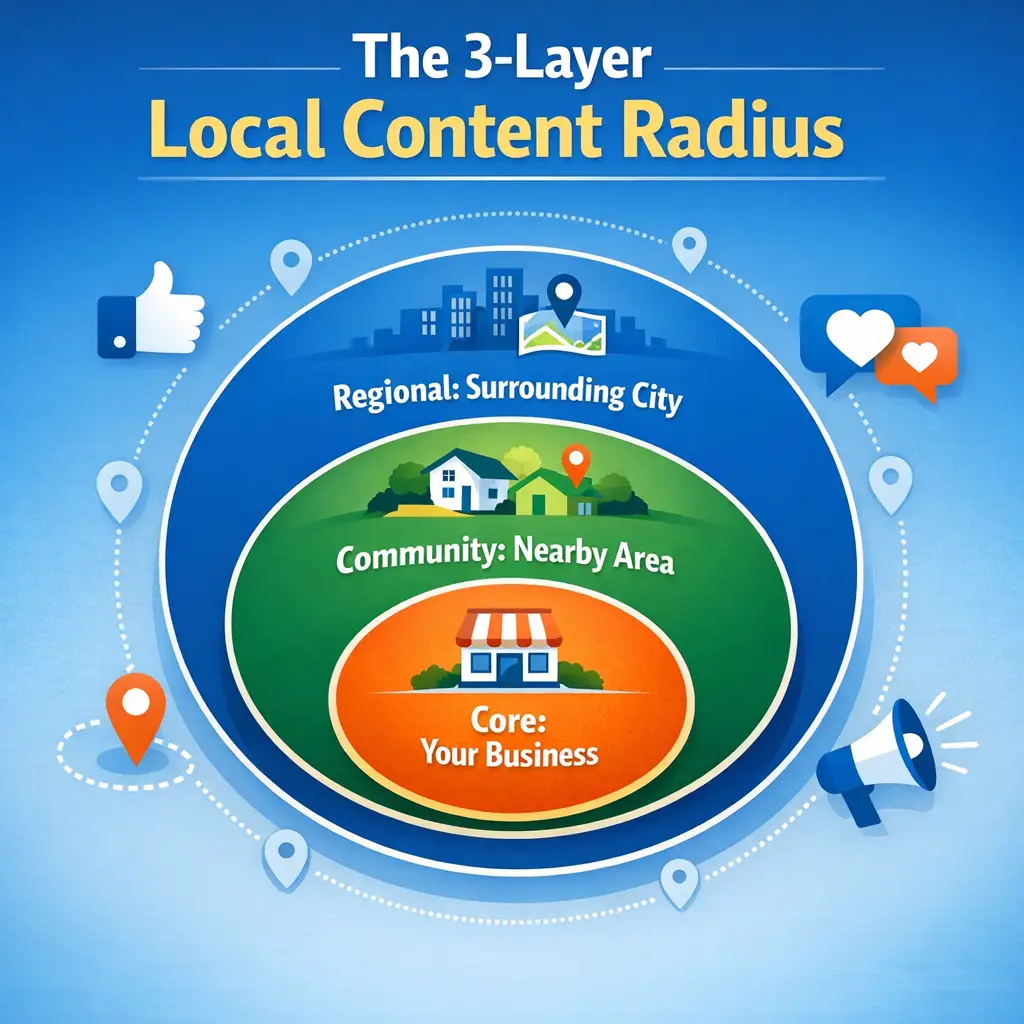
Effective local social content operates across three distinct layers simultaneously. Most businesses post exclusively in one layer without realizing it, which creates content that is either too insular to attract new customers or too broad to generate the “this is my neighborhood” recognition that drives loyalty and word-of-mouth.
Layer 1 — The Hyperlocal Layer (your immediate neighborhood)
Content at this radius names specific streets, landmarks, community figures, and local events. A post that tags a recognizable neighborhood park or references a well-known local business on the same block triggers a recognition response in viewers that a national brand physically cannot replicate. This is also where the algorithm’s geographic signal is strongest — geo-tagged content on Instagram and Facebook is surfaced more frequently to users in that location, particularly in Explore and Feed recommendations.
Layer 2 — The Community Layer (your city or broader region)
Content here participates in civic identity — local sports teams, regional seasonal events, city-specific references that generate an “us” response. This layer expands your reach while maintaining the authenticity of being “one of us.” It’s where you can grow your follower count without losing the community signal.
Layer 3 — The Discovery Layer (beyond your geography)
Counterintuitively, some of your most shareable content should have no local reference at all. Purely educational or entertaining content gets shared by your followers to their own networks, which may include people who will eventually move to, visit, or relocate to your area. This layer feeds top-of-funnel awareness and is the one most local businesses skip entirely.
The strategic problem is a predictable one: businesses that post only in Layer 1 build a loyal but tiny audience. Businesses that post only in Layer 3 look like generic brand accounts with no community attachment. A deliberate mix across all three layers is what generates both depth and growth.
Platform Strategy: Behavioral Reality, Not Demographics
Most platform advice sounds like this: “Instagram is great for visual businesses. LinkedIn is for B2B. Facebook is for an older demographic.” This is surface-level observation, and it leads to bad decisions.
What actually matters is how content consumption behavior on each platform shapes the type of local content that generates action. The same photograph posted on Facebook and Instagram performs differently not because of who sees it, but because of what they’re doing when they see it and what the algorithm rewards in response.
Platform-by-Platform Behavioral Breakdown for Local Businesses
| Platform | Primary Consumption Behavior | What Local Content Wins | What Underperforms |
|---|---|---|---|
| Passive browsing, community discovery, group participation | Neighborhood group posts, event listings, staff/customer stories, local news commentary | Pure promotional posts, heavily designed graphics with no personal element | |
| Facebook Groups | Active participation, peer recommendations | Business owner participation in local community groups (not self-promotion) | One-way announcements, direct selling |
| Aspirational browsing, discovery via Reels and Explore | Reels with local geo-tags, behind-the-scenes content, user-generated content reposted | Low-quality images, inconsistent aesthetic, posts with no geo-tag | |
| Instagram Reels | High-volume reach discovery | Short process/transformation videos, local event coverage, day-in-the-life content | Talking-head promotional videos with no visual hook |
| Google Business Profile (Posts) | High-intent search behavior | Offers, event announcements, service updates — anything that appears in local map results | Content without a clear call to action or local keyword reference |
| TikTok | Entertainment and discovery | Authentic behind-the-scenes content, local trend participation, staff personality-driven content | Polished corporate-style video |
| Nextdoor | Hyperlocal community discussion | Neighborhood business recommendations, local offers, community involvement | Unsolicited promotional posts, anything that reads as advertising |
The insight most local businesses miss: Facebook Groups consistently outperform Facebook Pages for local community penetration. A local restaurant owner who participates genuinely in three active neighborhood Facebook Groups — answering questions, sharing relevant news, being a visible community member — builds more qualified local awareness than the same time spent managing a Page feed. The Page is a directory. The Group is a community.
The Reels Algorithm Reality for Geographically Bounded Audiences
Reels on Instagram were designed for maximum reach. That is exactly the feature that makes them simultaneously powerful and potentially wasteful for local businesses if used without geographic strategy.
A Reels video that goes “viral” with 200,000 views across the country is largely worthless to a plumber operating in a single metro area. The metric that matters for local businesses is local reach — views and engagement from accounts within your service radius.
The mechanism to optimize for local Reels reach:
– Geo-tag every Reel to your specific location, not just the city
– Reference local landmarks or events in the first three seconds — this creates a geographic recognition signal for both the algorithm and the viewer
– Use location-specific hashtags in addition to topic hashtags (e.g., #AustinRestaurants alongside #TacoTuesday)
– Encourage local saves and shares — saves are the strongest signal to the Instagram algorithm that content has value, and shares within local networks amplify geographic reach organically
Content Strategy by Business Category: Why the 80/20 Rule Is Incomplete
The 80/20 rule — 80% value-add content, 20% promotional — is cited in virtually every social media guide. It’s a reasonable starting point, but it treats all local businesses as functionally identical. They are not.
The optimal content ratio, posting cadence, and content format mix vary significantly based on business category because the customer’s relationship with the business differs fundamentally across categories.
A restaurant’s customers think about it weekly or more. A plumber’s customers may think about them once every several years. A law firm’s clients engage under stress with high decision stakes. Each of these realities demands a different content architecture.
Content Ratio and Cadence by Business Category
Food and Hospitality (Restaurants, Cafés, Bars)
– Optimal posting frequency: 5–7 times per week
– Content mix: 40% food/product visuals, 25% behind-the-scenes and staff, 20% community involvement, 15% offers and events
– Key mechanic: Visual appetite appeal drives spontaneous visit decisions. Daily or near-daily posting maintains top-of-mind presence for the impulse visit. User-generated content (customer photos) is extremely high-trust and should be actively encouraged and reshared.
Home Services (Plumbing, HVAC, Electricians, Landscaping)
– Optimal posting frequency: 2–3 times per week
– Content mix: 50% educational/problem-solving content, 25% before-and-after project documentation, 15% local community involvement, 10% offers
– Key mechanic: The purchase decision for home services is triggered by a problem, not a craving. Content that demonstrates expertise and builds trust before the need arises ensures that when the water heater fails at 11pm, your business is the name they remember. Before-and-after project photos with brief explanations of the work are exceptionally effective trust builders.
Professional Services (Law, Accounting, Financial Advising)
– Optimal posting frequency: 2–3 times per week
– Content mix: 65% educational/informational, 20% community and team culture, 15% client results (anonymized/consented)
– Key mechanic: Trust is the primary conversion driver. Content that demonstrates competence in plain language — breaking down a legal concept, explaining a tax deadline, clarifying a regulation — does more for conversion than any promotional post. Showing the human side of the team through genuine, non-staged content reduces the psychological barrier of reaching out.
Retail (Boutiques, Hardware, Specialty Stores)
– Optimal posting frequency: 4–5 times per week
– Content mix: 35% product showcases and new arrivals, 30% lifestyle and use-case content, 20% community involvement and local features, 15% in-store events and offers
– Key mechanic: Retail social media competes directly with the infinite scroll of online shopping. The differentiator is the in-store experience and local identity — content that conveys discovery, personality, and community connection cannot be replicated by an Amazon listing.
Solving Local Social Media’s Hardest Problem: Offline Attribution
This is the measurement question that every local business owner eventually confronts and that virtually no social media guide addresses: how do you know if a social media post actually brought someone through the door?
Platform analytics tell you reach, impressions, likes, and clicks. They do not tell you that the couple who just ordered at Table 7 came in because they saw your Thursday Reel. That disconnect makes it genuinely difficult to justify continued investment in social media — and it leads many business owners to either over-invest blindly or abandon effective channels because they can’t see the connection.
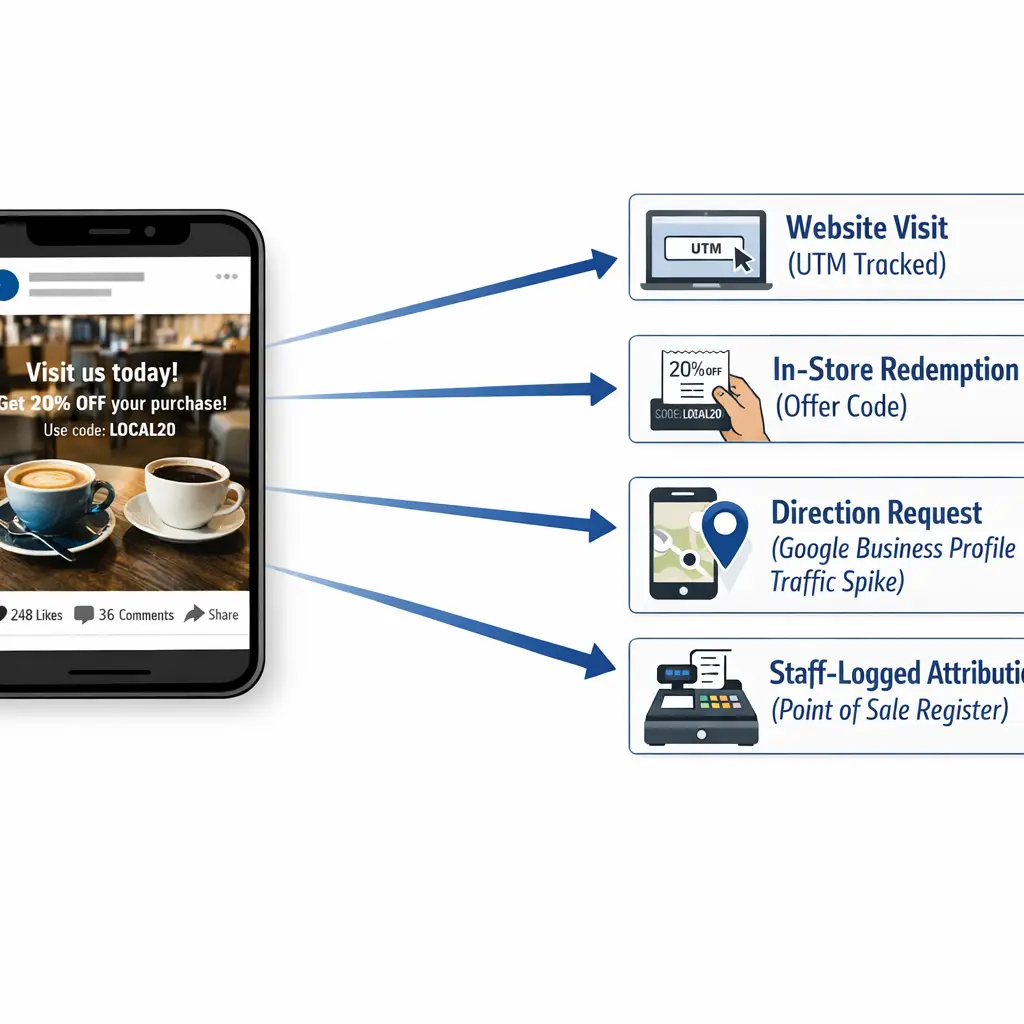
The answer is building what we refer to as a Social-to-Store Attribution Stack — a layered approach that creates measurable connections between your social content and real-world customer behavior.
The Four-Layer Attribution Stack
Layer 1 — UTM Parameter Discipline
Every link you place in a bio, Story swipe-up, or post should carry a unique UTM parameter that identifies the platform, content type, and campaign. This allows your website analytics to show you exactly which social source drove a user who then completed a contact form, clicked a directions link, or called your phone number. Without this, all social traffic looks identical and you cannot isolate which platform or post type is generating real intent behavior.
Layer 2 — Redemption-Based Tracking
Create social-exclusive offers that require a specific action at the point of purchase — showing a screenshot, mentioning a specific phrase, or presenting a unique code. This creates a direct, unambiguous link between a post and a transaction. The offer doesn’t need to be deep to be effective; the mechanism matters more than the incentive. The data you collect from even a handful of redemptions tells you more than months of engagement metrics.
Layer 3 — Google Business Profile Cross-Reference
Your Google Business Profile records “direction requests” and “phone calls” as distinct metric categories. These are high-intent behaviors — someone looking up directions or calling you from search is almost certainly a potential customer. Cross-reference spikes in these GBP metrics against your posting schedule. When a post goes out on a Tuesday afternoon and you see a direction-request spike on Wednesday morning, that’s an attribution signal that platform analytics will never show you. This connection between social activity and GBP performance is one of the most underutilized insights available to local businesses. For a deeper look at how to maximize your profile’s visibility and impact, the article on Google Business Profile optimization tips that actually work covers the mechanics in detail. You can also monitor these trends directly through Google Business Profile Insights.
Layer 4 — Qualitative Attribution at Point of Sale
Train your staff to ask one question: “How did you hear about us?” Log the answers consistently. This single practice, implemented over 90 days, produces attribution patterns that no algorithm can capture. Customers who say “I saw you on Instagram” or “I found you through that video you posted” are giving you direct evidence of what’s working — evidence that disappears forever if no one records it. For a structured approach to understanding how platform data connects to real-world outcomes, the Meta Business Help Center provides documentation on how platform analytics translate to business results.
From Audience to Community: The Flywheel Mechanics That Scale
The content treadmill is the most common and most exhausting failure mode in local social media. The business creates content. Followers passively consume it. Engagement is decent. Then the owner misses two weeks because of a busy season, and the account goes quiet, engagement drops, and it feels like starting over. The output requirement never decreases.
This happens because the business has built an audience, not a community. The distinction is not semantic — it is structural. An audience is a group that consumes what you produce. A community is a group that creates value for each other through your platform. One requires constant feeding. The other generates its own momentum.
Phase 1: Identify and Activate Your Founding Members
Every local business has 10 to 20 existing customers who already love what you do. They leave reviews without being asked. They tag you when they visit. They recommend you to friends. These people are not just loyal customers — they are the seed material for a community flywheel.
Identify them. Then explicitly acknowledge and invite them. Feature them in content. Ask for their opinions on real decisions (new menu item, updated hours, new service offering). Give them early access to announcements. Human beings are wired to reciprocate recognition with loyalty and advocacy — this is not a manipulation tactic; it is genuine relationship-building at scale.
Phase 2: Design Participation Architecture
The difference between a post that requests participation and one that requires it to function is everything. Generic “let us know in the comments!” calls to action generate noise. Genuine participation architecture looks different:
- A weekly poll where the result actually determines a business decision (and you follow through publicly with the outcome)
- A “help us name it” campaign for a new product, dish, or service — where the winning suggestion is announced, credited, and implemented
- A “caption this photo” contest using an authentic behind-the-scenes image that gives community members a chance to be clever and visible
The critical factor is authenticity. If the community senses the decision is already made, participation collapses immediately and takes trust with it.
Phase 3: Recognize the Peer-to-Peer Signal
The moment your community flywheel is genuinely spinning is recognizable by a specific behavior: community members start tagging each other in your posts, not just the business. One regular tags another and says “we need to try this.” A customer shares your post with a caption aimed at a specific friend. This peer-to-peer tagging behavior is the signal that you have moved from audience to community.
At this point, your organic reach grows through member networks rather than solely through algorithmic distribution. That reach is more trusted, more local, and more likely to convert — because a recommendation from a friend carries weight that no amount of ad spend can manufacture.
The goal of local social media is not to go viral. It is to become genuinely un-ignorable within a defined geography. That outcome is achievable for any local business with the right framework, the right measurement approach, and a commitment to building real connections rather than just posting content.
Putting It Together: The Local Social Media Audit Checklist
Before building or rebuilding a social media strategy, run through this diagnostic against your current presence:
Geographic Signal Audit
– Are you geo-tagging every post with a specific location, not just a city?
– Does your content mix include all three radius layers (hyperlocal, community, discovery)?
– Are you participating in local Facebook Groups as a community member, not just broadcasting on your Page?
Platform Behavior Alignment
– Is your content format matched to how users consume content on each platform (Reels for Instagram reach, long-form text for Facebook, visual-first for all)?
– Are you tracking which content types drive traffic to your website using UTM parameters?
Attribution Infrastructure
– Do you have at least one redemption-based tracking mechanism active at any time?
– Are you reviewing your Google Business Profile direction and call data weekly and cross-referencing against your posting calendar?
– Are your staff trained to ask and log “how did you hear about us?”
Community Architecture
– Can you name your top 10 most engaged customers right now?
– Do you have at least one recurring content format that requires community participation to function?
– Are you responding to every comment and DM within 24 hours?
If more than half of these questions reveal gaps, the strategic opportunity is significant — and the path forward is clearer than most business owners expect.
Building a social media strategy that actually produces measurable local business growth requires more than a posting schedule. It requires a framework that connects your content to real-world behavior, builds genuine community rather than passive followers, and treats “local” as a strategic advantage rather than a geographic label. That’s the work worth doing — and the results it produces are tangible, trackable, and compounding.
Final Strategic Recommendations for 2026
The landscape for local social media marketing continues to shift toward authenticity, precision, and community depth. Based on where platform algorithms, consumer behavior, and local search patterns are trending, these three moves deserve priority attention heading into 2026.
1. Adopt an AI-Assisted Content Calendar with Local Intent Filters
Tools like Later, Metricool, or Publer have matured significantly and now offer AI-assisted scheduling that can factor in local engagement windows — not just generic best-times-to-post data. The strategic next step is pairing these tools with your own historical engagement data to build a posting rhythm that reflects your specific audience’s behavior, not industry averages. In 2026, the businesses winning locally will be those who have optimized their cadence around their community, not a benchmark report. For a detailed breakdown of how to evaluate and select the right tool for your business, the article on how to choose social media management software walks through the key factors worth considering.
2. Build a First-Party Audience Asset
Social platforms remain rented land. The clearest risk-mitigation strategy for any local business is converting social followers into a direct communication channel — primarily an email list or SMS subscriber base — using tools like Klaviyo, Mailchimp, or SimpleTexting. Every piece of social content should have a low-friction pathway into a first-party list. This becomes your insurance policy against algorithm changes, platform disruptions, or account issues that are entirely outside your control.
3. Invest in Short-Form Video Infrastructure
Not production value — infrastructure. That means a consistent visual environment, a repeatable filming setup, and a simple editing workflow using tools like CapCut or Adobe Express. The businesses that will dominate local social discovery in 2026 are those who can produce genuine, recognizable short-form video consistently, not occasionally. Frequency and authenticity outperform polish at the local level every time.
Frequently Asked Questions
How often should a local business post on social media to see real results?
Consistency matters more than volume. For most local businesses, posting three to five times per week across your primary platform — with intentional content rather than filler — outperforms daily posting that lacks strategic purpose. The goal is to show up often enough to stay visible in your community’s feed without sacrificing the quality and relevance that drive actual engagement. Start with a cadence you can sustain, then build from there.
Which social media platform is best for local business marketing?
There is no universal answer, but there is a useful framework. Facebook remains the strongest platform for community engagement and local group participation, particularly for businesses serving customers aged thirty-five and older. Instagram performs best for businesses with strong visual products or services and younger demographics. Google Business Profile — often overlooked as a social channel — is arguably the highest-return platform for local discovery. The right answer depends on where your specific customers already spend their attention.
How do I know if my social media strategy is actually driving customers into my store or business?
Attribution at the local level requires layered tracking. Redemption-based offers tied to specific posts, staff-trained intake questions like “how did you hear about us?”, and weekly cross-referencing of your Google Business Profile call and direction data against your content calendar are the most practical methods. UTM parameters on any links driving website traffic add another layer of clarity. No single method is perfect, but combining two or three gives you a directionally reliable picture.
Is it worth hiring someone to manage social media, or should a local business owner do it themselves?
Both approaches can work — the deciding factor is whether the person doing the work, whether internal or external, understands the local community, the brand voice, and the strategic purpose behind each post. A local business owner who engages authentically and consistently will outperform a disconnected agency running generic content. Conversely, a skilled local marketing partner who takes time to understand your business, your neighborhood, and your customers can free up your attention while accelerating results. The quality of the strategic thinking matters far more than who is holding the phone.
Conclusion
Local social media marketing done well is genuinely one of the highest-leverage investments a small business can make — but only when the strategy is built around your community, your customers, and measurable outcomes rather than vanity metrics. At Mongoose Digital Marketing, social media management and local SEO strategy are built around exactly that philosophy: connecting real businesses to real customers in the places those customers already are. If you’re ready to stop guessing and start building something that compounds over time, Contact Mongoose Digital Marketing and let’s map out what that looks like for your business.