
Key Takeaways
- Your industry vertical — not your monthly investment level — is the single biggest determinant of how long SEO will take to produce measurable results in the Dayton market.
- Google Business Profile management is an ongoing operational discipline, not a one-time setup task, and map pack position directly drives call volume for Dayton service-area businesses.
- Content decay causes businesses to lose rankings they already earned, typically 12–18 months after an initial SEO campaign ends, making active content maintenance a core function of real SEO management.
- Genuinely cost-efficient SEO is defined by return on investment relative to effort — not by the lowest monthly retainer — and understanding which SEO activities compound versus which are pure maintenance overhead is essential before hiring any agency.
- For local Dayton businesses, a backlink from a regionally relevant source like the Dayton Business Journal or the Dayton Area Chamber of Commerce carries local relevance signals that a generic high-authority link cannot replicate.
Somewhere between “we tried SEO once and it didn’t do much” and “we can’t keep up with the inbound leads,” there’s a decision point that most Dayton business owners hit at roughly the same time: we need someone managing this properly, and we need it to actually pay off.
That’s a reasonable place to be. The Dayton market is not a generic mid-sized city to Google’s algorithm — it’s a specific competitive environment with distinct industry verticals, defined service corridors from Kettering to Beavercreek to Miamisburg, and a local SERP landscape shaped by healthcare networks, defense-adjacent industries, regional law firms, and a dense layer of service-area businesses all competing for the same map pack real estate.
What follows is not a service pitch dressed up as education. It’s a direct explanation of what separates SEO management that compounds and produces lasting returns from SEO engagement that produces a report, a few rankings, and then slowly fades. If you’re evaluating agencies or trying to understand what you’re actually paying for when you invest in ongoing SEO management in Dayton, this article gives you the framework to make that evaluation with precision.
Why Your Industry Vertical Determines Your SEO Timeline More Than Any Other Variable
Every agency in this market will tell you to expect results in 60 to 90 days. That number is not wrong — it’s just incomplete to the point of being meaningless without context.
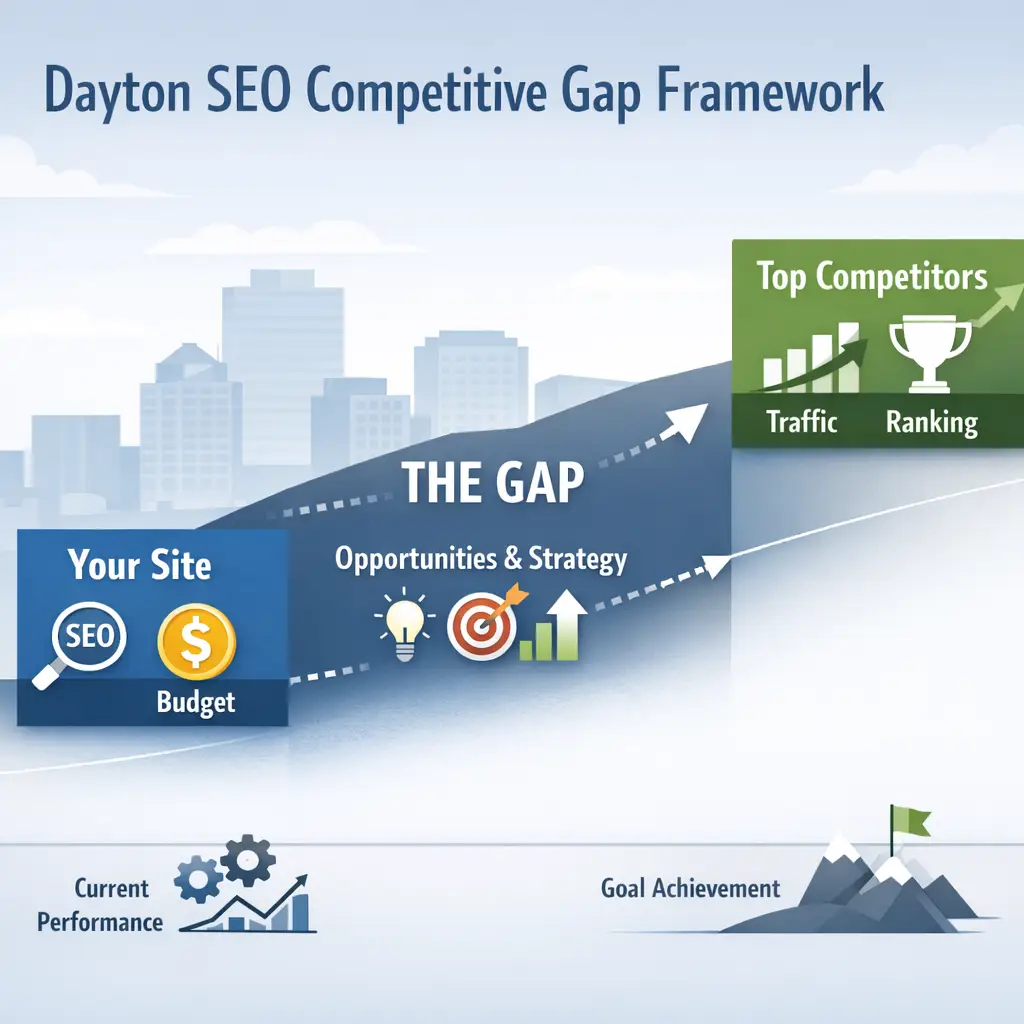
SEO timeline is a function of three compounding variables: the domain authority gap between your site and your top competitors, the keyword competitive density in your specific vertical, and the depth of content infrastructure your site currently has. Those three variables look dramatically different depending on whether you’re a Dayton HVAC contractor, a Kettering-based occupational therapist, a Beavercreek family law attorney, or a Miamisburg commercial cleaning company.
The Dayton Competitive Landscape Is Not Uniform
Consider two businesses both searching for affordable SEO management in Dayton at the same time:
Business A: A plumbing company in Huber Heights. Their primary competitors in the map pack are two independent local plumbers and one regional franchise. The franchise has a well-maintained GBP and roughly 180 reviews. The independents have thin websites and inconsistent citations. Domain authority gap: manageable. Content gap: closeable within two to three content cycles. Timeline to meaningful movement: four to six months with disciplined execution.
Business B: A primary care practice in Kettering. Their SERP environment includes Kettering Health network pages, Cleveland Clinic affiliate pages, Healthgrades aggregator listings, and WebMD. These are pages backed by institutional domain authority in the hundreds, with thousands of referring domains. The content depth required to compete organically with even secondary keywords in healthcare is substantial. Timeline to meaningful movement: twelve months minimum, and that assumes a technically clean site, consistent publishing, and active link acquisition.
Neither business is doing anything wrong. They’re just operating in fundamentally different competitive environments — and any agency that quotes them the same timeline without explaining this distinction is telling you what you want to hear.
How to Assess Your Actual Competitive Gap Before Signing Anything
Before committing to an SEO management engagement, any sophisticated buyer should run this basic diagnostic:
- Google your primary service + location (e.g., “electrician Centerville Ohio”) and identify the top three organic results and the top three map pack results.
- Check the domain authority of those top organic results using a tool like Moz or Ahrefs. If they’re sitting at DA 40–60+, you’re not moving them quickly.
- Review their content depth — how many pages do they have dedicated to services, locations, and supporting topics? A competitor with 80 topically relevant pages has a structural advantage over a site with 12.
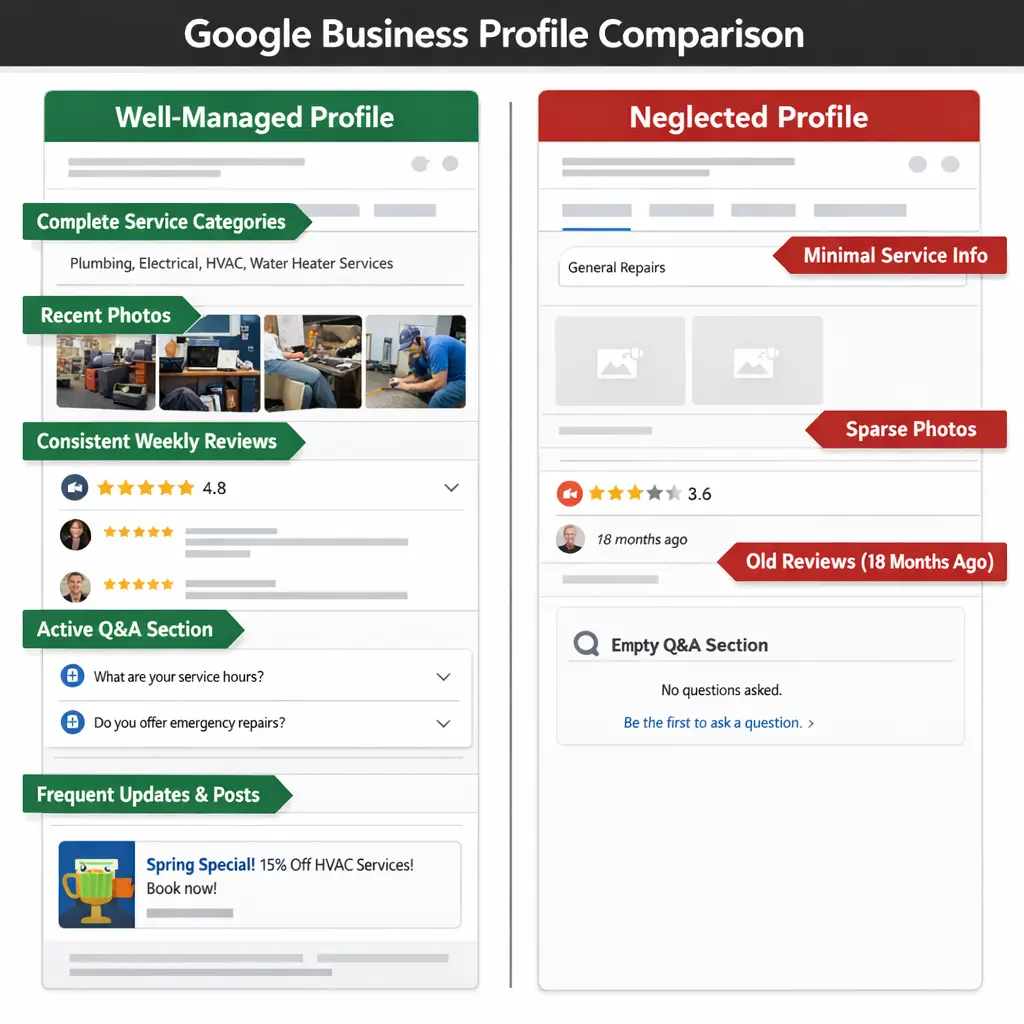
- Check their review count and recency in GBP — consistent weekly reviews over 18 months signal active management, not a one-time push.
- Look at their backlink profile’s local relevance — are they cited by Dayton-area publications, chambers, or associations? Local relevance signals in the link graph matter for map pack ranking in ways that pure domain authority doesn’t capture.
This five-step check takes about 30 minutes and tells you more about your actual SEO situation than most agency discovery calls will. For a deeper breakdown of how to evaluate and compare what different providers actually deliver, the Local SEO Agency Comparison: What Actually Matters article walks through the specific differentiators worth scrutinizing before signing anything.
The Google Business Profile Compounding Effect: The Highest-ROI Activity in Local SEO Management
Most agencies tell clients they’ll “optimize your Google Business Profile.” That phrase has become so common it no longer means anything specific. Here’s what it actually requires — and why it matters more for Dayton service-area businesses than almost any other SEO activity.
Google’s local pack algorithm operates separately from its organic search algorithm. The three primary ranking factors for map pack placement are relevance, distance, and prominence — and of these three, prominence is the one that requires the most active, ongoing management.
Prominence is not a static asset. It is built and maintained through:
- Review recency and velocity — Google’s algorithm weights recent reviews more heavily than accumulated total. A business with 50 reviews earned steadily over 12 months will frequently outrank a business with 200 reviews, most of which are two years old.
- Photo engagement signals — GBP profiles with regularly updated, high-engagement photos (clicks, views, direction requests triggered from photos) demonstrate active business operation to Google’s local ranking system.
- Q&A content management — The Q&A section of a GBP profile is an indexable content asset that most businesses ignore entirely. Populated Q&A content that matches common service-related queries adds keyword relevance signals directly to the profile.
- Service area precision — Incorrectly configured service areas, or service areas set so broadly they dilute geographic relevance, directly undermine map pack eligibility in the specific neighborhoods where you actually want to rank.
- Post frequency — GBP posts are not a social media afterthought. Regular posts signal recency and active business management to the local algorithm.
For a full breakdown of how to execute each of these elements correctly, the Google Business Profile Optimization Tips That Actually Work article covers the specific configuration decisions that drive measurable map pack movement.
Why Map Pack Position #1 vs. Position #4 Is Not a Minor Difference
For a plumber in Springboro, a therapist in Centerville, or a roofing contractor in Beavercreek, the difference between map pack position one and position four is not incremental — it is often the difference between a phone that rings and one that doesn’t.
Studies on local pack click behavior consistently show that the top three results in the map pack capture the substantial majority of engagement, with position one receiving disproportionate share. Position four — which appears only after a user clicks “more places” — receives dramatically less traffic. For service-area businesses where most customers don’t scroll past the first visible options, map pack position is a revenue variable, not a vanity metric.
This is precisely why GBP management is not a setup task. It is an ongoing operational discipline that requires consistent weekly attention — review response, photo updates, post publishing, Q&A monitoring, and service category auditing — to maintain and improve position over time.
The Crawl-Index-Rank Pipeline: What Technical SEO Actually Does for Dayton Business Websites
Technical SEO sections in most agency content describe what technical SEO is. Here’s what it actually does for the size and type of websites most Dayton businesses are running.
Crawl Budget and Small Business Sites
Crawl budget — the number of pages Googlebot will crawl on your site within a given timeframe — matters differently at different scales. For a Dayton accounting firm with a 40-page website, crawl budget is not a primary concern. For a regional e-commerce company or a home services franchise with hundreds of location pages, duplicate content and crawl inefficiency become significant ranking suppressors.
The most common technical issue Mongoose sees on local Dayton business sites is not crawl budget — it’s indexation problems caused by duplicate location pages and inconsistent canonical signals. A business that serves Dayton, Kettering, Beavercreek, and Miamisburg but creates near-identical service pages for each location without meaningful differentiated content is not earning four separate ranking opportunities. It is creating four pages competing against each other for the same query, signaling thin content to Google’s quality systems, and potentially suppressing the ranking potential of its most important pages.
Schema Markup and Local Pack Eligibility
LocalBusiness schema and Service schema are not ranking factors in the traditional sense — they don’t directly cause a page to move from position six to position two. What they do is help Google’s systems accurately interpret your site’s content and connect it to relevant local queries with greater confidence.
For Dayton businesses, properly implemented LocalBusiness schema that includes:
- Business name, address, and phone number consistent with GBP
- Service area specification matching configured GBP service area
- Service categories matching GBP primary and secondary categories
- Review aggregate data (when using a structured review system)
…creates a reinforcing signal environment between your website and your GBP profile. The two sources are effectively corroborating each other’s information to Google, which strengthens your local relevance profile across both organic and map pack results.
The GBP and Website Signal Relationship
This is a point that virtually no competitor content addresses directly: your Google Business Profile and your website must send consistent, reinforcing signals to each other. They are not independent tools — they are two parts of the same local authority system.
NAP (name, address, phone) consistency is foundational, but it goes deeper than that:
- Service categories listed in your GBP should have corresponding dedicated service pages on your website
- Geographic service areas in your GBP should be reflected in your on-site content architecture
- Keywords appearing in your GBP reviews should be present in your on-site content (when they’re genuinely relevant)
- Your website’s structured data should confirm the business information your GBP asserts
When these signals are misaligned — when a GBP lists “HVAC Repair” as a primary service but the website has only a generic “Services” page — Google’s confidence in surfacing that business for specific high-intent queries is reduced. Alignment between these two assets is one of the highest-leverage technical improvements available to most local Dayton businesses.
Content Decay: Why Businesses Lose Rankings They Already Earned
This is the part of SEO management that most agencies don’t explain clearly when they’re selling you an initial engagement — and it’s the core reason “management” is a different product than “setup.”
Content decay is the gradual loss of organic ranking positions that occurs when:
- Competitors publish fresher, more comprehensive content on the same topics your pages currently rank for
- Internal linking structures become orphaned after site redesigns, URL migrations, or CMS updates
- Keyword intent shifts as local search behavior evolves — queries that used to be informational become transactional, and pages written for the old intent no longer match what searchers are actually looking for
- Page experience signals degrade as your site ages without core web vital maintenance and mobile usability updates
The typical pattern looks like this: a Dayton business invests in SEO, sees rankings climb over six to twelve months, and then watches those rankings plateau and slowly decline over the following twelve months. They conclude “SEO stopped working.” What actually happened is that the content they built earned its initial rankings and then received no maintenance investment — while competitors continued publishing, updating, and building authority.
The Content Lifecycle Management Framework
Real SEO management includes a content maintenance cycle alongside content creation. In practice, this means:
| Content Activity | Frequency | Purpose |
|---|---|---|
| New primary service page publication | Quarterly or per business need | Expand topical authority and target new keyword opportunities |
| Existing page content refresh | Every 6–12 months per page | Maintain ranking positions, update for intent shifts, add depth |
| Internal linking audit | Semi-annually | Reconnect orphaned pages, distribute authority to high-priority pages |
| Local keyword intent review | Quarterly | Identify shifts in how Dayton searchers are querying for your services |
| Technical health check | Monthly | Catch crawl errors, broken links, page speed regressions, and indexation issues |
| Backlink profile review | Monthly | Identify toxic links, track new acquisition, and flag lost links from high-value sources |
The businesses that maintain rankings after 18 months are the ones whose SEO partner runs this cycle consistently. The businesses that plateau are the ones whose agency delivered a one-time content campaign and called it ongoing management.
Local Link Building: Why Dayton-Specific Sources Outperform Generic High-Authority Links
The standard agency pitch on link building goes: “We acquire high-authority backlinks to improve your domain authority.” That’s not wrong. It’s just incomplete for local SEO.
For map pack ranking specifically, and for local organic rankings in service-area verticals, local relevance weighting in the link graph matters independently of domain authority. A link from the Dayton Business Journal, the Dayton Area Chamber of Commerce, the Beavercreek Chamber, or a Dayton-specific industry association sends a co-citation signal that a generic DA-60 lifestyle blog cannot replicate.
Google’s local algorithm is trying to determine which businesses are genuinely embedded in and relevant to a specific geographic community. Local editorial mentions, chamber memberships, local sponsorship coverage, and citations in Dayton-specific directories are all part of that evidence set. They tell the algorithm: this business is a real, active participant in the Dayton market.
This has practical implications for evaluating any agency’s link-building approach:
- Ask what percentage of their link acquisition strategy focuses on locally relevant sources versus generic outreach
- Ask for examples of local placements they’ve secured for comparable clients in this market
- Understand that local relevance and domain authority are additive — the strongest link profile for a Dayton business combines both, not one at the expense of the other
What “Affordable SEO Management” Actually Means When Evaluated Analytically
The word “affordable” in this context deserves direct treatment, because it’s used as a positioning word by almost every agency in this market without any analytical substance behind it.
Affordable SEO management — properly defined — means high ROI relative to investment. That is a different concept than a lower monthly retainer. An engagement that costs less but produces no measurable ranking movement, no attributable traffic growth, and no conversion data is not affordable. It’s expensive for what it delivers. An engagement that requires a more meaningful investment but produces compounding organic traffic, consistent map pack positioning, and measurable lead growth has a cost-efficiency that compounds over time because organic traffic, unlike paid traffic, does not stop when the spend stops.
The analytical questions a business owner should be asking before evaluating any SEO management engagement:
- Which activities in this engagement produce compounding returns (content that ranks and drives traffic for years) versus maintenance overhead (citation monitoring, technical health checks)?
- How will we attribute leads and traffic specifically to organic search rather than to the combined effect of all marketing channels?
- What is the reporting cadence, and what metrics will be tracked consistently — not just rankings, but traffic trends, conversion events, GBP interaction data, and page-level performance?
- What happens to the work if we stop the engagement — do we own the content, the GBP optimizations, the technical improvements? This matters for evaluating the lasting value of the investment.
The most cost-efficient SEO management engagements are the ones where the ongoing work builds an asset — a content archive, a review profile, a backlink graph, a technically sound site — that retains value and continues producing returns independent of the month-to-month spend. That is the structure to look for, and it’s a meaningful differentiator between agencies that deliver lasting results and those that deliver activity reports. The Affordable SEO for Small Businesses: What Actually Works article expands on this framework with specific criteria for evaluating whether a given engagement is structured to compound or simply to bill.
Strategic Recommendations for 2026
The local search environment in Dayton is continuing to evolve in ways that reward businesses willing to invest in infrastructure rather than shortcuts. Three specific priorities deserve attention heading into 2026.
1. Prioritize Google Business Profile as a First-Class Asset
GBP is no longer a passive directory listing — it’s an active search surface with its own content layer. Businesses that treat their GBP as a managed content channel, publishing consistent updates, responding to reviews with keyword-aware language, maintaining accurate service area data, and populating the Q&A section with relevant queries, will hold a measurable advantage in map pack visibility across neighborhoods like Kettering, Beavercreek, and Centerville. Tools like LocalFalcon provide granular geo-grid ranking data that shows exactly where your map pack position holds and where it softens — this kind of visibility makes GBP management accountable rather than speculative.
2. Build a Structured Content Architecture Around Local Search Intent
The businesses that will accumulate the most durable organic traffic through 2026 are the ones creating content that answers specific, local questions — not just targeting broad service keywords. Using tools like Semrush or Ahrefs to map the actual question-based and comparison-based queries your target audience in the Dayton metro is running gives you a content roadmap that compounds. Each piece of content that earns a position is a long-term traffic asset that continues producing returns without additional spend.
3. Implement Conversion Tracking Before Scaling SEO Investment
Google Analytics 4, paired with Google Search Console and properly configured goal tracking, gives you the attribution layer necessary to evaluate whether SEO activity is producing business outcomes — not just traffic. Before increasing any SEO management engagement, make sure call tracking, form submission events, and page-level conversion data are cleanly configured. This infrastructure turns your SEO reporting from a ranking report into a revenue conversation, which is the standard any performance-oriented engagement should be held to.
Frequently Asked Questions
What does affordable SEO management actually mean for a Dayton business?
Affordable SEO management means the investment produces a return that justifies and exceeds its cost over time — not simply that the monthly fee is low. A low-cost engagement that generates no measurable traffic growth, no ranking movement, and no attributable leads is not affordable by any practical definition. The right question is whether the work being done builds lasting assets: content that ranks, a GBP profile that holds map pack positions, a technically sound website that earns trust from search engines. When those assets compound over time, the cost-efficiency of the engagement improves continuously, which is the model that actually serves Dayton businesses well.
How long does it take to see results from SEO management in a competitive local market?
Realistic timelines depend on the current state of your website, the competitiveness of your target keywords, and the consistency of the work being done. For most local businesses in the Dayton area targeting neighborhood-level or service-specific keywords, meaningful ranking movement typically becomes visible within three to six months of consistent, well-structured effort. Map pack visibility through GBP optimization can show movement more quickly. Broad, highly competitive terms take longer. Any engagement that promises significant ranking results within weeks without a clear explanation of how that will be achieved should be evaluated with skepticism.
Should a Dayton small business focus on local SEO or broader organic SEO?
For most small and mid-sized businesses serving customers in Dayton, Kettering, Beavercreek, Centerville, and surrounding areas, local SEO is the higher-priority foundation. Local SEO — meaning GBP optimization, localized on-page content, citation consistency, and review profile management — targets the searches where purchase intent is highest and where a business has a genuine geographic relevance advantage. Broader organic SEO builds on top of that foundation by creating content that captures research-phase queries and earns authoritative backlinks. The two strategies are complementary, but local infrastructure should be in place before content-driven organic efforts are scaled.
How do I evaluate whether my current SEO management is actually working?
The starting point is clean attribution data: Google Analytics 4 should be showing organic search as a distinct traffic channel with measurable session volume and conversion events attached to it. Google Search Console should be showing consistent or improving impressions and click-through rates on target queries. GBP Insights should reflect engagement — direction requests, calls, and website clicks originating from your profile. If your current reporting consists only of a keyword ranking spreadsheet without traffic trends, conversion data, or GBP performance metrics, you do not have enough information to evaluate whether the engagement is delivering business value. Insist on a reporting structure that connects SEO activity to measurable outcomes.
Conclusion
Dayton businesses — whether you’re operating in Kettering, serving clients across Beavercreek, or building a customer base throughout the broader metro — deserve an SEO management partner who treats your marketing investment as seriously as you do, with transparent reporting, work that builds lasting assets, and a strategy grounded in how your specific local market actually searches. Mongoose Digital Marketing proudly serves Dayton, Kettering, Beavercreek, and Centerville with exactly that approach: honest, accountable, local-first SEO management focused on results that compound over time. If you’re ready to stop guessing and start building, Contact Mongoose Digital Marketing to start a conversation about what’s actually possible for your business.