
Key Takeaways
- Service Area Businesses (SABs) such as plumbers and HVAC contractors require a fundamentally different local SEO methodology than storefront businesses, because Google’s proximity algorithm treats hidden-address listings differently — and most generalist agencies don’t account for this distinction.
- Google Business Profile suspensions are at an all-time high in 2024–2025, and certain aggressive optimization tactics used by some agencies — including keyword-stuffed business names and virtual office addresses — actively increase suspension risk and can eliminate 40–60% of inbound local leads overnight.
- Review platform scores (4.9/5, 5/5) are unreliable as the primary agency selection criterion because they don’t account for review recency, gating practices, or post-2023 algorithm performance — a 4.9 score built on reviews from 2019–2022 tells you almost nothing about current capability.
- Agencies whose methodology is heavily weighted toward Google Business Profile behavioral optimization and locally-relevant editorial content carry a significantly lower risk profile under recent Google Core Updates than those relying on bulk citation syndication or exact-match directory links.
- Transparent reporting in local SEO means tracking business-impact metrics — call tracking conversion rates, GBP direction requests, and Maps-driven website visits — not vanity metrics like raw keyword rankings.
Choosing a local SEO agency in the Dayton area should be a strategic business decision, not a search for the highest star rating on a directory site. If you operate in Dayton, Kettering, Beavercreek, Centerville, Huber Heights, Miamisburg, or Springboro, you’re competing in a market where local search visibility directly controls how many qualified phone calls, form submissions, and walk-ins your business generates. Getting that visibility requires an agency that understands how Google’s local ranking systems actually work — not one that recycles tactics from 2019 and hopes the algorithm hasn’t noticed.
This guide cuts through the surface-level comparison content you’ll find everywhere else. You won’t find a list of agency names ranked by Clutch score. What you will find is a rigorous framework for evaluating any local SEO agency against criteria that actually predict performance: methodology resilience, business-type fit, GBP compliance posture, and reporting substance. Use this as your decision-making infrastructure before you talk to a single agency.
Why Most Local SEO Agency Comparisons Mislead You
The majority of “local SEO agency comparison” content online is produced by one of two sources: directories monetizing placement (so their rankings are paid, not earned) or agencies listing themselves among competitors to capture comparison-stage traffic. Neither source has an incentive to give you an honest evaluation framework.
The result is a predictable pattern: a table of agency names, hourly rate ranges, a Clutch score, and a bullet list of services. That information describes options. It does not enable decisions.
The deeper problem is structural. Most comparison articles treat local SEO as a static, uniform discipline — as though optimizing a plumbing company’s service area presence in Miamisburg requires the same methodology as optimizing a dental practice’s storefront in Beavercreek. It doesn’t. The business type, competitive density, local search behavior, and algorithm risk profile are completely different across those scenarios. An agency comparison that ignores these distinctions isn’t a comparison — it’s a list.
The Review Score Illusion
Every major comparison article leads with aggregate review scores. This is a reasonable starting point and a terrible finishing point.
Consider what a 4.9-star Clutch rating actually tells you: that a sample of clients, at some point in time, rated their experience highly. It tells you nothing about:
- Review recency — was the bulk of that score earned before or after the 2023 Vicinity Update and 2024 Core Updates that rewrote how Google weighs local ranking signals?
- Review gating — did the agency selectively request reviews only from satisfied clients, inflating the aggregate score?
- Platform verification methodology — Clutch, G2, and GoodFirms use varying levels of review verification; not all scores are equally credible
An agency that built its reputation through strong performance in 2020–2022 may have been heavily reliant on tactics — bulk citation syndication, exact-match directory links — that Google has since devalued or actively penalized. Their star rating hasn’t updated. Their results likely have.
The Framework: Five Variables That Determine Agency Fit
Before evaluating any specific agency, establish clarity on your own business profile. These five variables determine which agency model is actually appropriate for your situation.
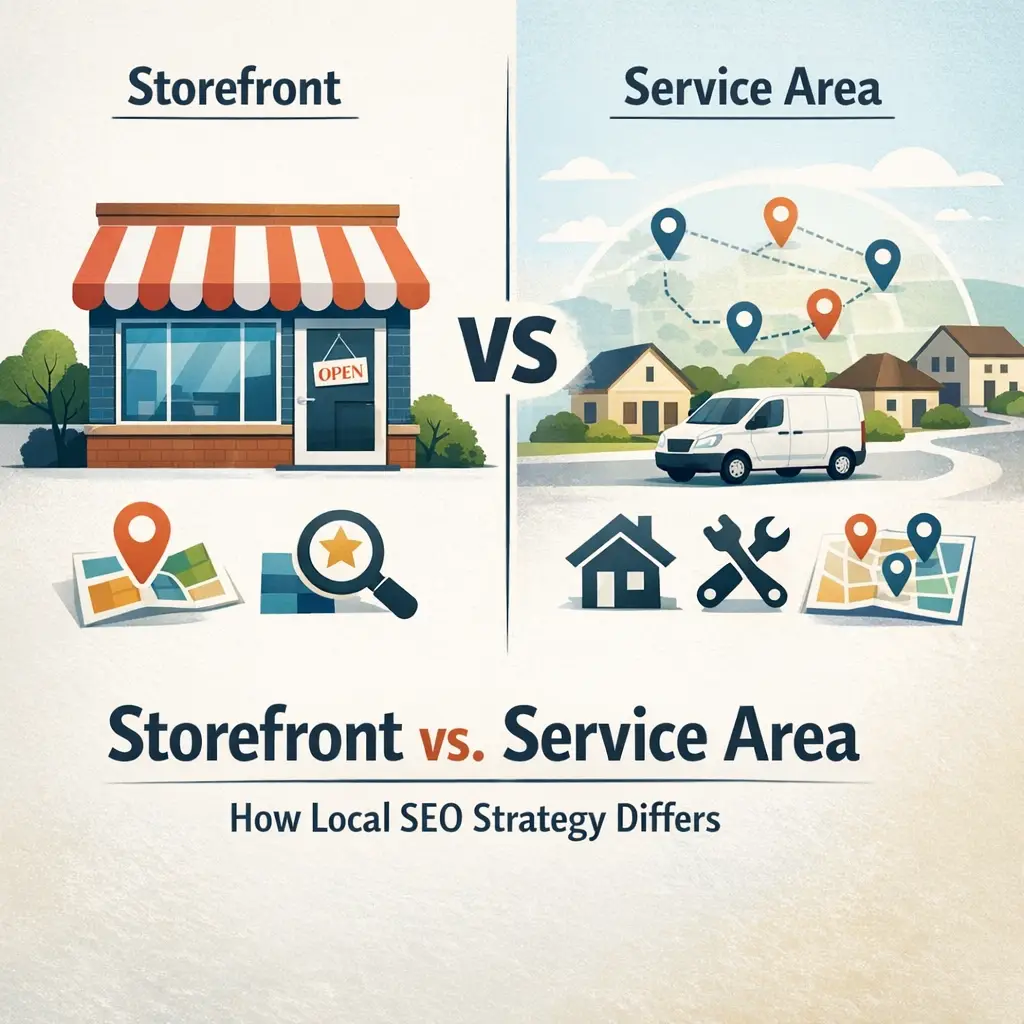
Variable 1: Business Type — Storefront vs. Service Area
This is the most consistently underexplored distinction in local SEO agency selection, and it fundamentally changes what competent local SEO looks like.
Storefront businesses (retail, restaurants, medical practices, law offices with a physical reception) benefit from a GBP pin location that establishes a clear geographic centroid. Google’s proximity algorithm uses that centroid to determine ranking radius. Optimization for storefronts is heavily weighted toward on-site signals, GBP category optimization, and review volume from customers who actually visited the location.
Service Area Businesses (plumbers, HVAC technicians, landscapers, cleaning services, electricians) operate under a fundamentally different set of constraints:
- GBP policy requires SABs to hide their physical address, which eliminates the proximity signal storefront businesses leverage
- Without a visible address, Google’s ranking algorithm shifts weight toward service area configuration accuracy, review velocity from specific zip codes within the service area, and hyperlocal landing pages
- SABs in competitive Southwest Ohio markets — home services in Huber Heights, HVAC in Centerville — face the additional challenge that their competitors may be gaming the proximity system through virtual office addresses, a practice that carries serious GBP suspension risk
The evaluation question you must ask any agency: What percentage of your local SEO clients are service area businesses versus storefronts, and can you walk me through how your strategy differs between those two scenarios?
An agency that can’t give a substantive, differentiated answer to that question is not equipped to handle SAB clients effectively, regardless of their overall review score.
Variable 2: Competitive Density of Your Target Market
Local SEO strategy in a lower-competition market like Springboro operates differently than in the denser competitive environment of central Dayton or Kettering. Competitive density affects:
- The volume and quality of editorial content required to establish topical authority
- How aggressively you need to pursue review velocity to displace established competitors in the Local Pack
- Whether GBP behavioral optimization alone can generate movement, or whether it needs to be supported by a sustained link acquisition strategy
Agencies that have worked specifically in Southwest Ohio markets understand this gradient. An agency that primarily serves clients in low-competition regional markets may underestimate what’s required to break into a densely contested Dayton niche like personal injury law or urgent care.
Variable 3: Your Growth Stage and Infrastructure Readiness
A single-location business launching its first local SEO campaign has different requirements than a multi-location operator expanding into new service territories across the Miami Valley. The agency capability requirements diverge significantly:
Single-location businesses need:
– A correctly configured and fully optimized GBP profile
– A review acquisition system that generates consistent volume over time
– Locally-relevant content that signals authority to Google for their primary service keywords
– Basic citation consistency across the major data aggregators
Multi-location operators need:
– Siloed GBP management infrastructure that keeps each location’s signals distinct and non-dilutive
– Hyperlocal content scalability — the ability to produce genuinely unique, locally-relevant pages for each location without thin content patterns that trigger quality filters
– Review velocity management across multiple locations with individual monitoring and response systems
– Inter-location link architecture that passes authority without creating footprint signals that Google’s spam systems flag
If you’re operating multiple locations across Beavercreek, Centerville, and Miamisburg simultaneously, the agency managing your local SEO needs demonstrated systems for multi-location infrastructure — not just the stated capability.
Variable 4: Vertical-Specific Algorithm Sensitivity
Not all industries face the same local SEO environment. Healthcare, legal, and financial services operate under Google’s YMYL (Your Money or Your Life) content sensitivity framework, which applies a higher quality threshold to ranking decisions in those verticals. For businesses in these categories, local SEO agencies need to understand:
- How to build topical authority without violating content quality standards that Google holds more strictly for YMYL queries
- How to structure GBP content in legal and medical contexts without triggering policy violations
- How regulatory constraints (HIPAA, bar advertising rules) intersect with aggressive local SEO tactics
A generalist agency producing the same content strategy for a Beavercreek HVAC company and a Dayton personal injury firm is not applying the necessary vertical sensitivity to either account.
Variable 5: Your Risk Tolerance for Aggressive Tactics
This is the variable almost no one discusses openly, and it’s where GBP suspension risk becomes a concrete business threat rather than a theoretical concern.
Some local SEO tactics produce faster short-term results but carry material risk of GBP policy violations. These include:
- Adding keyword-rich descriptors to the GBP business name beyond your legal business name (e.g., “Smith Plumbing — Dayton Emergency Plumber” instead of “Smith Plumbing”)
- Creating or supporting duplicate listings to expand geographic coverage beyond what a single listing can reach
- Using virtual office or shared workspace addresses to establish GBP presence in high-value markets like downtown Dayton without a genuine operational presence
- Soliciting reviews in bulk through practices that trigger Google’s spam detection (review gating, incentivized review campaigns)
A GBP suspension in a competitive Dayton market doesn’t just reduce your local search traffic — it can eliminate it entirely while the reinstatement process plays out over weeks or months with no guaranteed outcome. For businesses where local search drives the majority of inbound leads, that exposure is not acceptable.
The question every business owner should ask any prospective agency: Has a client’s GBP ever been suspended while under your management, and what was your reinstatement process?
An agency that answers “never” either hasn’t been operating long enough to have encountered this, serves only very low-competition markets, or isn’t being truthful. A credible agency will explain their compliance framework and how they balance optimization effectiveness with GBP policy adherence. For a deeper look at what the Google Business Profile optimization tips that actually work look like inside a compliant methodology, that article breaks down each optimization lever against current policy boundaries.
Evaluating Agency Methodology: The Algorithm-Resilience Test
Beyond business-type fit, the most important technical evaluation you can perform on any local SEO agency is assessing how their core methodology would hold up under the Google algorithm updates that have most significantly reshaped local search rankings since 2022.
The 2023 Vicinity Update’s Continuing Effects
The Vicinity Update (December 2021, with continued refinements through 2023) shifted ranking weight significantly away from keyword-optimized business names and toward physical proximity and behavioral relevance. Agencies that were building local authority primarily through business name keyword injection and directory citation volume saw client rankings drop — and many haven’t rebuilt on a more durable methodology since.
A methodology built for post-Vicinity local search looks substantially different from pre-Vicinity approaches:
| Tactic Category | Pre-Vicinity Weight | Post-Vicinity Weight | Risk Level |
|---|---|---|---|
| GBP Business Name Keywords | High (manipulable) | Reduced/Penalized | High — GBP suspension risk |
| Bulk Citation Syndication | High | Significantly Reduced | Low risk, low reward |
| GBP Post Frequency & Engagement | Moderate | Increased | Low risk, moderate reward |
| Review Velocity & Recency | Moderate | High | Low-to-moderate risk |
| Hyperlocal Editorial Content | Moderate | High | Low risk, high reward |
| Service Area Configuration (SABs) | Moderate | High | Low risk, high reward |
| Virtual Office Address Listings | Functional | Policy Violation | Very high — suspension/removal |
| Locally Embedded Landing Pages | Moderate | High | Low risk, high reward |
| Q&A Management on GBP | Low | Increased | Low risk, moderate reward |
| Exact-Match Directory Links | High | Reduced/Volatile | Moderate — link quality risk |
Ask any agency you’re evaluating to describe their methodology in terms of where they allocate effort across these categories. An agency whose answer is dominated by the top two rows — GBP name keywords and citation volume — is operating on a pre-2023 playbook in a post-2023 environment.
The 2024 Core Update and Review Spam Targeting
Google’s March and August 2024 Core Updates included explicit action against review manipulation and low-quality local content. Agencies that were building local authority through:
- Incentivized or gated review solicitation
- Templated, location-swapped content across multiple client sites (thin local pages that change only the city name)
- Exact-match anchor text patterns in niche directory submissions
…saw measurable ranking volatility in the months following these updates. The pattern is consistent: tactics that produce fast results by working around Google’s intent rather than with it carry compounding risk as the algorithm evolves.
The AI Overviews Factor
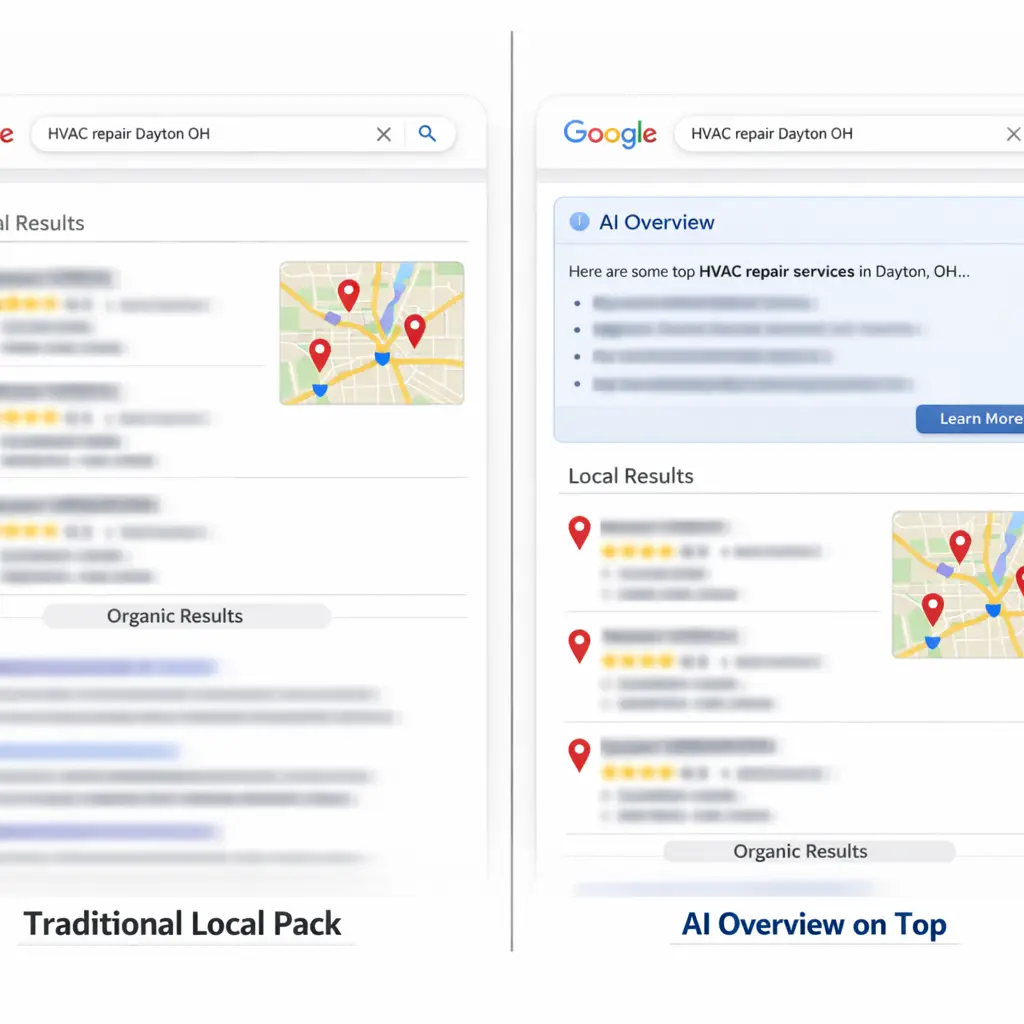
Google’s AI Overviews (the AI-generated summary blocks appearing above organic results) have begun appearing above the Local Pack for a growing range of local queries. This development is not yet fully mature, but it introduces a new dynamic that sophisticated local SEO agencies should already be strategizing around.
The practical effect is that some local queries — particularly informational queries that might precede a service purchase — are increasingly answered by AI Overviews before a user ever reaches the Local Pack. This shifts the value of certain content types and reinforces the importance of:
- Building entity authority through structured data and consistent NAP signals across the web
- Creating genuinely informative content that has a higher probability of being cited in AI Overview responses
- Optimizing for the conversion-focused queries (high commercial intent) where AI Overviews are less likely to intercede
An agency that isn’t discussing AI Overviews as a factor in your 2025 local SEO strategy is operating without full situational awareness of the current search environment.
What “Transparent Reporting” Actually Means
Every agency claims to offer transparent reporting. Almost none define what that means in operational terms. Here’s what it should mean, and how to evaluate whether an agency is actually delivering it.
Vanity Metrics vs. Business-Impact Metrics
There is a meaningful difference between metrics that look good in a report and metrics that tell you whether your local SEO investment is generating real business outcomes.
Vanity metrics (tell you about search performance, not business performance):
– Keyword ranking positions
– Domain authority scores
– Number of citations built
– GBP impression volume
Business-impact metrics (tell you whether local SEO is generating revenue-relevant activity):
– Call tracking conversion rate from local search traffic
– GBP direction requests (indicates genuine purchase intent)
– Website visits attributed to Google Maps clicks
– Form submissions from locally-targeted landing pages
– Review velocity trends over time (leading indicator of reputation momentum)
An agency reporting primarily on keyword rankings and citation counts is giving you a progress report on their activity, not your business outcomes. Legitimate transparent reporting includes attribution methodology — the ability to trace a phone call or form submission back to a specific local search interaction, not just “organic traffic.”
Reporting Cadence and Access
Transparent reporting also means:
- Monthly reporting at minimum — local search dynamics change quickly enough that quarterly reporting creates blind spots
- Dashboard access — you should have live access to your own data, not just a curated PDF snapshot delivered by the agency
- Baseline documentation — every agency engagement should begin with documented baselines for all tracked metrics, so performance claims can be measured against a real starting point, not against a self-serving “before” narrative
If a prospective agency can’t clearly articulate the metrics they’ll track, the tools they’ll use to track them, and how you’ll access your own data, that’s a structural transparency failure — not a minor administrative detail.
Case Study ROI Claims: How to Read Them Critically
Local SEO agency websites and comparison directories are filled with performance claims: “+375% increase in leads,” “+1,200% top-five keyword rankings,” “doubled their local visibility in 90 days.”
Before these numbers influence your decision, apply four critical questions:
What was the baseline? A 375% increase in leads from three leads per month to 14 is mathematically accurate and operationally marginal. The same percentage increase from 40 leads to 190 is a business transformation. Without the baseline, the percentage is meaningless.
What was the attribution methodology? Did leads increase because of local SEO specifically, or because the client simultaneously launched a PPC campaign, updated their website, or expanded their service area? Multi-channel environments make isolated attribution difficult — an agency claiming 100% of a lead increase was driven by local SEO alone should be pressed on how they know that.
What vertical and competitive context applies? A 90-day ranking improvement in a low-competition regional market is a different achievement than the same result in a densely contested Dayton legal or medical niche.
How recent is the case study? A case study from 2021 reflects performance under a fundamentally different algorithm than the one operating in 2025. Post-2023 algorithm changes have made some historical results non-reproducible through the same methods.
Questions to Ask Before Signing Any Local SEO Agency Agreement
Use this list as your minimum evaluation standard in any agency conversation:
- What percentage of your current client roster are service area businesses, and how does your strategy differ for SABs versus storefronts?
- Has a client’s GBP ever been suspended under your management? What was the cause, and what was your reinstatement process?
- How does your current methodology differ from what you were doing before the 2023 Vicinity Update?
- What’s your position on keyword-stuffing GBP business names to improve pack rankings?
- Which specific business-impact metrics will you report on, and how will I access that data directly?
- What is your strategy for AI Overviews, and how does it factor into your content planning?
- Can you provide a case study from the past 18 months, with baseline data and attribution methodology explained?
- Do you have experience with clients in my specific vertical, and what unique constraints apply to local SEO in that category?
An agency that responds to these questions with fluency, specificity, and intellectual honesty is demonstrating actual expertise. An agency that responds with deflection, generic talking points, or discomfort with the questions is telling you something important. The article what local SEO companies won’t tell you expands on the specific evasions to watch for and why they signal deeper methodology problems.
Choosing a Local SEO Partner in the Dayton Market
The Dayton-area market — spanning Kettering, Beavercreek, Centerville, Huber Heights, Miamisburg, and Springboro — is a competitive local search environment where the businesses that rank consistently in the Local Pack are doing so because their foundation is correct: accurate GBP configuration, genuine review velocity, and content that demonstrates real local relevance to Google’s quality systems.
The right agency for your business in this market isn’t necessarily the one with the most Clutch reviews or the most impressive-sounding percentage claims. It’s the agency that can demonstrate methodology aligned with how Google’s local ranking systems actually work in 2025, a clear understanding of your specific business type’s ranking constraints, and reporting infrastructure that keeps you accountable to business outcomes rather than search metrics.
At Mongoose Digital Marketing, we build local SEO strategies around those principles — tailored to your business type, your competitive environment in Southwest Ohio, and the metrics that actually move your bottom line. If you want a direct conversation about what effective local SEO looks like for your specific situation, start with a free consultation. No templates. No recycled playbooks. Just a clear-eyed assessment of where you stand and what it takes to rank.
Strategic Recommendations for 2026
As the local search landscape continues to shift, businesses evaluating or re-evaluating their local SEO partnerships should prioritize three actionable steps heading into 2026:
1. Audit Your GBP Health with a Structured Diagnostic Tool
Tools like BrightLocal’s GBP Audit or Whitespark’s Local Citation Finder have matured significantly and now surface issues — category mismatches, suppressed listings, duplicate records, and Q&A gaps — that weren’t easily visible even two years ago. Before signing with any agency, run an independent audit so you have a baseline that belongs to you, not your vendor.
2. Implement a Review Velocity System That Operates Without Dependency
In 2026, review signals remain one of the most durable local ranking inputs Google uses. The agencies worth working with will help you build a review acquisition workflow that lives inside your own operations — tied to your CRM, your point-of-sale, or your post-service follow-up sequence — rather than a black-box process you lose access to if you switch providers. Ask any prospective agency how the review system works if the relationship ends.
3. Evaluate AI Overview Visibility Alongside Traditional Local Pack Tracking
Standard rank tracking tools are catching up, but AI Overview appearances require a separate monitoring layer. Look for agencies incorporating tools like SE Ranking’s AI Overview tracker or Semrush’s AI snapshot reporting into their standard deliverables. Businesses that treat AI Overview visibility as a future concern rather than a current one are already falling behind in competitive verticals.
Frequently Asked Questions
How do I know if a local SEO agency is actually delivering results or just reporting vanity metrics?
The clearest signal is whether the agency ties its reporting to business outcomes — calls, direction requests, form submissions, and booked appointments — rather than ranking positions alone. Rankings are directionally useful, but a business ranking in position two for a high-intent search term with strong conversion infrastructure will outperform one in position one with a weak GBP and no review velocity. Ask your agency to show you GBP Insights data, tracked call volume trends, and how those numbers correlate to actual revenue activity over time.
What makes local SEO in the Dayton area different from general SEO services?
The Dayton market — including suburbs like Kettering, Beavercreek, Centerville, and Huber Heights — has its own competitive density patterns by vertical and geography. A service business competing in Centerville faces a different Local Pack environment than the same business type operating primarily in Huber Heights or Miamisburg. Effective local SEO here requires hyperlocal content strategy, service-area page architecture calibrated to Southwest Ohio geography, and citation and link signals that carry genuine local authority — not generic national directory placements. For businesses based in Beavercreek specifically, the article on digital marketing in Beavercreek, OH outlines how local competitive dynamics in that corridor differ from the broader Dayton market.
How long does it typically take to see meaningful local SEO results?
Timelines vary based on your starting point, your vertical’s competitiveness, and how much foundational work needs to happen before growth-oriented activities can take effect. Businesses with significant GBP issues, citation inconsistencies, or thin web presence should expect a foundation-repair phase before measurable ranking movement occurs. In less competitive verticals with a clean starting point, directional movement in Local Pack visibility can appear within 60 to 90 days. In highly competitive categories, a realistic timeline for sustained, compounding improvement is closer to six to twelve months.
Should I work with a national local SEO agency or a regional one that knows my market?
Both models have legitimate use cases, but for most small and mid-sized businesses competing for customers in a defined geographic area, a regionally grounded agency offers meaningful advantages. An agency operating in your market understands the competitive landscape by vertical, has likely worked with comparable businesses in adjacent service areas, and can calibrate strategy to local search behavior rather than applying national templates. What matters most is methodology transparency, vertical-specific experience, and the quality of communication — wherever the agency is headquartered.
Conclusion
For businesses in Dayton and the surrounding communities — including Beavercreek and Kettering — finding a local SEO partner that understands both the technical requirements of Google’s current ranking systems and the specific competitive dynamics of Southwest Ohio makes a measurable difference in outcomes. Mongoose Digital Marketing works exclusively from verified methodology, transparent reporting, and strategies built around your business type and local market — not recycled frameworks. If you’re ready for an honest assessment of where your local search presence stands and what it takes to improve it, Contact Mongoose Digital Marketing to schedule your free consultation.
See also: SEO Services Dayton: Local Strategies That Actually Work